The Cailleach: A Celtic Goddess of Winter

Arkane Curiosities

Just as the Greeks celebrate the change from winter to summer with Persephone arising from the underworld, the Celts had the twin goddesses of Brigid and Cailleach. While the bright Brigid ruled over the summer months, Cailleach was the goddess of winter — the dwindling of the light.

Winter Goddess

Cailleach was known as the Veiled One or the Queen of Winter and she determined the severity of the colder months. Samhain, or October 31st, marked the end of the Celtic year and the start of Cailleach’s reign. This lasted until Beltane, May 1st, when Brigid ushered in the summer months. Some believe there were two aspects of the same goddess. 

This might explain why she aged backward. Cailleach began Samhain as an ancient crone and gradually became younger as the months marched toward spring. Cailleach had total control over the frigid winter winds, being called Cailleach Bhéara in Scotland, the master of winds. She would determine if we received and early spring.

Collecting Firewood

On Imbolc, February 1st, Cailleach ran out of firewood. This forced her to journey out into the woods to collect more. In the Manx tradition, she transformed into a mighty bird, gathering branches in her beak. In Ireland and Scotland, she journeyed out on foot. 

This chore determined how severe the last months of winter would be. If Cailleach wanted winter to go on, she would make the day sunny and bright, allowing her to find more firewood and prolong the harsh winds of winter. However, if she overslept, the day remained gray and stormy, signaling that warmer weather was soon to come. 

This tradition has carried over into the United States as Groundhog Day. It shifted to February 2nd, but the ritual is very similar. A sunny day means that Punxsutawney Phil will see his shadow and bring six more weeks of winter. If the day is overcast, then he won’t see his shadow and we get an early spring. 

Oldest of Them All

There is a legend of a wandering friar and his scribe who chanced upon an old woman’s house (spoiler, this would be our Cailleach). The friar wanted to know how old the woman was, but she had survived so many winters, she couldn’t quite recall. All she did know was that each year she killed an ox and cooked up a soup. Then she’d toss the bones into the attic. 

The friar sent his young scribe scrambling up the ladder to throw the bones down for a count. As the pile grew, the friar soon ran out of paper in which to record the years this old lady had lived. He called up to the scribe to see how many bones were left. The scribe replied that he’d not even cleared one corner of the attic. 

Another tale involved Fintan the Wise, who accompanied Noah’s granddaughter to visit Ireland. This was before the Great Flood and Fintan felt he was the first to set foot on the Emerald Isle. Instead, he discovered Cailleach living in a small hut. 

Fintan was known as the man of a hundred lives, having lived some 5500 years. Yet he surmised that Cailleach was even older than he. He asked her, “Are you the one who ate the apples in the beginning?”, wondering if she might be Eve. He received no answer. 

The Well of Youth and the Green Isle

Perhaps Cailleach (also known as Beria) lived so long because each spring, she drank from the Well of Youth. These magical waters bubble up from the Green Island.This island, visible as only a speck off in the west, was a magical land where the only season was summer. It drifted along with the tides of the Atlantic, appearing off the coasts of Ireland and Scotland. Beria always knew where to find the isle and visited each spring to renew her life. 

Tim Kane
How Bloody Mary Inspired Two Gruesome Nursery Rhymes

Arkane Curiosities

Many early fairy tales and children’s songs have been sanitized over the years, their darker origins being submerged under the seeming nonsense of the verses. Yet if we dig deep enough, we can uncover the disturbing origin of nursery rhymes. Two gruesome nursery rhymes link directly back to Mary I of England.

Mary, Mary, Quite Contrary

The homicidal Queen Mary I (1553 to 1558), a fanatical Catholic, executed hundreds of Protestants during her reign. Although the nursery rhyme did not appear till 200 years later (1744), Mary remained an unpopular monarch. 

The most common lyrics today are:

Mary, Mary, quite contrary,
How does your garden grow?
With silver bells, and cockle shells,
And pretty maids all in a row

Mary I was quite contrary, going against the grain of English Protestism. Yet how does she “grow” her kingdom? With the sprouting of gravestones from the 284 Protestants she burned at the stake. In this interpretation, the silver bells and cockle shells can refer to torture devices. 

The pretty maids in a row can refer to her attempts to create an heir. She knew she needed someone to rule after her, otherwise her sister, Elizabeth, would take control and revert the country back to Protestant beliefs. Mary was already 38 when married to Philip. She suffered from “phantom pregnancies” where she retained her menstrual fluid, causing her belly to swell. In the end, she suffered two such false pregnancies. 

Three Blind Mice

This rhyme dates much closer to Mary I, being published in 1609 by one Thomas Ravenscroft. The modern lyrics go like this:

Three blind mice. Three blind mice.
See how they run. See how they run.
They all ran after the farmer’s wife,
Who cut off their tails with a carving knife,
Did you ever see such a sight in your life,
As three blind mice?

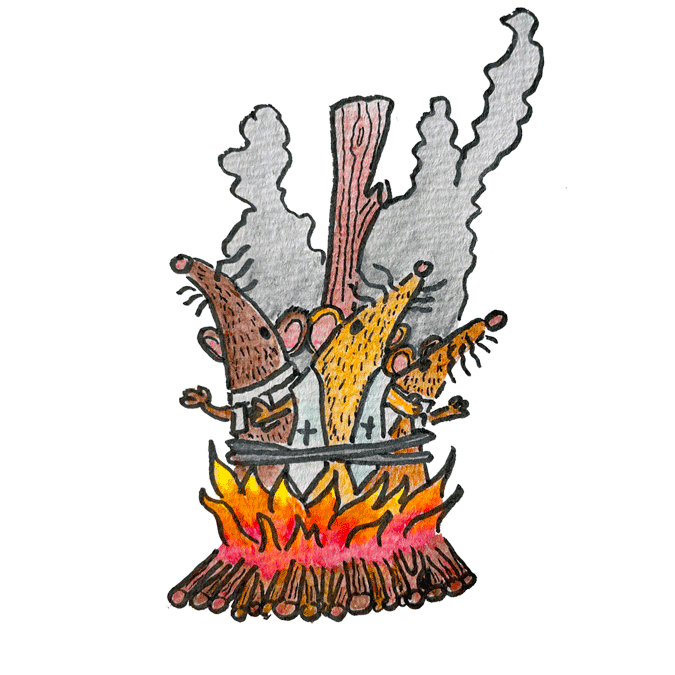
During Mary’s reign, three Protestant loyalists plotted against the queen. Hugh Latimer, Nicholas Radley, and The Archbishop of Canterbury, Thomas Cranmer all conspired to overthrow the queen. They were never blinded, but perhaps they were “blind” to the truth of God. Instead of cutting off their tails, Mary had the “Oxford Martyrs” burned at the stake. 

The farmer’s wife in this tale refers to Mary and her husband, King Philip of Spain, who owned massive estates. 

So the next time you hum one of these little ditties, think about the pain and suffering that inspired them.

Tim Kane

[mailerlite_form form_id=2]

Origin of Undyne from Undertale

Arcane Curiosities

The game Undertale, released September 15, 2015, has legions of devoted followers. You play as a human who falls into the Underground, filled with monsters. The most determined being Undyne the Undying. She is the head of the royal guard in the Underground. Her task, eliminate any and all humans. But what exactly is the origin of Undyne?

From Nymph to Royal Guard

Undyne’s name derives from the word Undyne (also spelled Ondine), a mythical water nymph. The undine is an elemental spirit representing water. The Swiss alchemist, Paracelsus, invented the name in his book “A Book on Nymphs, Sylphs, Pygmies, and Salamanders, and on the Other Spirits” from 1566. The Latin root for undine is unda or “wave”.

No such fate would befall Undyne, her name a play on the word undying. She is committed to eliminating humans and stealing your soul — the last one needed to allow the monsters to escape from the underground. 

“Seven. Seven human souls, and King Asgore will become a god. Six. That’s how many we have collected thus far. Understand? Through your seventh and final soul, this world will be transformed.”

Undyne

A Determined Piranha

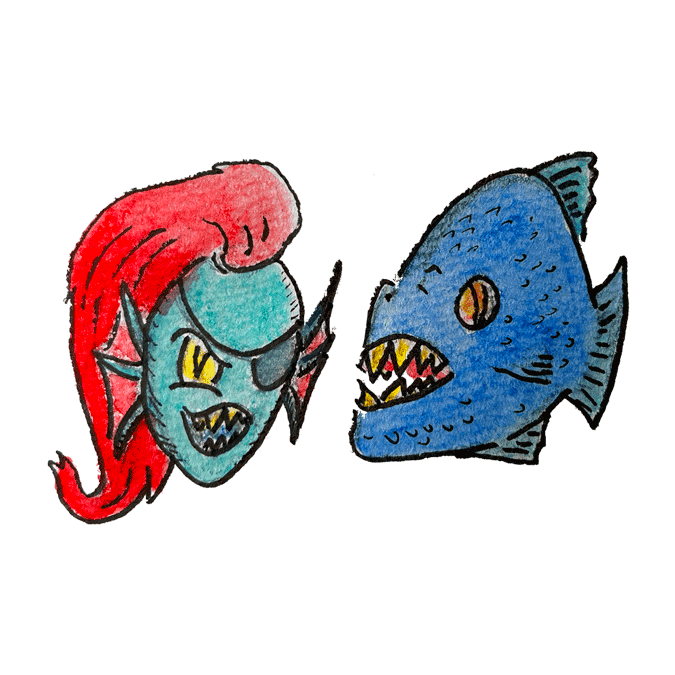
One theory about Undyne’s appearance is that she is a humanoid version of a piranha fish (specifically Serrasalmus Rhombeus).

Serrasalmus Rhombeus

Undyne is a fish-like monster with blue scales and a protruding maw of teeth. This matched the toothy grin of a piranha. Additionally, the Serrasalmus Rhombeus has red finned gills, matching Undyne’s red ponytail. Finally, piranhas have eyes with vertical slits, much the same as Undyne.

These fish also share Undyne’s personality, a ferocious determination to attack. However, piranha work in packs. Undyne needs no other help.

“Deep, deep in my soul. There’s a burning feeling I can’t describe. A burning feeling that WON’T let me die.”

Undyne

[mailerlite_form form_id=2]

Tim Kane