
Updated for a new century comes socially-conscious Millennial Batman gadgets. He sustainable sources all his ingredients and has local artisans craft each gadget to perfection.
Tim Kane
Updated for a new century comes socially-conscious Millennial Batman gadgets. He sustainable sources all his ingredients and has local artisans craft each gadget to perfection.
Tim Kane
Arkane Curiosities

When Hajime Isayama created Attack on Titan, he ushered us into a sprawling world of Titans, set on devouring all of mankind. Yet where did Hajime find inspiration for these walking behemoths and are there any other giants in mythology that can serve as models?
In a 2014 interview with the magazine Brutus, Isayama describes how he would doodle in his notebook during Junior High. “I was drawing ugly things exclusively.”
Originally, the Colossal Titan had a much different appearance. Isayama used a “30-Second Drawing” app and designed the giant with a stone body and covered in human teeth. Later, he felt the muscled figure would look cooler and switched it out.
Isayama worked part-time at an Internet cafe where he would observe the patrons. Many had a look of bewilderment, as if their life had no purpose. He brought these ideas into the idea of the Titans.
One night, he encountered a drunk patron. Trying to communicate with this person became frustrating and pointless. Isayama was intrigued by “the lack of the ability to communicate even though the person was of the same species.” Thus the Titans were mute, bent on their desire to consume humans.

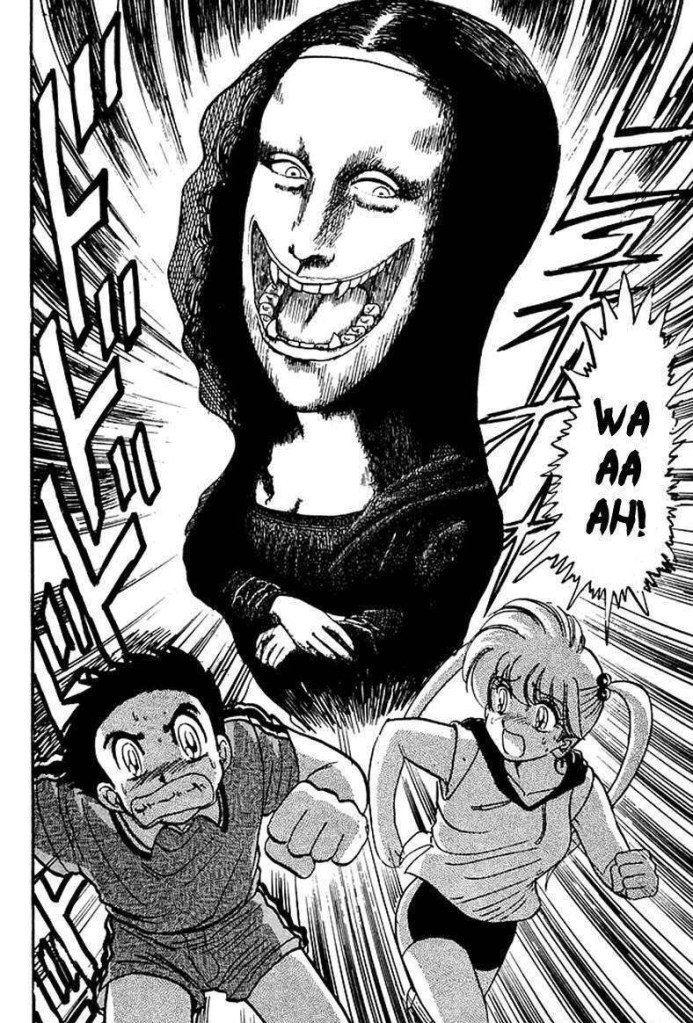
The manga Jigoku Sensei Nube also inspired Isayama. This series followed a teacher, Nūbē, who used a technique called Demon’s Hand to counter supernatural threats. In issue 34, he took on a now familiar-looking cannibalistic Mona Lisa. The figure would come out of the painting and eat people whole, much like the Titans.
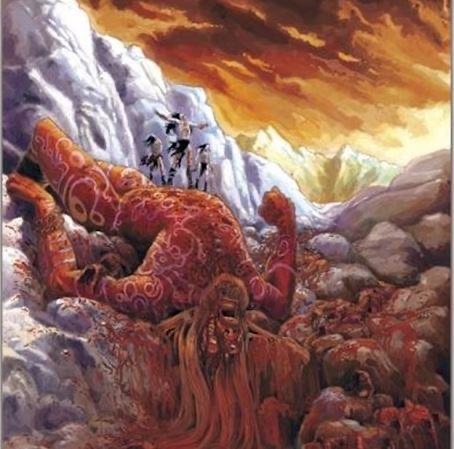
In Norse mythology, a race of giants, called Jötnar, live in the land of Jötunheimar. The Jötnar were the enemies of the gods (much like the Titans are the enemies of humanity). Yet many Norse gods had children with these giants and the Jötnar are important to the end of the world, Ragnarök.
Additionally, the primordial being in Norse mythology is Ymir, who existed before any of the gods. This huge frost giant spent all his time slurping from the teets of a massive cow, Audhumbla.
Three of the Norse gods hated the Jötnar and especially the greedy and noisy Ymir. They attacked the original frost giant, and finally defeated Ymir. The three gods tore apart the body, using Ymir’s flesh to create the world, his blood to make the ocean and his bones to build the mountains. Ymir’s hair became mighty forests and his brain transformed into the clouds in the sky.
Japan is filled with magical beings called Yokai and the most monstrous of them all is Gashadokuro — a giant skeleton that roams the night, eating people.
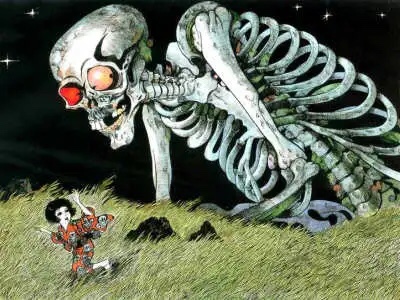
Legend has it that soldiers or victims of a plague who do not receive a proper burial are reborn as ghosts. They die with anger in their hearts and this energy binds hundreds of bones together into a gigantic skeletal monster.
Their teeth clatter (giving them their name) but they can also be silent. If they find a human out late and alone, the gashadokuro will creep up and catch the unwitting traveler. The skeleton crushes its victims in their hands or bites off their heads.
Tim Kane
[mailerlite_form form_id=2]
Arkane Curiosities

The wisest god in the Norse pantheon is not Odin. No, he gets all his advice from Mimir, the severed head god of wisdom. With direct access to Yggdrasill, the World Tree, Mimir can draw on vast stores of knowledge. But how did he end up losing his head, or body?
The Norse people had not one, but two pantheons of gods vying for control. On one side you had the straightforward, battle centered Aesir with Odin and Thor. On the other side were the more cunning and magic oriented Vanir with Freyr and Freya.
When Freya visited the Aesir, they were taken by her use of seidr (a powerful magic). Enthralled, they soon threw aside kin loyalty and sought only selfish desires. The Aesir labeled Freya as “Gullveig” (“Gold-greed”) and tried to burn her to death three times, but she was reborn from the ashes.
This led to war between the Aesir and the Vanir. The Aesir fought by the established rules of combat, using weapons and their strength to vanish enemies. The Vanir fought with magic, a more subtle form of combat. Eventually, both sides realized that they were too evenly matched.
With the prospect of peace, it was customary for each side to send a tribute to the other, a god or goddess who would live among the foreign tribe of deities. Freya, Freyr and Njord were sent to live with the Aesir. Hoenir and Mimir took their place among the Vanir.
Each time Hoenir sat in a meeting (called a Thing) with the Vanir, he would lean back and ask the more wise Mimir for advice. But one day, Hoenir went alone to the Thing. Each time he was asked to weigh in on a decision, he shrugged and said “Let others decide.”
The Vanir realized they had been cheated in the exchange of hostages. They’d sent their finest gods to the Aesir, but only received the dim-witted and indecisive Hoenir. In retaliation, they chopped off Mimir’s head and sent it back to Asgard. Apparently you need to pull your weight at a Vanir meeting.
Odin embalmed Mimi’s head with herbs to prevent rot. He also spoke charms over it, giving Mimir the power to speak again. Finally, Odin set Mimir at the foot of the Yggdrasil tree, next to a well. The well bore Mimir’s name, being known as the Mímisbrunnr.
Mimir drank from the well and gained great knowledge and secrets. To accomplish this task, he used the drinking horn Gjallarhorn (which is the same one Heimdallr would blow to announce the coming of Ragnarök). How Mimir managed this drinking, given that he was only a head, the sources won’t divulge.
Now Odin sets himself up as the frontman for being the wisest in the land. He doles out all the witty saying to the other Aesir, with Mimir feeding him advice and secrets from the wings.
Odin spent countless hours wringing information from Mimir. You see, he valued Mimir’s knowledge as well as their intellectual discussions. But Ragnarök was coming soon and he needed to gather every scrap of information he could. Thus, Odin asked to drink from the well of Mímisbrunnr, himself.
This was a big ask. The well contained untapped knowledge of not only this world, but all the nine realms. As the keeper of Mímisbrunnr, Mimir wanted something in exchange. For the privilege of drinking, Odin sacrificed his right eye, which he tossed to the bottom of the well.
After this point, not much is mentioned about Mimir. Did he still give Odin council, or was he forgotten, now that Odin had drunk from the mystical waters of Mímisbrunnr. Given that Odin appears in comics and movies and Mimir is all but forgotten, I think we can guess the answer.
Tim Kane
[mailerlite_form form_id=2]
Arkane Curiosities
At this point, Krampus has become a well known phenomenon. There’s even an American Dad episode about the mischievous bringer of discipline. Krampus is a downright celebrity these days. Here are three lesser known strange and bizarre Christmas traditions.

Tió de Nadal translates from Catalan to “Christmas log” or simply “tree trunk.” The other name for this Xmas tradition is Caga Tió, or poop log. Yes that’s right. It’s a log that poops out presents on Christmas Day.

It works like this, starting on the Dia de la Immaculada Concepció (Feast of Immaculate Conception, December 8th) you “feed” the Caga Tió sweets and candy. Each evening, after dinner, kids would save a peel from an orange or other fruit and place it in a feeding bowl in front of the little log. Bits of cookies and other sweets work as well.
Each night, you drape a blanket over the body of Caga Tió to keep it warm. We don’t want our gift-giving log to freeze in a cold winter home. This continues until December 24th, and gradually the log will grow in size (or maybe it’s the parents switching out the log for larger one).
Then comes the beating. You gather around your log and hit it with a stick to make sure it poops, all while singing a cute little song…
Caga tió, (Poop log)
tió de Nadal, (Log of Christmas)
no caguis arengades (Don’t poop salted herring)
que són massa salads (They are too salty)
caga turróns (Poop turróns)
que són més bons! (They are much better!)
Then, like magic, presents and candies (called turróns) appear under the blanket.
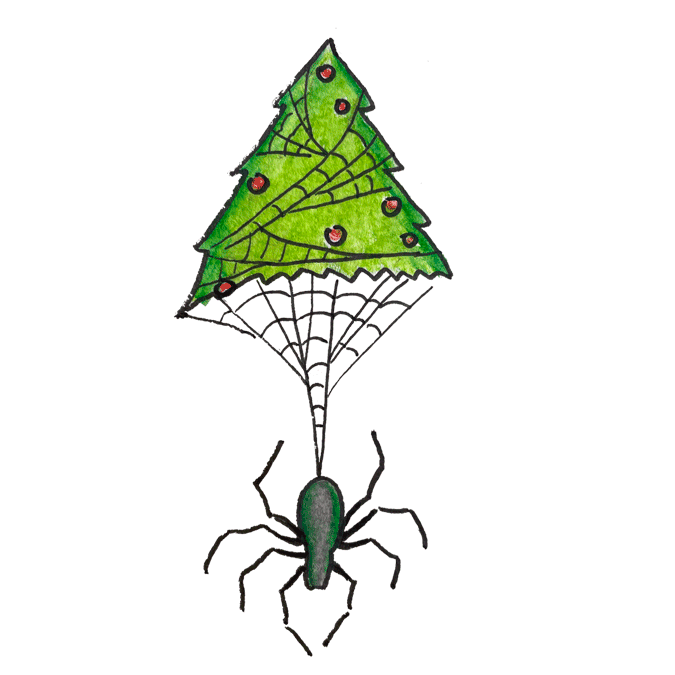
In Ukraine, you will often see spiderwebs decorating the Christmas tree. This comes from an old legend about some rather helpful arachnids.
There was once a widow who lived in a tiny house with her children. One day, a pine one took root outside their home and the children tended to the growing seedling in hopes of having a splendid Christmas tree. Yet as the year slipped into winter, the widow knew that they would not be able to afford decorations. Finally on Christmas Eve, they set up the tree in their house, but its branches were bare.
That night, while they slept, the spiders of the house heard the sobs from the disappointed children. They went to work on the tree, spinning delicate webs on every branch.
The next morning, the youngest child opened a window and the first rays of sunlight sparkled against the new decorations. The light of Christmas Day transformed the webbing into silver and gold. From that day forward, the widow never wanted for anything.
Ukrainians still decorate their trees with spiderwebs to bring good luck for the coming year. So maybe don’t shoo that spider away too quickly on Christmas Eve. After all, they also need a warm and cozy place on a winter night.
The Kallikantzaroi are mischief-making goblins who live in the center of the Earth. They spend the year trying to saw down the Tree of Life, which holds up the world.
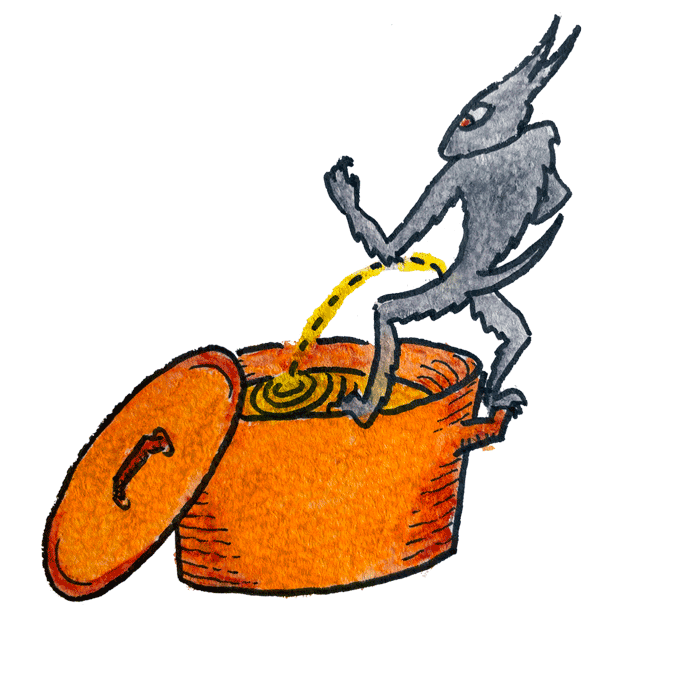
During the Twelve Days of Christmas, they dig their way to the surface to bring their naughty tricks to our houses. This is the time, starting at the Winter Solstice, where the sun does not shift in the sky.
Tiny black creatures with long tails, the Kallikantzaroi are mostly blind owing to their life underground. Afraid of the sunlight, they only emerge at night, feeding on any small critters, such as frogs, worms and snails.
They sneak into your house through any cracked window, down chimneys, or through keyholes. Once inside, the havoc begins. They are not evil, per se, but impish and idiotic.
There are up to twenty different types of Kallikantzaroi and each specialized in a different type of mayhem. Some urinate on your cooking or imbue food with horrific smells. Others mimic voices to tease, torment or steal.
You can keep the Kallikantzaroi away by leaving a colander on your doorstep. These little imps will have to count all the holes, but they can only ever make it to two and then are forced to start over. You can also burn an old shoe — the foul smell will keep these pests away.
A link to the Norse tradition of Yule comes with a method to keep these goblins out of your chimney. You simply burn a log, but keep it going for all twelve days. Once you’ve reached January 6th, you are safe and the Kallikantzaroi return to the center of the Earth.
Tim Kane
[mailerlite_form form_id=2]
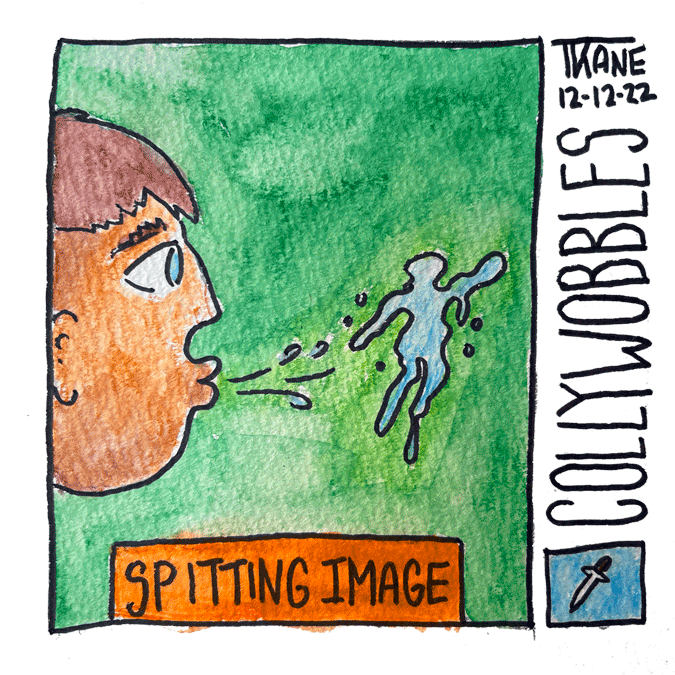
A new art form everyone is trying. Just spit out a drawing in the exact form of friends and family. A spitting image.
Tim Kane
 Tim Kane Books