
What would the millennial Batman drive? An electric (powered by renewable fuels) of course.
Tim Kane
What would the millennial Batman drive? An electric (powered by renewable fuels) of course.
Tim Kane

Do you detest those window stickers announcing the presence of a youngling in the car ahead of you? Perhaps you can imagine this image instead — a baby on board, literally floating on a scrap of wood, lost at sea.
Tim Kane
Arkane Curiosities
At this point, Krampus has become a well known phenomenon. There’s even an American Dad episode about the mischievous bringer of discipline. Krampus is a downright celebrity these days. Here are three lesser known strange and bizarre Christmas traditions.

Tió de Nadal translates from Catalan to “Christmas log” or simply “tree trunk.” The other name for this Xmas tradition is Caga Tió, or poop log. Yes that’s right. It’s a log that poops out presents on Christmas Day.

It works like this, starting on the Dia de la Immaculada Concepció (Feast of Immaculate Conception, December 8th) you “feed” the Caga Tió sweets and candy. Each evening, after dinner, kids would save a peel from an orange or other fruit and place it in a feeding bowl in front of the little log. Bits of cookies and other sweets work as well.
Each night, you drape a blanket over the body of Caga Tió to keep it warm. We don’t want our gift-giving log to freeze in a cold winter home. This continues until December 24th, and gradually the log will grow in size (or maybe it’s the parents switching out the log for larger one).
Then comes the beating. You gather around your log and hit it with a stick to make sure it poops, all while singing a cute little song…
Caga tió, (Poop log)
tió de Nadal, (Log of Christmas)
no caguis arengades (Don’t poop salted herring)
que són massa salads (They are too salty)
caga turróns (Poop turróns)
que són més bons! (They are much better!)
Then, like magic, presents and candies (called turróns) appear under the blanket.
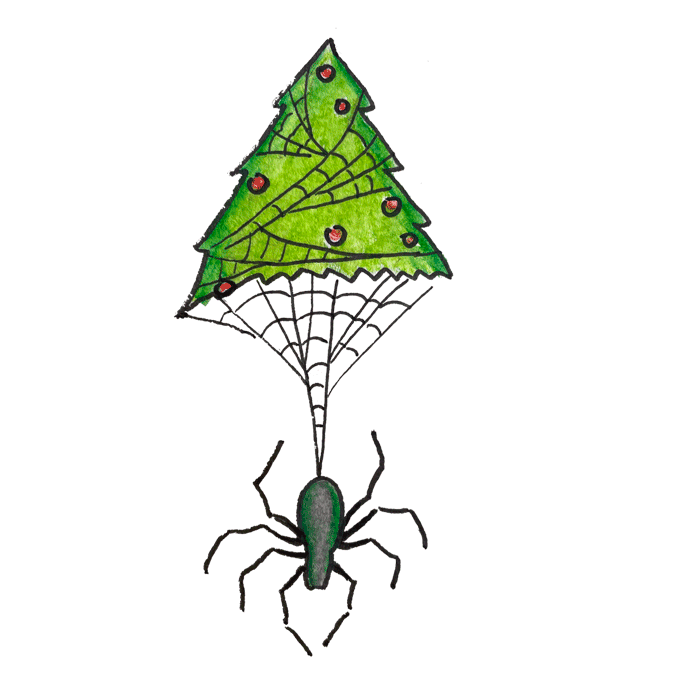
In Ukraine, you will often see spiderwebs decorating the Christmas tree. This comes from an old legend about some rather helpful arachnids.
There was once a widow who lived in a tiny house with her children. One day, a pine one took root outside their home and the children tended to the growing seedling in hopes of having a splendid Christmas tree. Yet as the year slipped into winter, the widow knew that they would not be able to afford decorations. Finally on Christmas Eve, they set up the tree in their house, but its branches were bare.
That night, while they slept, the spiders of the house heard the sobs from the disappointed children. They went to work on the tree, spinning delicate webs on every branch.
The next morning, the youngest child opened a window and the first rays of sunlight sparkled against the new decorations. The light of Christmas Day transformed the webbing into silver and gold. From that day forward, the widow never wanted for anything.
Ukrainians still decorate their trees with spiderwebs to bring good luck for the coming year. So maybe don’t shoo that spider away too quickly on Christmas Eve. After all, they also need a warm and cozy place on a winter night.
The Kallikantzaroi are mischief-making goblins who live in the center of the Earth. They spend the year trying to saw down the Tree of Life, which holds up the world.
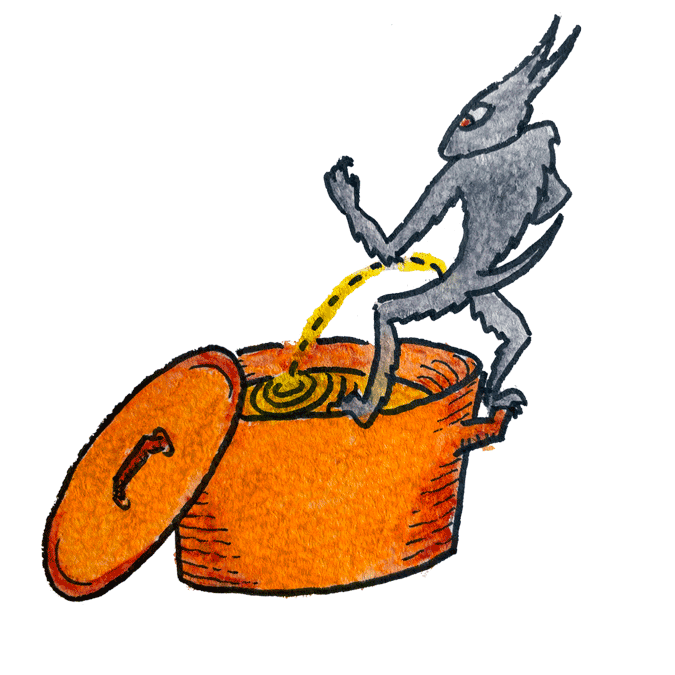
During the Twelve Days of Christmas, they dig their way to the surface to bring their naughty tricks to our houses. This is the time, starting at the Winter Solstice, where the sun does not shift in the sky.
Tiny black creatures with long tails, the Kallikantzaroi are mostly blind owing to their life underground. Afraid of the sunlight, they only emerge at night, feeding on any small critters, such as frogs, worms and snails.
They sneak into your house through any cracked window, down chimneys, or through keyholes. Once inside, the havoc begins. They are not evil, per se, but impish and idiotic.
There are up to twenty different types of Kallikantzaroi and each specialized in a different type of mayhem. Some urinate on your cooking or imbue food with horrific smells. Others mimic voices to tease, torment or steal.
You can keep the Kallikantzaroi away by leaving a colander on your doorstep. These little imps will have to count all the holes, but they can only ever make it to two and then are forced to start over. You can also burn an old shoe — the foul smell will keep these pests away.
A link to the Norse tradition of Yule comes with a method to keep these goblins out of your chimney. You simply burn a log, but keep it going for all twelve days. Once you’ve reached January 6th, you are safe and the Kallikantzaroi return to the center of the Earth.
Tim Kane
[mailerlite_form form_id=2]
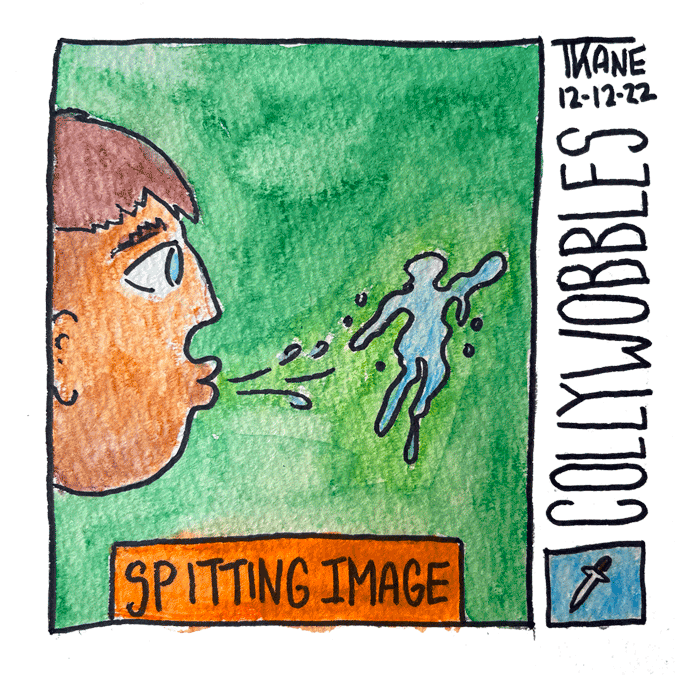
A new art form everyone is trying. Just spit out a drawing in the exact form of friends and family. A spitting image.
Tim Kane
Arkane Curiosities

Just as the Greeks celebrate the change from winter to summer with Persephone arising from the underworld, the Celts had the twin goddesses of Brigid and Cailleach. While the bright Brigid ruled over the summer months, Cailleach was the goddess of winter — the dwindling of the light.
Cailleach was known as the Veiled One or the Queen of Winter and she determined the severity of the colder months. Samhain, or October 31st, marked the end of the Celtic year and the start of Cailleach’s reign. This lasted until Beltane, May 1st, when Brigid ushered in the summer months. Some believe there were two aspects of the same goddess.
This might explain why she aged backward. Cailleach began Samhain as an ancient crone and gradually became younger as the months marched toward spring. Cailleach had total control over the frigid winter winds, being called Cailleach Bhéara in Scotland, the master of winds. She would determine if we received and early spring.
On Imbolc, February 1st, Cailleach ran out of firewood. This forced her to journey out into the woods to collect more. In the Manx tradition, she transformed into a mighty bird, gathering branches in her beak. In Ireland and Scotland, she journeyed out on foot.
This chore determined how severe the last months of winter would be. If Cailleach wanted winter to go on, she would make the day sunny and bright, allowing her to find more firewood and prolong the harsh winds of winter. However, if she overslept, the day remained gray and stormy, signaling that warmer weather was soon to come.
This tradition has carried over into the United States as Groundhog Day. It shifted to February 2nd, but the ritual is very similar. A sunny day means that Punxsutawney Phil will see his shadow and bring six more weeks of winter. If the day is overcast, then he won’t see his shadow and we get an early spring.
There is a legend of a wandering friar and his scribe who chanced upon an old woman’s house (spoiler, this would be our Cailleach). The friar wanted to know how old the woman was, but she had survived so many winters, she couldn’t quite recall. All she did know was that each year she killed an ox and cooked up a soup. Then she’d toss the bones into the attic.
The friar sent his young scribe scrambling up the ladder to throw the bones down for a count. As the pile grew, the friar soon ran out of paper in which to record the years this old lady had lived. He called up to the scribe to see how many bones were left. The scribe replied that he’d not even cleared one corner of the attic.
Another tale involved Fintan the Wise, who accompanied Noah’s granddaughter to visit Ireland. This was before the Great Flood and Fintan felt he was the first to set foot on the Emerald Isle. Instead, he discovered Cailleach living in a small hut.
Fintan was known as the man of a hundred lives, having lived some 5500 years. Yet he surmised that Cailleach was even older than he. He asked her, “Are you the one who ate the apples in the beginning?”, wondering if she might be Eve. He received no answer.
Perhaps Cailleach (also known as Beria) lived so long because each spring, she drank from the Well of Youth. These magical waters bubble up from the Green Island.This island, visible as only a speck off in the west, was a magical land where the only season was summer. It drifted along with the tides of the Atlantic, appearing off the coasts of Ireland and Scotland. Beria always knew where to find the isle and visited each spring to renew her life.
Tim Kane
 Tim Kane Books