Will O’Wisp: Tricksters Who Lure Travelers into Danger

Arkane Curiosities

Blue balls of flames burn in the night, hovering over the marshes. They lure travelers into danger and soon you’re sinking in a peat bog or tumble off a cliff. Also called ignis fatuus (Medieval Latin: “foolish fire”), these tricksters prey on the unsuspecting.

Word Origin

A “wisp” is a bundle of sticks or twisted paper used as a torch. Combined with the name “Will” we get Will-o’-the-wisp (literally “Will-of-the-torch”). Originating in England, these floating lights have crossed the pond and are known as “spook-lights”, “ghost-lights”, or “orbs” in the States. 

Other names for these mischievous nighttime tricksters are Hobby-Lantern, Jack-o’-Lantern, Jenny-Burnt-Tale, Kitty-Candlestick, and Peg-a-Lantern.

Evil Spirits

The Will-o’-the-wisps are considered a kind of evil spirits intent on diverting people off established roads. Their goal is to strand people in the wild with no hope of every reaching the land of the living again. 

On origin story, from Scotland, claims this wispy spirit is actually a deceased blacksmith names Jack. He was denied admittance to hell (which in Scottish lore is known as “the place of the wind of the cold passages, or the wind of the cold channels”). The devil gave Jack a single ember to warm himself as he wandered the mortal plane. It’s this light you see floating over the marshes — the Jack o’Lanten. 

Goblins with Lanterns

In Wales, the Will-o’-the-wisp goes by the name Ellylldan or Pooka (this is where we get the name Puck or Pwca). In this version, a farmer returns home after working the fields and sees a light bobbing before him. A small shadowy figure holds a lantern above its head. 

The farmer follows the light for miles only to find himself on the edge of a high cliff. Far below, a river rages. At this moment, the goblin leaps across the chasm and lands on the opposite side. It utters a malevolent laugh and blows out the lantern, leaving the farmer stranded in the dark. 

Lost Souls

Other versions of this myth have it that the Will-o’-the-wisps are the souls of unbaptized children. They cannot enter heaven and thus must roam the earth forever. They linger in dark forests and deserted places. 

If they spot a person at night, these lost souls hurry over and guide the traveler to water. Not in any attempt to drown the person, but in order to get baptized. 

There is a story from the Netherlands involving a certain Gandshoven from Molenbeek. When he encountered three will-o’-the-wisps, he baptized them. In that instant, thousands more will-o’-the-wisps surrounded him, all wanting the same treatment. Gandshoven spent the whole night baptizing them until the sun rose. 

So if you see a light bobbing mysteriously in the night, maybe leave it be. Who knows where it might lead you.

Tim Kane

[mailerlite_form form_id=2]

Flying Head Vampire: The Penanggalan

Arkane Curiosities

In Malaysia the Penanggalan detaches its head, leaving its body behind as an empty husk. This flying head vampire seeks out pregnant women to drain their blood. In fact, “Penanggal” or “Penanggalan” in Malay literally means “to detach” or “to remove”. But it’s not just the head. The internal organs dangle below, twinkling like fireflies.

Invisible Tongues

The Penanggalan, who always appears as a woman, looks completely normal during the day. She’ll avoid eye contact and smell strongly of vinegar (a tool of the vampire trade). Typically, Penanggalans take jobs as midwives. 

At night, it twists its head off and soars through the air, intestines and organs dangling below it. The Penanggalan perches on the roof and waits for the woman to go into labor. Then it wriggles an invisible tongue into the house to drain the blood from the mother. 

Legend has it, the tongue can pass through walls or slither through floorboards to reach its victim. Alternately, it will entwine the victim in its long intestines. 

Vinegar Bath

Upon reaching home again, the Penanggalan takes a quick dip in a tub of vinegar. Why, you ask? The vinegar shrinks the organs so it can squirm back into the body suit and pretend to be a person again. 

Snag Those Intestines

Want to keep yourself safe from this horrific creature? Your best bet is to snag those dangling intestines. Often people will scatter thorny leaves on roof or windows. Additionally, they might plant a pineapple tree under their house (Malaysian houses are built on stilts).

Still want a little more protection? Slide a pair of scissors under your pillow.

Mess With the Body

If your intent is to stop the Penanggalan for good, you’ll need to track the vampire to its lair (possibly by following anyone with the strong scent of vinegar). When the head detaches for the nightly peregrinations, you go to work. 

Fill the empty body with shards of broken glass. Then, when the creature returns to crawl into its body, the glass will shred the vampire’s organs. 

If you simply want to mess with the Penanggalan, just flip the body over. These creatures don’t really understand how human bodies work. It will reattach backward. Then the head will be facing in the wrong direction (an easy way to spot the vampire). 

Tim Kane

[mailerlite_form form_id=2]

Ohaguro Bettari: The Blackened Teeth Yokai

Arkane Curiosities

You are walking alone, late at night. You see a pretty girl from behind. But when she turns, the girl has no face. Only a smile filled with blackened teeth. This is the frightening yokai called Ohaguro Bettari.

Tradition of Blackened Teeth

The name “Ohaguro” refers to the practice of dyeing one’s teeth black, which was popular in Japan during the Edo period (1603-1868). The process of dyeing teeth black involved applying a special mixture of vinegar, iron filings, and other ingredients to the teeth. The mixture would turn the teeth black over time, and the process needed to be repeated every few days to maintain the color. 

The custom was also associated with the idea of “mibae,” which means “to show one’s maturity.” Married women who did not dye their teeth black were considered immature and not yet ready for marriage.

Suddenly a Smile

The tradition of “Ohaguro” explains the black teeth and “Bettari” means “appearing suddenly” or “appearing out of nowhere.” This yokai will be drawn to anyone walking alone at night. 

The creature takes the form of a beautiful young woman wearing a kimono. She hides her face and asks the person if she looks beautiful. If the person says no, she will disappear. If the person says yes, she will follow them for the rest of the night. 

A closer look reveals a shocking creature. The Ohaguro Bettari has no facial features, save its smile — a mouth filled with black teeth. She will laugh at your fear and surprise (and this is perhaps the reason for the yokai’s trickery). 

The lesson here: stay clear of pretty woman late at night.

Tim Kane

[mailerlite_form form_id=2]
The Kyorinrin: Words Given Life

Arkane Curiosities

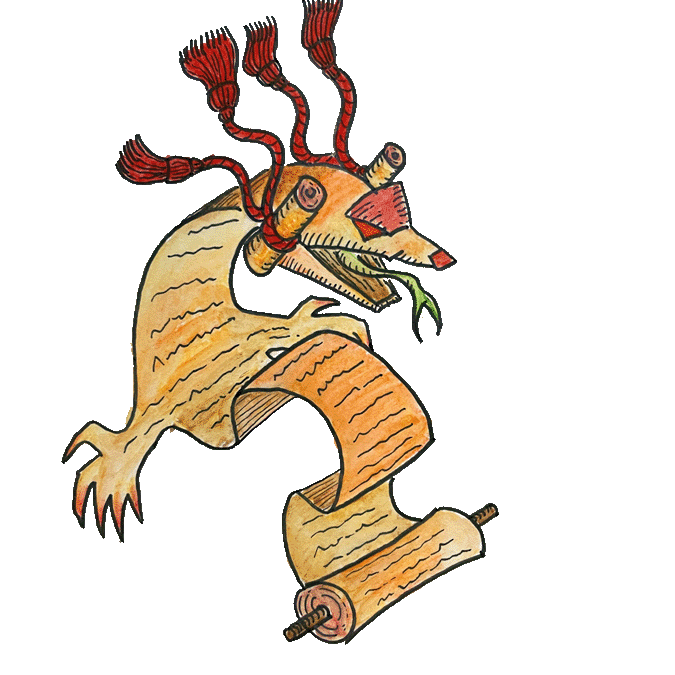
Writers, how many times have you started a new story or novel, only to jump ship for a new, shinier idea? Well, your written work might have some feelings about being abandoned. The Kyorinrin is literally words given life.

An Animated Spirit

In Japan, the tradition of the tsukumogami yokai allows tools and objects to acquire a spirit. Common examples of objects that can become tsukumogami include tools such as umbrellas, sandals, or teapots, as well as household items like lamps or futons. Once the object becomes a tsukumogami, it gains the ability to move and act on its own, often with mischievous or malevolent intent.

In Japanese folklore, tsukumogami are often depicted as small, furry creatures with big eyes and mischievous personalities. They are said to appear on the night of Setsubun, the day before the start of spring, and cause chaos and mischief in homes and businesses. However, some tsukumogami are more benevolent and may even bring good luck to those who keep them in their homes.

Forgotten Writing

The Kyōrinrin is a special type of tsukumogami formed when a scroll or book has lain forgotten for many years. After gathering a layer of dust, the writing gains a spirit. The Kyōrinrin decorate themselves with extravagant kimonos and ornate details, perhaps because they want to be noticed by their creator. They also develop bird-like qualities: beaks and long expandable wings. 

The Kyōrinrin shake off their dust and seek out their owners who have forgotten them. They only want to spread their knowledge and if it has to be by force, then so be it. 

So before your own writing grabs you by the throat and forces you to read it, perhaps you should dust off your own forgotten treasures and take a peek.

Tim Kane

[mailerlite_form form_id=2]
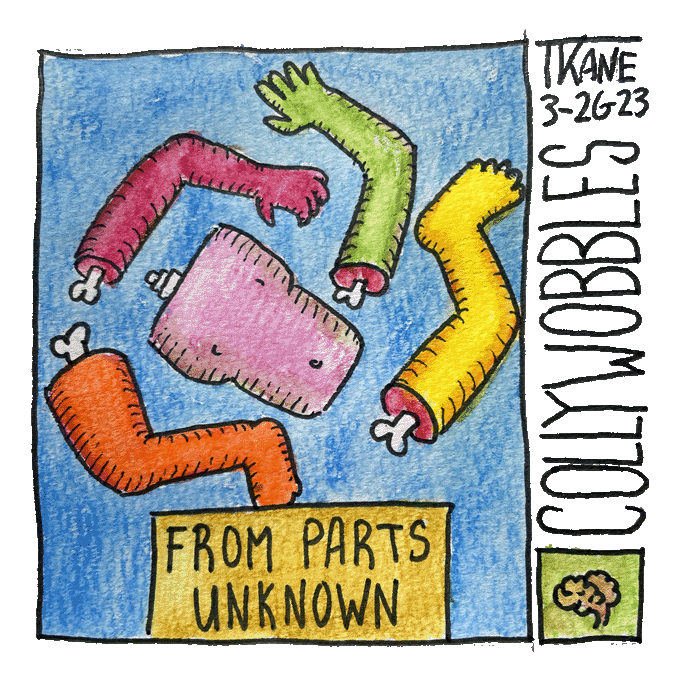
From Parts Unkown

When assembling your Frankenstein monster (or flesh golem) you need a reliable place to source your parts. The worst scenario is to get body pieces from parts unknown.

Tim Kane