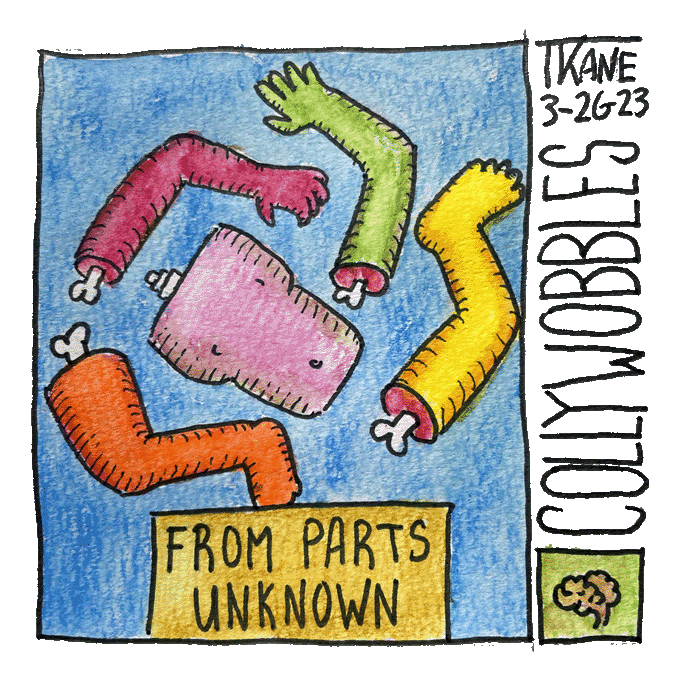
When assembling your Frankenstein monster (or flesh golem) you need a reliable place to source your parts. The worst scenario is to get body pieces from parts unknown.
Tim Kane
When assembling your Frankenstein monster (or flesh golem) you need a reliable place to source your parts. The worst scenario is to get body pieces from parts unknown.
Tim Kane
Arkane Curiosities
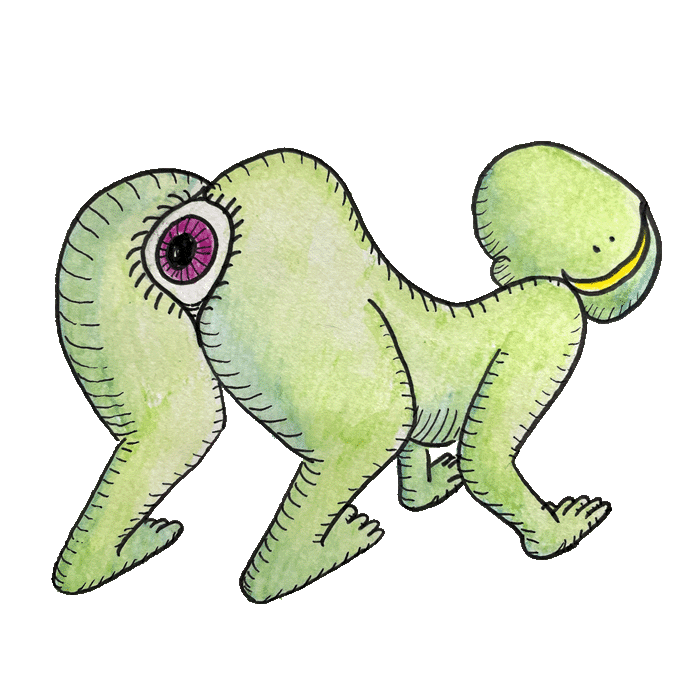
To the Western mind, images of ghosts and the supernatural conjures up amorphous spirits or tall creepy slender men. But in Japan, the supernatural takes a hilarious and often creepy twist. The word Yokai can be translated as monster, demon, spirit, or goblin and the come in many strange and bizarre forms. Yet, perhaps none more peculiar than the Shirime or eyeball butt yokai.
The word “shirime” translates literally to “butt eye” but it also has the meaning of a “backward glance”, which is quite literal to how this yokai looks at you. The shirime has the body of a man or woman, but instead of a face, it has a single large eyeball where its butthole should be. Other meanings for “shirime” have qualities of distress, which seems to be the motivation for this prankster creature.
The shirime approaches you looking, in all respects, like a normal person. It wears a kimono and asks you for a moment to spare. Once it has your attention, the kimono drops away. You see that this person has no facial features. It bends over, spreading its butt cheeks, to reveal a single eyeball, shining like lightning.
And that’s it. It doesn’t do anything else to you. Shock seems to be this creature’s only purpose.
Little is known about this yokai. A Japanese poet, Yosa no Buson, wrote the first and only encounter with this supernatural being. Some believe that shirime’s true form is just an animal, shapeshifting into a disturbing form in order to play a practical joke on us humans.
Tim Kane
[mailerlite_form form_id=2]
Arkane Curiosities
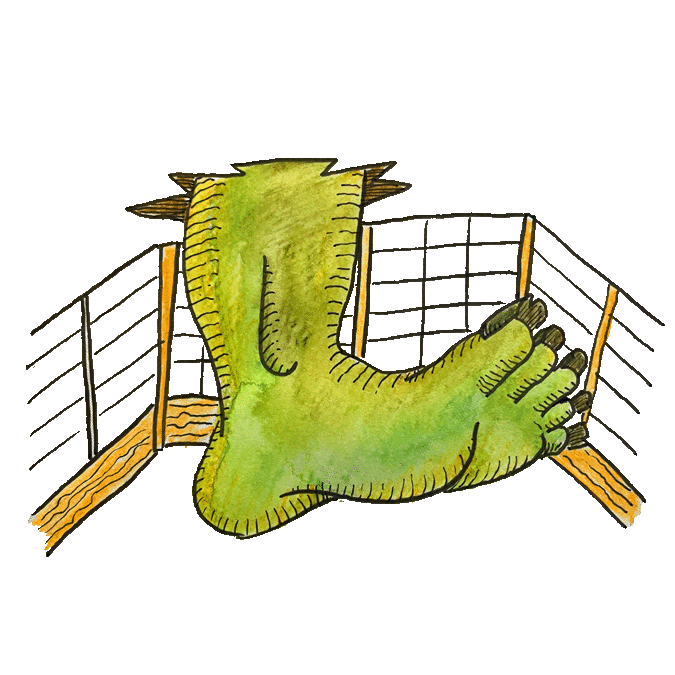
Sometimes ghosts are missing body parts. Headless specters abound (looking at you Nearly-Headless Nick). There are even ghosts with several arms or legs. Yet in Japan, we have a ghost who is only a foot. A giant ghostly foot that desires you to clean it — the Ashiarai Yashiki.
The Ashiarai Yashiki appeared suddenly in front of the door of a house. The occupants heard a booming voice shout out:
“WAAAASH MY FOOOOT!”
The ceiling splintered as a gigantic foot smashed though. This massive foot was covered in bristly thick hair and terribly filthy.
If the people refused to wash the foot, the yokai would stomp around, causing earthquakes and other natural disasters until its demands were met.
According to some variations of the legend, the Ashiarai Yashiki is actually the spirit of a wealthy merchant who was so obsessed with cleanliness, he would force his servants to wash his feet every night. When he died, his spirit was unable to rest and took on the form of the giant foot, continuing to demand that people wash it.
The Ashiarai Yashiki could also be a play on words. In ancient times, “to wash one’s feet” meant to be cleared of crimes and allegations. This would suggest that a visitation by the Ashiarai Yashiki meant the occupant was guilty of some crime. The yokai came to punish the criminal for their misdeeds.
Tim Kane
[mailerlite_form form_id=2]
Arkane Curiosities
Many people in France during World War II wanted to disappear and Dr. Marcel Petiot was more than happy to help them… but their disappearances were permanent. Marcel Petiot (later known as Dr. Satan) was a French doctor and fraudster who operated in Paris during World War II. He is believed to have killed between 26 to 63 people, mostly Jews seeking to escape Nazi persecution. He managed to escape punishment over and over and would go on to be known as the most famous French serial killer.
Petiot’s victims were lured into his home under the guise of providing them with false identity papers and medical certificates. Although he would charge them 25,000 Francs, he also knew they’d be loaded with countless valuables — cash, gold and jewels.
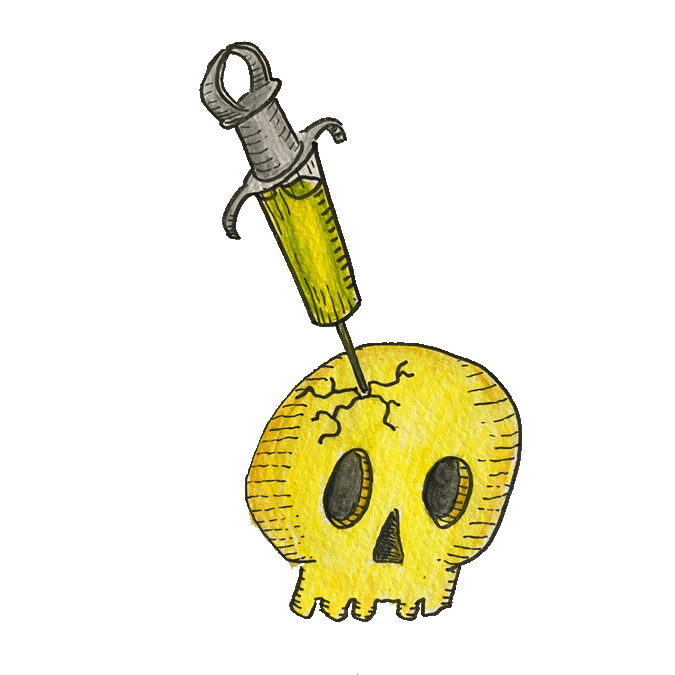
Upon arriving, Petiot would bring the victims to an airtight basement, claiming it was a safe hiding spot. The supposed destination for these refugees was Argentina. Petiot explained that the Argentinian officials needed any new arrivals to be vaccinated. As a doctor, he administered the injection himself.
Of course, there was no vaccine. Each shot was loaded with cyanide. However, despite what we all think, cyanide isn’t always fatal. Since the basement was airtight, he dealt with any surviving victims by turning on the gas and suffocating them to death. He even installed a peephole to watch the proceedings.
Marcel Petiot disposed of his victims’ bodies by dismembering them and dissolving them in acid. After killing his victims, he would use a saw to dismember their bodies into small pieces, making it easier to dispose of them.
Petiot then placed the dismembered body parts in a large metal container filled with quicklime and water. The quicklime would dissolve the flesh and bones, leaving behind only a sludge-like residue.
Petiot’s use of acid to dissolve his victims’ bodies was a particularly gruesome method of disposal, and it made it difficult for authorities to identify the victims or determine the exact number of people he killed. Later, he was officially convicted of 26 murders, but he may have killed up to 150 people over three years.
He left behind a macabre assortment of human remains, including 33 pounds of charred bones, three garbage cans filled with unidentified body parts, ten whole human scalps and nine severed heads.
In the 1920s, Petiot was involved in several fraudulent schemes, including fake stock deals and impersonating a doctor to solicit money from patients. He was convicted of fraud in 1926 and sentenced to five years in prison but managed to escape in 1927 by faking a seizure and being taken to a hospital, from where he fled.
In 1943, the Gestapo discovered his network, believing it was a genuine method to smuggle refugees out of France. They forced a Jewish prisoner, Yvan Dreyfus, to pretend to be a Jew wanting to escape. However, Dreyfus vanished.
The Gestapo eventually captured Petiot and tortured him about his smuggling network, but of course there was no information to give. They did discover that he was murdering his clients but chose to turn a blind eye. The Gestapo may have seen Petiot’s activities as a way to rid France of Jews and other undesirables, and didn’t want to interfere with his activities.
Petiot’s killing spree came to an end in March 11, 1944 when a neighbor reported a foul smell emanating from his property. When police investigated, they found evidence of Petiot’s gruesome activities. Firefighters discovered a furnace furiously burning with a human arm hanging out the side.
This time, Petiot claimed his victims were, in fact, traitors and Nazi infiltrators. He was a patriot and actually aiding the French resistance. And the French police bought into this and released him.
A closer examination of the remains as well as the 2000 pieces of clothing and belongings left behind, revealed that the victims were Jewish.
A seven month manhunt ensued with Petiot’s story and picture appearing in papers all over Europe. He was finally recognized in a Paris Metro station on Halloween, 1944. After a search, the police found him carrying a pistol, over 31,000 Francs and 50 sets of identity papers.
Petiot maintained his innocence to the end, but could never support his claims. On May 15, 1946, he strolled down Death Row toward the awaiting guillotine. When asked how he felt, Petiot replied: “My conscience is clear.” That was, because the man had no conscience to begin with.
Tim Kane
[mailerlite_form form_id=2]
Arkane Curiosities

Everyone needs a mother, even the gods. In central Anatolia (now modern Turkey) the Phrygian people held Cybele as their principal goddess. She also happened to be the mother of the gods.
Cybele was believed to have given birth to a number of gods and goddesses who ruled over various aspects of the natural world, such as: Dionysus, Hecate and Zeus.
Yet in traditional Greek lore, Rhea was the mother of Zeus and helped the young god slay his father to rule over Olympus. So how can Zeus have two mothers? Well, Rhea and Cybele come from different cultures, so Rhea was his Greek Mommy and Cybele was the Phrygian Mum.
In some versions of the mythology, there are even stories of the two goddesses being merged into a single deity, with Rhea being identified as a Greek version of Cybele.
Cybele also mothered the god Attis. He was sometimes associated with the god Adonis, who was a similar figure in Greek mythology. Both were associated with vegetation and rebirth, and both were believed to have died and been reborn each year as part of the cycle of the seasons.
Cybele took a fancy to her young son. She fell in love with him and made him her consort, but Attis later betrayed her by falling in love with a mortal woman. Cybele was so enraged by Attis’ betrayal that she drove him mad, causing him to castrate himself and die. In other versions, Attis died in battle or through self-mutilation. Either way, Attis cut off his dangly bits.
Followers of Cybele celebrated the mother of the gods through ecstatic rituals and frenzied dancing, often accompanied by the music of drums and cymbals. Her followers. They were known as the Corbants and their origins can be traced back to the ancient city of Phrygia, which is now modern-day Turkey.
The Corybants were often depicted as wearing armor and carrying shields and swords. They performed frenzied dances and drumming as part of the worship of Cybele. The cult of Cybele was centered around the idea of a divine mother figure who was associated with fertility, nature, and wild animals.
The male priests, called Galli, wore long robes, headdresses, and jewelry, and would often dye their hair and wear makeup. Their religious practices were highly ritualistic and often involved self-mutilation.
During certain religious ceremonies, the Galli would castrate themselves as a way of dedicating themselves fully to the worship of Cybele. This act was seen as a way of emulating the mythical figure of Attis, who was said to have castrated himself in a fit of religious ecstasy.
The Roman version of the cult was known as the Magna Mater, or the Great Mother, and it was often associated with the worship of the god Attis. The cult eventually declined as Christianity began to spread throughout the Roman Empire.
Tim Kane
[mailerlite_form form_id=2]
 Tim Kane Books