
I’ve cut away the sinister parts of me. So I’m all right now.
Tim Kane
I’ve cut away the sinister parts of me. So I’m all right now.
Tim Kane
Arkane Curiosities

In Malaysia the Penanggalan detaches its head, leaving its body behind as an empty husk. This flying head vampire seeks out pregnant women to drain their blood. In fact, “Penanggal” or “Penanggalan” in Malay literally means “to detach” or “to remove”. But it’s not just the head. The internal organs dangle below, twinkling like fireflies.
The Penanggalan, who always appears as a woman, looks completely normal during the day. She’ll avoid eye contact and smell strongly of vinegar (a tool of the vampire trade). Typically, Penanggalans take jobs as midwives.
At night, it twists its head off and soars through the air, intestines and organs dangling below it. The Penanggalan perches on the roof and waits for the woman to go into labor. Then it wriggles an invisible tongue into the house to drain the blood from the mother.
Legend has it, the tongue can pass through walls or slither through floorboards to reach its victim. Alternately, it will entwine the victim in its long intestines.
Upon reaching home again, the Penanggalan takes a quick dip in a tub of vinegar. Why, you ask? The vinegar shrinks the organs so it can squirm back into the body suit and pretend to be a person again.
Want to keep yourself safe from this horrific creature? Your best bet is to snag those dangling intestines. Often people will scatter thorny leaves on roof or windows. Additionally, they might plant a pineapple tree under their house (Malaysian houses are built on stilts).
Still want a little more protection? Slide a pair of scissors under your pillow.
If your intent is to stop the Penanggalan for good, you’ll need to track the vampire to its lair (possibly by following anyone with the strong scent of vinegar). When the head detaches for the nightly peregrinations, you go to work.
Fill the empty body with shards of broken glass. Then, when the creature returns to crawl into its body, the glass will shred the vampire’s organs.
If you simply want to mess with the Penanggalan, just flip the body over. These creatures don’t really understand how human bodies work. It will reattach backward. Then the head will be facing in the wrong direction (an easy way to spot the vampire).
Tim Kane
[mailerlite_form form_id=2]
Arkane Curiosities

You are walking alone, late at night. You see a pretty girl from behind. But when she turns, the girl has no face. Only a smile filled with blackened teeth. This is the frightening yokai called Ohaguro Bettari.
The name “Ohaguro” refers to the practice of dyeing one’s teeth black, which was popular in Japan during the Edo period (1603-1868). The process of dyeing teeth black involved applying a special mixture of vinegar, iron filings, and other ingredients to the teeth. The mixture would turn the teeth black over time, and the process needed to be repeated every few days to maintain the color.
The custom was also associated with the idea of “mibae,” which means “to show one’s maturity.” Married women who did not dye their teeth black were considered immature and not yet ready for marriage.
The tradition of “Ohaguro” explains the black teeth and “Bettari” means “appearing suddenly” or “appearing out of nowhere.” This yokai will be drawn to anyone walking alone at night.
The creature takes the form of a beautiful young woman wearing a kimono. She hides her face and asks the person if she looks beautiful. If the person says no, she will disappear. If the person says yes, she will follow them for the rest of the night.
A closer look reveals a shocking creature. The Ohaguro Bettari has no facial features, save its smile — a mouth filled with black teeth. She will laugh at your fear and surprise (and this is perhaps the reason for the yokai’s trickery).
The lesson here: stay clear of pretty woman late at night.
Tim Kane
[mailerlite_form form_id=2]
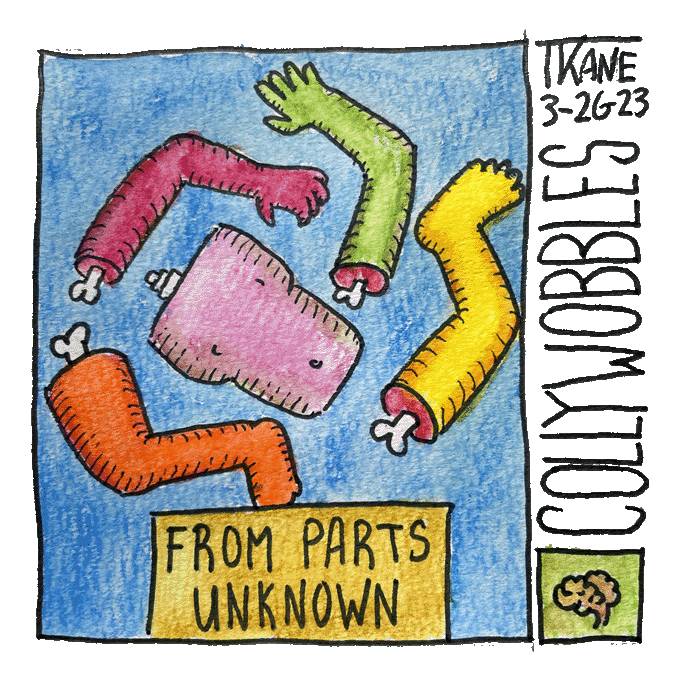
When assembling your Frankenstein monster (or flesh golem) you need a reliable place to source your parts. The worst scenario is to get body pieces from parts unknown.
Tim Kane
Arkane Curiosities
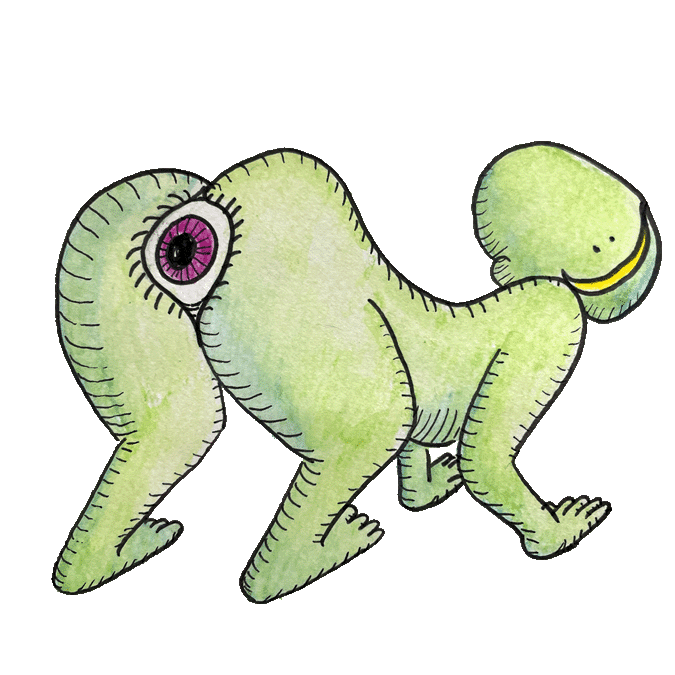
To the Western mind, images of ghosts and the supernatural conjures up amorphous spirits or tall creepy slender men. But in Japan, the supernatural takes a hilarious and often creepy twist. The word Yokai can be translated as monster, demon, spirit, or goblin and the come in many strange and bizarre forms. Yet, perhaps none more peculiar than the Shirime or eyeball butt yokai.
The word “shirime” translates literally to “butt eye” but it also has the meaning of a “backward glance”, which is quite literal to how this yokai looks at you. The shirime has the body of a man or woman, but instead of a face, it has a single large eyeball where its butthole should be. Other meanings for “shirime” have qualities of distress, which seems to be the motivation for this prankster creature.
The shirime approaches you looking, in all respects, like a normal person. It wears a kimono and asks you for a moment to spare. Once it has your attention, the kimono drops away. You see that this person has no facial features. It bends over, spreading its butt cheeks, to reveal a single eyeball, shining like lightning.
And that’s it. It doesn’t do anything else to you. Shock seems to be this creature’s only purpose.
Little is known about this yokai. A Japanese poet, Yosa no Buson, wrote the first and only encounter with this supernatural being. Some believe that shirime’s true form is just an animal, shapeshifting into a disturbing form in order to play a practical joke on us humans.
Tim Kane
[mailerlite_form form_id=2]
 Tim Kane Books