Superstitions of the Undead (Or How to Keep the Dead in Their Graves)

Arkane Curiosities

Every culture fears that the dead will return to haunt and terrorize them. Throughout the centuries, different superstitions regarding death and burial arose to help keep the dead in their graves, where they belong.

Haitian Lip Sewing

The religion of voodoo is a mixture of several different practices originating in Africa. The main fear is that a deceased person might rise as a zombie. This isn’t the flesh-eating ghoul introduced by George Romero’s Night of the Living Dead. These are bodies animated by a sorcerer (bokor) and forced into an eternal slavery.

One common practice is to sew the corpse’s mouth shut. A bokor could only raise the dead by forcing the deceased to answer its name. Thus, sewing the lips shut prevents the dead from speaking. 

Another way to keep the dead from talking is to bury the corpse face down with its mouth against the earth. A dagger is also given to the deceased so they can stab any bokor who disturbs them. 

Finally, you can distract the dead with trivial tasks. Leaving an eyeless needle that can never be threaded or sprinkling a handful of sesame seeds to be counted will keep the deceased busy so they won’t hear the bokor call their name. 

How Death Got His Scythe

In Eastern Europe, many corpses were found buried with a sickle or scythe positioned across their necks. The idea here is that if a corpse rose from its grave, the sickle would slice the head off. 

People finding these bodies in the Middle Ages associated the sickle and scythe with the apparition of death. 

The reason we see burial stones in the shape of a cross is yet another way to keep the dead where they belong. The sign of the cross was thought to deter an evil spirit. Even a sword, with its cross-like hilt, stabbed into the he grave soil will do the job.

A Coin is Your Ticket to the Afterlife

One superstition, dating back to the ancient Greeks, is to place a coin in the mouth of the deceased. The name for this offering is “Charon’s obol”. An obol is a measure of currency. The Greeks believed that the dead spirit traveled to the underworld where it needed to cross the River Styx. Charon was the ferryman tasked with taking souls across the river. But he didn’t work for nothing. The coin was a bribe to make sure your loved one reached the afterlife. Otherwise, they might return as an evil spirit. 

Greeks are obsessed with the idea of keeping at least one coin on their person at all times. Your pocket or purse should always have at least one coin. Even your bank account needed a little something. This superstition was meant to ensure that you always had money. 

Never Dress Your Corpse in Red

Apparently it’s a difficult journey from the grave to the afterlife. The Chinese believe that a soul travels through the ten Magistrates of Hell, where they face faces trials and torments (one for each sin they committed in life). To ease this journey, monks chanted around the deceased to get them through the Courts of Hell as quickly as possible. There would also be a group of people gambling. The idea being that the corpse must be guarded day and night and the gambling kept the people awake and alert. 

The color red signifies happiness. After a death, all statues of deities in the house should be covered with red paper, to protect them from the corpse. Mirrors are also removed because to see the reflection of a coffin means that you will shortly die. 

The deceased is never dressed in red because this will cause the corpse to return as a ghost. 

Dead Flesh Chewing Gum

In Turkey, gum chewing is perfectly fine so long as it happens during daylight hours. If you chew gum at night, it transforms into the flesh of the dead. The color of Turkish gum is very similar to skin tone and can be mistaken as flesh. 

Additionally, you are not supposed to trim your nails at night otherwise a djinn will paralyze you.

Tim Kane

[mailerlite_form form_id=2]
Did Dionysus Have Dissociative Identity Disorder?

Arkane Curiosities

Mortals aren’t the only ones who can manifest dissociative identity disorder — many deities from ancient times had multiple personas. People with dissociative identity disorder (previously known as Multiple Personality Disorder or incorrectly as “split personality”) have a system of individuals all working within a single host (or body).

The core is the original child and the first identity born to the host. Some view the core as the owner of the system and is often the part with the most power. There are multiple alters (or other personalities) that fulfill specific roles, such as Protector, Persecutor, and Memory Holder. A Gatekeeper often allows the different alters to front (or take control of the host).

Different deities from across the world’s pantheons have different aspects that front for various purposes. In Celtic mythology, there is the Morrígan, who has three aspects all related to war and death. In Hindu belief, the trimurti has three gods in one body each in charge of one aspect of creation.

Perhaps the most intriguing of these personality swapping gods is Dionysus — the Ancient Greek diety of wine, drunkenness, frenzy, suffering and madness. 

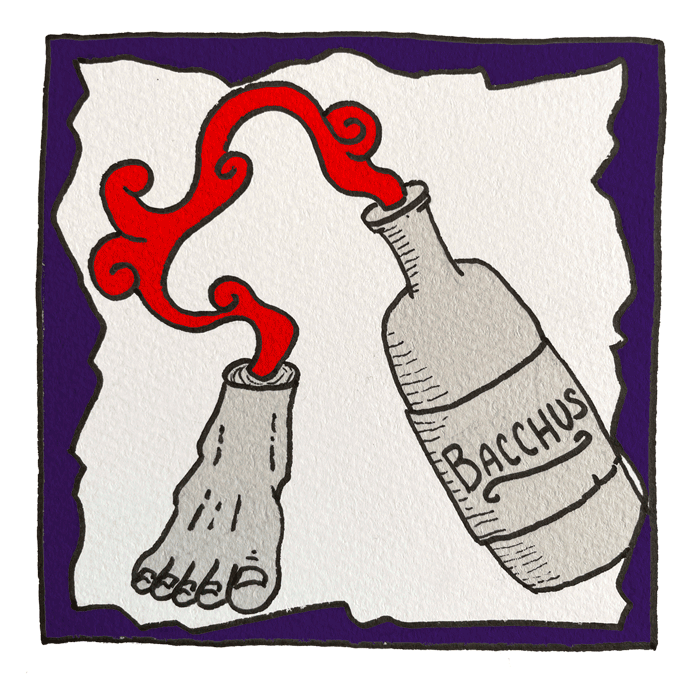
Dionysus (also known as Bacchus) is known for having a dual persona. He is a bringer of joy and merriment, but sometimes goes into a blinding rage to terrorize hapless victims. 

Twice Born

Dionysus was born twice. Zeus, always the player, seduced Semele, a princess of Thebes. His wife, Hera, was naturally not pleased and planned revenge. A mortal could not view a god in their true form. Thus Hera, in disguise, convinced Semele to make Zeus prove his godliness by revealing his true form. You can guess what happened… Semele made Zeus promise to do as she wished and then asked to see him in all his glory. Zeus was honorbound to comply and revealed his true form, blasting the pour mortal woman to ashes. However, the unborn Dionysus, being part god, survived. Zeus sewed the baby inside his thigh, allowing him to gestate until birth. Since Dionysus was born from a god (in this case, Zeus) he was granted immortality. This could qualify as the traumatic event that often ushers in dissociative identity disorder. 

God of Fun

Dionysus was portrayed as beautiful and joyful. He discovered the cultivation of vines and taught others how to ferment grapes into wine. His worship is often connected with the idea of partying and having a good time (under the influence of wine, of course). He was connected to such mythological creatures as satyrs and centaurs. Dionysus was depicted riding a panther or in a chariot pulled by pumas (way to make a grand entrance). 

Terror Frenzy

Some Greek cities attempted to ban the wild rites of the maenads (followers of Dionysus). The most notorious case came with King Pentheus of Thebes (written about by Euripides). The king attempted to imprison Dionysus, but the prison doors would not close and the shackles simply slipped off. 

Despite fearing this new worship, the king was also fascinated by it and wanted to learn more. His own mother, Agave, had been lured in by the rites of Dionysus. The wine god allowed Pentheus to observe the secret rituals firsthand, but only if the king disguised himself as a woman. Pentheus did as instructed and spied on the maenads from behind a tree. 

Dionysus had driven the women into a frenzy and they seized upon any small animal they could find, ripping it apart. Soon they discovered the king and, thinking he was a lion, the maenads tore him limb from limb. Even his mother, Agave, carried off his head thinking she had slain a lion. Thus the Thebans were punished for having resisted the rites of Dionysus. 

The terror-frenzy that Dionysus creates in his followers feels very much like the protector alter of the dissociative identity disorder. A Protector might lash out to defend the host from physical or other kinds of abuse. 

Dionysus remains a complex deity with many facets. He was beloved by the Greeks and went on many more adventures. Whether the Greek myths utilized him as a way to explain individuals with different personas remains to be seen. One thing is certain, if you upset Dionysus, you would suffer the consequences.

Consider the last lines of the Homeric Hymns to Dionysus

“And the Nymphs followed in his train with
him for their leader; and the boundless forest was filled with their outcry…”

Tim Kane

Dissociative Identity Disorder in the Gods (The Morrígan)

Arkane Curiosities

The character of Jane exploded into public awareness with airing of DC’s Doom Patrol. Dubbed “Crazy Jane” (and played by the excellent Diane Guerrero), she is one of the alters of Kay Challis, a girl who developed dissociative identity disorder following physical and sexual abuse by her father.

Doom Patrol (both the comic and streaming series) does an excellent job of explaining and normalizing the mental disorder (formerly called multiple personality disorder or split personality disorder). Jane herself has no powers to add to the team of misfit heroes. But some of her alters do. When not fronting (or controlling the host body) Jane descends to the Underground with 63 other alters. 

Just as there are ancient gods to symbolized various elements of the natural world, so too do we see dissociative identity disorder crop up in a few prominent deities. To start, let’s look at The Morrígan.

The Morrígan

As a Celtic goddess, the Morrígan translates from old Irish as “Great Queen” or “Phantom Queen.” She is often dubbed a trinity goddess, but this is a modern pagan view of what, in reality, is quite a bit more complex. True, the Morrígan does have three aspects, but they don’t align to the Maiden, Mother and Crone. 

The triple aspect of the Morrígan are depicted as sisters and also referred to as “The Daughters of Ernmas” (an Irish mother goddess famous for having triplet children). The first two aspects of the Morrígan consistently remain Macha (a death goddess) and Badb (a war goddess). The third aspect varies with different tales, shifting between Némain, Féa, or Anu. The organization The Order of the Crows recognizes Némain as the third aspect and the Morrígan as the constituent whole.

Badb

Némain is also recognized as a war goddess, but separate from Badb. Whereas Badb stirs up panic and fear on the battlefield, Némain embodies with frenzied havoc of war. This alone shows the subtle nature of different alters within a host. Both Némain and Badb represent war, but bring different attributes to the battle. 

The Irish noted how black birds and crows shrieked and cawed around the bodies left in the aftermath of war. As scavengers, they fed upon human carnage. Badb was known as the “Battle Crow”, representing the death and carnage of battle. In Ireland, if one were to see a crow before the battle had begun, it foretold death and disaster. This was Badb preparing to feast. 

Badb is the most well known of the three aspects of the Morrígan and may very well be the core personality. 

Némain

Her sister, Némain, can unleash a cry of terror and brings panic like an infection. The site Living Liminally, quotes Windisch, “Nemain brought intoxication upon the army there, falling in their armor and on the points of their spears and sword-edges, so a hundred warriors of them die in the midst of the encampment and at the side of that place a time of terror the cry carried from on high.”

Macha

Macha, symbolized by fiery red hair, represents death. However, she is not feared in the way other harbingers of the afterlife tended to be. The Celts saw death as a natural element of life. Macha was a welcome goddess and an omen for what is to come.

One story involved Macha marrying a mortal, Cruinnic. She warns her husband not to tell a soul of her true identity, but Cruinnic is weak-willed and runs his mouth at a chariot race, bragging that his divine wife can outrun the king’s horses. 

The King of Ulster got wind of this and summoned Macha, demanding that she race the royal horses. At the time, she was pregnant and pleaded to postpone the competition until after she’d given birth. The king was adamant and the bizarre race, a pregnant woman versus the royal horses, commenced. 

Macha outpaced the horses, but as she crossed the finish line, she wailed in pain, giving  birth to a boy (True) and a girl (Modest). In her pain and anger, she cursed the men of Ulster nine times nine generations so in times of the worst peril, they should suffer the pain of childbirth. This shows that Macha can be vengeful when disrespected. 

Ancient stories rarely talk of these personalities trading off with each other. Rather, they simply list them together, calling them sisters, and listing their names together when describing the heat of battle. 

In us mortals, dissociative identity disorder is associated with trauma. No such explanation has been recorded for the Morrígan (Macha’s birth at the race not withstanding). However, it was natural for deities like the Morrígan to bee seen as multiple aspects of the same goddess, each one emerging when needed.

In the next installment, we’ll look at Dionysus and his massive swings in emotion.

Tim Kane

The Tarot Cards Choose a New Owner

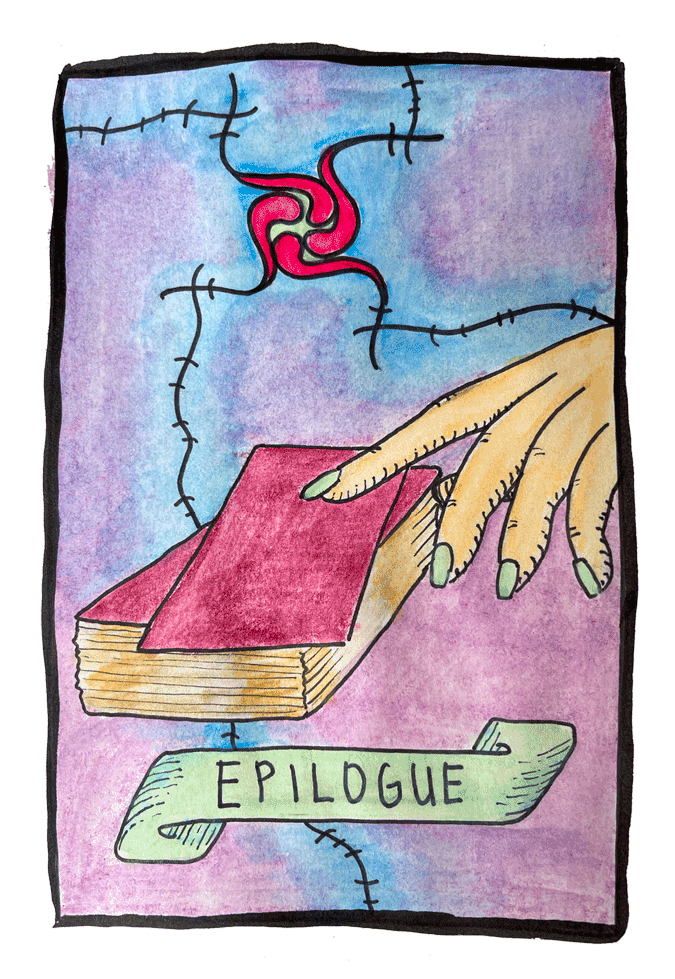
Epilogue

This is a Young Adult story tackling issues of self-harm and suicide. It is intended for teen readers or older. If you want to read from the beginning, click over to chapter 1.

Kassandra

The bus screeched to a stop at the curb and the doors hissed open. Kassandra and Gabriel climbed on board. He had real boy clothes now. Auntie Jo had driven them by the Retro and Gabriel found some things that fit. They weren’t stylish—money was still tight—but at least he wasn’t wearing Mom jeans anymore.

Kassandra had ditched the Tarot-bought clothes. All of them into the trash. She was forced to pick up a pair of used jeans along with Gabriel. They were worn at the knees, but not ripped yet.

Scooting down the aisle, Kassandra tugged Gabriel along. “Okay. We have to go over your cover story.”

“Am I supposed to be your cousin?”

“Ew, no. That was Auntie Jo’s idea.”

Book Girl sat in the usual spot, her legs wedged against the seat in front with a paperback balanced on top. She glanced up, eyeing Gabriel a little too long.

Kassandra continued heading toward the back of the bus. “I’m pulling the plug on the whole cousin thing. I mean, what if I turn out to like you later?”

He scrunched up his face in confusion.

“Kiss. It means what if we end up kissing.”

“Oh.” Gabriel looked a bit embarrassed. “Courtship between cousins was not entirely uncommon in my day.”

“Well, these days it’s disgusting.”

The bus lurched forward. Kassandra managed to half sit, half fall into the seat, but Gabriel wasn’t so lucky. He stumbled to one knee before making it onto the seat.

“Sorry, I should have warned you about Driver Lady.” She pulled out the battered crocheted bag, searching for a pen and some paper. Next to the other purse, this thing was a cavern. “Let’s get some notes down so we both know your story.”

Something squirmed past her fingers and launched into the air. Gabriel snatched the slip of paper before it fluttered away.

“I should never have made this for you.”

“I like it.” Kassandra took the paper back. It was a drawing he’d made of the nightingale. She’d cut around the edges of the pencil sketch so it could move its wings. Even stuck back in the purse, the paper wings flapped back and forth, trying to fly. “You’ll have a heck of a time in Science class. Maybe let me do the drawings for cellular mitosis.”

“Do you still have them?” Gabriel eyed her purse.

He was asking about the cards. The way he did every five seconds.

“Don’t be so paranoid. Where are they going to go?”

But when Kassandra reached into the purse, they weren’t there. She started pulling things out, searching for the cards. The bus braked, throwing her forward.

“Where are they?” She stood and searched the seat, even stuffing one hand down the foam rip. Nothing. “They can’t disappear. They just don’t do that.”

Some of the kids twisted around to see what was going on. Kassandra had one final idea. She pushed past Gabriel and leaned down, scanning the floor under the seats.

“Sit down back there,” Driver Lady hollered, putting the bus back in gear. Kassandra balanced by bracing against the seats. Backpacks littered the floor. There was a forest of legs. Even if the cards were down there somewhere, she couldn’t see anything. Gabriel yanked her back into the seat.

“They’re gone.” Kassandra stared blankly forward.

She should be relieved. She’d wanted rid of those things since day one. But what about Luke? If someone let him out, he’d come straight for her. Just like Carol, the Clerk Lady at the Psychic Mind. Then another idea slipped into Kassandra’s mind. The first day she’d found the cards. Carol seemed so shocked. Maybe they’d vanished from her pocket.

Kassandra turned to Gabriel. “The cards. They’ve chosen someone new.”

Margaret

Margaret hiked her legs up, squashing it against the seat in front. What were these seats stuffed with—wood? It was impossible to get comfortable on one of these. She propped the book on one knee. With any luck, Ms. Sammers wouldn’t ride the brake all the way to school.

Cracking open the paperback, Margaret dug in. The hero, Billy, was shoved in a boxcar with plenty of other prisoners of war. The place seemed filthy and cramped. It reminded her of the bus ride.

After only a page, she swayed forward as the bus stopped to pick up more passengers. Great, here came the new girl. It looked like she traded boyfriend number one for a new model. Margaret watched them pass, poking her glasses up her nose. The first guy was cuter, though this one wasn’t half bad.

She tried to steer her mind back to the book and the boxcar rumbling through Germany, but the new girl kept chattering. The girl was way too perky today. Margaret liked her better before—all mopey and quiet. The bus lurched forward, sending the new girl on her ass. It served her right. If she hadn’t learned about how Ms. Sammers drove by now, she was hopeless.

Margaret snugged down in the seat, creasing the book open, but her heart wasn’t in it. The new girl would make an easy scapegoat, but truthfully, it wasn’t only her. Everyone on this bus wore Margaret down. They all went on and on, believing every word they said was vitally important when all it really amounted to was jabbering. These people didn’t know the first thing about life and how to live it. Margaret cracked her knuckles. She’d so like to educate them.

The bus jerked forward again and her face nearly mashed into her knee. The book tumbled to the floor. Mrs. Sammers was riding the brake again.

Margaret groped between the seats, but one hand brushed a stack of cards. She did a quick glance of the bus passengers and then scooped them up along with the book. The cards were oversized, meant for meaty hands and not her slender fingers.

A commotion erupted from the back of the bus. Twisting around, she saw the new girl was having a hissy fit. Enough with the drama already.

Margaret flipped over the top card and saw a stone pillar towering above an ocean. A single rose sprouted from the center of the rock. She tapped the person-shaped empty space right in the middle.

“It’s like someone forgot to finish the picture.”

The bottom read The Fool. “Now who on the bus fits this description?” She giggled. “Take your pick. Most of these folks tread water in the shallow end of the pool.”

Margaret flipped through the rest of the cards. The Emperor, Judgment, The Tower. This was clearly a Tarot deck. But the illustrations looked different from any deck she’d seen before. They had more life to them. Why were some of the cards blank, like The Fool? Had the artist skipped out before the end?

She paused at an illustration of a man wearing the most ridiculous red suit. The bottom said he was The Magician, but the guy looked more like a clown. Margaret was about to move on when the figure shifted. She blinked. It wasn’t her imagination. He really moved. One minute he was staring at the table. The next, he looked at her.

“Why do you look so familiar?” She tilted the card. “This some kind of hologram?” The image didn’t change this time.

The bus lurched, the wheels klunking into a pothole. Ms. Sammers was aiming to hit them all this morning. Margaret glanced back at the card. The man looked at the table again. Maybe it was only her imagination.

Margaret flipped the card back onto the pile and slid the Tarot deck into her backpack. She might as well keep them. They could be good for a laugh. The image of the Fool card popped into her head and she grinned. The blank spot was so begging to be penciled in. And Margaret knew plenty of candidates.