
We all succumb to the lure of doughnuts, chips, cookies and ice cream. This is the power of the Junk Food god.
Tim Kane
We all succumb to the lure of doughnuts, chips, cookies and ice cream. This is the power of the Junk Food god.
Tim Kane

In 1904 H.G. Wells wrote about the Food of the Gods, which transformed regular animals and people into gargantuan proportions. The title was apt, because like us mortals, deities must also feast in order to survive.
Perhaps the most famous divine nourishment would be the ambrosia consumed by the Greek gods on Mount Olympus. Before they discovered this magical foodstuff, gods had to inhale vapors from their dead enemies, akin to taking in the soul of the vanquished.
As the god Zeus grew from a baby to a full-grown thunderbolt-wielding god, he was nursed by a goat (or possibly a nymph) named Amalthea. Baby Zeus, like most infants, grabbed anything near him. While feeding, he broke off one of Amalthea’s horns. This was later transformed into a Cornucopia (or Horn of Plenty).
The Horn of Plenty would create a limitless supply of ambrosia for the gods (along with any type of food for mortals). White doves would whisk this precious food up to Mount Olympus each day.
Nectar was also used interchangeably with ambrosia, though it was said to taste like honey and be carried by a swift eagle.
The gods and goddesses gained immortality by gobbling up ambrosia and nectar. Immortality has its downside. Their blood transformed to ichor, a divine life force.
If the gods missed too many meals, their immortality would fade away. The great Demeter, goddess of the hearth, went for days without eating in her search for Persephone and nearly perished with the effort.
One story has Achilles gaining his famous invulnerability by being anointed with ambrosia, which burnt away his mortal skin. His mother, Thetis, would have covered his whole body in the stuff, but Peleus, her husband, thought she was trying to harm little Achilles and stopped her, leaving his famous ankle still mortal.
The gods used ambrosia to cure diseases, heal scars and beautify the human body. If applied to a freshly killed hero, the ambrosia would preserve the body forever. When Patroclus died in the Trojan war, his body was anointed with Ambrosia to keep it in a perfect state.
Some believed that if mortals consumed ambrosia (or nectar), they too would become immortal. King Tantalus attempted to seal some of the mythical provisions only to fail and become immortal in another way (punished with eternal hunger in Tartarus).
There might even have been a whole garden with immortality-bearing food. In the far west, where the sun sets, lay the Garden of Hesperides. Three nymphs, called the “Daughters of the Evening” tended the garden which held a special apple tree. One of Hercules’s tasks was to pluck an apple from this tree.
In the play Hippolytus, Euripides mentions a place where “streams flow with ambrosia by Zeus’s bed of love and holy Gaia”. This could possibly be the resting place of the fable Cornucoplia.
That’s a pretty good journey for those doves each day.
[mailerlite_form form_id=2]
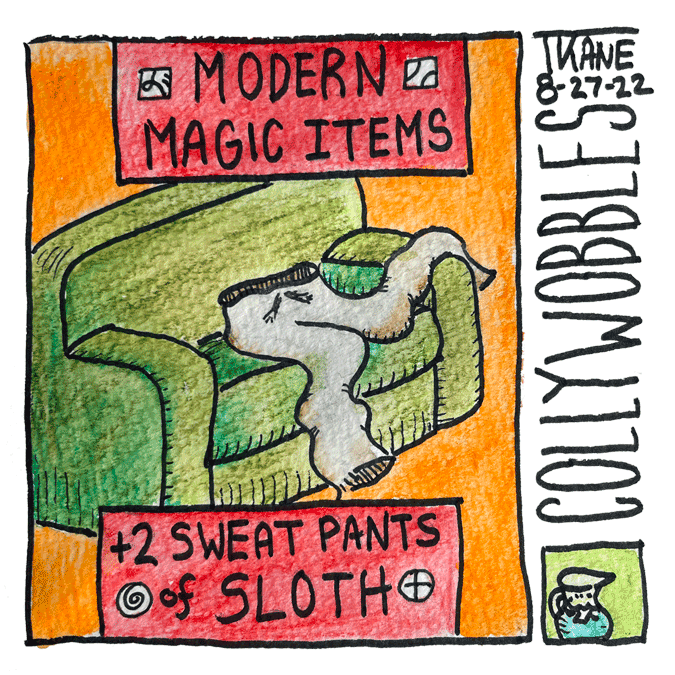
The latest in modern magic items includes the +2 sweatpants of sloth, which resist activity and encourage relaxation.
Tim Kane

Marvel Comics would have us believe that Thor’s hammer was forged in a collapsed neutron star somewhere in the far reaches of space. The actual myth is a bit more terrestrial (or Asgardian…?). The Dwarves were, indeed, responsible for the creation of the mighty Mjölnir, but the job was botched. And like most mistakes in the Norse pantheon, this one can be traced back to the god of mischief, Loki.
Loki was constantly pulling pranks on the other gods (and then attempting to extricate himself from blame). Loki knew knew that Thor loved his wife, Sif, and her golden hair. On a lark, Loki waited for Sif to be asleep, took a pair of shears and snipped her golden off, every single lock.
Naturally, when Thor learned of this, he seized his brother and threatened to break every bone in his body. Loki, always quick on his feet (and wanting to save his own skin) promised he could return Sif’s golden hair.
Loki journeyed to the land of the Dwarves, Nidavellir (the dark fields, also sometimes called Svartalfheim). He pleaded with the two sons of Ivaldi (never named on their own) to fashion a new head of hair for Sif. These master craftspeople ended up creating three stunning treasures to please the gods:
The items were so wondrous, Loki declared the sons of Ivaldi the most skilled crafters in the realm. However, two brothers, Brokk and Eitri overheard the boast. Never one to miss an opportunity, Loki taunted the brothers, claiming they lacked the skill to create anything equaling the creations of the Ivaldi brothers.
What’s a wager without a prize? Loki was so sure of his victory, he bet his own head as the prize. The brothers promptly accepted.
Loki now had to make sure he won the bet or he’d lose his own head. He transformed himself into a fly and heard the brothers talking. Eitri worked the forge and reminded Brokk that the bellows must be worked without pause to ensure the required heat.
As Brokk pumped the bellows, Loki buzzed around his head, tormenting him as only a fly can. The dwarf was able to maintain focus through the first two items, Gullinbursti (a golden boar) and Draupnir (a golden arm ring).
The last item was to be Mjölnir, a war hammer for Thor. Loki, determined to keep his head on his shoulders, dived into Brokkr’s eyelid and bit so hard he drew blood. The dwarf stopped for a moment to wipe his eyes.
The hammer emerged from the forge, a weapon of unsurpassed might, able to always hit its mark and then return to the owner’s hand. But it was flawed. Most warhammers were meant to be wielded with two hands. But Mjölnir’s handle was too short and could only be held with one hand.
Despite the mistake, Brokk was certain he and his brother had won the wager. Together with Loki, they traveled to Asgard. They laid their works before Odin.
All the gods concluded that Brokk and Eitri had won the wager and Loki owed the dwarves his head. Ever the cunning one, Loki agreed to give over his head. Except, he had never promised his neck.
Brokk decided that since Loki’s head was his, he could at least shut the god up for a while. Using Eitri’s awl, he sewed Loki’s lip shut with a leather thong. Satisfied, the brothers returned to their forge.
[mailerlite_form form_id=2]

Newsena knows we all get sucked in by the news. She then makes us go on and on, doom scrolling into the wee hours of the night. (She doubles as the goddess of anxiety).
Tim Kane
 Tim Kane Books