Three Bizarre Christmas Traditions: Poop Logs, Christmas Spiders and Evil Goblins

Arkane Curiosities

At this point, Krampus has become a well known phenomenon. There’s even an American Dad episode about the mischievous bringer of discipline. Krampus is a downright celebrity these days. Here are three lesser known strange and bizarre Christmas traditions.

The Poop Log of Catalonia

Tió de Nadal translates from Catalan to “Christmas log” or simply “tree trunk.” The other name for this Xmas tradition is Caga Tió, or poop log. Yes that’s right. It’s a log that poops out presents on Christmas Day.

It works like this, starting on the Dia de la Immaculada Concepció (Feast of Immaculate Conception, December 8th) you “feed” the Caga Tió sweets and candy. Each evening, after dinner, kids would save a peel from an orange or other fruit and place it in a feeding bowl in front of the little log. Bits of cookies and other sweets work as well.

Each night, you drape a blanket over the body of Caga Tió to keep it warm. We don’t want our gift-giving log to freeze in a cold winter home. This continues until December 24th, and gradually the log will grow in size (or maybe it’s the parents switching out the log for larger one). 

Then comes the beating. You gather around your log and hit it with a stick to make sure it poops, all while singing a cute little song…

Caga tió, (Poop log)
tió de Nadal, (Log of Christmas)
no caguis arengades (Don’t poop salted herring)
que són massa salads (They are too salty)
caga turróns (Poop turróns)
que són més bons! (They are much better!)

Then, like magic, presents and candies (called turróns) appear under the blanket.

Ukrainian Christmas Spiders

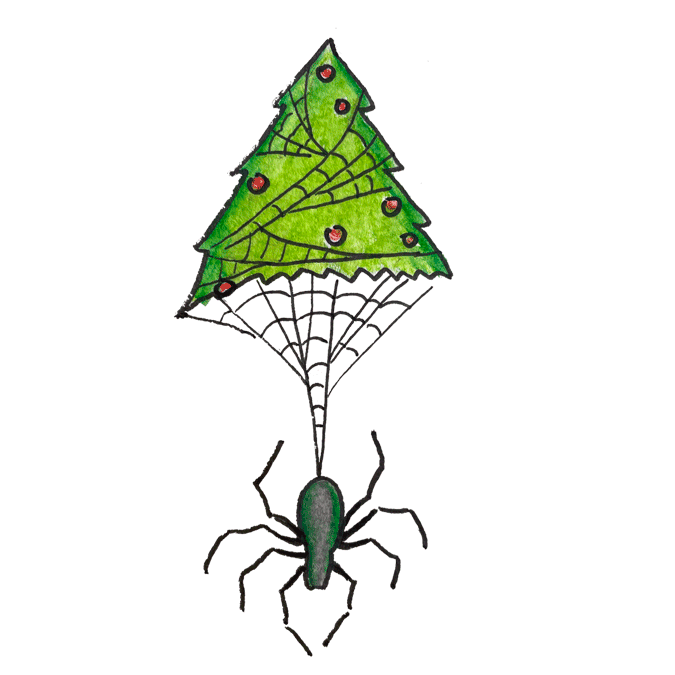
In Ukraine, you will often see spiderwebs decorating the Christmas tree. This comes from an old legend about some rather helpful arachnids. 

There was once a widow who lived in a tiny house with her children. One day, a pine one took root outside their home and the children tended to the growing seedling in hopes of having a splendid Christmas tree. Yet as the year slipped into winter, the widow knew that they would not be able to afford decorations. Finally on Christmas Eve, they set up the tree in their house, but its branches were bare.

That night, while they slept, the spiders of the house heard the sobs from the disappointed children. They went to work on the tree, spinning delicate webs on every branch. 

The next morning, the youngest child opened a window and the first rays of sunlight sparkled against the new decorations. The light of Christmas Day transformed the webbing into silver and gold. From that day forward, the widow never wanted for anything. 

Ukrainians still decorate their trees with spiderwebs to bring good luck for the coming year. So maybe don’t shoo that spider away too quickly on Christmas Eve. After all, they also need a warm and cozy place on a winter night.

Mischievous Greek Goblins

The Kallikantzaroi are mischief-making goblins who live in the center of the Earth. They spend the year trying to saw down the Tree of Life, which holds up the world.
During the Twelve Days of Christmas, they dig their way to the surface to bring their naughty tricks to our houses. This is the time, starting at the Winter Solstice, where the sun does not shift in the sky.

Tiny black creatures with long tails, the Kallikantzaroi are mostly blind owing to their life underground. Afraid of the sunlight, they only emerge at night, feeding on any small critters, such as frogs, worms and snails.

They sneak into your house through any cracked window, down chimneys, or through keyholes. Once inside, the havoc begins. They are not evil, per se, but impish and idiotic.

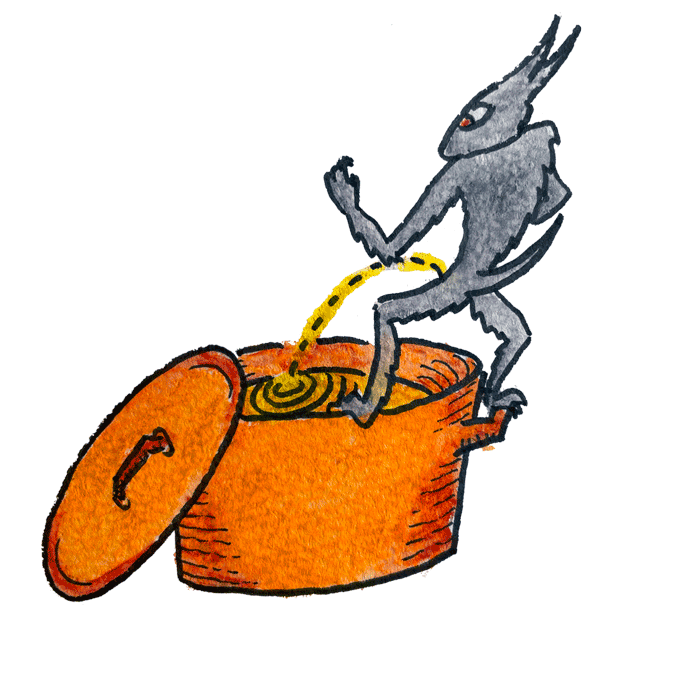
There are up to twenty different types of Kallikantzaroi and each specialized in a different type of mayhem. Some urinate on your cooking or imbue food with horrific smells. Others mimic voices to tease, torment or steal. 

You can keep the Kallikantzaroi away by leaving a colander on your doorstep. These little imps will have to count all the holes, but they can only ever make it to two and then are forced to start over. You can also burn an old shoe — the foul smell will keep these pests away. 

A link to the Norse tradition of Yule comes with a method to keep these goblins out of your chimney. You simply burn a log, but keep it going for all twelve days. Once you’ve reached January 6th, you are safe and the Kallikantzaroi return to the center of the Earth.  

Tim Kane

[mailerlite_form form_id=2]
The Cailleach: A Celtic Goddess Who Shaped the Land with an Apron Full of Rocks

Arkane Curiosities

The Cailleach was a Celtic goddess who traversed Ireland, Scotland and the Isle of Man. She was responsible for the creation of islands and lakes. Seen as both a creator and destroyer, she was known as the “Veiled One.”

Cailleach means “old woman” or “hag” in Scottish and Gaelic. In fact, some scholars believe that this was a title given to any old woman. 

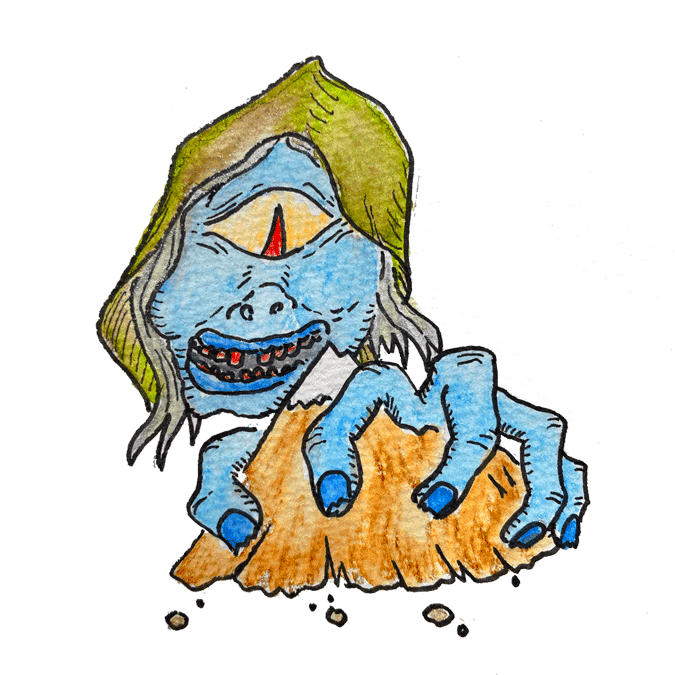
The Cailleach is often veiled, often depicted with a single eye. She has deathly pale skin with red teeth. Skulls adorned her clothing. Sometimes she was depicted as a giantess, leaping from mountain to mountain. The Manx believed she could shapeshift into a giant bird. 

The Shaper of the Land

As she leapt from mountain to mountain, she carried huge rocks bundled up in her apron. Dropping these could create new hills or even islands. She also managed several wells and could use these to flood the land. 

Her tools of creation and destruction included her hammer, with which she was able to control storms and thunder. In some legends, she also controlled a well that would occasionally overflow and flood the land.

Poet Jonathan Swift (1667-1745) included her in one of his compositions:

“Determined now her tomb to build,
Her ample skirt with stones she filled,
And dropped a heap on Carron-more;
Then stepped one thousand yards to Loar,
And dropped another goodly heap;
And then with one prodigious leap,
Gained carrion-beg; and on its height
Displayed the wonders of her might.”

Builder of Islands

One day, the Cailleach happened to be wading through the Northern Channel, between Scotland and Ireland. A French sailor maneuvered his ship between the giantess’s legs. The sail brushed her inner thigh and the sensation to this intimate area gave Cailleach a start. She dropped her load of rocks, forming the island of Ailsa Craig. (Source: Eleanor Hull in her article Legends and Traditions of the Cailleach Bheara or Old Woman (Hag) of Beare)

Hill Builder

In ancient times, many giants roamed the northern isles — the most famous being Gog-Magog and Cailleach-Mhore (Great Cailleach). Legends say that Cailleach-Mhore trudged over the hills, this time carrying massive rocks in a creel (a basket slung over her back). She halted to catch her breath and the creel ripped under the weight. Boulders tumbled onto the landscape, forming new hills. Many hills are known as the “spellings from the creel of the big old woman.”

The Cailleach (also known as Beria in Scotland) created the mountains to use as stepping stones across the land. They also provided houses for her many sons, called the Foawr, the stone throwing giants. These giant children always quarreled with each other. To punish any children who disobeyed her, Beria would close up their mountain houses so they could not leave.

Still angry with each other, her children would climb to the top of their mountain houses and toss boulders at each other. Many of these now lie on the steep slopes or scattered around the valleys of Scotland. 

Beria also used her magic hammer to shape the hills, splintering the rocks so that she could tell one hill from another. She would also strike the ground to form valleys.

Creator of Loch Ness

The Cailleach also had two wells that she managed. Each morning, she would uncap the wells to draw water and then shut them up at dusk. But the two wells were very far apart and she grew weary of trekking backing and forth each day.

She hired a maiden, named Nessa, to work the smaller well. One day, Nessa was late and found the water gushing out of the well. Frightened, she ran away, leaving the water flowing all night. 

Needless to say, Cailleach was displeased. She cursed the maid to forever run and never leave the water. Nessa was transformed into the river Ness, which flows into Loch Ness.

According to legend, once a year (on the anniversary of her transformation) Nessa emerges from the Loch and sings a sad song to the moon. Her voice is more melodious than any bird or the golden harps of the fairies. 

The Cailleach was also the goddess of winter, and we’ll explore that in the next post. 

Tim Kane

[mailerlite_form form_id=2]

3 Weird Ways to Confuse a Vampire

Arkane Curiosities

If a vampire has you on their menu, you can reach for a stake or garlic. But another solution is to simply confuse the vampire. Through the years, people have surmised various weaknesses of these nocturnal bloodsuckers and come up with different ways to perplex them. A confused vampire is one that won’t be feasting on you.

Force the Vampire to Do Some Math

Many cultures contend that vampires are obsessive to the point of compulsion. They will count various objects, no matter how many, until the job is done. We can use this to our advantage.

Germans would scatter seeds (poppy, mustard, oat or carrot) around the grave of a suspected vampire. The undead was compelled to count all the seeds before leaving the grave to seek blood. Although this seems like a simple task, often the vampire found themselves delayed till daylight. The Kashubs of Poland believed a vampire could only count a single seed a year, thus keeping it busy for centuries. 

Knots could also delay a vampire. Nets were often buried with the deceased forcing the undead to untie all the knots.

A more macabre practice was to leave a dead cat or dog on your doorstep. In this case, the vampire must count all the hairs on the animal. Personally, I would opt for the seeds. 

Trick the Vampire with Poop

Never has the poop emoji been so powerful. No garlic or crucifix at hand? Just shove a bowl of excrement in the vampire’s face.

In Europe, vampires were thought to exit the grave through small holes (the size a serpent might make). In Bulgaria, they placed bowls of feces (or poison) right outside these holes. The vampire, it seems, is so famished that it will consume the first thing it comes across, devouring the bowl of excrement. 

Get the Vampire Drunk

A happy vampire is one that won’t invade your home. Sometimes a bottle of whiskey was left in the grave with the corpse. If the vampire became too drunk, it might not be able to find the home of its relatives, preventing it from feeding on you. 

In Romania, people would bury a bottle of wine with the corpse. After six weeks, they dug up the bottle and drank it, offering a form of protection from the strigoi (a Romanian vampire).

Tim Kane

[mailerlite_form form_id=2]

3 Weird Ways to Stop a Vampire (Carpet, Hairpin, Lemon)

Arkane Curiosities

Vampires rise from the grave to bite our necks and gulp down our blood. Not a great situation if you’re on the punctured side of the equation. The best way to cope with these bloodsuckers is to make sure they never get out of their coffins in the first place.

Wrap the Vampire in a Carpet

In areas of Eastern Europe, people bound the knees (or sometimes even the whole body) of a suspected vampire with a rope. This prevented the corpse from clambering out of the grave. People would take this one step further, and wrap a rug around the bloodsucker to completely immobilize it. In Ireland, people would pile stones on the grave to keep the Dearg-dul (Irish vampire) from rising. 

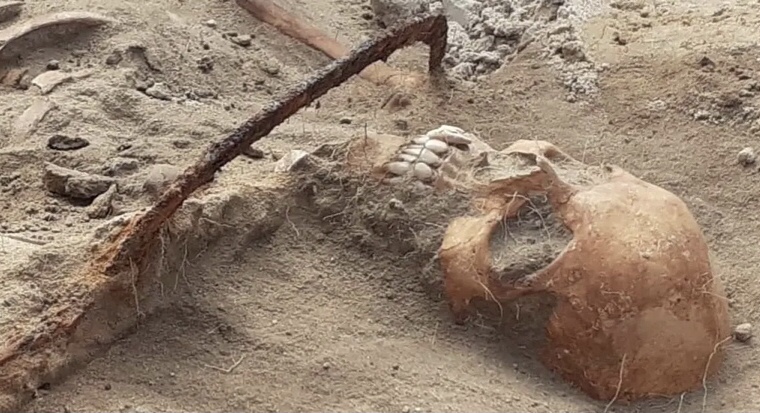
In the case of the recently discovered vampire in Poland, the corpse had a padlock on her left big toe to symbolize that she would never rise again. Serbians took this one step further and cut off the toe of a Vlkoslak (a Serbian vampire).

Poke the Vampire with a Hairpin

Various sharp objects have been found in vampire graves, all meant to discourage the undead from leaving the grave. The discovery of a female skeleton buried with a sickle across her neck was not the first anti-vampire method. The idea with the sickle was to cut the head off if the vampire should rise.


Image credit: Miroslav Blicharski / Aleksander. Photograph:( Others )

Hairpins or thorns would also prevent a vampire from rising. These objects were inserted either under the tongue or in the navel. In Bulgaria they wrapped their version of a vampire (Krvoijac) with wild roses. The thorns of these were seen as a deterrent. 

When dug up, people noted that some corpses looked plumper than before (due to the swelling of the body after death). Pins or thorns were thought to keep the body from swelling.

Give the Vampire a Lemon

A certain German vampire called Neuntöter was afraid of lemons. Placing a lemon in its mouth when buried would keep the vampire in its grave (they would sometimes cut off the head between 11pm and midnight). 

The lemon has long been seen as a treatment for illness and poison. The ancient Romans used lemon juice to cure colds and fevers, while the Egyptians would drink the juice to protect against poison. Ancient Greeks claimed that eating lemons could help people survive being bitten by a poisonous snake.

Tim Kane

[mailerlite_form form_id=2]

3 Weird Ways to Kill a Vampire (Needle, Bullet, Sock)

Arkane Curiosities

It’s the middle of the night and a bloodsucking undead is traipsing through your house. You reach for your trusty stake… Wait! This is the 21st century. Nobody has a stake lying around. So what are some other ways to kill a vampire?

1 Kill a Vampire with a Needle

Vampires have two hearts. The human heart they had in life and a second heart, located at their navel. The Romanians believe (present tense, mind you) that a needle jammed into the navel will pierce the second heart. This is the one that keeps the vampire alive after death.

Beware the Splatter

Even if you use a tiny needle, you need to watch out for vampire blood. Vampires were seen as squishy blood balloons. Their blood was so corrupt, that anyone who touched the stuff would go insane. In olden days, vampire hunters would drape an animal hide over the body when staking. These days, a plastic tarp will do. 

2 Shoot the Coffin

Vampires need to sleep off their blood-drinking binge in a nasty and foul coffin. A consecrated bullet, shot through the wood of the coffin, would “bless” the resting place and the vampire would no longer be able to enter. It wasn’t sunlight that killed the vampire (this was invention of Hollywood) but rather exhaustion from lack of sleep. 

3 Steal His Sock

Yes, you heard that right. Vampires are rather possessive of their footwear. Steal bloodsucker’s left sock (considered the “evil” one because the Latin word for left is sinister). Fill the sock with rocks and toss it in a nearby stream or ocean (but not a lake). The nosferatu will go searching for their sock and will have to dive into the water to retrieve it. Moving water has long been the death knell for the undead. 

There you have it. Three modern solutions to your own vampire infestation. 

Tim Kane

[mailerlite_form form_id=2]