Hungry Ghosts: The Symbol of Eternal Wanting

Arkane Curiosities

In the West, we think of ghosts as spirits to haunt old and dilapidated places. The kinds of specters that make our blood run cold and serve to scare the wits out of us. Yet across Easter Asia, the concept of a hungry ghosts emerged — these hungry ghost are forced to wander to earth, eternally wanting.

Suffering Spirits

The Japanese call these ghosts Gaki (literally meaning “hungry ghost”) but they also go under the name Preta from Buddhist cosmology. These are the spirits of people who were exceptionally greedy in life. Most of the tales about how Gaki are created originate with a person refusing to give a Buddhist monk food or water. 

A commonality with all hungry ghosts is their insatiable need to eat. Yet most of the time they are unable to consume food. For some it’s impossible to find nourishment. With others, their mouths or necks are too small to eat the food. And for some, the food bursts into flames even as they consume it. 

Feeding the Hungry Ghosts

The Buddhist cosmology has six realms of existence and rebirth. The realm of Gakidō is the land of hungry spirits. It’s a barren land filled with deserts. A person who is cursed to become a Gaki is trapped there for 500 years (A single day for a hungry ghost is equivalent to 10 of our years). Yet the living can perform a ritual to ease the cravings of these restless spirits. 

A special Buddhist ceremony, called the Segaki (feeding the hungry ghosts) is performed as part of the O-Bon festival in July or August (and feels a bit like the Western All Hallows’ Eve). Offerings of rice and water are presented on altars positioned out of sight of any Buddha statues. 

The 36 Types of Hungry Ghosts

Gaki come in all shapes and sizes. Many of the sites simply give a brief example of a few, but we’ll list the whole shebang here. If you want a more detailed explanation, you can read Sūtra of the Foundations of Mindfulness of the True Law. Presented here are the first 16 of these ghosts. The remainder will come in the next post.

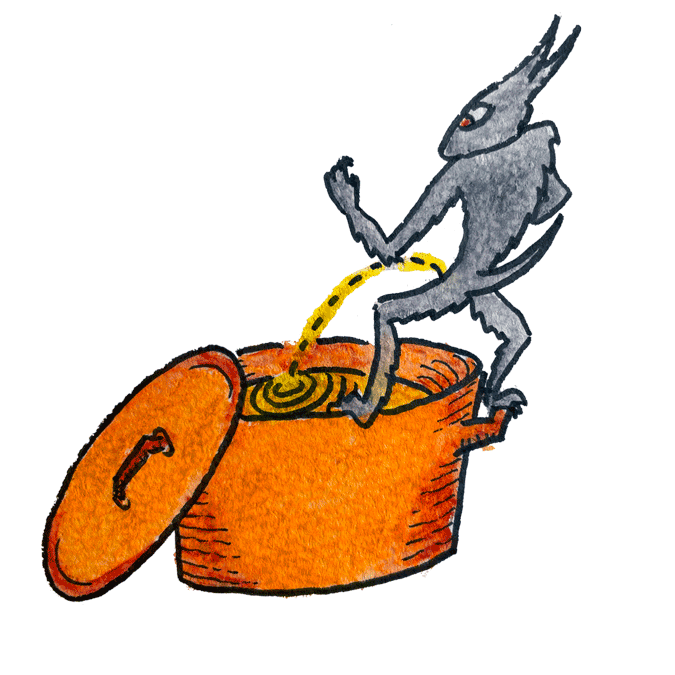
1 Cauldron-Body Ghosts

These Gaki are twice the size of a human and they can never find food. These ghosts are plagued by fire. In life, they were greedy and refused to return items to their rightful owners. 

2 Needle-Mouth Ghosts

These spirits have throats only as wide as a needle. Even when they find food, they cannot consume it. In life, these people were rich but pretended to be poor to avoid giving to charity. 

3 Vomit-Eating Ghosts

Ghosts of this sort prefer to scarf up vomit. Although harmless, they may follow around an alcoholic and seek to influence that person to drink more, in order to produce more vomit. In life, these people only shared “inferior” or lower-quality food with others while keeping the most delicious eats for themselves. 

4 Excrement-Eating Ghosts

These Gaki prefer to dine on excrement and frequent dirty toilets. If you enter a bathroom and feel like someone is watching you, it might be this spirit. In life, they offered spoiled food to charity or to holy people.

5 Foodless Ghosts

These should really be called thirst-ghosts. They roam the countryside in search of water to quench the raging flames in their stomachs. In life, these people starved others to death. They can also be people who abused their power over others (as in jailers abusing prisoners).

6 Odor-Eating Ghosts

Ghosts in this category feed off the smell of food offered to deities. In life, these people didn’t share the best foods with their spouse or family members. 

7 Dharma-Eating Ghosts

These repulsive ghosts are bony and emancipated, with protruding veins along their body. Insects swarm around them, slowly nibbling away. Their only sustenance is to hear monks at the temple teaching Dharma. They tend to cluster around temples anytime there is a Dharma talk. In life, they spread false teaching of Dharma. 

8 Water-Eating Ghosts

These Gaki have desiccated and brittle bodies. They live near drains or rivers and slurp up water, but with their dry, withered bodies make it hard to hydrate. They can only swallow small droplets of water at a time because they try to grab it with their hands and it slips through their fingers. In life, these people were brewers of alcohol, but they tampered with their product by adding worms or insects.

9 Living-On-Hope Ghosts

These spirits are extremely hairy with deep wrinkles on their faces. The can only consume offerings made by mourners to honor deceased parents. THey frequent funerals. In life, these people profited off the misfortune of others by selling goods at inflated prices. 

10 Spittle-Eating Ghosts

These Gaki hunger for human spit and they follow those who spit often. In life, they offered impure food to monks. 

11 Garland-Eating Ghosts

These ghosts can appear in dreams to scare people. They crave offerings intended for Buddha or monks. However, once they have these offerings in hand, the garland attached itself to the ghost to torment it. In life, these people were caught stealing from religious places.

12 Blood-Eating Ghosts

These Gaki are attracted to blood. They will influence the mind of a victim to self-inflict wounds in order to draw blood. 

Another type of ghost with supernatural power. They are attracted by blood and blood sacrifice. Some people mistaken them as gods and make blood offerings to them and pray to them for material gains.

13 Flesh-Eating Ghosts

These ghosts feed on various meat offerings, preferring raw meat to blood. In life, these people were butchers who took advantage of customers by short selling meat. 

14 Fragrance-Eating Ghosts

Gaki of this sort yearn for incense and sweet smells. They have the ability to fool people into worshiping them in order that someone will burn incense. In life, they sold low-quality incense at high prices. 

15 Harmful-Conduct Ghosts

These ghosts feed off the wicked deeds of unsavory people. They delight in epidemics and death, often traveling thousands of miles in seconds to find a meal. In life, they encouraged people to donate to the poor, but kept the donations for themselves. 

16 Looking-For-The-Right-Opportunity Ghosts

These ghosts have hairy bodies and are always surrounded by flames. They feed off the negative energy generated from weak-willed people — a sort of energy vampire. Meditation and chanting can strengthen the mind and thus fend off these ghosts. Instead of a former human life, these spirits are yakṣa, a nature-spirits.

The next post will show the rest of the hungry ghosts. Until then, be virtuous, lest you end up as a Gaki in the afterlife.

Tim Kane

[mailerlite_form form_id=2]
Angels Are Horrifyingly Beautiful (What Angels Really Look Like)

Arkane Curiosities

When I first picked up the book A Wind in the Door by Madeleine L’Engle, I was transfixed by the image of a Cherubim. How could that be an angel? I couldn’t reconcile the image I was seeing with the more traditional depiction of angels, with their human-like bodies and pair of wings. Yet this is what angels really look like.

Renaissance Created the Disney-Versions of Cherubs

Those cute baby angels you see fluttering around every February, those are the sanitized versions of Cherubs (originally known as Cherubim). It seems Renaissance painters mashed together angelic Cherubs with the Greek god Cupid. 

Raphael created characters in his paintings called “putti”, from the Latin word putus, meaning boy. These little toddlers represented pure love. Soon, people began referring to these putti as “Cherubs” because of their association with the pure love of God. 

Yet the true visage of these angels is anything but cute.

The True Meaning of Awesome

The word awesome has taken a left turn in modern English. It now simply refers to something amazing or wonderful. The original meaning is darker. Awesome meant to feel awe, as in bone shaking fear and admiration for what you beheld. It was a word tailor-made for looking on the true image of angels.

The Cherubim — Multi-Faced Creatures of Fire

The putti versions of Cherubs float on clouds and shoot arrows at love-sick teens. The true Cherubim are engulfed in the fiery light of God’s Glory. 

Instead of a single pudgy baby head, the Book of Ezekiel says these angels have four heads: a lion, an ox, an eagle and a human. They also have four wings, two of which tilt down to cover their legs, which have bull hooves by the way.

Art from Isis Sangare

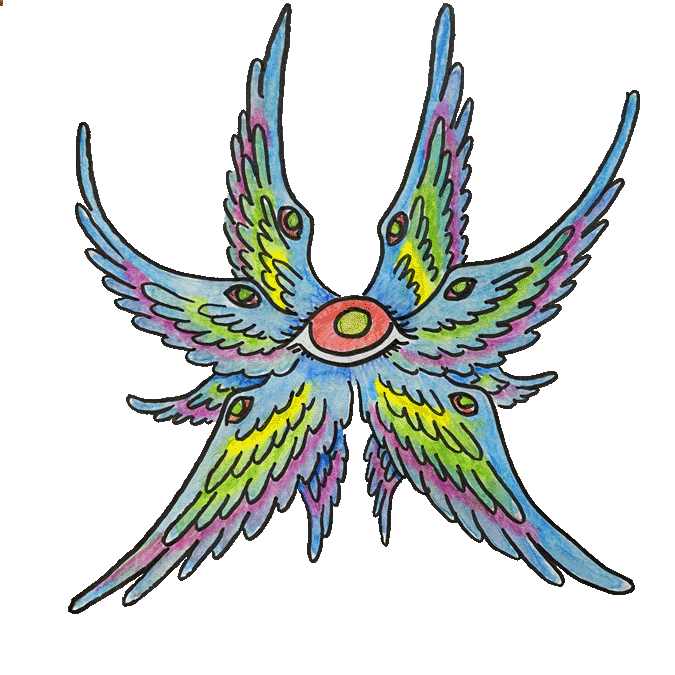
Ezekiel also mentions that every part of the Cherumin — hands, wings, feet — are covered with eyes. This is what Madeleine L’Engle was going for with her description of the angel in A Wind in the Door.

But this is not the most bizarre angel out there. While Cherubims clock in at number three on the angelic hierarchy, Seraphim are number one. 

Seraphim — A Mess of Wings and Flame

The word Seraphim translates to “burning ones”. According to the prophet Isaiah, these angels surround the throne of God. They have six wings, two to cover their legs (because feet are unclean and unworthy to show God), two to fly, and two to cover their face. The result, all you see is wings. This seems to also match Madeleine L’Engle’s depiction of angels.

Art by Aeriel Lee

Depicted as being red, Seraphim are associated with Fire. They each hold a flaming sword with the words “holy, holy, holy” on the blade. In the vision, a Seraphim touches a burning coal to Isaiah’s lips in order to purge him of his sin and to make him fit to be a prophet. 

But at least the Seraphim have recognizable parts, wings and eyes. The number two ranked angel in Heaven doesn’t even have a body.

The Ophanim — Giant Winged Wheels

In Ezekiel’s account, he describes the Ophanim as giant golden wheels, each covered with multiple eyes. In fact the word Ophanim means “wheels”. They had four interlocking golden wheels and could fly in any direction. They are tasked with guarding the throne of God.

The next time you envision an angel, perhaps you will better understand the true meaning of the word awesome. These spiritual beings are meant to instill wonder and fear at the concept of God. 

Tim Kane

[mailerlite_form form_id=2]

Attack on Titan: Giants in Mythology Around the World

Arkane Curiosities

When Hajime Isayama created Attack on Titan, he ushered us into a sprawling world of Titans, set on devouring all of mankind. Yet where did Hajime find inspiration for these walking behemoths and are there any other giants in mythology that can serve as models?

Hajime Isayama Loved Things Ugly

In a 2014 interview with the magazine Brutus, Isayama describes how he would doodle in his notebook during Junior High. “I was drawing ugly things exclusively.”

Originally, the Colossal Titan had a much different appearance. Isayama used a “30-Second Drawing” app and designed the giant with a stone body and covered in human teeth. Later, he felt the muscled figure would look cooler and switched it out. 

Drunken Humans Became the First Titans

Isayama worked part-time at an Internet cafe where he would observe the patrons. Many had a look of bewilderment, as if their life had no purpose. He brought these ideas into the idea of the Titans. 

One night, he encountered a drunk patron. Trying to communicate with this person became frustrating and pointless. Isayama was intrigued by “the lack of the ability to communicate even though the person was of the same species.” Thus the Titans were mute, bent on their desire to consume humans.

Cannibalistic Mona Lisa

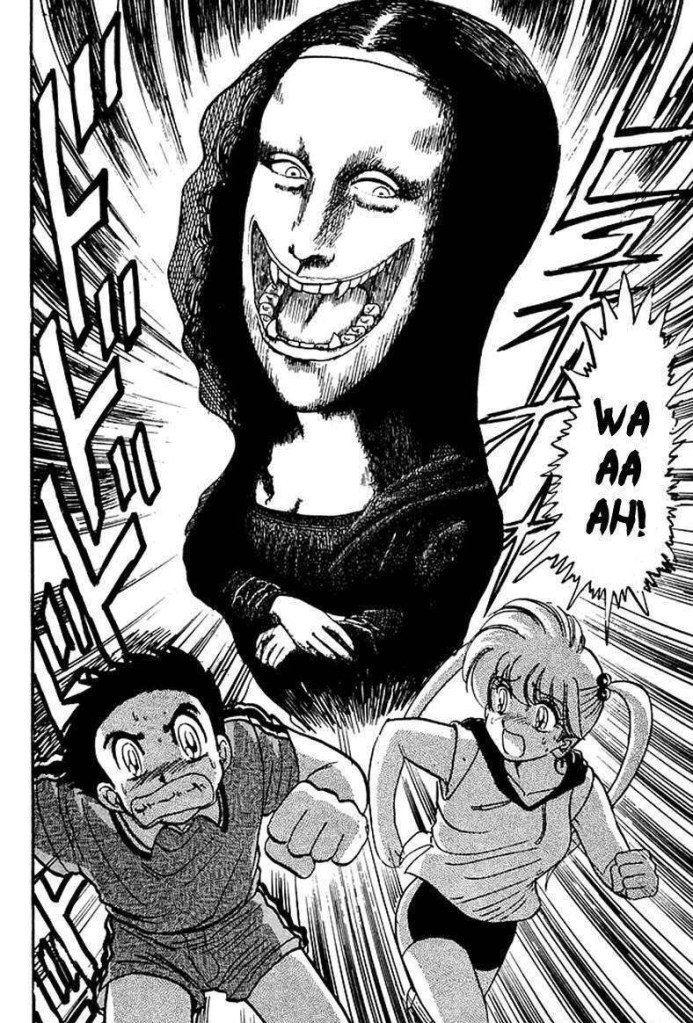
The manga Jigoku Sensei Nube also inspired Isayama. This series followed a teacher, Nūbē, who used a technique called Demon’s Hand to counter supernatural threats. In issue 34, he took on a now familiar-looking cannibalistic Mona Lisa. The figure would come out of the painting and eat people whole, much like the Titans.

The Norse Jötnar Reveal the Founder, Ymir

In Norse mythology, a race of giants, called Jötnar, live in the land of Jötunheimar. The Jötnar were the enemies of the gods (much like the Titans are the enemies of humanity). Yet many Norse gods had children with these giants and the Jötnar are important to the end of the world, Ragnarök. 

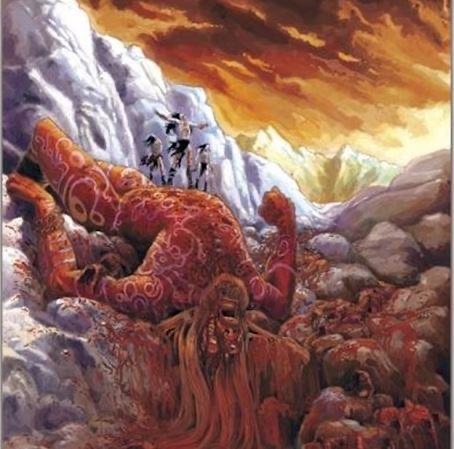
Additionally, the primordial being in Norse mythology is Ymir, who existed before any of the gods. This huge frost giant spent all his time slurping from the teets of a massive cow, Audhumbla.

Three of the Norse gods hated the Jötnar and especially the greedy and noisy Ymir. They attacked the original frost giant, and finally defeated Ymir. The three gods tore apart the body, using Ymir’s flesh to create the world, his blood to make the ocean and his bones to build the mountains. Ymir’s hair became mighty forests and his brain transformed into the clouds in the sky.

The Gashadokuro, or Heaped Bones of the Angry Dead

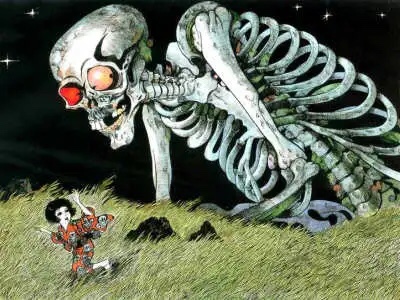
Japan is filled with magical beings called Yokai and the most monstrous of them all is Gashadokuro — a giant skeleton that roams the night, eating people.

Legend has it that soldiers or victims of a plague who do not receive a proper burial are reborn as ghosts. They die with anger in their hearts and this energy binds hundreds of bones together into a gigantic skeletal monster.

Their teeth clatter (giving them their name) but they can also be silent. If they find a human out late and alone, the gashadokuro will creep up and catch the unwitting traveler. The skeleton crushes its victims in their hands or bites off their heads. 

Tim Kane

[mailerlite_form form_id=2]

Three Bizarre Christmas Traditions: Poop Logs, Christmas Spiders and Evil Goblins

Arkane Curiosities

At this point, Krampus has become a well known phenomenon. There’s even an American Dad episode about the mischievous bringer of discipline. Krampus is a downright celebrity these days. Here are three lesser known strange and bizarre Christmas traditions.

The Poop Log of Catalonia

Tió de Nadal translates from Catalan to “Christmas log” or simply “tree trunk.” The other name for this Xmas tradition is Caga Tió, or poop log. Yes that’s right. It’s a log that poops out presents on Christmas Day.

It works like this, starting on the Dia de la Immaculada Concepció (Feast of Immaculate Conception, December 8th) you “feed” the Caga Tió sweets and candy. Each evening, after dinner, kids would save a peel from an orange or other fruit and place it in a feeding bowl in front of the little log. Bits of cookies and other sweets work as well.

Each night, you drape a blanket over the body of Caga Tió to keep it warm. We don’t want our gift-giving log to freeze in a cold winter home. This continues until December 24th, and gradually the log will grow in size (or maybe it’s the parents switching out the log for larger one). 

Then comes the beating. You gather around your log and hit it with a stick to make sure it poops, all while singing a cute little song…

Caga tió, (Poop log)
tió de Nadal, (Log of Christmas)
no caguis arengades (Don’t poop salted herring)
que són massa salads (They are too salty)
caga turróns (Poop turróns)
que són més bons! (They are much better!)

Then, like magic, presents and candies (called turróns) appear under the blanket.

Ukrainian Christmas Spiders

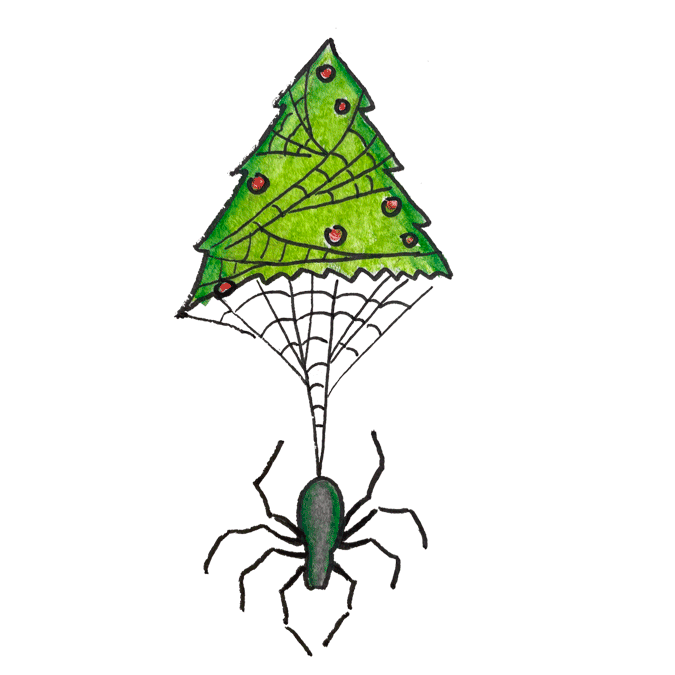
In Ukraine, you will often see spiderwebs decorating the Christmas tree. This comes from an old legend about some rather helpful arachnids. 

There was once a widow who lived in a tiny house with her children. One day, a pine one took root outside their home and the children tended to the growing seedling in hopes of having a splendid Christmas tree. Yet as the year slipped into winter, the widow knew that they would not be able to afford decorations. Finally on Christmas Eve, they set up the tree in their house, but its branches were bare.

That night, while they slept, the spiders of the house heard the sobs from the disappointed children. They went to work on the tree, spinning delicate webs on every branch. 

The next morning, the youngest child opened a window and the first rays of sunlight sparkled against the new decorations. The light of Christmas Day transformed the webbing into silver and gold. From that day forward, the widow never wanted for anything. 

Ukrainians still decorate their trees with spiderwebs to bring good luck for the coming year. So maybe don’t shoo that spider away too quickly on Christmas Eve. After all, they also need a warm and cozy place on a winter night.

Mischievous Greek Goblins

The Kallikantzaroi are mischief-making goblins who live in the center of the Earth. They spend the year trying to saw down the Tree of Life, which holds up the world.

During the Twelve Days of Christmas, they dig their way to the surface to bring their naughty tricks to our houses. This is the time, starting at the Winter Solstice, where the sun does not shift in the sky.

Tiny black creatures with long tails, the Kallikantzaroi are mostly blind owing to their life underground. Afraid of the sunlight, they only emerge at night, feeding on any small critters, such as frogs, worms and snails.

They sneak into your house through any cracked window, down chimneys, or through keyholes. Once inside, the havoc begins. They are not evil, per se, but impish and idiotic.

There are up to twenty different types of Kallikantzaroi and each specialized in a different type of mayhem. Some urinate on your cooking or imbue food with horrific smells. Others mimic voices to tease, torment or steal. 

You can keep the Kallikantzaroi away by leaving a colander on your doorstep. These little imps will have to count all the holes, but they can only ever make it to two and then are forced to start over. You can also burn an old shoe — the foul smell will keep these pests away. 

A link to the Norse tradition of Yule comes with a method to keep these goblins out of your chimney. You simply burn a log, but keep it going for all twelve days. Once you’ve reached January 6th, you are safe and the Kallikantzaroi return to the center of the Earth.  

Tim Kane

[mailerlite_form form_id=2]

How Bloody Mary Inspired Two Gruesome Nursery Rhymes

Arkane Curiosities

Many early fairy tales and children’s songs have been sanitized over the years, their darker origins being submerged under the seeming nonsense of the verses. Yet if we dig deep enough, we can uncover the disturbing origin of nursery rhymes. Two gruesome nursery rhymes link directly back to Mary I of England.

Mary, Mary, Quite Contrary

The homicidal Queen Mary I (1553 to 1558), a fanatical Catholic, executed hundreds of Protestants during her reign. Although the nursery rhyme did not appear till 200 years later (1744), Mary remained an unpopular monarch. 

The most common lyrics today are:

Mary, Mary, quite contrary,
How does your garden grow?
With silver bells, and cockle shells,
And pretty maids all in a row

Mary I was quite contrary, going against the grain of English Protestism. Yet how does she “grow” her kingdom? With the sprouting of gravestones from the 284 Protestants she burned at the stake. In this interpretation, the silver bells and cockle shells can refer to torture devices. 

The pretty maids in a row can refer to her attempts to create an heir. She knew she needed someone to rule after her, otherwise her sister, Elizabeth, would take control and revert the country back to Protestant beliefs. Mary was already 38 when married to Philip. She suffered from “phantom pregnancies” where she retained her menstrual fluid, causing her belly to swell. In the end, she suffered two such false pregnancies. 

Three Blind Mice

This rhyme dates much closer to Mary I, being published in 1609 by one Thomas Ravenscroft. The modern lyrics go like this:

Three blind mice. Three blind mice.
See how they run. See how they run.
They all ran after the farmer’s wife,
Who cut off their tails with a carving knife,
Did you ever see such a sight in your life,
As three blind mice?

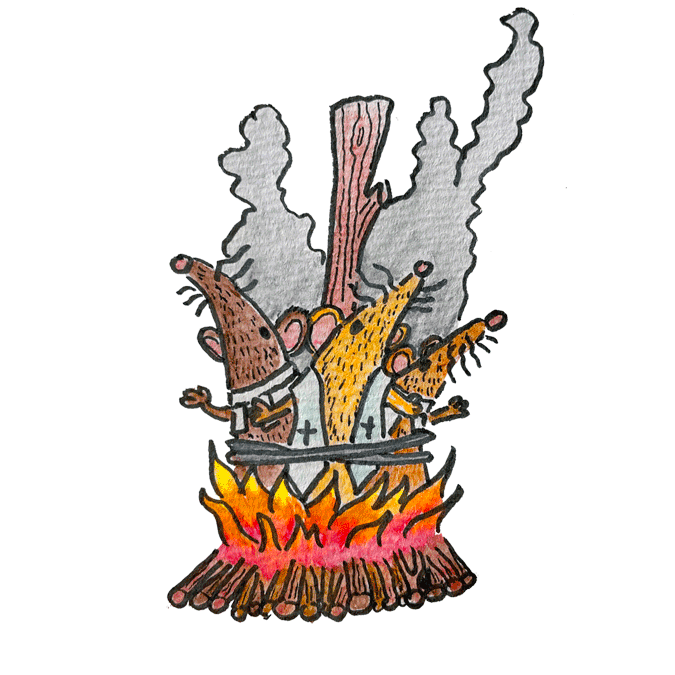
During Mary’s reign, three Protestant loyalists plotted against the queen. Hugh Latimer, Nicholas Radley, and The Archbishop of Canterbury, Thomas Cranmer all conspired to overthrow the queen. They were never blinded, but perhaps they were “blind” to the truth of God. Instead of cutting off their tails, Mary had the “Oxford Martyrs” burned at the stake. 

The farmer’s wife in this tale refers to Mary and her husband, King Philip of Spain, who owned massive estates. 

So the next time you hum one of these little ditties, think about the pain and suffering that inspired them.

Tim Kane

[mailerlite_form form_id=2]