Arkane Curiosities
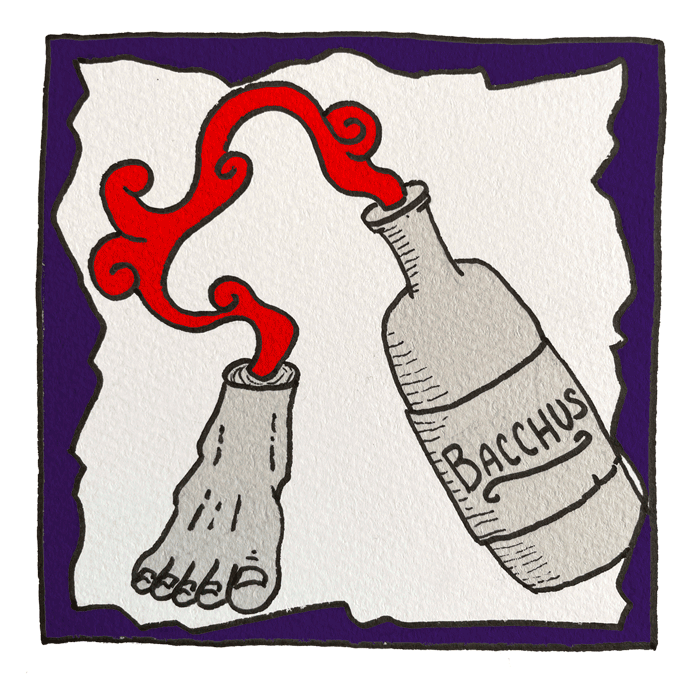
Mortals aren’t the only ones who can manifest dissociative identity disorder — many deities from ancient times had multiple personas. People with dissociative identity disorder (previously known as Multiple Personality Disorder or incorrectly as “split personality”) have a system of individuals all working within a single host (or body).
The core is the original child and the first identity born to the host. Some view the core as the owner of the system and is often the part with the most power. There are multiple alters (or other personalities) that fulfill specific roles, such as Protector, Persecutor, and Memory Holder. A Gatekeeper often allows the different alters to front (or take control of the host).
Different deities from across the world’s pantheons have different aspects that front for various purposes. In Celtic mythology, there is the Morrígan, who has three aspects all related to war and death. In Hindu belief, the trimurti has three gods in one body each in charge of one aspect of creation.
Perhaps the most intriguing of these personality swapping gods is Dionysus — the Ancient Greek diety of wine, drunkenness, frenzy, suffering and madness.
Dionysus (also known as Bacchus) is known for having a dual persona. He is a bringer of joy and merriment, but sometimes goes into a blinding rage to terrorize hapless victims.
Twice Born
Dionysus was born twice. Zeus, always the player, seduced Semele, a princess of Thebes. His wife, Hera, was naturally not pleased and planned revenge. A mortal could not view a god in their true form. Thus Hera, in disguise, convinced Semele to make Zeus prove his godliness by revealing his true form. You can guess what happened… Semele made Zeus promise to do as she wished and then asked to see him in all his glory. Zeus was honorbound to comply and revealed his true form, blasting the pour mortal woman to ashes. However, the unborn Dionysus, being part god, survived. Zeus sewed the baby inside his thigh, allowing him to gestate until birth. Since Dionysus was born from a god (in this case, Zeus) he was granted immortality. This could qualify as the traumatic event that often ushers in dissociative identity disorder.
God of Fun
Dionysus was portrayed as beautiful and joyful. He discovered the cultivation of vines and taught others how to ferment grapes into wine. His worship is often connected with the idea of partying and having a good time (under the influence of wine, of course). He was connected to such mythological creatures as satyrs and centaurs. Dionysus was depicted riding a panther or in a chariot pulled by pumas (way to make a grand entrance).
Terror Frenzy
Some Greek cities attempted to ban the wild rites of the maenads (followers of Dionysus). The most notorious case came with King Pentheus of Thebes (written about by Euripides). The king attempted to imprison Dionysus, but the prison doors would not close and the shackles simply slipped off.
Despite fearing this new worship, the king was also fascinated by it and wanted to learn more. His own mother, Agave, had been lured in by the rites of Dionysus. The wine god allowed Pentheus to observe the secret rituals firsthand, but only if the king disguised himself as a woman. Pentheus did as instructed and spied on the maenads from behind a tree.
Dionysus had driven the women into a frenzy and they seized upon any small animal they could find, ripping it apart. Soon they discovered the king and, thinking he was a lion, the maenads tore him limb from limb. Even his mother, Agave, carried off his head thinking she had slain a lion. Thus the Thebans were punished for having resisted the rites of Dionysus.
The terror-frenzy that Dionysus creates in his followers feels very much like the protector alter of the dissociative identity disorder. A Protector might lash out to defend the host from physical or other kinds of abuse.
Dionysus remains a complex deity with many facets. He was beloved by the Greeks and went on many more adventures. Whether the Greek myths utilized him as a way to explain individuals with different personas remains to be seen. One thing is certain, if you upset Dionysus, you would suffer the consequences.
Consider the last lines of the Homeric Hymns to Dionysus
“And the Nymphs followed in his train with
him for their leader; and the boundless forest was filled with their outcry…”
Tim Kane





 Tim Kane Books