Egyptian Field of Reeds, Death is Not the End

Arkane Curiosities

The Egyptians believed that the soul continued on after death. The concept of the “Field of Reeds”, was depicted as a paradise for the soul. Any who lived virtuous lives and adhered to Ma’at, the principle of balance and harmony could journey there.

The Concept of Aaru

The Field of Reeds, also known as Aaru, was depicted as a lush meadow where the soul could exist in a peaceful afterlife. There, the deceased could enjoy their lives in the company of their loved ones, surrounded by the bounties of nature. This celestial paradise was considered the ultimate reward for leading a just and moral life.

Journey to Aaru

A person’s journey to the afterlife was marked by trials and challenges. The heart of the deceased was weighed against the feather of Ma’at in the Hall of Two Truths during the judgment by Osiris, the god of the afterlife. If the heart was found to be lighter than the feather, it symbolized that the individual had led a righteous life and could continue their journey to Aaru. 

No one is quite sure where the “Field of Reeds” lies. It might be in the sky or it might dwell under the earth, in the domain of Osiris. Spell 149 of the Book of the Dead states “I know the gate in the middle of the Field of Reeds from which Re goes out into the middle of the sky”.

Tiny Servants

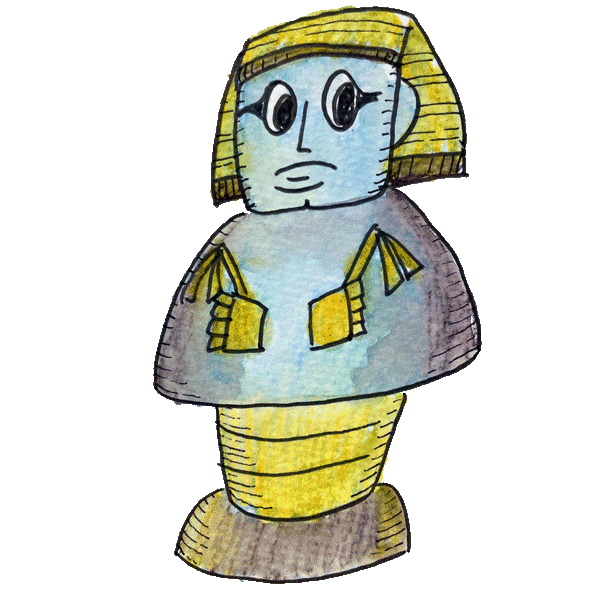
Many Egyptians were buried with shabtis, small figurines intricately crafted to serve the deceased in the afterlife. The word “shabti” originates from the ancient Egyptian work for “stick”. In the New Kingdom, it took on the meaning of “substitute.”

Shabtis were created with the purpose of acting as substitutes for the deceased. One of the tasks in the Field of Reeds was to plough the fields. If one had a shabti, it would magically come to life and plough the field for you. 

Each shabti only worked for one day of the year. Thus if you wanted a relaxing afterlife, you needed to be buried with a whole year’s worth of shabti figures. 

Tim Kane

[mailerlite_form form_id=2]

Exploring Junji Ito’s Haunting Realms of Japanese Horror Manga

Arkane Curiosities

Junji Ito is the undisputed master of Japanese horror manga. With his twisted and surreal narratives, Ito has cemented his status as one of the most influential figures in the genre. Works like “Uzumaki,” “Tomie,” and “Gyo” showcase his mastery in blending body horror, psychological torment, and cosmic dread. Ito’s ability to delve into the darkest recesses of the human psyche has captivated audiences worldwide, solidifying his legacy as a modern horror icon.

A Glimpse into the Mind of Junji Ito

Initially inspired by classic horror movies like Dracula, Frankenstein, and Suspiria, Junji Ito began reading the horror manga of Kazuo Umezu at age 4. He even tried his own hand at manga, saying: “I took a pencil and paper, or sometimes the back of advertisements, and would draw frames, imitating the manga I had read.”

His professional ourney into manga began when he submitted a story to horror magazine, Monthly Halloween, earning him recognition and encouragement to pursue his passion. The story was later serialized in the late 1980s as “Tomie,” a chilling series exploring the malevolent power of a beautiful, immortal girl. 

The Power of the Bizarre

At the core of Ito’s approach to horror lies his profound understanding of fear as a fundamental human emotion. He taps into our primal fears, expertly weaving the strange into everyday settings. His stories deal with body horror, psychological torment, or cosmic horror.

Ito draws inspiration from various sources, including H.P. Lovecraft, Salvador Dalí, and H.R. Giger. In interviews, he has also credited the films of Guillermo del Toro. 

Uzumaki

New readers to Ito should start with Uzumaki, where a mysterious curse engulfs its residents of the town of Kurouzu-cho. A spiral motif infects every aspect of life, twisting minds and bodies with increasing intensity. Ito’s intricate illustrations beautifully capture the grotesque transformations, immersing readers in a relentless descent into madness.

Tomie

His breakthrough work was “Tomie” where a seductive young woman brings about jealousy, obsession, and a chilling cycle of death and regeneration. Ito weaves a complex tale exploring the depths of human desire and the destructive consequences it can unleash.

Gyo

This manga focuses on body horror as fish-like creatures with mechanical appendages invade the land. Through atmospheric visuals and spine-chilling encounters, Ito pushes the boundaries of what it means to be repulsed and fascinated simultaneously.

Influences and Legacy

Junji Ito’s unparalleled imagination and masterful storytelling have firmly established him as a titan in the realm of horror manga. Whether you’re a die-hard horror fan or a casual reader, immersing yourself in the twisted and captivating worlds crafted by Junji Ito is an experience that will both haunt and fascinate you for years to come. 

Tim Kane

[mailerlite_form form_id=2]

The Bizarre and Bewildering World of Apollyon SCP Entities

Arakane Curiosities

Picture this: a universe where objects defy logic, creatures shatter the boundaries of comprehension, and phenomena threaten the very fabric of existence. As you traverse the cryptic corridors of the SCP Foundation, you will come across anomalous objects, creatures, and phenomena. The Apollyon SCP entities pose an existential threat to humanity and cannot be contained or controlled by the Foundation’s conventional means.

Apollyon Class Entities

The term “Apollyon” refers to Abaddon, mentioned in the Book of Revelation in the Christian Bible. It is associated with the destruction and end of the world. SCP Foundation authors have adopted this term to describe entities or phenomena that have the potential to bring about an apocalyptic scenario.

Apollyon-class SCP entities are characterized by their immense power, invulnerability, or sheer incomprehensibility. They are often portrayed as forces of destruction that defy containment, research, or understanding. These entities may possess reality-altering abilities, be beyond human comprehension, or exhibit anomalous properties that challenge the limits of the Foundation’s knowledge and capabilities.

SCP-192119 Unstoppable Computer Virus

This deadly computer virus can inject itself into any computer on the planet. No matter how well protected, no security can stand up to SCP-192119. Once infected, the virus created thousands of pop ups written in a strange language: ኃጢአተኛ ነፍስህ. 

These pop up windows cannot be closed. A glitching sound will play, even if the computer has no ability to create sound. Then the computer will detonate. Any persons who witness the computer explosions will suffer a heart attack. In addition, their cerebellums will swell and explode. SCP-192119 is sentient and aware of what it is doing.

SCP-3125 – “The Escapee”

Then there’s SCP-3125, an entity so incomprehensible that our puny human minds are reduced to quivering masses of jelly at its mere mention. This reality-defying monstrosity seeks to dismantle the very fabric of our perceptions. 

SCP-3125 originated in the fifth dimension, where concepts and ideas are alive. These living memes feast on weaker concepts to increase their power. Dubbed “The Escapee”, SCP-3125 has begun to emerge into our dimension. 

Anyone who learns about SCP-3125 will be targeted for attack. This entity will inhabit a victim’s mind and erase all knowledge of both SCP-3125 and its attack from the world. Should a person escape direct attack, or gain even a sliver of information about SCP-3125, then it will cause antimemetic spider-like creatures to emerge from bystanders. These anti-memes will attack and kill anyone with knowledge of “The Escapee.”

The only place it is safe to “think” about SCP-3125 is the one place it will never go: its own containment cell in the Foundation. Operatives can enter the room and be safe. 

Conclusion

The Foundation’s response to Apollyon-class entities is typically focused on minimizing their impact or delaying their inevitable effects, rather than attempting to directly contain or neutralize them. In some cases, containment protocols for Apollyon-class entities involve information suppression or the implementation of long-term plans to mitigate or delay their catastrophic effects.

In a universe where reality itself can bend and break, where forces beyond comprehension lurk, we find solace in our humble insignificance.

Tim Kane

[mailerlite_form form_id=2]