Hungry Ghosts: Mischievous Spirits

Arkane Curiosities

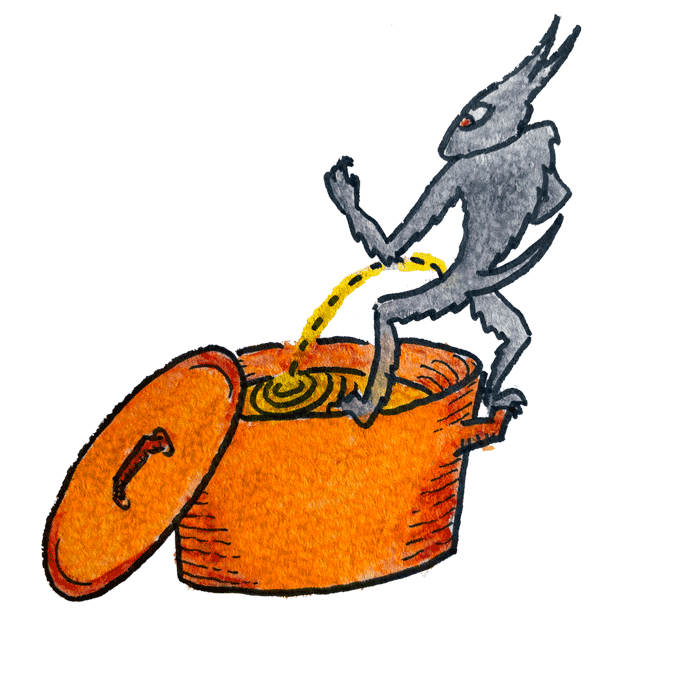
In Japan, ghosts can be much more than simply chain-rattling spirits. They hunger, and not only for the things you expect. Some of the hungry spirits (or Gaki) yearn for vomit or baby poop (yes, you heard me right). Many of the Gaki originate from sins people did while alive, a group of hungry ghosts are nothing more than mischievous spirits, called yasha.

Nature Spirits into Demons and Back

The yasha are supernatural beings that can range from caring to murderous. They began in India as benevolent nature spirits who watched over the earth and the forests. Yet as they migrated into China, they shifted into ghost-like spirits who preyed on travelers. 

Finally, as these spirits entered Japan, they were seen as a demon-god (kijin) to be worshiped and feared. They mixed with the legends of the amanojaku and oni.

The Last Twenty Gaki

In the last post, we explored the first sixteen hungry ghosts. Here are the other twenty to make the full consort of 36.

17 Underworld Ghosts

These spirits live in caves or with snakes in their burrows. They suffer from hunger and chills, a result of extreme thirst. These Gaki can also create epidemics. In life, they put someone in jail for personal gain. 

18 Supernatural-Power Ghosts

The most powerful of the Hungry Ghosts, these spirits may experience some joy. They inhabit the deep mountains, the middle of the sea, or other remote locations. Demons surround them, constantly staring at them. In life, they abused power by stealing other people’s property. 

19 Blazing Ghosts

The bodies of these spirits continually burn with a blazing fire, making them cry out in pain. They wander the countryside, desiring to loot villages or robbing people. In life, they looted and robbed. 

20 Infant-Excrement-Eating Ghosts

Only the excrement of babies will do for these spirits, who linger around cribs. They target mothers who let their babies sit in their own poop too long. When a child cries, people believe that the ghost has appeared to the child. These spirits are yakṣa rather than the  deceased.

21 Desirable Appearance Ghosts

These ghosts will shift appearance, becoming attractive or repulsive to gain access to food. They can prey on people’s lust. Additionally, they can transform into animals to swoop in to steal food. These spirits are considered yakṣa, a class of nature-spirits. 

22 Island Ghosts

These spirits are always thirsty and live on uninhabited islands. They slurp up the morning dew, but it offers them little respite. The heat of even a single winter day would feel hotter than ten-times a summer’s day. In life, these people abused those in difficult situations, like refugees or lost travelers. 

23 Assistant-to-the-Underworld Ghosts

Also known as Assistants of Yama Armed with Sticks, these hungry ghosts managed other ghosts and spirits. Yama, the Indian god of the Dead, record sinful acts committed by humans and bring these sinners back to Yama. Physically, they have scrunched-up hair draped over their faces and long ears with protruding stomachs. People pray to these ghosts on their deathbed, which means these Assistants linger between the human world and the underworld. 

24 Child-Eating Ghosts

These Gaki are malicious, feeding off the energy of infants. They wander in search of children to kidnap, but are often unsuccessful (thus their hunger). In life, they were healers who promised to cure a sick person with prayers, but abused their position. 

25 Energy-Eating Ghosts

These Gaki lurk around critically ill people and siphon off their energy. They might also target depressed people, gradually creeping into that person’s life to absorb their “vital energy.”

26 Brahmanic Rākṣasa Ghosts

These ghosts haunt crossroads and back all eyes. They linger and await the right opportunity to latch onto a victim and possess the body. While controlling the person, they will act recklessly in an attempt to kill the person. In life, these people were religious leaders who lost their faith. 

27 Hearth Ghosts

These Gaki loiter in kitchens or religious establishments to steal food. They also gorge on temple leftovers, mixed with coal. In life, these were people who stole food from religious sites. 

28 Dirty Street Ghosts

These Gaki live on dirty city streets, skulking in places where vomit and urine stains the streets. They dine off this refuse as their nourishment. 

29 Wind-Eating Ghosts

Each time this ghost reached for food or drink, it proves to be an optical illusion and vanishes with the wind. They are tormented by illusions of sustenance, only to have nothing in the end. In life, these people made empty promises and donations to charity. 

30 Coal-Eating Ghosts

These hungry ghosts wander through cemeteries, searching for the remains of a cremated body. They then scarf down the ashes generated from cremation fires. In life, they were in charge of prisons and let the inmates suffer from hunger. 

31 Poison-Eating Ghost

These ghosts nosh on poisonous fumes and toxic grass. Their food ends up killing them and then they regain their life only to hunger for these poisons again. They live in caves on mountains with extreme hot or cold weather. The mountains are home to wild beasts (lions, hawks or tigers) who pluck out the eyes of these unfortunate Gaki. Additionally, it can sometimes rain knives from the sky. In life, they poisoned someone to steal that person’s property. 

32 Jungle Ghosts

These Gaki roam the jungle, driven by intense hunger. As they traverse the wilds, branches and thorns cut their skin, jungle animals attack them, and fierce birds swoop down. When they finally arrive where they think there’s food, they discover it’s the wrong place. These ghosts are punished for a very specific punishment. Often, virtuous men would plant trees and provide people with water while traveling. These thieves steal the water, making the travelers thirsty and weak, and thus easier to rob. 

33 Living-in-Cremation-Grounds and Eating-Hot-Ashes Ghosts

Similar to the Coal-Eating ghosts, these long titled ghosts lug instruments of torture on their back to mimic the acts they committed in their former lives. In addition, they also carry red-hot irons on their head. In life, they stole offerings and flowers from temples.

34 Living-in-Trees Ghosts

These ghosts are reborn inside trees, where insects and animals chew away their bodies. Also, the weather that batters the tree also affects these ghosts. It’s believed that hermit monks, who live away from civilization, will be tormented by entire forests of these Gaki. In life, they stole wood from Buddhist temples.

35 Crossroads Ghosts

These ghosts reside in the classic haunted area of crossroads. People will make offerings to these spirits to ward off illness or difficulties at work. In life, they stole food from travelers who were crossing through remote parts of the world. 

36 Mara-Body Ghosts

These Gaki superficially feed off the confusion generated by the daily lives of Buddhist temples. They frighten monks with sinister sounds or nightmares. Their goal is to disrupt and undermine the entire community. In life, these people spouted false doctrines. 

Tim Kane

[mailerlite_form form_id=2]

Are Angels Gender Neutral?

Arkane Curiosities

Often Angels are depicted in art with male dress. The named angels also sound very masculine — Michael or Gabriel. Even the Greek word angelos (as well as the Hebrew word מֲלְאָךְ malak) are both masculine meaning a messenger from God. But is it really right to speak of angels as being masculine? Are angels gender neutral?

Man Was a Neutral Word for Centuries

The default to masculine names and male dress might have been influenced by the use of “man” as a gender neutral term (at least in English).

The proverb, man does not live by bread alone, refers more to humankind rather than just men. 

Up until a thousand years ago, the word for a male person was “wǣpmann” and a female person was “wīfmann”. This root word, “mann” means a person.

Angels Are Spirits with No Form

Humans and other Earthly creatures were designed to breed, thus the male and female forms. Unless they breed asexually, that is. Yet angels are not related to these mortal creatures at all. 

In Hebrews 1:14 (the New International Version) states this about angels:

Are not all angels ministering spirits sent to serve those who will inherit salvation?

God created the angels completely by scratch. They were never meant to reproduce, and thus have no need of genders. 

Additionally, angels are constructs of pure thought. They have no physical form but are simply spiritual beings. Assigning them a gender is pointless. 

Perhaps the reason we depict them as some form of gender speaks to our own limitations on how to perceive the divine. It makes it easier for our limited mortal brains to comprehend the angels. As spirits, they have no physical form at all. 

Tim Kane

[mailerlite_form form_id=2]

Gods of Thieving

Arkane Curiosities

In the various mythologies around the world, we can find plenty of luck and gambling deities. Yet there are very few gods of outright theft. Saint Nicolas (yes, the Santa Claus guy) comes close with his breaking and entering, but he’s the patron saint of reformed theives. Who exactly are the gods of thieving and outright stealing?

Hermes the Trickster

One of the most famous gods of mischief and trickery is Hermes, who started his career in crime as a baby. It seems the infant god had a hankering for some beef and left his cradle to wrangle up fifty cattle belonging to his brother, Apollo.

To keep the theft secret, Hermes marched the cattle backward, thus disguising which direction the cattle were traveling. Hermes also invented sandals to hide the shape of his feet. All of this so he could roast up a good side of ribs.

He was eventually caught, but Apollo was so amused by the youngster’s trickery that the two became fast friends. Apollo even gave the trickster god a golden caduceus, becoming a symbol for Hermes ever since. 

Santa Muerte

The newest addition to the small pantheon of criminal deities is Santa Muerte, also known as Señora de las Sombras (Lady of the Shadows) or La Santísima Muerte (The Most Holy Death). The phrase Santa Muerte means good death and comes from a Catholic prayer asking for a peaceful passing into the afterlife. Since then, Santa Muerte has become the beloved saint of any who are dispossessed. 

Figures of death have been a common fixture  in Catholic iconography since the thirteenth century, originating with the European plagues. Santa Muerte’s first appearance was in a 1797 inquisition report on the practices of indigenous worshipers. She was mentioned again in the novel Los hijos de Sánchez by American anthropologist Oscar Lewis. 

However Santa Muerte exploded into celebrity with the season three episode of Breaking Bad (No Mas), depicting the Santa Muerte shrine. Since the early 2000s, the cult of Santa Muerte has grown exponentially.

She is popular with migrants as well as sex workers and those in LGBTQ communities. Santa Muerte is associated with those who live precarious lives or are engaged in dangerous undertakings. Worship of her derives from indigenous practices including elements of Spiritualism, Santería, and New Age ideas about spiritual energy.

Santa Muerte’s appeal lies in her non-judgemental nature. She will grant wishes in return for a pledge or an offering. She holds no moral judgment over your actions. 

Both the Catholic Church and the Mexican government oppose and outlaw the worship of Santa Muerte, despite the millions who pay homage to her. 

Laverna the Lost Goddess of Thieving

Laverna was the Roman goddess who answered the prayers of robbers and thieves. The Porta Lavernalis on Aventine Hill was named after her. 

Little is known of this ancient goddess. She may have originated with the Etruscans, where she was venerated as a goddess of the underworld. Since most thieving happens in the dark, the connection is obvious. The word Laverna derives from the Latin latere (to lurk) and levator (a thief).

To honor Laverna, you pour libations with your left hand. This ensures that you have a successful heist without getting caught. She might have also been a goddess of vengeance. In a Plautus play, a cook calls upon Laverna to seek revenge on some thieves who pilfered his tools. Perhaps Laverna served the person who called upon her first (or offered her the most). Or maybe she simply gets annoyed with thieves who were bungling enough to let their crimes be known. 

Tim Kane

[mailerlite_form form_id=2]

Mimir: The Severed Head God of Wisdom

Arkane Curiosities

The wisest god in the Norse pantheon is not Odin. No, he gets all his advice from Mimir, the severed head god of wisdom. With direct access to Yggdrasill, the World Tree, Mimir can draw on vast stores of knowledge. But how did he end up losing his head, or body?

Rival Pantheons

The Norse people had not one, but two pantheons of gods vying for control. On one side you had the straightforward, battle centered Aesir with Odin and Thor. On the other side were the more cunning and magic oriented Vanir with Freyr and Freya. 

When Freya visited the Aesir, they were taken by her use of seidr (a powerful magic). Enthralled, they soon threw aside kin loyalty and sought only selfish desires. The Aesir labeled Freya as “Gullveig” (“Gold-greed”) and tried to burn her to death three times, but she was reborn from the ashes. 

War Between the Gods

This led to war between the Aesir and the Vanir. The Aesir fought by the established rules of combat, using weapons and their strength to vanish enemies. The Vanir fought with magic, a more subtle form of combat. Eventually, both sides realized that they were too evenly matched. 

With the prospect of peace, it was customary for each side to send a tribute to the other, a god or goddess who would live among the foreign tribe of deities. Freya, Freyr and Njord were sent to live with the Aesir. Hoenir and Mimir took their place among the Vanir. 

The Vanir Feel Cheated

Each time Hoenir sat in a meeting (called a Thing) with the Vanir, he would lean back and ask the more wise Mimir for advice. But one day, Hoenir went alone to the Thing. Each time he was asked to weigh in on a decision, he shrugged and said “Let others decide.”

The Vanir realized they had been cheated in the exchange of hostages. They’d sent their finest gods to the Aesir, but only received the dim-witted and indecisive Hoenir. In retaliation, they chopped off Mimir’s head and sent it back to Asgard. Apparently you need to pull your weight at a Vanir meeting. 

Odin embalmed Mimi’s head with herbs to prevent rot. He also spoke charms over it, giving Mimir the power to speak again. Finally, Odin set Mimir at the foot of the Yggdrasil tree, next to a well. The well bore Mimir’s name, being known as the Mímisbrunnr.

Mimir the Keeper of Secrets

Mimir drank from the well and gained great knowledge and secrets. To accomplish this task, he used the drinking horn Gjallarhorn (which is the same one Heimdallr would blow to announce the coming of Ragnarök). How Mimir managed this drinking, given that he was only a head, the sources won’t divulge. 

Now Odin sets himself up as the frontman for being the wisest in the land. He doles out all the witty saying to the other Aesir, with Mimir feeding him advice and secrets from the wings. 

Odin spent countless hours wringing information from Mimir. You see, he valued Mimir’s knowledge as well as their intellectual discussions. But Ragnarök was coming soon and he needed to gather every scrap of information he could. Thus, Odin asked to drink from the well of Mímisbrunnr, himself.

This was a big ask. The well contained untapped knowledge of not only this world, but all the nine realms. As the keeper of Mímisbrunnr, Mimir wanted something in exchange. For the privilege of drinking, Odin sacrificed his right eye, which he tossed to the bottom of the well. 

After this point, not much is mentioned about Mimir. Did he still give Odin council, or was he forgotten, now that Odin had drunk from the mystical waters of Mímisbrunnr. Given that Odin appears in comics and movies and Mimir is all but forgotten, I think we can guess the answer.

Tim Kane

[mailerlite_form form_id=2]
Three Bizarre Christmas Traditions: Poop Logs, Christmas Spiders and Evil Goblins

Arkane Curiosities

At this point, Krampus has become a well known phenomenon. There’s even an American Dad episode about the mischievous bringer of discipline. Krampus is a downright celebrity these days. Here are three lesser known strange and bizarre Christmas traditions.

The Poop Log of Catalonia

Tió de Nadal translates from Catalan to “Christmas log” or simply “tree trunk.” The other name for this Xmas tradition is Caga Tió, or poop log. Yes that’s right. It’s a log that poops out presents on Christmas Day.

It works like this, starting on the Dia de la Immaculada Concepció (Feast of Immaculate Conception, December 8th) you “feed” the Caga Tió sweets and candy. Each evening, after dinner, kids would save a peel from an orange or other fruit and place it in a feeding bowl in front of the little log. Bits of cookies and other sweets work as well.

Each night, you drape a blanket over the body of Caga Tió to keep it warm. We don’t want our gift-giving log to freeze in a cold winter home. This continues until December 24th, and gradually the log will grow in size (or maybe it’s the parents switching out the log for larger one). 

Then comes the beating. You gather around your log and hit it with a stick to make sure it poops, all while singing a cute little song…

Caga tió, (Poop log)
tió de Nadal, (Log of Christmas)
no caguis arengades (Don’t poop salted herring)
que són massa salads (They are too salty)
caga turróns (Poop turróns)
que són més bons! (They are much better!)

Then, like magic, presents and candies (called turróns) appear under the blanket.

Ukrainian Christmas Spiders

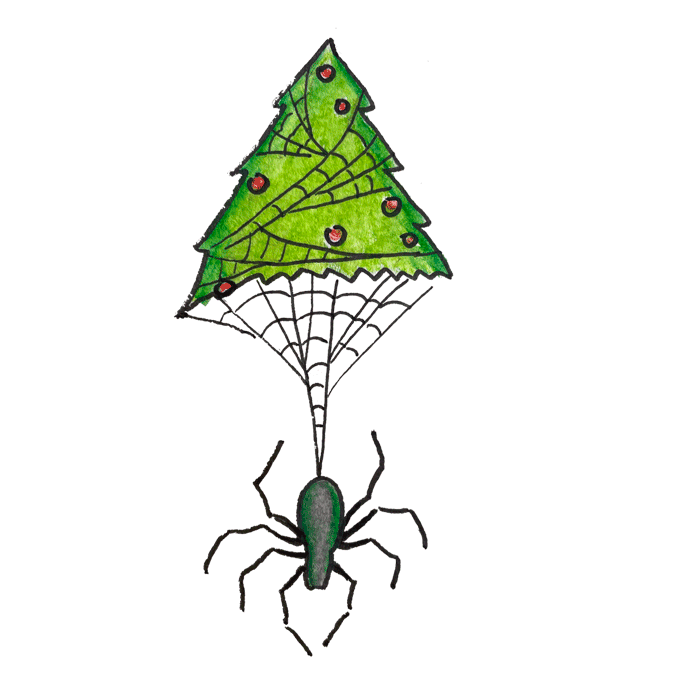
In Ukraine, you will often see spiderwebs decorating the Christmas tree. This comes from an old legend about some rather helpful arachnids. 

There was once a widow who lived in a tiny house with her children. One day, a pine one took root outside their home and the children tended to the growing seedling in hopes of having a splendid Christmas tree. Yet as the year slipped into winter, the widow knew that they would not be able to afford decorations. Finally on Christmas Eve, they set up the tree in their house, but its branches were bare.

That night, while they slept, the spiders of the house heard the sobs from the disappointed children. They went to work on the tree, spinning delicate webs on every branch. 

The next morning, the youngest child opened a window and the first rays of sunlight sparkled against the new decorations. The light of Christmas Day transformed the webbing into silver and gold. From that day forward, the widow never wanted for anything. 

Ukrainians still decorate their trees with spiderwebs to bring good luck for the coming year. So maybe don’t shoo that spider away too quickly on Christmas Eve. After all, they also need a warm and cozy place on a winter night.

Mischievous Greek Goblins

The Kallikantzaroi are mischief-making goblins who live in the center of the Earth. They spend the year trying to saw down the Tree of Life, which holds up the world.

During the Twelve Days of Christmas, they dig their way to the surface to bring their naughty tricks to our houses. This is the time, starting at the Winter Solstice, where the sun does not shift in the sky.

Tiny black creatures with long tails, the Kallikantzaroi are mostly blind owing to their life underground. Afraid of the sunlight, they only emerge at night, feeding on any small critters, such as frogs, worms and snails.

They sneak into your house through any cracked window, down chimneys, or through keyholes. Once inside, the havoc begins. They are not evil, per se, but impish and idiotic.

There are up to twenty different types of Kallikantzaroi and each specialized in a different type of mayhem. Some urinate on your cooking or imbue food with horrific smells. Others mimic voices to tease, torment or steal. 

You can keep the Kallikantzaroi away by leaving a colander on your doorstep. These little imps will have to count all the holes, but they can only ever make it to two and then are forced to start over. You can also burn an old shoe — the foul smell will keep these pests away. 

A link to the Norse tradition of Yule comes with a method to keep these goblins out of your chimney. You simply burn a log, but keep it going for all twelve days. Once you’ve reached January 6th, you are safe and the Kallikantzaroi return to the center of the Earth.  

Tim Kane

[mailerlite_form form_id=2]