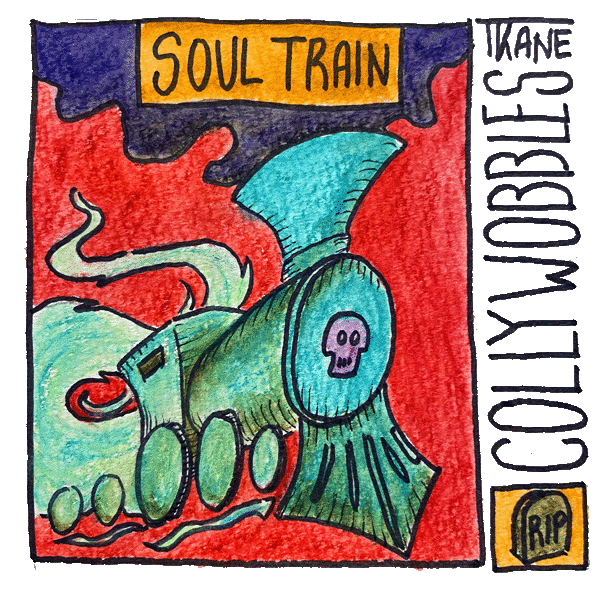
Ride the soul train into the afterlife? Do you have a first class ticket or will you ride economy? Beware the stops along the way. If you get off at the wrong station, you’ll be doomed for all eternity.
Tim Kane
Ride the soul train into the afterlife? Do you have a first class ticket or will you ride economy? Beware the stops along the way. If you get off at the wrong station, you’ll be doomed for all eternity.
Tim Kane

The myth of La Siguanaba is closely linked withMayan heritage — a haunting portrait of a beautiful woman in a white dress who emerges at night, beckoning to unsuspecting travelers or those who have transgressed societal norms. Passed down through generations, this legend bears the unique imprints of various cultures that have woven their distinct elements into its narrative. But who is La Siguanaba?
Picture the moonless nights in the Salvadoran countryside, where La Siguanaba prowls, captivating unwary travelers—often unfaithful men—near bodies of water. She appears as a near-nude figure, radiating an irresistible charm. She entices men with the promise of intimacy.
When she gets her victim along, her facade dissipates, revealing her true visage—a horse’s face. Some legends show her with huge deformed breasts that she beats on rocks to terrify her victims. Some succumb to sheer fright, while others are driven to madness. Those unfortunate enough to survive find themselves abandoned in the wilderness, condemned to wander until their inevitable demise.
In Central America, the tale of La Siguanaba maintains close ties to the ancient Aztec religion. La Siguanaba was originally known as Sihuehuet, translating to “beautiful woman.” Sihuehuet, a peasant woman, possessed an unparalleled beauty that could captivate even the gods themselves, including Tlaloc, the lord of the storm.
Sihuehuet ensnared Tlaloc, and bore him a child. But she apparently didn’t have any maternal inclinations. She neglected the child and cheated on Tlaloc when he went to war.
Driven by an insatiable hunger for power, Sihuehuet plotted to eliminate Tlaloc and usurp his divine throne. Crafting a poisonous plan, she intended to assassinate him. Yet, the scheme backfired when it transformed Tlaloc into a monstrous entity that wreaked havoc upon the community.
Upon learning of La Siguanaba’s malevolent actions, Tlaloc sought aid from the mighty god Teotl. Teotl then cursed her with the epithet “Siguanaba,” meaning “hideous woman.” This curse warped her into the nightmarish figure with a horse-faced appearance. Her days are now spent laundering clothes by a river’s edge while endlessly searching for her lost son, trapped in her grotesque form as punishment for her past misdeeds.
The best advice is to simply not be lured with the prospect of sex with a strange woman. But should you fall victim, here are some ways to protect yourself:
You can also scare her away by yelling three times: “no te vas a ir Maria, pata de gallina,” which means “you are not leaving, crabgrass Maria”.
Tim Kane
[mailerlite_form form_id=2]

Are you a History Buff? Do you work out with copies of the Iliad? Do you do WWII reps to strengthen your social studies muscles?
Tim Kane
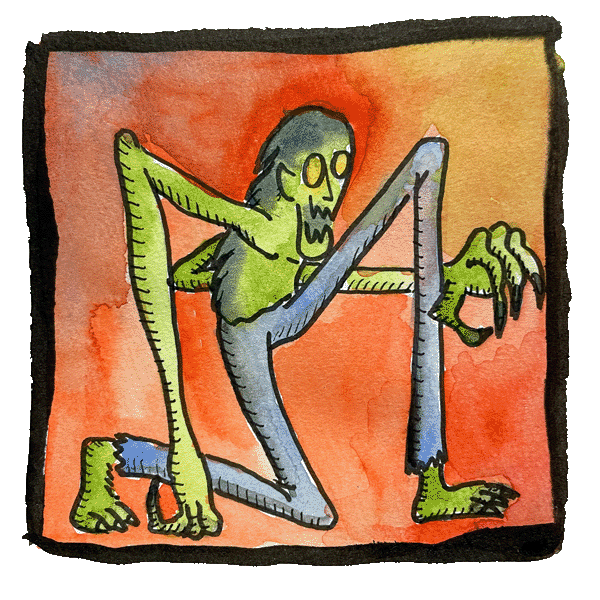
One boogeyman stands taller than all the rest—the towering Mètminwi. This mysterious Haitian boogeyman, rumored to be a colossal two stories in height, haunts the nocturnal streets, where tales of his appearance vary from incredibly long-legged to a giant with stilt-like limbs and arms.
Throughout Haitian folklore, various renditions describe Mètminwi as a seclusive giant with haunting red eyes and a pale, frowning countenance. His haunting presence emerges precisely at midnight, and he is said to prowl the streets, indiscriminately catching and consuming any unfortunate soul still lingering outside, regardless of their behavior.
The Mètminwi’s story serves as a cautionary tale, instilling lessons about obedience, respect, and the consequences of defying the night’s rules. The legend is a tool to dissuade mischief and wandering after the witching hour, guiding the young to heed the warnings of their elders.
While the descriptions of Mètminwi might vary, the central message remains consistent: he stands as a looming figure in the night, a warning against venturing out after midnight. Mètminwi name is a clever play on words, translated as “midnight master.” It’s a reminder that a midnight snack at home might be a safer choice than a moonlit stroll on the streets of Haiti.
Mètminwi, in essence, remains a steadfast reminder to all: the night belongs to the daring, but it also holds its own share of mysterious and cautionary tales.
Tim Kane
[mailerlite_form form_id=2]

Exactly what do you have under there? People say to keep it under your hat…but what if “it” gets loose?
Tim Kane
 Tim Kane Books