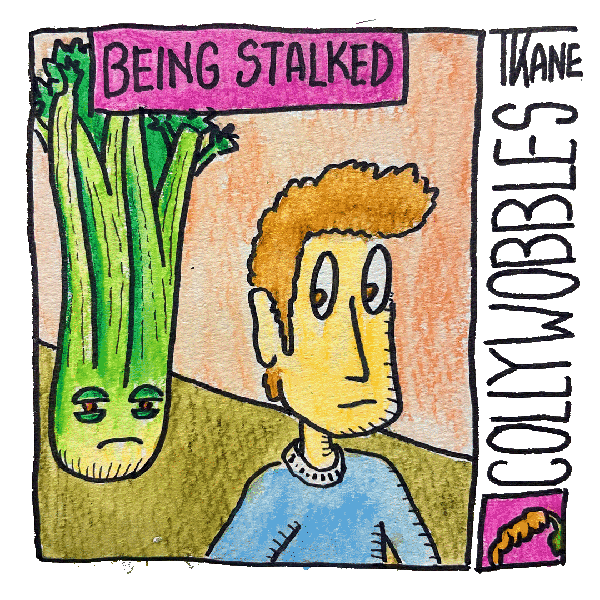
STEMinist YA

This idea of a STEM influenced fiction is something very new to me. When I was at the Southern California writers’ conference, the agent I was talking to said my manuscript fell into this category and I had to ask: what category is that?

As a science and math teacher, I love mathematics and the sort of structured and logical thinking that goes with it. When I put together my current manuscript, I wanted to share my love of mathematics and scientific thinking. I know I don’t wanna drop any formulas in the book but I also want to share the viewpoint that science and math can bring and just how beautiful mathematics can be in its view of the world.

It’s funny, whenever someone talks to me about math, they always say: “Well. At least there’s a right answer.” And I disagree. I feel like math, in its true form, has more questions than answers. It simply is another way to view and explain the world. I know that when I teach algebra, often times the answer is not a number, but just another equation.

I guess the logic behind STEMinist YA fiction is that you have a female protagonist in a role of science or mathematics or engineer that might typically have been a male role.

In my current manuscript, it was just a no-brainer. I wanted the main character to view the world in a science and mathematical way.

Tim Kane
El Coco and the Legend of the Evil Coconut

The legend of El Coco has its roots in numerous Spanish-speaking countries. Millions of children across the globe encounter the tale of El Coco in their bedtime stories. What are the mysteries surrounding the El Coco legend? And what exactly do they have to do with an evil coconut?

An Evil Coconut

El Coco derives its name from the Spanish word for coconut El Coco is described as having a brown, hairy face that evokes the eerie image of a frightening coconut. This mythical bogeyman enters children’s bedrooms if they fail to sleep soundly or behave properly.

A Cautionary Tale for Kids

Spanish-speaking parents caution their children that El Coco lurks on neighborhood rooftops, searching for those who refuse to go to bed on time or exhibit disobedient behavior. Should a child become a target of El Coco, the creature may emerge from under the bed or inside a cupboard to whisk them away.

While this tale may sound unsettling, it instills good behavior, obedience to parents, and caution around strangers. These essential teachings are vital for children as they grow, shaping them into responsible and capable adults.

A Haunting Rhyme

As children lay in their beds, a parent will recite the El Coco rhyme to send them off to sleep. 

Duérmete niño
Duérmete ya
Que viene el coco
Y te llevará.
Duérmete niño
Duérmete ya
Que viene el coco
Y te comerá.

Go to sleep child
Sleep now
The coco is coming
And it will take you.
Go to sleep child
Sleep now
The coco is coming
And it will eat you.

Quite the pleasant tale to tell your kids. This song reinforces the message by warning the child that failing to go to sleep will summon El Coco, who will make them disappear.

The Legend Works

Picture yourself in a dimly lit home, shrouded in darkness with no street lights outside. The family gathers around the fire, sharing tales of a mysterious bogeyman. Whether you are a child or an adult, listening to the legend of El Coco, and then hearing the wind whistle through the trees or an animal screech, would undoubtedly be sufficient to instill a sense of caution and encourage well-behaved behavior, steering clear of any potential encounter with the monster!

Tim Kane

Asema – The Corpse Light Vampire

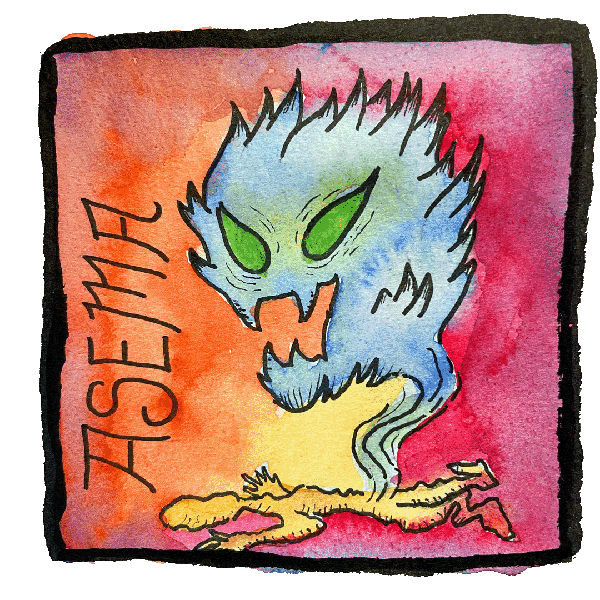
The cloak of night descends and the human skin slips away, falling into a heap on the floor. What remains is a radiant orb of blue light. This is the Asema, a vampire native to the northern stretches of South America. The corpse light vampire, also known as a ball vampire, invades homes, driving by its insatiable thirst for blood.

Bloody Habit

The Asema loves the taste of human blood. It often would not drain a victim dry, choosing to return night after night. But if your blood was particularly tasty, you might be emptied that very night. With the break of dawn, it resumed their human guise, repeating this haunting cycle day after day.

Defensive Measures

Placing garlic around your bedside will deter the Asema. Some people consume herbal concoctions to render their blood unappealing to these supernatural beings. 

Many vampires can be waylaid with scattered seeds. The Asema takes this OCD behavior to the next level. You can mix in the trimmed claws of an owl with the seeds. The Asema must pick up and count the seeds, yet if it grabs a single owl claw, it must drop them all and start over. 

Shriveled Skin

The best way to stop an Asema permanently involves its discarded skin. You give the skin a heavy dose of salt, but not as the usual seasoning. In this case, you want to shrink the skin so that it will not longer fit the Asema when it returns in the morning and the day’s light will destroy it.

In this fashion, the Asema bears a similarity to the Malaysian Penanggalan. In that case, you fill the discarded skin with shards of glass. On wonders if these two vampires are related or have a common ancestor?

Tim Kane

[mailerlite_form form_id=2]