
When you are crying to the saddest song, you want to share that experience, right? Because misery loves company.
Tim Kane
When you are crying to the saddest song, you want to share that experience, right? Because misery loves company.
Tim Kane
Arkane Curiosities
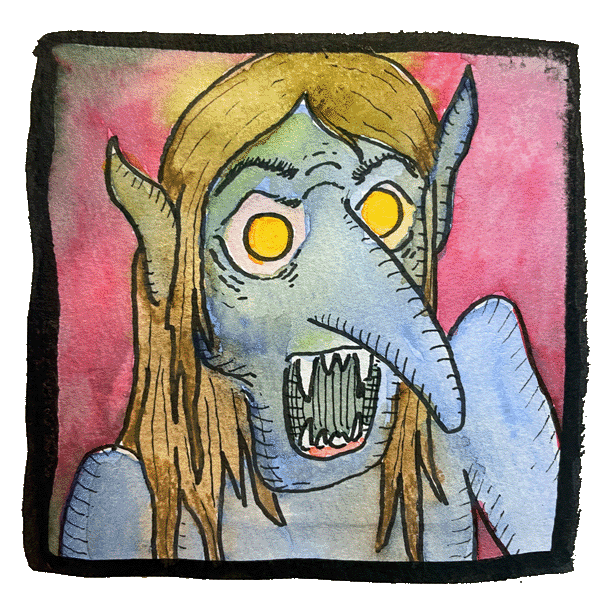
We all know about the legend of Dracula, But have you ever heard of Abhartach, the Irish vampire? This lesser-known figure from Irish folklore hails from the hauntingly beautiful County Derry in Northern Ireland. Unlike your typical vampire, the story of the Irish Vampire is rooted in ancient legends with a unique twist.
Long ago, in the 5th or 6th century, there lived an evil chieftain named Abhartach. Described as a goblin-like figure with a grotesque appearance, he was a possessive and jealous husband and he harbored suspicions of his wife’s infidelity.
One fateful night, he attempted to climb outside his wife’s bedroom window to catch her in the act. But in a twist of fate, he slipped and plummeted to his death, his life extinguished in an instant. His subjects, recognizing the need to accord him the honors befitting a chieftain, laid him to rest in a most peculiar manner—standing upright.
Yet, as the sun dipped below the horizon on the following day, Abhartach defied the laws of life and death. He returned, a nightmarish revenant, demanding a gruesome tribute from his terrified subjects. With a sinister thirst for their blood, he ordered them to bleed in order to create a bowl of blood for his consumption.
As time wore on, the people grew weary of living in perpetual fear. They turned to a local chieftain, Cathán, to rid them of the curse once and for all. Twice, Cathán dispatched the Abhartach and each time the creature returned, demanding more blood from the terrified populace.
Cathán turned to the local druid, seeking guidance from the wise sage. The druid revealed the key to defeating the undead chieftain. Abhartach could only be vanquished by a sword forged from yew wood, buried upside down with his feet reaching skyward. A massive stone placed upon the grave would act as a barrier against his resurrection. Surrounding the stone, the branches of sacred Irish trees, such as hawthorn and rowan, were to be intertwined to further hinder his return.
The druid’s warning was grave and ominous. Should the stone ever be removed, Abhartach would be unleashed once more upon the world. With unwavering determination, Cathán followed the druid’s counsel, executing the sacred ritual to the letter.
Finally, the curse was broken. Abhartach was silenced, and the people could breathe a sigh of relief, freed from the clutches of their undead ruler. To ensure the memory of their harrowing ordeal lived on, the twigs surrounding Abhartach’s resting place grew into a formidable thorn tree, and a colossal stone tomb (a dolmen) was erected to seal the memory of their struggle.
Today, only a solitary stone and the ancient tree remain, standing as silent sentinels to the legend of Cathán, Abhartach, and the extraordinary ritual that safeguarded a world from an evil that should never walk among us again.
Over two decades ago, a bold attempt to clear the sinister thorn tree and massive stone marking Abhartach’s resting place was foiled by inexplicable occurrences. Chainsaws broke down three times while trying to cut down the tree, and the chainsaw chain wrapped around the stone intended for removal, snapping and cutting a worker’s hand. The worker’s blood seeped into the ground, leaving the cursed site untouched since, as if Abhartach’s malevolence still guards his unholy resting place.
Collected during the late 1800s by renowned folklorist and historian Patrick Weston Joyce, this chilling folktale would have undoubtedly circulated in Dublin, where Bram Stoker served as a civil servant. The eerie connection between the Irish term “droch fhola,” signifying “bad blood,” and the name “Dracula” is an intriguing linguistic parallel that adds another layer of intrigue to the lore surrounding Stoker’s legendary vampire character.
Tim Kane
[mailerlite_form form_id=2]

Ever take a trip where everything goes wrong? Check the map. Maybe you’re going from Bad to Worse.
Tim Kane
Arkane Curiosities
I watched an old documentary on Vlad Dracula hosted by none other than Vincent Price. Most of the information I was already aware of, but one bit jumped out at me. A unique way to annoy a vampire involving sound.
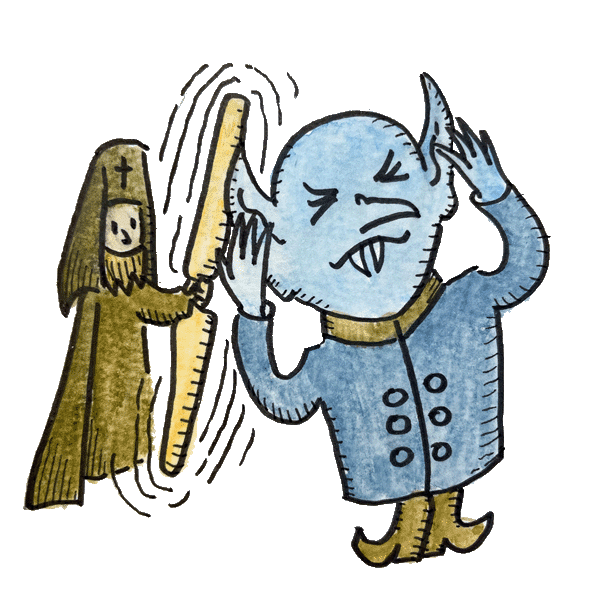
This documentary showed an Orthodox priest walking through town carrying a large piece of wood, called a toaca. This is a type of portable sematron used to create sound. He would bang on the toaca with a hammer as a way to keep vampires away. Despite scouring the Internet, I can’t find an exact reason for this. My best guess is that it annoyed the vampire.
I’ve posted about this before, but the toaca reminded me of another way to annoy vampires. I’d first learned about this in an X-Files episode (Bad Blood). Here we see the quintessential way to piss off a vampire.
Many Slavic people believe that vampires were forced to count the holes in fishing nets or the number of scattered seeds. It was common for townsfolk to hang a net over their door or spill seeds on the stoop as a way to deter would be blood-drinkers. The most common seed used was mustard seed, also known as eye of newt.
So folks, want to annoy the bejeezus out of your local vampire? Start banging on some wood. And be sure to scatter seeds all over the place. You’ll be safe… at least until the vampire gets done counting.
Tim Kane
[mailerlite_form form_id=2]

This is the best kind of headband, one that performs live wherever you go.
Tim Kane
 Tim Kane Books