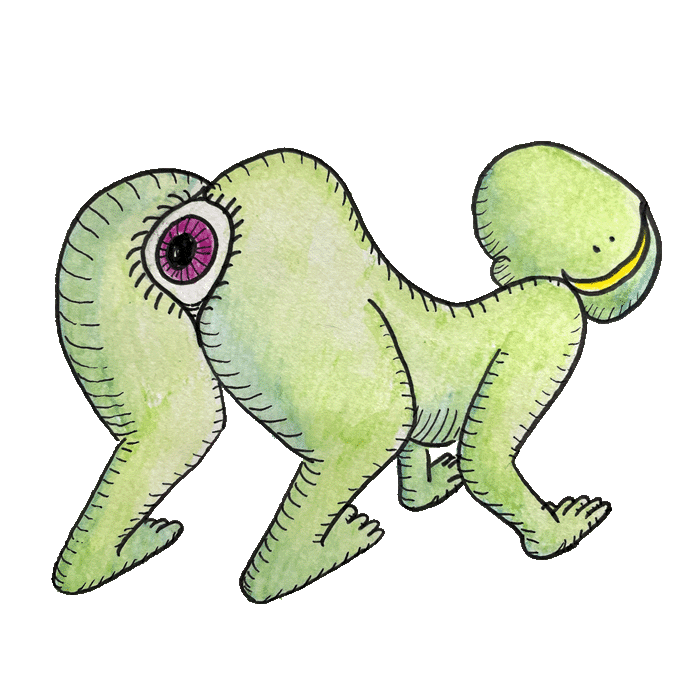
Shirime: the Eyeball Butt Yokai

Arkane Curiosities

To the Western mind, images of ghosts and the supernatural conjures up amorphous spirits or tall creepy slender men. But in Japan, the supernatural takes a hilarious and often creepy twist. The word Yokai can be translated as monster, demon, spirit, or goblin and the come in many strange and bizarre forms. Yet, perhaps none more peculiar than the Shirime or eyeball butt yokai.

It’s Looking at You

The word “shirime” translates literally to “butt eye” but it also has the meaning of a “backward glance”, which is quite literal to how this yokai looks at you. The shirime has the body of a man or woman, but instead of a face, it has a single large eyeball where its butthole should be. Other meanings for “shirime” have qualities of distress, which seems to be the motivation for this prankster creature. 

A Supernatural Flasher

The shirime approaches you looking, in all respects, like a normal person. It wears a kimono and asks you for a moment to spare. Once it has your attention, the kimono drops away. You see that this person has no facial features. It bends over, spreading its butt cheeks, to reveal a single eyeball, shining like lightning. 

And that’s it. It doesn’t do anything else to you. Shock seems to be this creature’s only purpose. 

Origin

Little is known about this yokai. A Japanese poet, Yosa no Buson, wrote the first and only encounter with this supernatural being. Some believe that shirime’s true form is just an animal, shapeshifting into a disturbing form in order to play a practical joke on us humans.

Tim Kane

[mailerlite_form form_id=2]
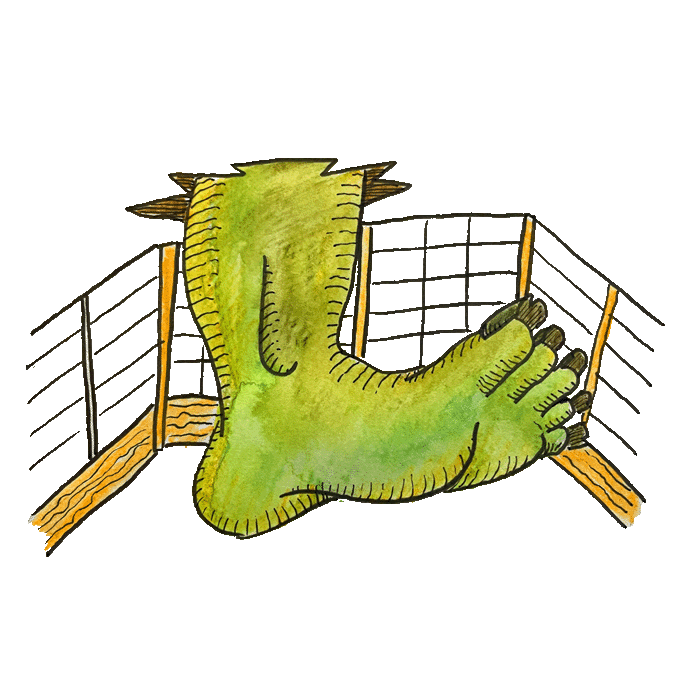
Ashiarai Yashiki: Giant Ghostly Foot

Arkane Curiosities

Sometimes ghosts are missing body parts. Headless specters abound (looking at you Nearly-Headless Nick). There are even ghosts with several arms or legs. Yet in Japan, we have a ghost who is only a foot. A giant ghostly foot that desires you to clean it — the Ashiarai Yashiki.

Nocturnal Foot Washing

The Ashiarai Yashiki appeared suddenly in front of the door of a house. The occupants heard a booming voice shout out:

“WAAAASH MY FOOOOT!”

The ceiling splintered as a gigantic foot smashed though. This massive foot was covered in bristly thick hair and terribly filthy.

If the people refused to wash the foot, the yokai would stomp around, causing earthquakes and other natural disasters until its demands were met.

A Deceased Merchant

According to some variations of the legend, the Ashiarai Yashiki is actually the spirit of a wealthy merchant who was so obsessed with cleanliness, he would force his servants to wash his feet every night. When he died, his spirit was unable to rest and took on the form of the giant foot, continuing to demand that people wash it.

Maybe You’re Guilty of Something

The Ashiarai Yashiki could also be a play on words. In ancient times, “to wash one’s feet” meant to be cleared of crimes and allegations. This would suggest that a visitation by the Ashiarai Yashiki meant the occupant was guilty of some crime. The yokai came to punish the criminal for their misdeeds. 

Tim Kane

[mailerlite_form form_id=2]

Mother of the Gods (with a Castration Cult)

Arkane Curiosities

Everyone needs a mother, even the gods. In central Anatolia (now modern Turkey) the Phrygian people held Cybele as their principal goddess. She also happened to be the mother of the gods.

Zeus Has Two Mothers

Cybele was believed to have given birth to a number of gods and goddesses who ruled over various aspects of the natural world, such as: Dionysus, Hecate and Zeus.

Yet in traditional Greek lore, Rhea was the mother of Zeus and helped the young god slay his father to rule over Olympus.  So how can Zeus have two mothers? Well, Rhea and Cybele come from different cultures, so Rhea was his Greek Mommy and Cybele was the Phrygian Mum.

In some versions of the mythology, there are even stories of the two goddesses being merged into a single deity, with Rhea being identified as a Greek version of Cybele.

She Slept with Her Own Son

Cybele also mothered the god Attis. He was sometimes associated with the god Adonis, who was a similar figure in Greek mythology. Both were associated with vegetation and rebirth, and both were believed to have died and been reborn each year as part of the cycle of the seasons.

Cybele took a fancy to her young son. She fell in love with him and made him her consort, but Attis later betrayed her by falling in love with a mortal woman. Cybele was so enraged by Attis’ betrayal that she drove him mad, causing him to castrate himself and die. In other versions, Attis died in battle or through self-mutilation. Either way, Attis cut off his dangly bits. 

Cult of Castration

Followers of Cybele celebrated the mother of the gods through ecstatic rituals and frenzied dancing, often accompanied by the music of drums and cymbals. Her followers. They were known as the Corbants and their origins can be traced back to the ancient city of Phrygia, which is now modern-day Turkey.

The Corybants were often depicted as wearing armor and carrying shields and swords. They performed frenzied dances and drumming as part of the worship of Cybele. The cult of Cybele was centered around the idea of a divine mother figure who was associated with fertility, nature, and wild animals.

The male priests, called Galli, wore long robes, headdresses, and jewelry, and would often dye their hair and wear makeup. Their religious practices were highly ritualistic and often involved self-mutilation.

During certain religious ceremonies, the Galli would castrate themselves as a way of dedicating themselves fully to the worship of Cybele. This act was seen as a way of emulating the mythical figure of Attis, who was said to have castrated himself in a fit of religious ecstasy.

The Roman version of the cult was known as the Magna Mater, or the Great Mother, and it was often associated with the worship of the god Attis. The cult eventually declined as Christianity began to spread throughout the Roman Empire. 

Tim Kane

[mailerlite_form form_id=2]