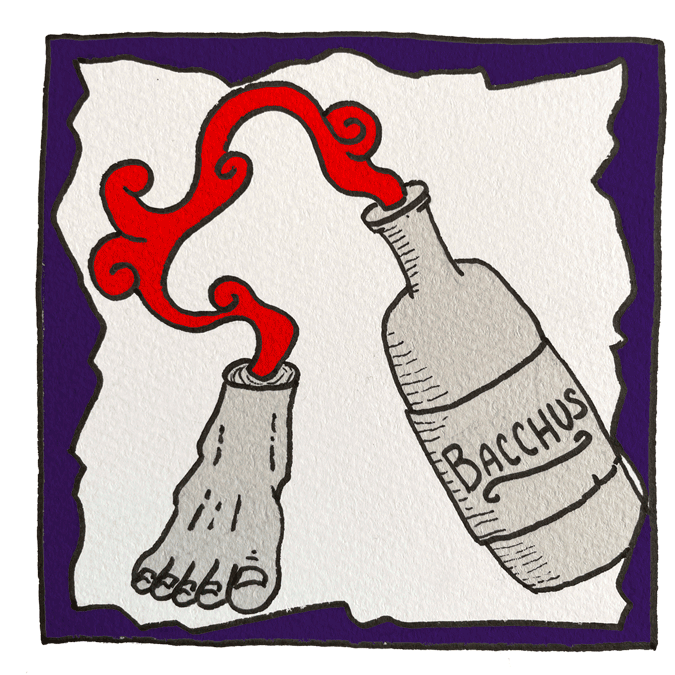
Food of the Gods

Arkane Curiosities

In 1904 H.G. Wells wrote about the Food of the Gods, which transformed regular animals and people into gargantuan proportions. The title was apt, because like us mortals, deities must also feast in order to survive.

Magical Goat Food

Perhaps the most famous divine nourishment would be the ambrosia consumed by the Greek gods on Mount Olympus. Before they discovered this magical foodstuff, gods had to inhale vapors from their dead enemies, akin to taking in the soul of the vanquished. 

As the god Zeus grew from a baby to a full-grown thunderbolt-wielding god, he was nursed by a goat (or possibly a nymph) named Amalthea. Baby Zeus, like most infants, grabbed anything near him. While feeding, he broke off one of Amalthea’s horns. This was later transformed into a Cornucopia (or Horn of Plenty).

The Horn of Plenty would create a limitless supply of ambrosia for the gods (along with any type of food for mortals). White doves would whisk this precious food up to Mount Olympus each day.

Nectar was also used interchangeably with ambrosia, though it was said to taste like honey and be carried by a swift eagle.

Ichor and Immortality

The gods and goddesses gained immortality by gobbling up ambrosia and nectar. Immortality has its downside. Their blood transformed to ichor, a divine life force. 

If the gods missed too many meals, their immortality would fade away. The great Demeter, goddess of the hearth, went for days without eating in her search for Persephone and nearly perished with the effort. 

Mortals and Ambrosia

One story has Achilles gaining his famous invulnerability by being anointed with ambrosia, which burnt away his mortal skin. His mother, Thetis, would have covered his whole body in the stuff, but Peleus, her husband, thought she was trying to harm little Achilles and stopped her, leaving his famous ankle still mortal. 

The gods used ambrosia to cure diseases, heal scars and beautify the human body. If applied to a freshly killed hero, the ambrosia would preserve the body forever. When Patroclus died in the Trojan war, his body was anointed with Ambrosia to keep it in a perfect state. 

Some believed that if mortals consumed ambrosia (or nectar), they too would become immortal. King Tantalus attempted to seal some of the mythical provisions only to fail and become immortal in another way (punished with eternal hunger in Tartarus).

Immortality Garden

There might even have been a whole garden with immortality-bearing food. In the far west, where the sun sets, lay the Garden of Hesperides. Three nymphs, called the “Daughters of the Evening” tended the garden which held a special apple tree. One of Hercules’s tasks was to pluck an apple from this tree. 

In the play Hippolytus, Euripides mentions a place where “streams flow with ambrosia by Zeus’s bed of love and holy Gaia”. This could possibly be the resting place of the fable Cornucoplia. 

That’s a pretty good journey for those doves each day.

[mailerlite_form form_id=2]

How the Dwarves Botched Thor’s Hammer

Arkane Curiosities

Marvel Comics would have us believe that Thor’s hammer was forged in a collapsed neutron star somewhere in the far reaches of space. The actual myth is a bit more terrestrial (or Asgardian…?). The Dwarves were, indeed, responsible for the creation of the mighty Mjölnir, but the job was botched. And like most mistakes in the Norse pantheon, this one can be traced back to the god of mischief, Loki.

Loki’s Prank

Loki was constantly pulling pranks on the other gods (and then attempting to extricate himself from blame). Loki knew knew that Thor loved his wife, Sif, and her golden hair. On a lark, Loki waited for Sif to be asleep, took a pair of shears and snipped her golden off, every single lock. 

Naturally, when Thor learned of this, he seized his brother and threatened to break every bone in his body. Loki, always quick on his feet (and wanting to save his own skin) promised he could return Sif’s golden hair. 

Forging the Magical Treasures

Loki journeyed to the land of the Dwarves, Nidavellir (the dark fields, also sometimes called Svartalfheim). He pleaded with the two sons of Ivaldi (never named on their own) to fashion a new head of hair for Sif. These master craftspeople ended up creating three stunning treasures to please the gods:

  • For Sif, they crafted hair spun from actual gold with the magical ability to grow upon her head.
  • For Freyr (Lord of peace and fertility), they built the ship Skidbladnir (meaning assembled from thin pieces of wood). This was the best of all ships, always catching the most favorable wind. As a bonus, the ship could be folded up and put in a pocket. 
  • For mighty Odin, chief of all the Norse gods, they forged Gungnir, a deadly spear that always hit its mark. 

The items were so wondrous, Loki declared the sons of Ivaldi the most skilled crafters in the realm. However, two brothers, Brokk and Eitri overheard the boast. Never one to miss an opportunity, Loki taunted the brothers, claiming they lacked the skill to create anything equaling the creations of the Ivaldi brothers. 

The Wager

What’s a wager without a prize? Loki was so sure of his victory, he bet his own head as the prize. The brothers promptly accepted. 

Loki now had to make sure he won the bet or he’d lose his own head. He transformed himself into a fly and heard the brothers talking. Eitri worked the forge and reminded Brokk that the bellows must be worked without pause to ensure the required heat. 

As Brokk pumped the bellows, Loki buzzed around his head, tormenting him as only a fly can. The dwarf was able to maintain focus through the first two items, Gullinbursti (a golden boar) and Draupnir (a golden arm ring). 

The Mistake

The last item was to be Mjölnir, a war hammer for Thor. Loki, determined to keep his head on his shoulders, dived into Brokkr’s eyelid and bit so hard he drew blood. The dwarf stopped for a moment to wipe his eyes.

The hammer emerged from the forge, a weapon of unsurpassed might, able to always hit its mark and then return to the owner’s hand. But it was flawed. Most warhammers were meant to be wielded with two hands. But Mjölnir’s handle was too short and could only be held with one hand. 

Despite the mistake, Brokk was certain he and his brother had won the wager. Together with Loki, they traveled to Asgard. They laid their works before Odin. 

  • For Freyr, they presented Gullinbursti, a living boar with golden hair. This could outrun any horse and had the strength to pull Freyr’s chariot, even through water or air.
  • To Odin they gave Draupnir (the “Dripper”). This was an enchanted golden ring that created eight new golden rings every ninth night. 
  • To Thor when the hammer Mjölnir (meaning lighting). 

Loki Escapes on a Technicality

All the gods concluded that Brokk and Eitri had won the wager and Loki owed the dwarves his head. Ever the cunning one, Loki agreed to give over his head. Except, he had never promised his neck. 

Brokk decided that since Loki’s head was his, he could at least shut the god up for a while. Using Eitri’s awl, he sewed Loki’s lip shut with a leather thong. Satisfied, the brothers returned to their forge.

[mailerlite_form form_id=2]

Did Dionysus Have Dissociative Identity Disorder?

Arkane Curiosities

Mortals aren’t the only ones who can manifest dissociative identity disorder — many deities from ancient times had multiple personas. People with dissociative identity disorder (previously known as Multiple Personality Disorder or incorrectly as “split personality”) have a system of individuals all working within a single host (or body).

The core is the original child and the first identity born to the host. Some view the core as the owner of the system and is often the part with the most power. There are multiple alters (or other personalities) that fulfill specific roles, such as Protector, Persecutor, and Memory Holder. A Gatekeeper often allows the different alters to front (or take control of the host).

Different deities from across the world’s pantheons have different aspects that front for various purposes. In Celtic mythology, there is the Morrígan, who has three aspects all related to war and death. In Hindu belief, the trimurti has three gods in one body each in charge of one aspect of creation.

Perhaps the most intriguing of these personality swapping gods is Dionysus — the Ancient Greek diety of wine, drunkenness, frenzy, suffering and madness. 

Dionysus (also known as Bacchus) is known for having a dual persona. He is a bringer of joy and merriment, but sometimes goes into a blinding rage to terrorize hapless victims. 

Twice Born

Dionysus was born twice. Zeus, always the player, seduced Semele, a princess of Thebes. His wife, Hera, was naturally not pleased and planned revenge. A mortal could not view a god in their true form. Thus Hera, in disguise, convinced Semele to make Zeus prove his godliness by revealing his true form. You can guess what happened… Semele made Zeus promise to do as she wished and then asked to see him in all his glory. Zeus was honorbound to comply and revealed his true form, blasting the pour mortal woman to ashes. However, the unborn Dionysus, being part god, survived. Zeus sewed the baby inside his thigh, allowing him to gestate until birth. Since Dionysus was born from a god (in this case, Zeus) he was granted immortality. This could qualify as the traumatic event that often ushers in dissociative identity disorder. 

God of Fun

Dionysus was portrayed as beautiful and joyful. He discovered the cultivation of vines and taught others how to ferment grapes into wine. His worship is often connected with the idea of partying and having a good time (under the influence of wine, of course). He was connected to such mythological creatures as satyrs and centaurs. Dionysus was depicted riding a panther or in a chariot pulled by pumas (way to make a grand entrance). 

Terror Frenzy

Some Greek cities attempted to ban the wild rites of the maenads (followers of Dionysus). The most notorious case came with King Pentheus of Thebes (written about by Euripides). The king attempted to imprison Dionysus, but the prison doors would not close and the shackles simply slipped off. 

Despite fearing this new worship, the king was also fascinated by it and wanted to learn more. His own mother, Agave, had been lured in by the rites of Dionysus. The wine god allowed Pentheus to observe the secret rituals firsthand, but only if the king disguised himself as a woman. Pentheus did as instructed and spied on the maenads from behind a tree. 

Dionysus had driven the women into a frenzy and they seized upon any small animal they could find, ripping it apart. Soon they discovered the king and, thinking he was a lion, the maenads tore him limb from limb. Even his mother, Agave, carried off his head thinking she had slain a lion. Thus the Thebans were punished for having resisted the rites of Dionysus. 

The terror-frenzy that Dionysus creates in his followers feels very much like the protector alter of the dissociative identity disorder. A Protector might lash out to defend the host from physical or other kinds of abuse. 

Dionysus remains a complex deity with many facets. He was beloved by the Greeks and went on many more adventures. Whether the Greek myths utilized him as a way to explain individuals with different personas remains to be seen. One thing is certain, if you upset Dionysus, you would suffer the consequences.

Consider the last lines of the Homeric Hymns to Dionysus

“And the Nymphs followed in his train with
him for their leader; and the boundless forest was filled with their outcry…”

Tim Kane

Dissociative Identity Disorder in the Gods (The Morrígan)

Arkane Curiosities

The character of Jane exploded into public awareness with airing of DC’s Doom Patrol. Dubbed “Crazy Jane” (and played by the excellent Diane Guerrero), she is one of the alters of Kay Challis, a girl who developed dissociative identity disorder following physical and sexual abuse by her father.

Doom Patrol (both the comic and streaming series) does an excellent job of explaining and normalizing the mental disorder (formerly called multiple personality disorder or split personality disorder). Jane herself has no powers to add to the team of misfit heroes. But some of her alters do. When not fronting (or controlling the host body) Jane descends to the Underground with 63 other alters. 

Just as there are ancient gods to symbolized various elements of the natural world, so too do we see dissociative identity disorder crop up in a few prominent deities. To start, let’s look at The Morrígan.

The Morrígan

As a Celtic goddess, the Morrígan translates from old Irish as “Great Queen” or “Phantom Queen.” She is often dubbed a trinity goddess, but this is a modern pagan view of what, in reality, is quite a bit more complex. True, the Morrígan does have three aspects, but they don’t align to the Maiden, Mother and Crone. 

The triple aspect of the Morrígan are depicted as sisters and also referred to as “The Daughters of Ernmas” (an Irish mother goddess famous for having triplet children). The first two aspects of the Morrígan consistently remain Macha (a death goddess) and Badb (a war goddess). The third aspect varies with different tales, shifting between Némain, Féa, or Anu. The organization The Order of the Crows recognizes Némain as the third aspect and the Morrígan as the constituent whole.

Badb

Némain is also recognized as a war goddess, but separate from Badb. Whereas Badb stirs up panic and fear on the battlefield, Némain embodies with frenzied havoc of war. This alone shows the subtle nature of different alters within a host. Both Némain and Badb represent war, but bring different attributes to the battle. 

The Irish noted how black birds and crows shrieked and cawed around the bodies left in the aftermath of war. As scavengers, they fed upon human carnage. Badb was known as the “Battle Crow”, representing the death and carnage of battle. In Ireland, if one were to see a crow before the battle had begun, it foretold death and disaster. This was Badb preparing to feast. 

Badb is the most well known of the three aspects of the Morrígan and may very well be the core personality. 

Némain

Her sister, Némain, can unleash a cry of terror and brings panic like an infection. The site Living Liminally, quotes Windisch, “Nemain brought intoxication upon the army there, falling in their armor and on the points of their spears and sword-edges, so a hundred warriors of them die in the midst of the encampment and at the side of that place a time of terror the cry carried from on high.”

Macha

Macha, symbolized by fiery red hair, represents death. However, she is not feared in the way other harbingers of the afterlife tended to be. The Celts saw death as a natural element of life. Macha was a welcome goddess and an omen for what is to come.

One story involved Macha marrying a mortal, Cruinnic. She warns her husband not to tell a soul of her true identity, but Cruinnic is weak-willed and runs his mouth at a chariot race, bragging that his divine wife can outrun the king’s horses. 

The King of Ulster got wind of this and summoned Macha, demanding that she race the royal horses. At the time, she was pregnant and pleaded to postpone the competition until after she’d given birth. The king was adamant and the bizarre race, a pregnant woman versus the royal horses, commenced. 

Macha outpaced the horses, but as she crossed the finish line, she wailed in pain, giving  birth to a boy (True) and a girl (Modest). In her pain and anger, she cursed the men of Ulster nine times nine generations so in times of the worst peril, they should suffer the pain of childbirth. This shows that Macha can be vengeful when disrespected. 

Ancient stories rarely talk of these personalities trading off with each other. Rather, they simply list them together, calling them sisters, and listing their names together when describing the heat of battle. 

In us mortals, dissociative identity disorder is associated with trauma. No such explanation has been recorded for the Morrígan (Macha’s birth at the race not withstanding). However, it was natural for deities like the Morrígan to bee seen as multiple aspects of the same goddess, each one emerging when needed.

In the next installment, we’ll look at Dionysus and his massive swings in emotion.

Tim Kane