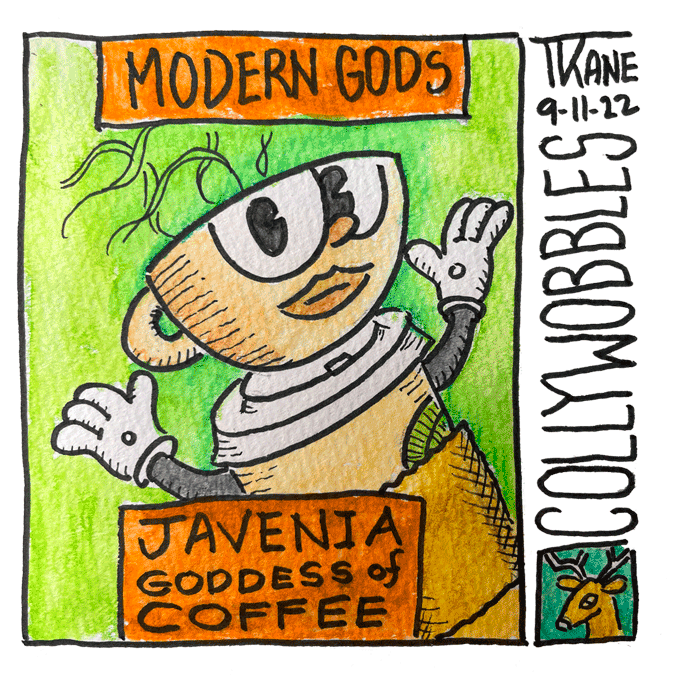
All hail Javenia, goddess of coffee. Praise her and she shall caffeinate your day.
Tim Kane
All hail Javenia, goddess of coffee. Praise her and she shall caffeinate your day.
Tim Kane

What would fairytales be like if Amazon delivered? This modern fairytale is the premise for the flash fiction “Beanstalk in a Box”. The story explores the disclaimers and legalease the company would use should it sell such items.
Look for the anthology Professor Feiff’s Compleat Pocket Guide to Xenobiology for the Galactic Traveller on the Move is available, ironically, at Amazon.


The passage of weeks shape our lives in so many ways. But the story of how we settled on seven days and the names of the days dates back thousands of years.
The Babylonians had remarkably good astronomical knowledge. In addition to the sun and the moon, they knew about the five closest planets. Add those up and you get seven celestial bodies — one for each day of the week.
Seven days also matched the cycles of the moon — the time it took to transition from one phase to the next.
The names for the days of the week corresponded with different Babylonian gods, each associated with a planet.
As the Greek civilization grew to dominate the Mediterranean, they were influenced by the Babylonians. They, too, named two days after the sun and the moon, calling them day of the Sun (Hemera Helio) and day of the moon (Hemera Selenes). Hemera was the goddess who personified the day.
All the other days of the week were named for Greek gods, instead of the visible planets.
The Romans were famous for taking what someone else had done and slapping their own name on it. They simply took the Greek gods and replaced them with the Latin name.
The Romans continued to honor the sun and the moon, making “dies Solis” (for Sunday) and “dies Lunae” (for Monday).
The folks living across the Rhine River had continual contact with the Romans and adopted many of their customs. When the Roman Empire collapsed, Germanic tribes spread out over Europe. They kept the same days of the week, simply swapping out their own Norse gods for the Roman counterparts.
Sunday
In German, this started as sunnon-dagaz “day of the sun”. The Norse mythology called the Sun Sunna. As it migrated into English, it became Soneday.
Monday
The Germanic tribes preserved this as a moon day. The “mon” in Monday represents the Moon.
Tuesday
This day was named after the Norse god Tyr, a god of warriors and combat (the closest to the Roman Mars). Tyr’s name was sometimes spelled Tiw, giving us Tiwesday.
Wednesday
The Germanic tribes associated their chief god, Odin, with the messenger god Mercury (both traveled to earth to deliver wisdom). If it seems a strange leap from Odin to Wednesday, we need to understand he was also called Woden, giving us Wodnesday.
Thursday
Just as the Romans and Greeks honored the king of the gods, the German tribes did the same, but with Thor rather than Zeus. There were two names to this day. We have the literal thunresdæg for “thunder’s day” or thorsdagr for “Thor’s day”.
Friday
This marks the biggest shift from the Greek/Roman system and what we know in English. Instead of the goddess of love, they opted for Odin’s wife Frigg (or Freda). The day was known as frigedæg and later simply fridai.
Saturday
The Germanic tribes didn’t assign a god to this day of the week. Instead, they kept the Roman name of Saturni, shifting to sæterdæg and later saterday.
Every time you mark a date on your calendar, you’re actually honoring ancient gods and goddesses that go back thousands of years.
Tim Kane
[mailerlite_form form_id=2]

We all succumb to the lure of doughnuts, chips, cookies and ice cream. This is the power of the Junk Food god.
Tim Kane

In 1904 H.G. Wells wrote about the Food of the Gods, which transformed regular animals and people into gargantuan proportions. The title was apt, because like us mortals, deities must also feast in order to survive.
Perhaps the most famous divine nourishment would be the ambrosia consumed by the Greek gods on Mount Olympus. Before they discovered this magical foodstuff, gods had to inhale vapors from their dead enemies, akin to taking in the soul of the vanquished.
As the god Zeus grew from a baby to a full-grown thunderbolt-wielding god, he was nursed by a goat (or possibly a nymph) named Amalthea. Baby Zeus, like most infants, grabbed anything near him. While feeding, he broke off one of Amalthea’s horns. This was later transformed into a Cornucopia (or Horn of Plenty).
The Horn of Plenty would create a limitless supply of ambrosia for the gods (along with any type of food for mortals). White doves would whisk this precious food up to Mount Olympus each day.
Nectar was also used interchangeably with ambrosia, though it was said to taste like honey and be carried by a swift eagle.
The gods and goddesses gained immortality by gobbling up ambrosia and nectar. Immortality has its downside. Their blood transformed to ichor, a divine life force.
If the gods missed too many meals, their immortality would fade away. The great Demeter, goddess of the hearth, went for days without eating in her search for Persephone and nearly perished with the effort.
One story has Achilles gaining his famous invulnerability by being anointed with ambrosia, which burnt away his mortal skin. His mother, Thetis, would have covered his whole body in the stuff, but Peleus, her husband, thought she was trying to harm little Achilles and stopped her, leaving his famous ankle still mortal.
The gods used ambrosia to cure diseases, heal scars and beautify the human body. If applied to a freshly killed hero, the ambrosia would preserve the body forever. When Patroclus died in the Trojan war, his body was anointed with Ambrosia to keep it in a perfect state.
Some believed that if mortals consumed ambrosia (or nectar), they too would become immortal. King Tantalus attempted to seal some of the mythical provisions only to fail and become immortal in another way (punished with eternal hunger in Tartarus).
There might even have been a whole garden with immortality-bearing food. In the far west, where the sun sets, lay the Garden of Hesperides. Three nymphs, called the “Daughters of the Evening” tended the garden which held a special apple tree. One of Hercules’s tasks was to pluck an apple from this tree.
In the play Hippolytus, Euripides mentions a place where “streams flow with ambrosia by Zeus’s bed of love and holy Gaia”. This could possibly be the resting place of the fable Cornucoplia.
That’s a pretty good journey for those doves each day.
[mailerlite_form form_id=2]
 Tim Kane Books