Ancient Egyptian Afterlife: The Opening of the Mouth Ceremony

Arkane Curiosities

The ancient Egyptians left behind an awe-inspiring legacy of culture, architecture, and beliefs. The ancient Egyptians also held a particularly fascinating and complex view of the afterlife. The concept of a double soul and the opening the mouth ceremony were only the start to a long journey in the ancient Egyptian afterlife.

Ka and Ba: The Dual Essence of the Soul

Central to the Egyptian concept of the afterlife were the ka and ba. These two aspects represented the dual essence of an individual’s soul. The ka was the life force or spiritual double, residing within the physical body during life and continuing to exist after death. It required sustenance in the form of offerings to remain content and connected to the earthly realm.

On the other hand, the ba was the individual’s personality, often depicted as a bird with a human head. After death, the ba would separate from the body to roam freely in the spirit world, visiting loved ones and sacred places. However, it needed to return to the tomb periodically to reunite with the ka and sustain its existence.

Opening the Mouth

The “Opening of the Mouth” ceremony aimed to revitalize the deceased’s senses, allowing the mummy to see, hear, smell, eat, and breathe again in the realm of the dead. Essentially, this would allow the ka, still residing in the body, to accept and enjoy any offerings presented to it. 

Key Elements of the Ceremony

Touching the Mouth: The priest touched the mouth and eyes of the mummy with a special forked tool. This gesture symbolized the restoration of the mummy’s senses, allowing them to speak and see again.

Incantations and Spells: During the ceremony, priests would recite spells and incantations to invoke the help of various gods and deities. These spells were believed to activate the powers of the objects used in the ritual and ensure the successful transition of the deceased into the afterlife.

Offerings: Replicas of milk (activated with the incantations) were presented to the mummy. This represented the baby’s first nourishment. There were also replicas for salt water (used for cleansing) and fresh water. These offerings were meant to sustain the deceased in the afterlife and provide them with the necessities for eternity.

Reborn: The idea that the body was “reborn” into the afterlife was strong. Egyptians used a forked blade (called a pesesh-kef) to touch the mummy’s mouth. This was the same tool used to sever the umbilical cord when this person was born.

The Opening of the Mouth ceremony aimed to reanimate the senses of the deceased and ensure their successful transition into the afterlife. By performing this ceremony, the ancient Egyptians believed that the mummy would be fully prepared to undertake the journey to the realm of the dead, where they could enjoy eternal life in the presence of the gods. 

Tim Kane

[mailerlite_form form_id=2]

Exploring Junji Ito’s Haunting Realms of Japanese Horror Manga

Arkane Curiosities

Junji Ito is the undisputed master of Japanese horror manga. With his twisted and surreal narratives, Ito has cemented his status as one of the most influential figures in the genre. Works like “Uzumaki,” “Tomie,” and “Gyo” showcase his mastery in blending body horror, psychological torment, and cosmic dread. Ito’s ability to delve into the darkest recesses of the human psyche has captivated audiences worldwide, solidifying his legacy as a modern horror icon.

A Glimpse into the Mind of Junji Ito

Initially inspired by classic horror movies like Dracula, Frankenstein, and Suspiria, Junji Ito began reading the horror manga of Kazuo Umezu at age 4. He even tried his own hand at manga, saying: “I took a pencil and paper, or sometimes the back of advertisements, and would draw frames, imitating the manga I had read.”

His professional ourney into manga began when he submitted a story to horror magazine, Monthly Halloween, earning him recognition and encouragement to pursue his passion. The story was later serialized in the late 1980s as “Tomie,” a chilling series exploring the malevolent power of a beautiful, immortal girl. 

The Power of the Bizarre

At the core of Ito’s approach to horror lies his profound understanding of fear as a fundamental human emotion. He taps into our primal fears, expertly weaving the strange into everyday settings. His stories deal with body horror, psychological torment, or cosmic horror.

Ito draws inspiration from various sources, including H.P. Lovecraft, Salvador Dalí, and H.R. Giger. In interviews, he has also credited the films of Guillermo del Toro. 

Uzumaki

New readers to Ito should start with Uzumaki, where a mysterious curse engulfs its residents of the town of Kurouzu-cho. A spiral motif infects every aspect of life, twisting minds and bodies with increasing intensity. Ito’s intricate illustrations beautifully capture the grotesque transformations, immersing readers in a relentless descent into madness.

Tomie

His breakthrough work was “Tomie” where a seductive young woman brings about jealousy, obsession, and a chilling cycle of death and regeneration. Ito weaves a complex tale exploring the depths of human desire and the destructive consequences it can unleash.

Gyo

This manga focuses on body horror as fish-like creatures with mechanical appendages invade the land. Through atmospheric visuals and spine-chilling encounters, Ito pushes the boundaries of what it means to be repulsed and fascinated simultaneously.

Influences and Legacy

Junji Ito’s unparalleled imagination and masterful storytelling have firmly established him as a titan in the realm of horror manga. Whether you’re a die-hard horror fan or a casual reader, immersing yourself in the twisted and captivating worlds crafted by Junji Ito is an experience that will both haunt and fascinate you for years to come. 

Tim Kane

[mailerlite_form form_id=2]

The Bizarre and Bewildering World of Apollyon SCP Entities

Arakane Curiosities

Picture this: a universe where objects defy logic, creatures shatter the boundaries of comprehension, and phenomena threaten the very fabric of existence. As you traverse the cryptic corridors of the SCP Foundation, you will come across anomalous objects, creatures, and phenomena. The Apollyon SCP entities pose an existential threat to humanity and cannot be contained or controlled by the Foundation’s conventional means.

Apollyon Class Entities

The term “Apollyon” refers to Abaddon, mentioned in the Book of Revelation in the Christian Bible. It is associated with the destruction and end of the world. SCP Foundation authors have adopted this term to describe entities or phenomena that have the potential to bring about an apocalyptic scenario.

Apollyon-class SCP entities are characterized by their immense power, invulnerability, or sheer incomprehensibility. They are often portrayed as forces of destruction that defy containment, research, or understanding. These entities may possess reality-altering abilities, be beyond human comprehension, or exhibit anomalous properties that challenge the limits of the Foundation’s knowledge and capabilities.

SCP-192119 Unstoppable Computer Virus

This deadly computer virus can inject itself into any computer on the planet. No matter how well protected, no security can stand up to SCP-192119. Once infected, the virus created thousands of pop ups written in a strange language: ኃጢአተኛ ነፍስህ. 

These pop up windows cannot be closed. A glitching sound will play, even if the computer has no ability to create sound. Then the computer will detonate. Any persons who witness the computer explosions will suffer a heart attack. In addition, their cerebellums will swell and explode. SCP-192119 is sentient and aware of what it is doing.

SCP-3125 – “The Escapee”

Then there’s SCP-3125, an entity so incomprehensible that our puny human minds are reduced to quivering masses of jelly at its mere mention. This reality-defying monstrosity seeks to dismantle the very fabric of our perceptions. 

SCP-3125 originated in the fifth dimension, where concepts and ideas are alive. These living memes feast on weaker concepts to increase their power. Dubbed “The Escapee”, SCP-3125 has begun to emerge into our dimension. 

Anyone who learns about SCP-3125 will be targeted for attack. This entity will inhabit a victim’s mind and erase all knowledge of both SCP-3125 and its attack from the world. Should a person escape direct attack, or gain even a sliver of information about SCP-3125, then it will cause antimemetic spider-like creatures to emerge from bystanders. These anti-memes will attack and kill anyone with knowledge of “The Escapee.”

The only place it is safe to “think” about SCP-3125 is the one place it will never go: its own containment cell in the Foundation. Operatives can enter the room and be safe. 

Conclusion

The Foundation’s response to Apollyon-class entities is typically focused on minimizing their impact or delaying their inevitable effects, rather than attempting to directly contain or neutralize them. In some cases, containment protocols for Apollyon-class entities involve information suppression or the implementation of long-term plans to mitigate or delay their catastrophic effects.

In a universe where reality itself can bend and break, where forces beyond comprehension lurk, we find solace in our humble insignificance.

Tim Kane

[mailerlite_form form_id=2]

The Curious Case of Keter SCP Entities: Where Chaos Meets Containment

Arkane Curiosities

Keter symbolizes the pinnacle of difficulty when it comes to containment. Keter SCP entities are among the most unpredictable and potentially catastrophic anomalies lurking within the SCP Foundation’s vaults.

Origins of the Keter Classification

Derived from the Hebrew word for “crown” and comes from the topmost part of the Tree of Life in the Jewish Kabbalah. Just like a crown sits atop a regal head, these Keter entities hold a position of authority and demand the utmost attention and care.

Now, let’s shed some light on a few examples of famous Keter SCP entities that have left researchers scratching their heads and clutching their containment manuals for dear life.

SCP-106 – The Old Man

Also known as Corporal Lawrence, this enigmatic and elusive creature appears as an elderly man who seems to be rotting. It will remain motionless for days at a time to wait for its prey. It will “corrode” any object it comes in contact with, generating rust, rock or cracks in the material. 

It can also phase through solid matter, leaving behind a patch of corrosive mucus. In actuality, it slips into a pocket dimension and then is able to exit from any point connected to the initial entry point. Thus, it is contained within 40 layers of lead-lined steel to slow and detect its movement. 

SCP-610 – The Flesh That Hates

This entity is a pervasive and rapidly spreading biological infection that affects both organic and inorganic matter.

SCP-610 primarily manifests as a skin condition, initially appearing as a series of red rashes and blotches on the infected individual’s skin. Within five hours , the infection progresses, causing the skin to decay and erode. The affected tissue is gradually replaced by a highly resilient and flexible organic substance similar to muscle and cartilage, often referred to as “flesh.”

Infected individuals may develop multiple appendages resembling arms or legs. In addition, their head might elongate or distort. Finally, the skin May split open revealing additional fleshy appendages.  

The infection is highly contagious and can spread through direct contact with infected individuals or exposure to infected biological matter, including blood, tissue samples, or airborne spores.

SCP-2317 – The Devourer of Worlds

The containment area for this cosmic horror is seemingly benign: a wooden door leading to the basement of a Massachusetts brownstone. However, passage through the door leads you to an pocket-dimension where the Devourer of Worlds is chained. 

SCP-2317 is humanoid in appearance but colossal in size, standing over 200 kilometers tall. It has horns like tree branches and overlapping scales. 

The entity is supposed to be chained to seven pillars, but six of these chains have already broken. As the name implies, should SCP-2317 ever fully break free, it is capable of devouring entire universes. Let’s hope that the final chain holds. 

Containing the Horrors

In the face of such formidable anomalies, the dedicated researchers and agents of the SCP Foundation persist in their ceaseless efforts to maintain a semblance of order. They tirelessly toil, concocting elaborate containment procedures and protocols, hoping to contain these unruly forces.

Tim Kane

[mailerlite_form form_id=2]
Unraveling the Veil: The Origins of SCP Entities

Arkane Curiosities

In the darkest recesses of our world, where reality intertwines with the unfathomable, lies a secret organization tasked with containing and studying the most extraordinary and perilous entities known to mankind. Welcome to the realm of the SCP Foundation. Step into a world where the laws of nature unravel, and the impossible becomes tangible. But what exactly are these creatures and what are the origins of SCP entities?

The Birth of the SCP Foundation

The SCP Foundation (which stands for Secure, Contain, Protect) emerged in 2007 in the “paranormal” /x/ forum of 4chan. An anonymous user posted the original thread introducing the concept of the SCP Foundation, a secret organization dedicated to securing, containing, and protecting anomalous entities and phenomena. This user was later identified as Moto42. People expanded on the post and soon a wiki was set up to explore the concept of the SCP Foundation. 

To understand the origins of SCP entities, we simply look back to  legends and myths from all over the world. Supernatural beings and unexplained events have always been with us. These stories serve as precursors to the modern SCP entities, hinting at a long history of the abnormal intertwined with human existence.

The First Entity

The annals of the SCP Foundation record the inaugural SCP entity: SCP-001. Often referred to as the “Broken God” or “Gate Guardian,” this entity holds a unique position within the SCP Foundation. It is the subject of intense debate and speculation, with multiple conflicting theories surrounding its true nature.

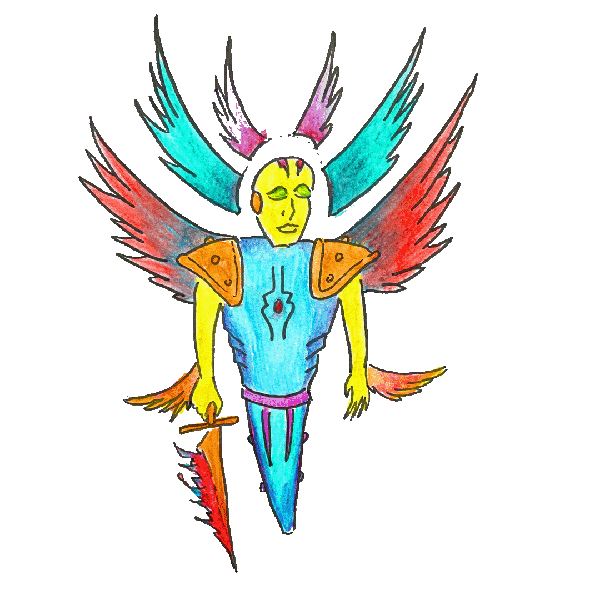
SCP-001 is a Keter class entity (we’ll explore Keter anomalies in the next post). The Gate Guardian is humanoid in shape and about 700 cubits high (1033 feet). It possessed luminous wings sprouting from its shoulders, back, temples, angles and wrists. 

Where Do SCP Entities Come From?

At the core of the SCP Foundation’s universe are the SCP entities themselves. These entities can take the form of objects, creatures, locations, or even abstract concepts. Each SCP entity is assigned a unique identification number and accompanied by a detailed document known as an SCP entry. These entries serve as containment protocols, scientific analysis, and records of incidents related to the respective SCPs.

There is no single source for the development and discover of SCP Entities. Their origins are a who’s who of supernatural and strange.

Natural phenomena: Some SCP entities arise from natural occurrences or anomalies that exist within the fabric of the world. These could be inherent abnormalities in nature or manifestations of unknown forces.

Human-created anomalies: Certain SCP entities are the result of human experimentation, scientific accidents, or the misuse of advanced technologies. These anomalies can possess dangerous and unpredictable characteristics.

Extra-dimensional or inter-dimensional entities: SCP entities may come from alternate dimensions, parallel universes, or realms beyond conventional human perception. These entities often possess abilities or properties that defy the laws of our reality.

Supernatural or mythological origins: SCP entities can be rooted in ancient legends, myths, and folklore. They may be ancient beings, deities, or spirits with immense power and influence.

Extraterrestrial sources: Some SCP entities have extraterrestrial origins, originating from other planets, distant galaxies, or encounters with unidentified flying objects (UFOs). These entities may have arrived on Earth through various means, bringing with them their unique traits and abilities.

Anomalous artifacts or objects: SCP entities can also be tied to anomalous artifacts or objects with mysterious origins. These items may possess inherent properties that give rise to or house the entity within them.

Collaborative Creation

One of the defining aspects of the SCP Foundation project is its collaborative nature. A community of writers and fans passionately contributes to the ongoing development and expansion of the SCP universe. Individuals can create new SCP entities, provide feedback, and engage in discussions. This collaborative approach has led to a diverse and ever-growing collection of SCP entities, each with its own intriguing narrative and characteristics. As of now, there are over 6000 documented entities.

Tim Kane

[mailerlite_form form_id=2]