Will O’Wisp: Tricksters Who Lure Travelers into Danger

Arkane Curiosities

Blue balls of flames burn in the night, hovering over the marshes. They lure travelers into danger and soon you’re sinking in a peat bog or tumble off a cliff. Also called ignis fatuus (Medieval Latin: “foolish fire”), these tricksters prey on the unsuspecting.

Word Origin

A “wisp” is a bundle of sticks or twisted paper used as a torch. Combined with the name “Will” we get Will-o’-the-wisp (literally “Will-of-the-torch”). Originating in England, these floating lights have crossed the pond and are known as “spook-lights”, “ghost-lights”, or “orbs” in the States. 

Other names for these mischievous nighttime tricksters are Hobby-Lantern, Jack-o’-Lantern, Jenny-Burnt-Tale, Kitty-Candlestick, and Peg-a-Lantern.

Evil Spirits

The Will-o’-the-wisps are considered a kind of evil spirits intent on diverting people off established roads. Their goal is to strand people in the wild with no hope of every reaching the land of the living again. 

On origin story, from Scotland, claims this wispy spirit is actually a deceased blacksmith names Jack. He was denied admittance to hell (which in Scottish lore is known as “the place of the wind of the cold passages, or the wind of the cold channels”). The devil gave Jack a single ember to warm himself as he wandered the mortal plane. It’s this light you see floating over the marshes — the Jack o’Lanten. 

Goblins with Lanterns

In Wales, the Will-o’-the-wisp goes by the name Ellylldan or Pooka (this is where we get the name Puck or Pwca). In this version, a farmer returns home after working the fields and sees a light bobbing before him. A small shadowy figure holds a lantern above its head. 

The farmer follows the light for miles only to find himself on the edge of a high cliff. Far below, a river rages. At this moment, the goblin leaps across the chasm and lands on the opposite side. It utters a malevolent laugh and blows out the lantern, leaving the farmer stranded in the dark. 

Lost Souls

Other versions of this myth have it that the Will-o’-the-wisps are the souls of unbaptized children. They cannot enter heaven and thus must roam the earth forever. They linger in dark forests and deserted places. 

If they spot a person at night, these lost souls hurry over and guide the traveler to water. Not in any attempt to drown the person, but in order to get baptized. 

There is a story from the Netherlands involving a certain Gandshoven from Molenbeek. When he encountered three will-o’-the-wisps, he baptized them. In that instant, thousands more will-o’-the-wisps surrounded him, all wanting the same treatment. Gandshoven spent the whole night baptizing them until the sun rose. 

So if you see a light bobbing mysteriously in the night, maybe leave it be. Who knows where it might lead you.

Tim Kane

[mailerlite_form form_id=2]

Flying Head Vampire: The Penanggalan

Arkane Curiosities

In Malaysia the Penanggalan detaches its head, leaving its body behind as an empty husk. This flying head vampire seeks out pregnant women to drain their blood. In fact, “Penanggal” or “Penanggalan” in Malay literally means “to detach” or “to remove”. But it’s not just the head. The internal organs dangle below, twinkling like fireflies.

Invisible Tongues

The Penanggalan, who always appears as a woman, looks completely normal during the day. She’ll avoid eye contact and smell strongly of vinegar (a tool of the vampire trade). Typically, Penanggalans take jobs as midwives. 

At night, it twists its head off and soars through the air, intestines and organs dangling below it. The Penanggalan perches on the roof and waits for the woman to go into labor. Then it wriggles an invisible tongue into the house to drain the blood from the mother. 

Legend has it, the tongue can pass through walls or slither through floorboards to reach its victim. Alternately, it will entwine the victim in its long intestines. 

Vinegar Bath

Upon reaching home again, the Penanggalan takes a quick dip in a tub of vinegar. Why, you ask? The vinegar shrinks the organs so it can squirm back into the body suit and pretend to be a person again. 

Snag Those Intestines

Want to keep yourself safe from this horrific creature? Your best bet is to snag those dangling intestines. Often people will scatter thorny leaves on roof or windows. Additionally, they might plant a pineapple tree under their house (Malaysian houses are built on stilts).

Still want a little more protection? Slide a pair of scissors under your pillow.

Mess With the Body

If your intent is to stop the Penanggalan for good, you’ll need to track the vampire to its lair (possibly by following anyone with the strong scent of vinegar). When the head detaches for the nightly peregrinations, you go to work. 

Fill the empty body with shards of broken glass. Then, when the creature returns to crawl into its body, the glass will shred the vampire’s organs. 

If you simply want to mess with the Penanggalan, just flip the body over. These creatures don’t really understand how human bodies work. It will reattach backward. Then the head will be facing in the wrong direction (an easy way to spot the vampire). 

Tim Kane

[mailerlite_form form_id=2]

Shirime: the Eyeball Butt Yokai

Arkane Curiosities

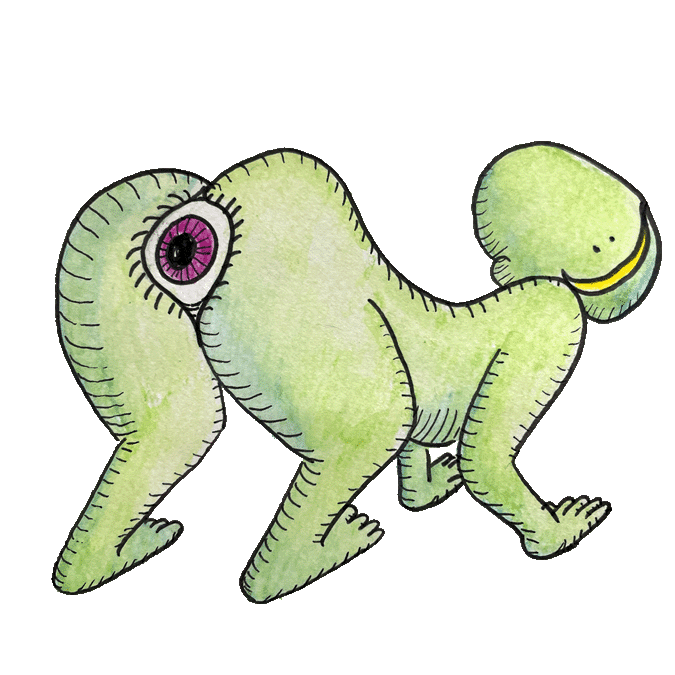
To the Western mind, images of ghosts and the supernatural conjures up amorphous spirits or tall creepy slender men. But in Japan, the supernatural takes a hilarious and often creepy twist. The word Yokai can be translated as monster, demon, spirit, or goblin and the come in many strange and bizarre forms. Yet, perhaps none more peculiar than the Shirime or eyeball butt yokai.

It’s Looking at You

The word “shirime” translates literally to “butt eye” but it also has the meaning of a “backward glance”, which is quite literal to how this yokai looks at you. The shirime has the body of a man or woman, but instead of a face, it has a single large eyeball where its butthole should be. Other meanings for “shirime” have qualities of distress, which seems to be the motivation for this prankster creature. 

A Supernatural Flasher

The shirime approaches you looking, in all respects, like a normal person. It wears a kimono and asks you for a moment to spare. Once it has your attention, the kimono drops away. You see that this person has no facial features. It bends over, spreading its butt cheeks, to reveal a single eyeball, shining like lightning. 

And that’s it. It doesn’t do anything else to you. Shock seems to be this creature’s only purpose. 

Origin

Little is known about this yokai. A Japanese poet, Yosa no Buson, wrote the first and only encounter with this supernatural being. Some believe that shirime’s true form is just an animal, shapeshifting into a disturbing form in order to play a practical joke on us humans.

Tim Kane

[mailerlite_form form_id=2]

Ashiarai Yashiki: Giant Ghostly Foot

Arkane Curiosities

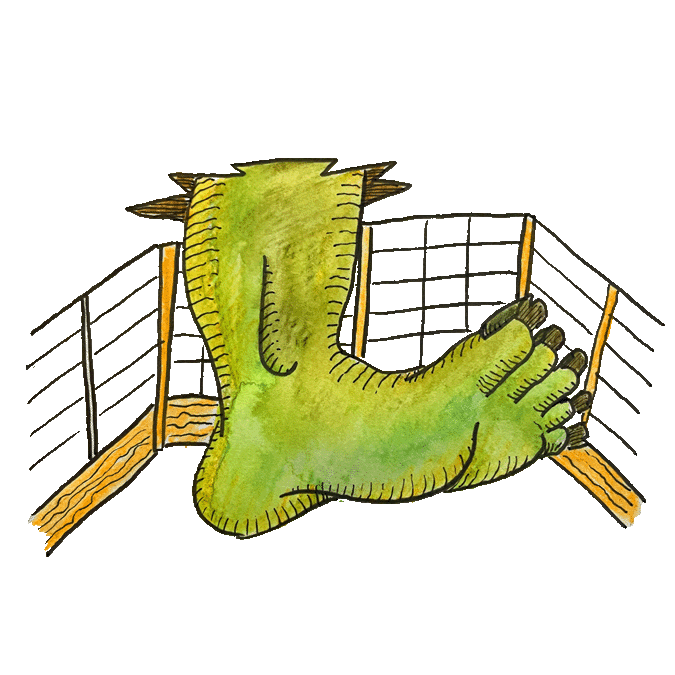
Sometimes ghosts are missing body parts. Headless specters abound (looking at you Nearly-Headless Nick). There are even ghosts with several arms or legs. Yet in Japan, we have a ghost who is only a foot. A giant ghostly foot that desires you to clean it — the Ashiarai Yashiki.

Nocturnal Foot Washing

The Ashiarai Yashiki appeared suddenly in front of the door of a house. The occupants heard a booming voice shout out:

“WAAAASH MY FOOOOT!”

The ceiling splintered as a gigantic foot smashed though. This massive foot was covered in bristly thick hair and terribly filthy.

If the people refused to wash the foot, the yokai would stomp around, causing earthquakes and other natural disasters until its demands were met.

A Deceased Merchant

According to some variations of the legend, the Ashiarai Yashiki is actually the spirit of a wealthy merchant who was so obsessed with cleanliness, he would force his servants to wash his feet every night. When he died, his spirit was unable to rest and took on the form of the giant foot, continuing to demand that people wash it.

Maybe You’re Guilty of Something

The Ashiarai Yashiki could also be a play on words. In ancient times, “to wash one’s feet” meant to be cleared of crimes and allegations. This would suggest that a visitation by the Ashiarai Yashiki meant the occupant was guilty of some crime. The yokai came to punish the criminal for their misdeeds. 

Tim Kane

[mailerlite_form form_id=2]

Hungry Ghosts: Mischievous Spirits

Arkane Curiosities

In Japan, ghosts can be much more than simply chain-rattling spirits. They hunger, and not only for the things you expect. Some of the hungry spirits (or Gaki) yearn for vomit or baby poop (yes, you heard me right). Many of the Gaki originate from sins people did while alive, a group of hungry ghosts are nothing more than mischievous spirits, called yasha.

Nature Spirits into Demons and Back

The yasha are supernatural beings that can range from caring to murderous. They began in India as benevolent nature spirits who watched over the earth and the forests. Yet as they migrated into China, they shifted into ghost-like spirits who preyed on travelers. 

Finally, as these spirits entered Japan, they were seen as a demon-god (kijin) to be worshiped and feared. They mixed with the legends of the amanojaku and oni.

The Last Twenty Gaki

In the last post, we explored the first sixteen hungry ghosts. Here are the other twenty to make the full consort of 36.

17 Underworld Ghosts

These spirits live in caves or with snakes in their burrows. They suffer from hunger and chills, a result of extreme thirst. These Gaki can also create epidemics. In life, they put someone in jail for personal gain. 

18 Supernatural-Power Ghosts

The most powerful of the Hungry Ghosts, these spirits may experience some joy. They inhabit the deep mountains, the middle of the sea, or other remote locations. Demons surround them, constantly staring at them. In life, they abused power by stealing other people’s property. 

19 Blazing Ghosts

The bodies of these spirits continually burn with a blazing fire, making them cry out in pain. They wander the countryside, desiring to loot villages or robbing people. In life, they looted and robbed. 

20 Infant-Excrement-Eating Ghosts

Only the excrement of babies will do for these spirits, who linger around cribs. They target mothers who let their babies sit in their own poop too long. When a child cries, people believe that the ghost has appeared to the child. These spirits are yakṣa rather than the  deceased.

21 Desirable Appearance Ghosts

These ghosts will shift appearance, becoming attractive or repulsive to gain access to food. They can prey on people’s lust. Additionally, they can transform into animals to swoop in to steal food. These spirits are considered yakṣa, a class of nature-spirits. 

22 Island Ghosts

These spirits are always thirsty and live on uninhabited islands. They slurp up the morning dew, but it offers them little respite. The heat of even a single winter day would feel hotter than ten-times a summer’s day. In life, these people abused those in difficult situations, like refugees or lost travelers. 

23 Assistant-to-the-Underworld Ghosts

Also known as Assistants of Yama Armed with Sticks, these hungry ghosts managed other ghosts and spirits. Yama, the Indian god of the Dead, record sinful acts committed by humans and bring these sinners back to Yama. Physically, they have scrunched-up hair draped over their faces and long ears with protruding stomachs. People pray to these ghosts on their deathbed, which means these Assistants linger between the human world and the underworld. 

24 Child-Eating Ghosts

These Gaki are malicious, feeding off the energy of infants. They wander in search of children to kidnap, but are often unsuccessful (thus their hunger). In life, they were healers who promised to cure a sick person with prayers, but abused their position. 

25 Energy-Eating Ghosts

These Gaki lurk around critically ill people and siphon off their energy. They might also target depressed people, gradually creeping into that person’s life to absorb their “vital energy.”

26 Brahmanic Rākṣasa Ghosts

These ghosts haunt crossroads and back all eyes. They linger and await the right opportunity to latch onto a victim and possess the body. While controlling the person, they will act recklessly in an attempt to kill the person. In life, these people were religious leaders who lost their faith. 

27 Hearth Ghosts

These Gaki loiter in kitchens or religious establishments to steal food. They also gorge on temple leftovers, mixed with coal. In life, these were people who stole food from religious sites. 

28 Dirty Street Ghosts

These Gaki live on dirty city streets, skulking in places where vomit and urine stains the streets. They dine off this refuse as their nourishment. 

29 Wind-Eating Ghosts

Each time this ghost reached for food or drink, it proves to be an optical illusion and vanishes with the wind. They are tormented by illusions of sustenance, only to have nothing in the end. In life, these people made empty promises and donations to charity. 

30 Coal-Eating Ghosts

These hungry ghosts wander through cemeteries, searching for the remains of a cremated body. They then scarf down the ashes generated from cremation fires. In life, they were in charge of prisons and let the inmates suffer from hunger. 

31 Poison-Eating Ghost

These ghosts nosh on poisonous fumes and toxic grass. Their food ends up killing them and then they regain their life only to hunger for these poisons again. They live in caves on mountains with extreme hot or cold weather. The mountains are home to wild beasts (lions, hawks or tigers) who pluck out the eyes of these unfortunate Gaki. Additionally, it can sometimes rain knives from the sky. In life, they poisoned someone to steal that person’s property. 

32 Jungle Ghosts

These Gaki roam the jungle, driven by intense hunger. As they traverse the wilds, branches and thorns cut their skin, jungle animals attack them, and fierce birds swoop down. When they finally arrive where they think there’s food, they discover it’s the wrong place. These ghosts are punished for a very specific punishment. Often, virtuous men would plant trees and provide people with water while traveling. These thieves steal the water, making the travelers thirsty and weak, and thus easier to rob. 

33 Living-in-Cremation-Grounds and Eating-Hot-Ashes Ghosts

Similar to the Coal-Eating ghosts, these long titled ghosts lug instruments of torture on their back to mimic the acts they committed in their former lives. In addition, they also carry red-hot irons on their head. In life, they stole offerings and flowers from temples.

34 Living-in-Trees Ghosts

These ghosts are reborn inside trees, where insects and animals chew away their bodies. Also, the weather that batters the tree also affects these ghosts. It’s believed that hermit monks, who live away from civilization, will be tormented by entire forests of these Gaki. In life, they stole wood from Buddhist temples.

35 Crossroads Ghosts

These ghosts reside in the classic haunted area of crossroads. People will make offerings to these spirits to ward off illness or difficulties at work. In life, they stole food from travelers who were crossing through remote parts of the world. 

36 Mara-Body Ghosts

These Gaki superficially feed off the confusion generated by the daily lives of Buddhist temples. They frighten monks with sinister sounds or nightmares. Their goal is to disrupt and undermine the entire community. In life, these people spouted false doctrines. 

Tim Kane

[mailerlite_form form_id=2]