Enigmatic Euclid SCP Entities

Arkane Curiosities

In the elusive world of the SCP Foundation, thousands of entities exist. Knowing how to separate the safe from the dangerous is essential. Euclid entities are like that mysterious neighbor down the street who keeps you on your toes. They exhibit anomalies or properties that are not fully understood, making their behavior unpredictable or variable. These entities can range from harmless to potentially dangerous, demanding careful observation and containment measures. Euclid SCP entities require a certain level of vigilance, as their actions and effects may fluctuate, causing researchers to remain on alert.

Origin of the Category

The name “Euclid” draws its inspiration from Euclidean geometry, developed by the ancient Greek mathematician Euclid. Euclidean geometry is based on a set of principles and axioms that define geometric shapes and their relationships within a three-dimensional space.

The term “Euclid” serves as a classification for abnormalities who are less dangerous and more predictable than their more dangerous, Keter, counterparts. These entities require continuous observation and cautious containment due to their unpredictable nature.

Examples of Euclid Entities

While there are thousands of abnormalities that fall between the bending “Safe” and the dangerous “Keter”, here are a few that stand out.

SCP-049: The Plague Doctor

SCP-049 appears as a humanoid figure dressed in a long, black robe and wearing a traditional plague doctor’s mask. It seeks to “cure” individuals it deems to be infected with an incurable disease, referred to as the “Pestilence.” 

Their touch is lethal. But that’s not the end of things. The Plague Doctor will produce a black leather bag containing various medical tools, including scalpels and vials of an unidentified substance. The “surgery” will revive the victim, but in a feral and aggressive state. It will seek out others to attack. 

SCP-173: The Sculpture

If ever there was an expert at catching you off guard, it’s SCP-173. A seemingly harmless concrete sculpture, SCP-173 possesses the uncanny ability to move at staggering speeds whenever you blink. It cannot move while being looked at. However, looking away, even for an instant, will allow it to move significantly closer to you. If it reaches you, it will snap your neck. 

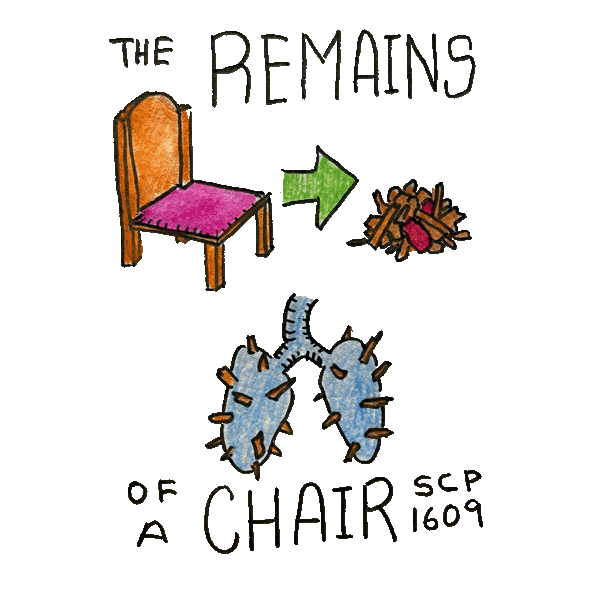
SCP-1609: The Remains of a Chair

SCP-1609 used to be a chair. It was created by an unknown man only known as “The Carpenter”. The object was meant to help people by instantly teleporting to anyone who needed to sit down and rest. 

The Global Occult Coalition seeks to protect humanity from anomalous entities. Thus they put the chair through a wood chipper. Although reduced to wood chips, SCP-1609 retained its sentience, though now obviously hurt and scared. It harbors a deep hatred for the GOC and now will teleport into the lungs of those that anger it, killing the person from the inside. 

To keep the entity safe, the SCP Foundation uses the wood chips as a mulch for a flower garden. Operatives pacify the entity by complementing it on the beautiful flowers it has grown. 

SCP-3008: The Infinite IKEA

Imagine stepping into an IKEA store and never finding a way out. Welcome to SCP-3008, where shopping becomes an otherworldly ordeal. Once inside this innocuous furniture store, the surroundings stretch out indefinitely, trapping unfortunate customers within its maze-like aisles. Survivors must navigate a bizarre retail landscape, braving strange humanoid creatures known as “Staff Members”.

“Staff Members” look humanoid, but with no facial features. They wear an IKEA-like uniform and during the daylight hours will not bother anyone walking through the store. However, at night, they pursue you, saying things like “The store is now closed. Please exit the building.” If killed, they will not bleed or decay. 

Conclusion

Navigating the Euclid SCP entities is akin to playing interdimensional hopscotch blindfolded. Each step unravels a new layer of strangeness. These strange anomalies are a testament to the mind-expanding wonders that exist just beyond our ordinary perceptions.

Tim Kane

[mailerlite_form form_id=2]
Thaumiel-Class Entities of the SCP Foundation

Arkane Curiosities

In the vast universe of SCPs, Thaumiel-class entities are the hidden gems. They possess the power to subvert, neutralize, or harness the abilities of other anomalies, making them invaluable tools for maintaining cosmic order. It’s as if the SCP Foundation has stumbled upon an alien civilization that has mastered the art of anomaly taming.

The Meaning of Thaumiel

Within the SCP Foundation mythos, Thaumiel is a classification used to identify anomalies that possess the unique ability to aid in the containment or control of other anomalies.

The term itself draws inspiration from the Kabbalistic Tree of Life, specifically from the Sephirot of the same name. In Kabbalah, Thaumiel represents a realm of duality and the opposing forces of chaos and disorder. In other words, this SCP Foundation must use these shadowy entities for the sake of containing even more dangerous entities. 

Examples of Thaumiel Class Entities

Imagine a device that can manipulate the fabric of reality itself to keep other anomalies in check. Or a sentient entity capable of traversing dimensions to lock away rogue phenomena. These Thaumiel-class SCPs possess the kind of technological prowess that would make even the most advanced alien civilizations raise an eyebrow.

SCP-179: Sauelsuesor

This entity is humanoid and orbits our sun, whom she calls brother. Her skin is a matte-black and she has long hair that drifts for kilometers. Some sources state that her hair reaches into the very core of the universe. A series of tattoos or markings run along her midline.

As a Thaumiel-class entity, she is a valuable ally to the SCP Foundation. She points out threats that might affect Earth. The SCP Foundation has been able to avoid these threats or capture them for study. 

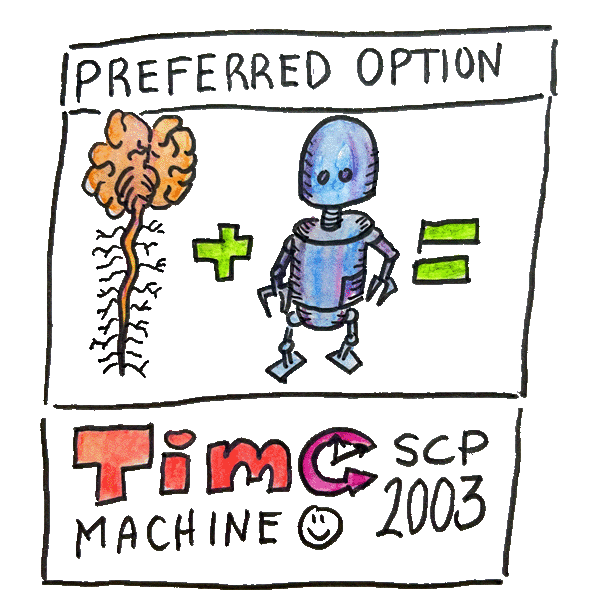
SCP-2003: Preferred Option

This is a machine built by the SCP Foundation over a period of 25 years. It allows a limited degree of time travel with a serious caveat: it is deadly to all forms of life. The only tissue that can survive the time travel is the nervous system and brain. Thus agents designated for time travel must have their brains and spinal columns removed and housed inside a robotic body. 

SCP-3000: Anantashesha

This Thaumiel-class SCP entity is a massive, 300 mile long eel creature residing in the Bay of Bengal. Also known as Endless Sesha or the King of Nagas, many thing that Anantashesha is actually a primordial deity. While awake, Anantashesha will devour anything it comes across. Luckily, it spends most of its existence snoozing on the seafloor. However, even looking at this creature is dangerous as it can cause paranoia and memory loss. 

The SCP Foundation has found use for such a daunting entity in a goo secreted after it has eaten. Dubbed Y-909, this compound is used to erase memories as well as making people susceptible to hypnotic suggestions. 

Tim Kane

[mailerlite_form form_id=2]
Unraveling the Veil: The Origins of SCP Entities

Arkane Curiosities

In the darkest recesses of our world, where reality intertwines with the unfathomable, lies a secret organization tasked with containing and studying the most extraordinary and perilous entities known to mankind. Welcome to the realm of the SCP Foundation. Step into a world where the laws of nature unravel, and the impossible becomes tangible. But what exactly are these creatures and what are the origins of SCP entities?

The Birth of the SCP Foundation

The SCP Foundation (which stands for Secure, Contain, Protect) emerged in 2007 in the “paranormal” /x/ forum of 4chan. An anonymous user posted the original thread introducing the concept of the SCP Foundation, a secret organization dedicated to securing, containing, and protecting anomalous entities and phenomena. This user was later identified as Moto42. People expanded on the post and soon a wiki was set up to explore the concept of the SCP Foundation. 

To understand the origins of SCP entities, we simply look back to  legends and myths from all over the world. Supernatural beings and unexplained events have always been with us. These stories serve as precursors to the modern SCP entities, hinting at a long history of the abnormal intertwined with human existence.

The First Entity

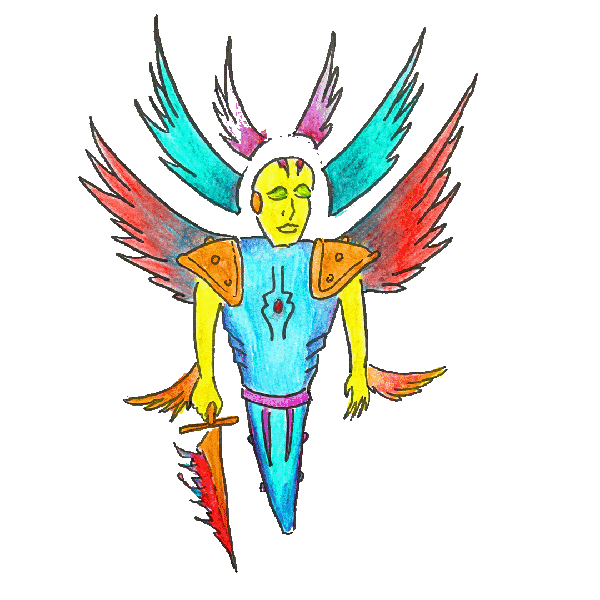
The annals of the SCP Foundation record the inaugural SCP entity: SCP-001. Often referred to as the “Broken God” or “Gate Guardian,” this entity holds a unique position within the SCP Foundation. It is the subject of intense debate and speculation, with multiple conflicting theories surrounding its true nature.

SCP-001 is a Keter class entity (we’ll explore Keter anomalies in the next post). The Gate Guardian is humanoid in shape and about 700 cubits high (1033 feet). It possessed luminous wings sprouting from its shoulders, back, temples, angles and wrists. 

Where Do SCP Entities Come From?

At the core of the SCP Foundation’s universe are the SCP entities themselves. These entities can take the form of objects, creatures, locations, or even abstract concepts. Each SCP entity is assigned a unique identification number and accompanied by a detailed document known as an SCP entry. These entries serve as containment protocols, scientific analysis, and records of incidents related to the respective SCPs.

There is no single source for the development and discover of SCP Entities. Their origins are a who’s who of supernatural and strange.

Natural phenomena: Some SCP entities arise from natural occurrences or anomalies that exist within the fabric of the world. These could be inherent abnormalities in nature or manifestations of unknown forces.

Human-created anomalies: Certain SCP entities are the result of human experimentation, scientific accidents, or the misuse of advanced technologies. These anomalies can possess dangerous and unpredictable characteristics.

Extra-dimensional or inter-dimensional entities: SCP entities may come from alternate dimensions, parallel universes, or realms beyond conventional human perception. These entities often possess abilities or properties that defy the laws of our reality.

Supernatural or mythological origins: SCP entities can be rooted in ancient legends, myths, and folklore. They may be ancient beings, deities, or spirits with immense power and influence.

Extraterrestrial sources: Some SCP entities have extraterrestrial origins, originating from other planets, distant galaxies, or encounters with unidentified flying objects (UFOs). These entities may have arrived on Earth through various means, bringing with them their unique traits and abilities.

Anomalous artifacts or objects: SCP entities can also be tied to anomalous artifacts or objects with mysterious origins. These items may possess inherent properties that give rise to or house the entity within them.

Collaborative Creation

One of the defining aspects of the SCP Foundation project is its collaborative nature. A community of writers and fans passionately contributes to the ongoing development and expansion of the SCP universe. Individuals can create new SCP entities, provide feedback, and engage in discussions. This collaborative approach has led to a diverse and ever-growing collection of SCP entities, each with its own intriguing narrative and characteristics. As of now, there are over 6000 documented entities.

Tim Kane

[mailerlite_form form_id=2]
Counting Crows: What the Number of Crows Symbolizes

Arkane Curiosities

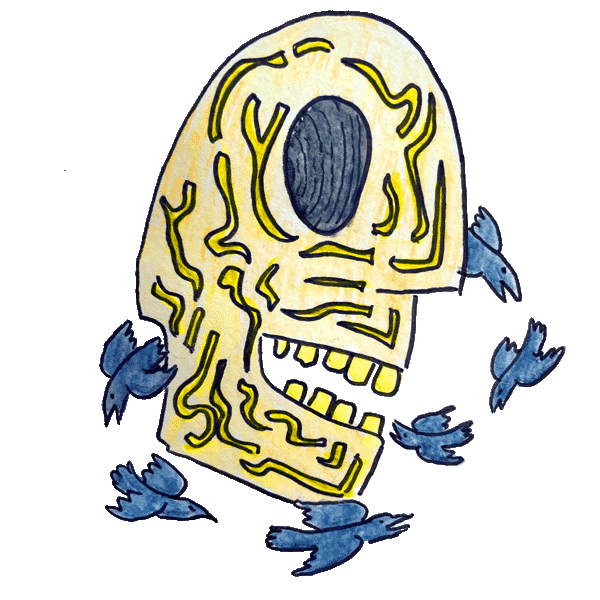
Sure, a big flock of crows is a murder. But often you’ll only see a few crows at a time. In some cultures, crows are associated with intelligence, mystery, and magic. The number of crows symbolizes different things, from good luck to death.

One Crow

Crows are linked with the afterlife and death. Seeing a single crow means you have a message from someone recently deceased. This often means bad luck for you. 

Two Crows

If one crow means destruction, a pair of crows signifies harmony and good luck. New opportunities are coming your way. A new chapter of your life is about to begin. 

Three Crows

Bad luck comes in spades when you see three crows together. Something is going to die. It could be an old relationship. It could mean illness will strike a loved one. At the very least, you’ll get some bad news. 

Four Crows

Four crows on the horizon? Cash is coming your way. Four crows symbolizes good luck and prosperity. Maybe a promotion at work or you discover a new source of income. Either way, take advantage of this opportunity. You’re on the right track.

Five Crows

Five crows represents sickness. You or a family member might catch an illness or suffer mental distress. 

Six Crows

This is the most powerful bad luck. Six crows? Tread carefully the next few days. You might have something stolen from you… or you can lose your life. Impending doom is on your way with five crows. This moment of destruction will transform everything, possibly leading to a new beginning. The destructive event you face could be a minor bump, like a car accident. Or it could be a full on disaster. In any event, dark days are coming your way. 

Any more than six crows and let’s face it, you have a murder of crows. 

Tim Kane

[mailerlite_form form_id=2]

The Dancing Hut of Baba Yaga

Arkane Curiosities

Picture a small thatched hut of warped boards, old rusty nails, and decaying thatch. Bizarre symbols and human skulls adorn the walls. You step too close and the hut rises up, perched atop gigantic chicken legs growing out of the foundation. This is the dancing hut of Baba Yaga, one of the most bizarre and bewildering sights in all of Slavic folklore.

The Dancing Hut

The Dancing Hut was originally a simple wooden cabin, built by Baba Yaga as a place to retreat and conduct her sorcery in solitude. Over time, however, the Hut began to take on a life of its own, growing in size and becoming increasingly twisted and malevolent. Perhaps, Baba Yaga cast a powerful enchantment on the Hut, imbuing it with a sinister sentience that allowed it to move and dance of its own accord.

Why chicken legs? Does Baba Yaga have a fondness for poultry? It might be a nod to the ancient Slavic tradition of using chicken feet in various magical rituals. Baba Yaga simply incorporated this imagery into the Hut as a symbol of her power.

One site mentions that Baba Yaga’s hut might not have always resided atop chicken legs (or курьи ножки meaning chicken bones). Instead it might have sat on smoked legs (курные). This is the practice of setting a house up on wooden struts saturated with smoke to avoid rot. This was common in the houses of the dead where Slavic people stored the ashes of their ancestors. 

Ditching the Broomstick

Baba Yaga didn’t use the conventional methods of flying like a broomstick or flying carpet. Picture, if you will, a gigantic wooden mortar, with a pestle as long as a tree trunk jutting out from one end. Baba Yaga sat in the hollowed-out bowl of the mortar, gripping the pestle like a joystick, cackling maniacally as she hurtled through the skies. Yes, you read that right. A mortar and pestle, the kind used for grinding herbs and spices in the kitchen.

She did incorporate a broom in flying. Not for the flying part, but to keep her peregrinations secret. The witch gripped a broom constructed of silver birch and swept away any traces of her passage. 

Be Warned

For those brave enough to seek out Baba Yaga and her dancing hut, the rewards can be great. The witch is known to possess great knowledge and power, and those who approach her with respect and humility may find themselves blessed with her gifts. 

But be warned: Baba Yaga is a creature of chaos and contradiction, and her dancing hut is but one facet of her strange and otherworldly existence. To encounter Baba Yaga is to embark on a journey that is both perilous and profound, a dance with the unknown that may lead to either enlightenment or destruction.

Tim Kane

[mailerlite_form form_id=2]