How to Annoy a Vampire

Arkane Curiosities

I watched an old documentary on Vlad Dracula hosted by none other than Vincent Price. Most of the information I was already aware of, but one bit jumped out at me. A unique way to annoy a vampire involving sound.

The Resonant Toaca

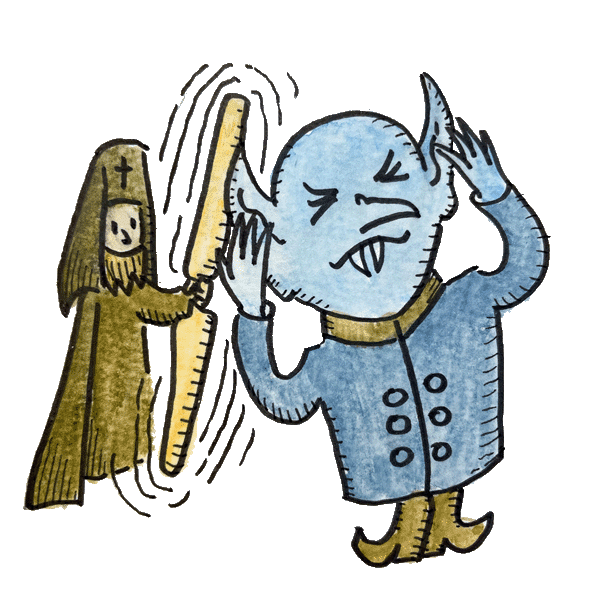
This documentary showed an Orthodox priest walking through town carrying a large piece of wood, called a toaca. This is a type of portable sematron used to create sound. He would bang on the toaca with a hammer as a way to keep vampires away. Despite scouring the Internet, I can’t find an exact reason for this. My best guess is that it annoyed the vampire. 

Make Your Vampire Do Math

I’ve posted about this before, but the toaca reminded me of another way to annoy vampires. I’d first learned about this in an X-Files episode (Bad Blood). Here we see the quintessential way to piss off a vampire. 

Many Slavic people believe that vampires were forced to count the holes in fishing nets or the number of scattered seeds. It was common for townsfolk to hang a net over their door or spill seeds on the stoop as a way to deter would be blood-drinkers. The most common seed used was mustard seed, also known as eye of newt.

So folks, want to annoy the bejeezus out of your local vampire? Start banging on some wood. And be sure to scatter seeds all over the place. You’ll be safe… at least until the vampire gets done counting.

Tim Kane

[mailerlite_form form_id=2]

Grúacach: Wild Goblins of Ireland and Scotland

Arkane Curiosities

In the folklore of Ireland and Scotland, amidst the emerald landscapes and misty hills, resides wild goblins called Grúacach (also Gruagachs or even Brownies). These spirits are often associated with the land and are believed to inhabit certain natural features or landmarks, rather than constructed houses.

Helpful Spirits

The Grúacach is described as a small, hairy, humanoid figure, often depicted as having wild, untamed hair and a disheveled appearance. It dresses in animal hides or simple clothing, and possessing a playful or helpful disposition.

Grúacachs reside in and around homes, especially in remote or rural areas, where they form a close bond with the family or individuals — assisting with household chores, farming tasks, and general maintenance of the home. 

Given the ability to become invisible, they prefer to operate in secret, shying away from direct acknowledgment. But you can reward the Grúacach with a jug of cream. 

Though generally gentle and helpful, Grúacachs will often scuttle about and get under your feet. Also, if they feel unappreciated, neglected, or slighted in any way, they might play tricks or pranks on the occupants of the home.

If your Grúacach becomes a nuisance, simply invite over a member of the clergy. These spirits have a great fear of priests and will there presence will drive the Grúacach away. 

Nature Guardian

The Grúacach is believed to have a strong connection to nature, particularly the forests and streams. It is said to be protective of the natural world and the creatures inhabiting it. They are often associated with specific ancient sites, sacred groves, or notable landmarks. It’s believed that they dwell within or near these areas, watching over them. 

Since the Grúacach is impervious to extreme temperatures, they can live in any cave, hollow or cleft in the landscape. All around Ireland and Scotland, you’ll find large stones leaned together called Grúacach houses. 

While these spirits are generally helpful, they can display mischievous behavior if angered or mistreated. A Grúacach may engage in pranks or mischief to teach a lesson to those who disrespect nature or its dwelling. It’s customary in Irish and Scottish folklore to treat these beings with caution and respect. People would avoid disturbing their dwellings or disrespecting the natural sites associated with them.

Rooted in Celtic Lands

The legend of the Grúacach is deeply rooted in Irish and Scottish culture, and it embodies respect and reverence for nature and the environment. It also serves as a cautionary tale to treat the natural world and its creatures with care and appreciation.

Tim Kane

[mailerlite_form form_id=2]
Egyptian Field of Reeds, Death is Not the End

Arkane Curiosities

The Egyptians believed that the soul continued on after death. The concept of the “Field of Reeds”, was depicted as a paradise for the soul. Any who lived virtuous lives and adhered to Ma’at, the principle of balance and harmony could journey there.

The Concept of Aaru

The Field of Reeds, also known as Aaru, was depicted as a lush meadow where the soul could exist in a peaceful afterlife. There, the deceased could enjoy their lives in the company of their loved ones, surrounded by the bounties of nature. This celestial paradise was considered the ultimate reward for leading a just and moral life.

Journey to Aaru

A person’s journey to the afterlife was marked by trials and challenges. The heart of the deceased was weighed against the feather of Ma’at in the Hall of Two Truths during the judgment by Osiris, the god of the afterlife. If the heart was found to be lighter than the feather, it symbolized that the individual had led a righteous life and could continue their journey to Aaru. 

No one is quite sure where the “Field of Reeds” lies. It might be in the sky or it might dwell under the earth, in the domain of Osiris. Spell 149 of the Book of the Dead states “I know the gate in the middle of the Field of Reeds from which Re goes out into the middle of the sky”.

Tiny Servants

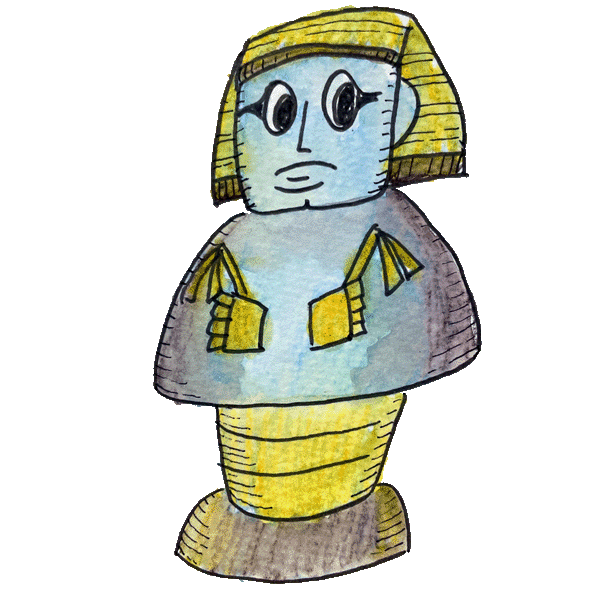
Many Egyptians were buried with shabtis, small figurines intricately crafted to serve the deceased in the afterlife. The word “shabti” originates from the ancient Egyptian work for “stick”. In the New Kingdom, it took on the meaning of “substitute.”

Shabtis were created with the purpose of acting as substitutes for the deceased. One of the tasks in the Field of Reeds was to plough the fields. If one had a shabti, it would magically come to life and plough the field for you. 

Each shabti only worked for one day of the year. Thus if you wanted a relaxing afterlife, you needed to be buried with a whole year’s worth of shabti figures. 

Tim Kane

[mailerlite_form form_id=2]
Egyptian Afterlife: Weighing of the Soul

Arkane Curiosities

The ancient Egyptians believed that all deeds resided in a person’s heart — the bad and the good. When you died, your heart was weighed against the feather of Maat (goddess of truth and justice). This process was called the weighing of the soul and it determined what sort of afterlife you could expect.

Ma’at – A Universe in Perfect Order

The goddess Ma’at was the daughter of Ra and married to Thoth, god of wisdom. But she was so much more than a simple goddess in the mythological hierarchy of Egypt. Ma’at was a primordial force that keep the world working. With Ma’at, the world had order because she kept everything in balance.

The ancient Egyptians believed the universe had an order to it, and it was Ma’at who kept everything in balance. Her name referred to the overarching concept of truth, order, and justice that she represented. The ancient Egyptians believed that the world was maintained through the principles of Ma’at, which included notions of truthfulness, moral integrity, and social harmony.

A Single Feather

The Feather of Ma’at, also known as the Feather of Truth, was a symbolic element in ancient Egyptian mythology and religious beliefs. After death, a person’s soul would enter the Hall of Ma’at in the underworld, where their heart would be weighed against the Feather of Ma’at on a set of scales. 

If the heart was found to be lighter than the Feather of Ma’at, it symbolized that the person had led a virtuous and just life, adhering to the principles of truth and social harmony. The person was deemed worthy to proceed to the eternal paradise known as the “Field of Reeds.”

Should the scales tip unfavorably, signifying a heart burdened with the weight of wrongdoing, a dire fate awaited the soul. Ammit, a fearsome deity with the head of a crocodile, body of a lion, and hindquarters of a hippopotamus, stood ready to devour the heart. The soul of the deceased would then face eternal punishment or be denied access to the afterlife.

The emphasis on the balance between one’s actions and truth echoes the universal human pursuit of leading a morally upright life. The choices we make in life reverberate beyond our existence.

Tim Kane

[mailerlite_form form_id=2]