Egyptian Field of Reeds, Death is Not the End

Arkane Curiosities

The Egyptians believed that the soul continued on after death. The concept of the “Field of Reeds”, was depicted as a paradise for the soul. Any who lived virtuous lives and adhered to Ma’at, the principle of balance and harmony could journey there.

The Concept of Aaru

The Field of Reeds, also known as Aaru, was depicted as a lush meadow where the soul could exist in a peaceful afterlife. There, the deceased could enjoy their lives in the company of their loved ones, surrounded by the bounties of nature. This celestial paradise was considered the ultimate reward for leading a just and moral life.

Journey to Aaru

A person’s journey to the afterlife was marked by trials and challenges. The heart of the deceased was weighed against the feather of Ma’at in the Hall of Two Truths during the judgment by Osiris, the god of the afterlife. If the heart was found to be lighter than the feather, it symbolized that the individual had led a righteous life and could continue their journey to Aaru. 

No one is quite sure where the “Field of Reeds” lies. It might be in the sky or it might dwell under the earth, in the domain of Osiris. Spell 149 of the Book of the Dead states “I know the gate in the middle of the Field of Reeds from which Re goes out into the middle of the sky”.

Tiny Servants

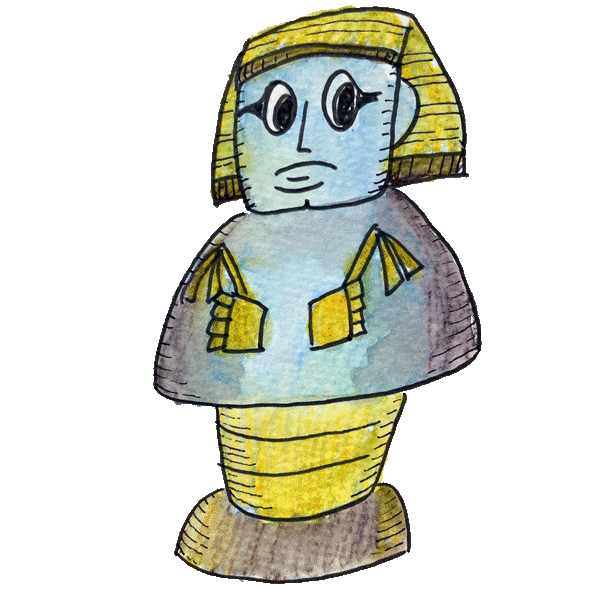
Many Egyptians were buried with shabtis, small figurines intricately crafted to serve the deceased in the afterlife. The word “shabti” originates from the ancient Egyptian work for “stick”. In the New Kingdom, it took on the meaning of “substitute.”

Shabtis were created with the purpose of acting as substitutes for the deceased. One of the tasks in the Field of Reeds was to plough the fields. If one had a shabti, it would magically come to life and plough the field for you. 

Each shabti only worked for one day of the year. Thus if you wanted a relaxing afterlife, you needed to be buried with a whole year’s worth of shabti figures. 

Tim Kane

[mailerlite_form form_id=2]
Egyptian Afterlife: Weighing of the Soul

Arkane Curiosities

The ancient Egyptians believed that all deeds resided in a person’s heart — the bad and the good. When you died, your heart was weighed against the feather of Maat (goddess of truth and justice). This process was called the weighing of the soul and it determined what sort of afterlife you could expect.

Ma’at – A Universe in Perfect Order

The goddess Ma’at was the daughter of Ra and married to Thoth, god of wisdom. But she was so much more than a simple goddess in the mythological hierarchy of Egypt. Ma’at was a primordial force that keep the world working. With Ma’at, the world had order because she kept everything in balance.

The ancient Egyptians believed the universe had an order to it, and it was Ma’at who kept everything in balance. Her name referred to the overarching concept of truth, order, and justice that she represented. The ancient Egyptians believed that the world was maintained through the principles of Ma’at, which included notions of truthfulness, moral integrity, and social harmony.

A Single Feather

The Feather of Ma’at, also known as the Feather of Truth, was a symbolic element in ancient Egyptian mythology and religious beliefs. After death, a person’s soul would enter the Hall of Ma’at in the underworld, where their heart would be weighed against the Feather of Ma’at on a set of scales. 

If the heart was found to be lighter than the Feather of Ma’at, it symbolized that the person had led a virtuous and just life, adhering to the principles of truth and social harmony. The person was deemed worthy to proceed to the eternal paradise known as the “Field of Reeds.”

Should the scales tip unfavorably, signifying a heart burdened with the weight of wrongdoing, a dire fate awaited the soul. Ammit, a fearsome deity with the head of a crocodile, body of a lion, and hindquarters of a hippopotamus, stood ready to devour the heart. The soul of the deceased would then face eternal punishment or be denied access to the afterlife.

The emphasis on the balance between one’s actions and truth echoes the universal human pursuit of leading a morally upright life. The choices we make in life reverberate beyond our existence.

Tim Kane

[mailerlite_form form_id=2]

Egyptian Afterlife: Mummies with Golden Tongues

Arkane Curiosities

The ancient Egyptian civilization has always held an allure of mystery and magic, with intriguing burial rituals and belief in the afterlife. Among the fascinating artifacts discovered in Egyptian tombs are the Golden Tongue Amulets. These small yet significant charms have sparked the curiosity of archaeologists and historians alike, revealing not only the ancient Egyptians’ beliefs but also their artistic craftsmanship. So why do we find some mummies with golden tongues?

The Significance of the Golden Tongue Amulet

The Golden Tongue Amulet is a small, intricately crafted charm that was placed inside the mouths of deceased individuals during the mummification process. These amulets were believed to have magical properties, ensuring that the deceased would retain the ability to speak in the afterlife. 

Protect Your Speech

The Golden Tongue Amulet symbolized the power of speech and communication. In Egyptian mythology, it was essential for the deceased to recite the correct spells and incantations during their journey to the afterlife. The amulet served as a potent talisman, safeguarding the deceased’s ability to speak and express themselves in the presence of divine beings.

Also, during the weighing of the heart, the deceased would need to recite specific spells and declarations to assert their innocence and adherence to the principles of Ma’at. The amulet enabled the deceased to speak eloquently and convincingly before the divine tribunal.

Only Limited Golden Tongues

It’s important to note that not all mummies were found with golden tongues. The practice of adding golden tongue amulets seems to have been more prevalent during the New Kingdom (around 1550 to 1069 BCE). For example, when archeologists found a cache of mummies outside of Alexandria, only two had golden tongues. 

Artistry and Craftsmanship

Despite their small size, these amulets were meticulously crafted from precious metals such as gold, which symbolized the sun and the eternal cycle of life. The intricate details of the amulets, often shaped like small tongues, highlighted the artisans’ dedication to their craft and their reverence for the afterlife beliefs.

Tim Kane

[mailerlite_form form_id=2]