The Cailleach: A Celtic Goddess of Winter

Arkane Curiosities

Just as the Greeks celebrate the change from winter to summer with Persephone arising from the underworld, the Celts had the twin goddesses of Brigid and Cailleach. While the bright Brigid ruled over the summer months, Cailleach was the goddess of winter — the dwindling of the light.

Winter Goddess

Cailleach was known as the Veiled One or the Queen of Winter and she determined the severity of the colder months. Samhain, or October 31st, marked the end of the Celtic year and the start of Cailleach’s reign. This lasted until Beltane, May 1st, when Brigid ushered in the summer months. Some believe there were two aspects of the same goddess. 

This might explain why she aged backward. Cailleach began Samhain as an ancient crone and gradually became younger as the months marched toward spring. Cailleach had total control over the frigid winter winds, being called Cailleach Bhéara in Scotland, the master of winds. She would determine if we received and early spring.

Collecting Firewood

On Imbolc, February 1st, Cailleach ran out of firewood. This forced her to journey out into the woods to collect more. In the Manx tradition, she transformed into a mighty bird, gathering branches in her beak. In Ireland and Scotland, she journeyed out on foot. 

This chore determined how severe the last months of winter would be. If Cailleach wanted winter to go on, she would make the day sunny and bright, allowing her to find more firewood and prolong the harsh winds of winter. However, if she overslept, the day remained gray and stormy, signaling that warmer weather was soon to come. 

This tradition has carried over into the United States as Groundhog Day. It shifted to February 2nd, but the ritual is very similar. A sunny day means that Punxsutawney Phil will see his shadow and bring six more weeks of winter. If the day is overcast, then he won’t see his shadow and we get an early spring. 

Oldest of Them All

There is a legend of a wandering friar and his scribe who chanced upon an old woman’s house (spoiler, this would be our Cailleach). The friar wanted to know how old the woman was, but she had survived so many winters, she couldn’t quite recall. All she did know was that each year she killed an ox and cooked up a soup. Then she’d toss the bones into the attic. 

The friar sent his young scribe scrambling up the ladder to throw the bones down for a count. As the pile grew, the friar soon ran out of paper in which to record the years this old lady had lived. He called up to the scribe to see how many bones were left. The scribe replied that he’d not even cleared one corner of the attic. 

Another tale involved Fintan the Wise, who accompanied Noah’s granddaughter to visit Ireland. This was before the Great Flood and Fintan felt he was the first to set foot on the Emerald Isle. Instead, he discovered Cailleach living in a small hut. 

Fintan was known as the man of a hundred lives, having lived some 5500 years. Yet he surmised that Cailleach was even older than he. He asked her, “Are you the one who ate the apples in the beginning?”, wondering if she might be Eve. He received no answer. 

The Well of Youth and the Green Isle

Perhaps Cailleach (also known as Beria) lived so long because each spring, she drank from the Well of Youth. These magical waters bubble up from the Green Island.This island, visible as only a speck off in the west, was a magical land where the only season was summer. It drifted along with the tides of the Atlantic, appearing off the coasts of Ireland and Scotland. Beria always knew where to find the isle and visited each spring to renew her life. 

Tim Kane
Pray to the Gods to Overcome Writer’s Block

Arkane Curiosities

As long as writing has existed, there have been writers staring at the blank page, utterly blocked. Often, we look to the divine to intervene and help us overcome writer’s block.

Here are three ancient deities of writing that might inspire your to greater narrative glory. 

Seshat, the Mistress of the House of Books

Seshat was a goddess credited with the invention of writing, though her consort, Thoth, received most of the credit. Seshat oversaw all libraries and was the patron of any form of writing. She is seen as either an aspect of Thoth, or his daughter or wife (Egyptian mythology is complicated). 

Seshat would guide the hands of scribes as they held their reeds, helping with their attempts to communicate with the divine. In fact, her name translated to “female scribe”. She is the only Egyptian goddess seen in the actual act of writing. 

Want your writing to live on forever, then Seshat is the one you should look to. The Egyptians believed that everything done on Earth was mirrored in heaven. When an author pens a story on the mortal plane, an ethereal copy was also created in the celestial realm. Seshat then placed this book in the library of the good, preserving it forever. Thus, when you pass on as a writer, everything you’ve written is waiting for you on the other side. 

Quetzalcoatl, the Rescuer of Light and Knowledge

After the world was created, the gods and humans lived together in harmony. Only Quetzalcoatl felt sorrow for he saw that the humans were subjugated by the other gods. Quetzalcoatl adopted the human form to share divine knowledge and writing with humankind. 

Quetzalcoatl was the god of writing and books. His name comes from the Nahuatl and is a compound of “Quetzal” and “Coatl”, or a combination of bird and snake. He was venerated in religious colleges and temples, where future priests were educated. 

The “Plumed God” consistently went out of his way to help us poor humans. According to legend, the Aztec people ate only roots and wild game. They knew about maize, but the plant only grew on the other side of a great mountain range. Other gods attempted to move the mountain with brute force. 

Only Quetzalcoatl used his wits. He noticed a stream of ants marching over the mountain. He transformed himself into an ant and finally reached the fields of maize. Still in ant form, he retrieved a single kernel and brought this back to the Aztec people, thus bringing them the gift of maize. 

Saraswati, Giver of Speech

The Hindu goddess Saraswati embodies all of the arts. She endowed us the Hindu people with speech, wisdom and the ability to learn. She is depicted with four hands, each representing aspects of human learning — mind, intellect, alertness and ego. In one hand she holds a lotus, the symbol of knowledge and the opposite hand, she grasps the sacred scriptures, the Vedas. 

A Hindu festival celebrates Saraswati’s birthday, on the fifth day of the month of Magha, known as Saraswati Puja and Saraswati Jayanti in India. Families encourage their young children to write their first words with their fingers, the very first step in writing. Educational institutions decorate statues of Saraswati, and often arrange poetic and musical celebrations. 

A Sanskrit mantra can be said to the goddess, asking to grant knowledge and wisdom. Here is the the Sanskrit version: 

“Om Saraswati Mahabhagey, Vidye Kamala Lochaney
Viswarupey Vishalakshmi, Vidyam Dehi Namohastutey
Jaya Jaya Devi, Charachara Sharey, Kuchayuga Shobhita, Mukta Haarey
Vina Ranjita, Pustaka Hastey, Bhagavati Bharati Devi Namohastutey.”

The English translation shows off the beauty of this mantra: 

“May Goddess Saraswati,
who is fair like the jasmine-colored moon,
and whose pure white garland is like frosty dew drops;
who is adorned in radiant white attire,
on whose beautiful arm rests the veena,
and whose throne is a white lotus;
who is surrounded and respected by the Gods, protect me.
May you fully remove my lethargy, sluggishness, and ignorance.”

There is also a curse of Saraswati. When we indulge in the arts, our fragile ego often drifts away from the pure pursuit of knowledge toward the bright lights of fame and wealth. All the more reason to ground yourself with the original intent Saraswati embodies. 

Perhaps one of these deities can inspire your own words. At the very least, you can feel in good company as writers for thousands of years have looked to the divine for inspiration. 

Tim Kane

[mailerlite_form form_id=2]

The Cailleach: A Celtic Goddess Who Shaped the Land with an Apron Full of Rocks

Arkane Curiosities

The Cailleach was a Celtic goddess who traversed Ireland, Scotland and the Isle of Man. She was responsible for the creation of islands and lakes. Seen as both a creator and destroyer, she was known as the “Veiled One.”

Cailleach means “old woman” or “hag” in Scottish and Gaelic. In fact, some scholars believe that this was a title given to any old woman. 

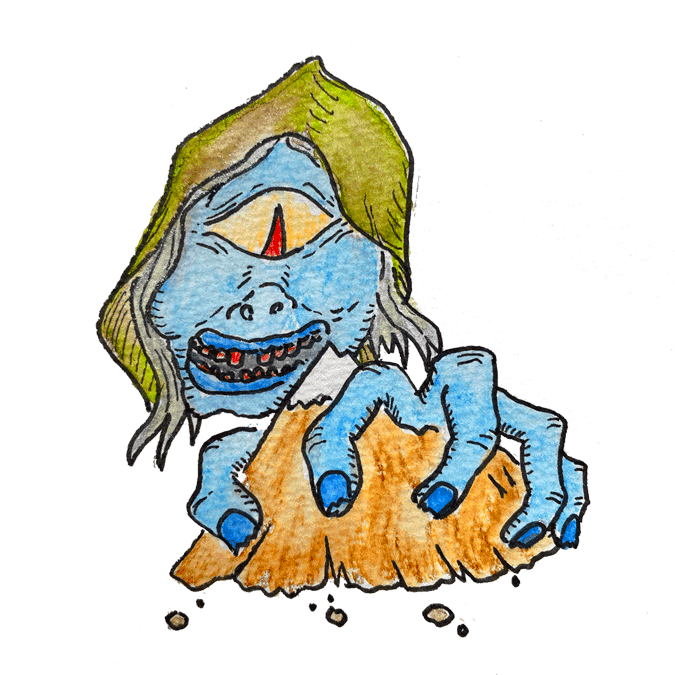
The Cailleach is often veiled, often depicted with a single eye. She has deathly pale skin with red teeth. Skulls adorned her clothing. Sometimes she was depicted as a giantess, leaping from mountain to mountain. The Manx believed she could shapeshift into a giant bird. 

The Shaper of the Land

As she leapt from mountain to mountain, she carried huge rocks bundled up in her apron. Dropping these could create new hills or even islands. She also managed several wells and could use these to flood the land. 

Her tools of creation and destruction included her hammer, with which she was able to control storms and thunder. In some legends, she also controlled a well that would occasionally overflow and flood the land.

Poet Jonathan Swift (1667-1745) included her in one of his compositions:

“Determined now her tomb to build,
Her ample skirt with stones she filled,
And dropped a heap on Carron-more;
Then stepped one thousand yards to Loar,
And dropped another goodly heap;
And then with one prodigious leap,
Gained carrion-beg; and on its height
Displayed the wonders of her might.”

Builder of Islands

One day, the Cailleach happened to be wading through the Northern Channel, between Scotland and Ireland. A French sailor maneuvered his ship between the giantess’s legs. The sail brushed her inner thigh and the sensation to this intimate area gave Cailleach a start. She dropped her load of rocks, forming the island of Ailsa Craig. (Source: Eleanor Hull in her article Legends and Traditions of the Cailleach Bheara or Old Woman (Hag) of Beare)

Hill Builder

In ancient times, many giants roamed the northern isles — the most famous being Gog-Magog and Cailleach-Mhore (Great Cailleach). Legends say that Cailleach-Mhore trudged over the hills, this time carrying massive rocks in a creel (a basket slung over her back). She halted to catch her breath and the creel ripped under the weight. Boulders tumbled onto the landscape, forming new hills. Many hills are known as the “spellings from the creel of the big old woman.”

The Cailleach (also known as Beria in Scotland) created the mountains to use as stepping stones across the land. They also provided houses for her many sons, called the Foawr, the stone throwing giants. These giant children always quarreled with each other. To punish any children who disobeyed her, Beria would close up their mountain houses so they could not leave.

Still angry with each other, her children would climb to the top of their mountain houses and toss boulders at each other. Many of these now lie on the steep slopes or scattered around the valleys of Scotland. 

Beria also used her magic hammer to shape the hills, splintering the rocks so that she could tell one hill from another. She would also strike the ground to form valleys.

Creator of Loch Ness

The Cailleach also had two wells that she managed. Each morning, she would uncap the wells to draw water and then shut them up at dusk. But the two wells were very far apart and she grew weary of trekking backing and forth each day.

She hired a maiden, named Nessa, to work the smaller well. One day, Nessa was late and found the water gushing out of the well. Frightened, she ran away, leaving the water flowing all night. 

Needless to say, Cailleach was displeased. She cursed the maid to forever run and never leave the water. Nessa was transformed into the river Ness, which flows into Loch Ness.

According to legend, once a year (on the anniversary of her transformation) Nessa emerges from the Loch and sings a sad song to the moon. Her voice is more melodious than any bird or the golden harps of the fairies. 

The Cailleach was also the goddess of winter, and we’ll explore that in the next post. 

Tim Kane

[mailerlite_form form_id=2]