El Coco and the Legend of the Evil Coconut

The legend of El Coco has its roots in numerous Spanish-speaking countries. Millions of children across the globe encounter the tale of El Coco in their bedtime stories. What are the mysteries surrounding the El Coco legend? And what exactly do they have to do with an evil coconut?

An Evil Coconut

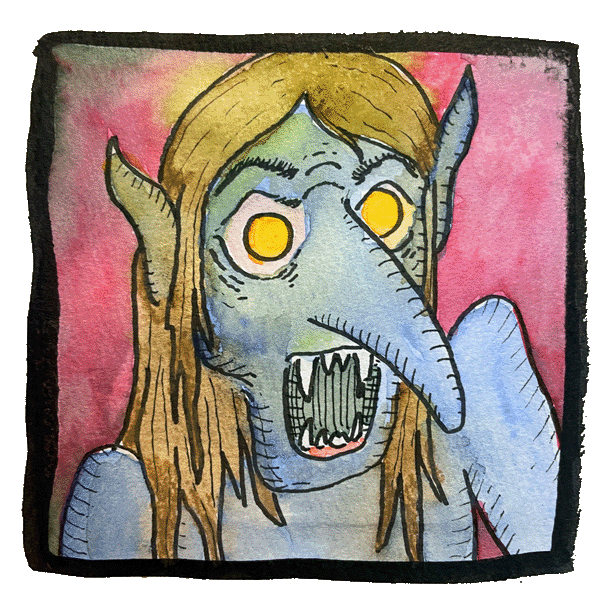
El Coco derives its name from the Spanish word for coconut El Coco is described as having a brown, hairy face that evokes the eerie image of a frightening coconut. This mythical bogeyman enters children’s bedrooms if they fail to sleep soundly or behave properly.

A Cautionary Tale for Kids

Spanish-speaking parents caution their children that El Coco lurks on neighborhood rooftops, searching for those who refuse to go to bed on time or exhibit disobedient behavior. Should a child become a target of El Coco, the creature may emerge from under the bed or inside a cupboard to whisk them away.

While this tale may sound unsettling, it instills good behavior, obedience to parents, and caution around strangers. These essential teachings are vital for children as they grow, shaping them into responsible and capable adults.

A Haunting Rhyme

As children lay in their beds, a parent will recite the El Coco rhyme to send them off to sleep. 

Duérmete niño
Duérmete ya
Que viene el coco
Y te llevará.
Duérmete niño
Duérmete ya
Que viene el coco
Y te comerá.

Go to sleep child
Sleep now
The coco is coming
And it will take you.
Go to sleep child
Sleep now
The coco is coming
And it will eat you.

Quite the pleasant tale to tell your kids. This song reinforces the message by warning the child that failing to go to sleep will summon El Coco, who will make them disappear.

The Legend Works

Picture yourself in a dimly lit home, shrouded in darkness with no street lights outside. The family gathers around the fire, sharing tales of a mysterious bogeyman. Whether you are a child or an adult, listening to the legend of El Coco, and then hearing the wind whistle through the trees or an animal screech, would undoubtedly be sufficient to instill a sense of caution and encourage well-behaved behavior, steering clear of any potential encounter with the monster!

Tim Kane
Asema – The Corpse Light Vampire

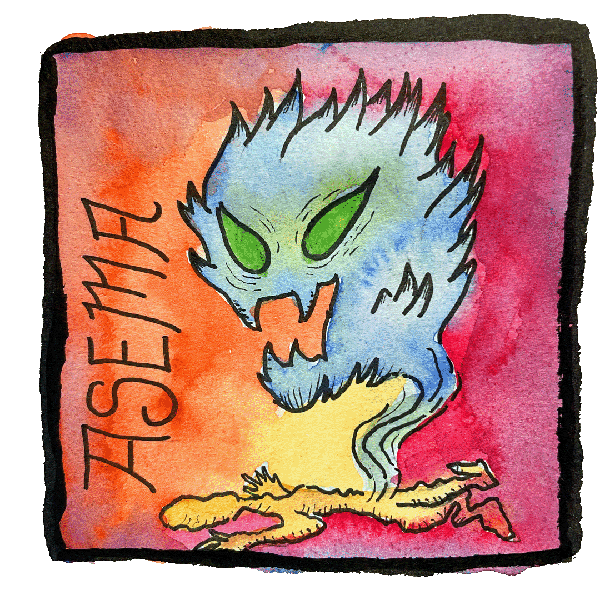
The cloak of night descends and the human skin slips away, falling into a heap on the floor. What remains is a radiant orb of blue light. This is the Asema, a vampire native to the northern stretches of South America. The corpse light vampire, also known as a ball vampire, invades homes, driving by its insatiable thirst for blood.

Bloody Habit

The Asema loves the taste of human blood. It often would not drain a victim dry, choosing to return night after night. But if your blood was particularly tasty, you might be emptied that very night. With the break of dawn, it resumed their human guise, repeating this haunting cycle day after day.

Defensive Measures

Placing garlic around your bedside will deter the Asema. Some people consume herbal concoctions to render their blood unappealing to these supernatural beings. 

Many vampires can be waylaid with scattered seeds. The Asema takes this OCD behavior to the next level. You can mix in the trimmed claws of an owl with the seeds. The Asema must pick up and count the seeds, yet if it grabs a single owl claw, it must drop them all and start over. 

Shriveled Skin

The best way to stop an Asema permanently involves its discarded skin. You give the skin a heavy dose of salt, but not as the usual seasoning. In this case, you want to shrink the skin so that it will not longer fit the Asema when it returns in the morning and the day’s light will destroy it.

In this fashion, the Asema bears a similarity to the Malaysian Penanggalan. In that case, you fill the discarded skin with shards of glass. On wonders if these two vampires are related or have a common ancestor?

Tim Kane

[mailerlite_form form_id=2]

Unearthing the Macabre Tale of Abhartach, the Irish Vampire

Arkane Curiosities

We all know about the legend of Dracula, But have you ever heard of Abhartach, the Irish vampire? This lesser-known figure from Irish folklore hails from the hauntingly beautiful County Derry in Northern Ireland. Unlike your typical vampire, the story of the Irish Vampire is rooted in ancient legends with a unique twist.

The First Death

Long ago, in the 5th or 6th century, there lived an evil chieftain named Abhartach. Described as a goblin-like figure with a grotesque appearance, he was a possessive and jealous husband and he harbored suspicions of his wife’s infidelity. 

One fateful night, he attempted to climb outside his wife’s bedroom window to catch her in the act. But in a twist of fate, he slipped and plummeted to his death, his life extinguished in an instant. His subjects, recognizing the need to accord him the honors befitting a chieftain, laid him to rest in a most peculiar manner—standing upright.

Yet, as the sun dipped below the horizon on the following day, Abhartach defied the laws of life and death. He returned, a nightmarish revenant, demanding a gruesome tribute from his terrified subjects. With a sinister thirst for their blood, he ordered them to bleed in order to create a bowl of blood for his consumption.

The Second and Third Deaths

As time wore on, the people grew weary of living in perpetual fear. They turned to a local chieftain, Cathán, to rid them of the curse once and for all. Twice, Cathán dispatched the Abhartach and each time the creature returned, demanding more blood from the terrified populace.

Cathán turned to the local druid, seeking guidance from the wise sage. The druid revealed the key to defeating the undead chieftain. Abhartach could only be vanquished by a sword forged from yew wood, buried upside down with his feet reaching skyward. A massive stone placed upon the grave would act as a barrier against his resurrection. Surrounding the stone, the branches of sacred Irish trees, such as hawthorn and rowan, were to be intertwined to further hinder his return.

The druid’s warning was grave and ominous. Should the stone ever be removed, Abhartach would be unleashed once more upon the world. With unwavering determination, Cathán followed the druid’s counsel, executing the sacred ritual to the letter.

The Abhartach Defeated

Finally, the curse was broken. Abhartach was silenced, and the people could breathe a sigh of relief, freed from the clutches of their undead ruler. To ensure the memory of their harrowing ordeal lived on, the twigs surrounding Abhartach’s resting place grew into a formidable thorn tree, and a colossal stone tomb (a dolmen) was erected to seal the memory of their struggle.

Today, only a solitary stone and the ancient tree remain, standing as silent sentinels to the legend of Cathán, Abhartach, and the extraordinary ritual that safeguarded a world from an evil that should never walk among us again.

Over two decades ago, a bold attempt to clear the sinister thorn tree and massive stone marking Abhartach’s resting place was foiled by inexplicable occurrences. Chainsaws broke down three times while trying to cut down the tree, and the chainsaw chain wrapped around the stone intended for removal, snapping and cutting a worker’s hand. The worker’s blood seeped into the ground, leaving the cursed site untouched since, as if Abhartach’s malevolence still guards his unholy resting place.

Inspiration for Dracula

Collected during the late 1800s by renowned folklorist and historian Patrick Weston Joyce, this chilling folktale would have undoubtedly circulated in Dublin, where Bram Stoker served as a civil servant. The eerie connection between the Irish term “droch fhola,” signifying “bad blood,” and the name “Dracula” is an intriguing linguistic parallel that adds another layer of intrigue to the lore surrounding Stoker’s legendary vampire character.

Tim Kane

[mailerlite_form form_id=2]

How to Annoy a Vampire

Arkane Curiosities

I watched an old documentary on Vlad Dracula hosted by none other than Vincent Price. Most of the information I was already aware of, but one bit jumped out at me. A unique way to annoy a vampire involving sound.

The Resonant Toaca

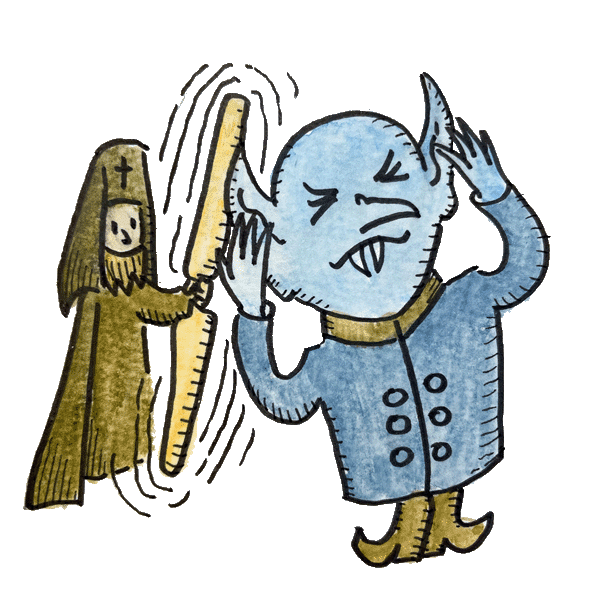
This documentary showed an Orthodox priest walking through town carrying a large piece of wood, called a toaca. This is a type of portable sematron used to create sound. He would bang on the toaca with a hammer as a way to keep vampires away. Despite scouring the Internet, I can’t find an exact reason for this. My best guess is that it annoyed the vampire. 

Make Your Vampire Do Math

I’ve posted about this before, but the toaca reminded me of another way to annoy vampires. I’d first learned about this in an X-Files episode (Bad Blood). Here we see the quintessential way to piss off a vampire. 

Many Slavic people believe that vampires were forced to count the holes in fishing nets or the number of scattered seeds. It was common for townsfolk to hang a net over their door or spill seeds on the stoop as a way to deter would be blood-drinkers. The most common seed used was mustard seed, also known as eye of newt.

So folks, want to annoy the bejeezus out of your local vampire? Start banging on some wood. And be sure to scatter seeds all over the place. You’ll be safe… at least until the vampire gets done counting.

Tim Kane

[mailerlite_form form_id=2]

Flying Head Vampire: The Penanggalan

Arkane Curiosities

In Malaysia the Penanggalan detaches its head, leaving its body behind as an empty husk. This flying head vampire seeks out pregnant women to drain their blood. In fact, “Penanggal” or “Penanggalan” in Malay literally means “to detach” or “to remove”. But it’s not just the head. The internal organs dangle below, twinkling like fireflies.

Invisible Tongues

The Penanggalan, who always appears as a woman, looks completely normal during the day. She’ll avoid eye contact and smell strongly of vinegar (a tool of the vampire trade). Typically, Penanggalans take jobs as midwives. 

At night, it twists its head off and soars through the air, intestines and organs dangling below it. The Penanggalan perches on the roof and waits for the woman to go into labor. Then it wriggles an invisible tongue into the house to drain the blood from the mother. 

Legend has it, the tongue can pass through walls or slither through floorboards to reach its victim. Alternately, it will entwine the victim in its long intestines. 

Vinegar Bath

Upon reaching home again, the Penanggalan takes a quick dip in a tub of vinegar. Why, you ask? The vinegar shrinks the organs so it can squirm back into the body suit and pretend to be a person again. 

Snag Those Intestines

Want to keep yourself safe from this horrific creature? Your best bet is to snag those dangling intestines. Often people will scatter thorny leaves on roof or windows. Additionally, they might plant a pineapple tree under their house (Malaysian houses are built on stilts).

Still want a little more protection? Slide a pair of scissors under your pillow.

Mess With the Body

If your intent is to stop the Penanggalan for good, you’ll need to track the vampire to its lair (possibly by following anyone with the strong scent of vinegar). When the head detaches for the nightly peregrinations, you go to work. 

Fill the empty body with shards of broken glass. Then, when the creature returns to crawl into its body, the glass will shred the vampire’s organs. 

If you simply want to mess with the Penanggalan, just flip the body over. These creatures don’t really understand how human bodies work. It will reattach backward. Then the head will be facing in the wrong direction (an easy way to spot the vampire). 

Tim Kane

[mailerlite_form form_id=2]