Unearthing the Macabre Tale of Abhartach, the Irish Vampire

Arkane Curiosities

We all know about the legend of Dracula, But have you ever heard of Abhartach, the Irish vampire? This lesser-known figure from Irish folklore hails from the hauntingly beautiful County Derry in Northern Ireland. Unlike your typical vampire, the story of the Irish Vampire is rooted in ancient legends with a unique twist.

The First Death

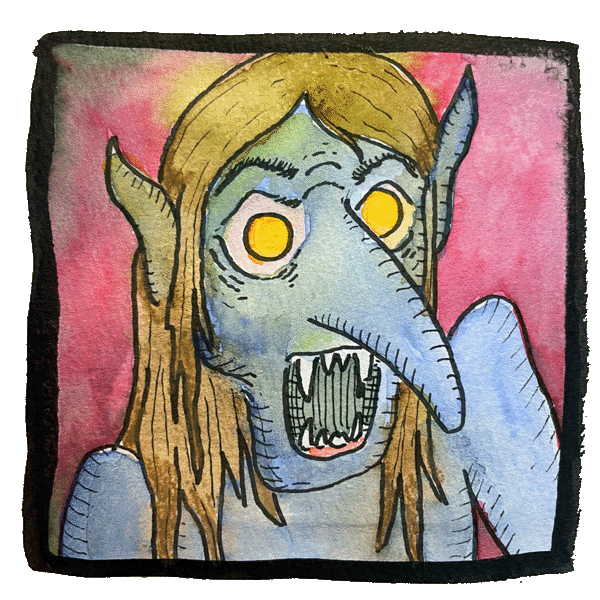
Long ago, in the 5th or 6th century, there lived an evil chieftain named Abhartach. Described as a goblin-like figure with a grotesque appearance, he was a possessive and jealous husband and he harbored suspicions of his wife’s infidelity. 

One fateful night, he attempted to climb outside his wife’s bedroom window to catch her in the act. But in a twist of fate, he slipped and plummeted to his death, his life extinguished in an instant. His subjects, recognizing the need to accord him the honors befitting a chieftain, laid him to rest in a most peculiar manner—standing upright.

Yet, as the sun dipped below the horizon on the following day, Abhartach defied the laws of life and death. He returned, a nightmarish revenant, demanding a gruesome tribute from his terrified subjects. With a sinister thirst for their blood, he ordered them to bleed in order to create a bowl of blood for his consumption.

The Second and Third Deaths

As time wore on, the people grew weary of living in perpetual fear. They turned to a local chieftain, Cathán, to rid them of the curse once and for all. Twice, Cathán dispatched the Abhartach and each time the creature returned, demanding more blood from the terrified populace.

Cathán turned to the local druid, seeking guidance from the wise sage. The druid revealed the key to defeating the undead chieftain. Abhartach could only be vanquished by a sword forged from yew wood, buried upside down with his feet reaching skyward. A massive stone placed upon the grave would act as a barrier against his resurrection. Surrounding the stone, the branches of sacred Irish trees, such as hawthorn and rowan, were to be intertwined to further hinder his return.

The druid’s warning was grave and ominous. Should the stone ever be removed, Abhartach would be unleashed once more upon the world. With unwavering determination, Cathán followed the druid’s counsel, executing the sacred ritual to the letter.

The Abhartach Defeated

Finally, the curse was broken. Abhartach was silenced, and the people could breathe a sigh of relief, freed from the clutches of their undead ruler. To ensure the memory of their harrowing ordeal lived on, the twigs surrounding Abhartach’s resting place grew into a formidable thorn tree, and a colossal stone tomb (a dolmen) was erected to seal the memory of their struggle.

Today, only a solitary stone and the ancient tree remain, standing as silent sentinels to the legend of Cathán, Abhartach, and the extraordinary ritual that safeguarded a world from an evil that should never walk among us again.

Over two decades ago, a bold attempt to clear the sinister thorn tree and massive stone marking Abhartach’s resting place was foiled by inexplicable occurrences. Chainsaws broke down three times while trying to cut down the tree, and the chainsaw chain wrapped around the stone intended for removal, snapping and cutting a worker’s hand. The worker’s blood seeped into the ground, leaving the cursed site untouched since, as if Abhartach’s malevolence still guards his unholy resting place.

Inspiration for Dracula

Collected during the late 1800s by renowned folklorist and historian Patrick Weston Joyce, this chilling folktale would have undoubtedly circulated in Dublin, where Bram Stoker served as a civil servant. The eerie connection between the Irish term “droch fhola,” signifying “bad blood,” and the name “Dracula” is an intriguing linguistic parallel that adds another layer of intrigue to the lore surrounding Stoker’s legendary vampire character.

Tim Kane

[mailerlite_form form_id=2]
How to Annoy a Vampire

Arkane Curiosities

I watched an old documentary on Vlad Dracula hosted by none other than Vincent Price. Most of the information I was already aware of, but one bit jumped out at me. A unique way to annoy a vampire involving sound.

The Resonant Toaca

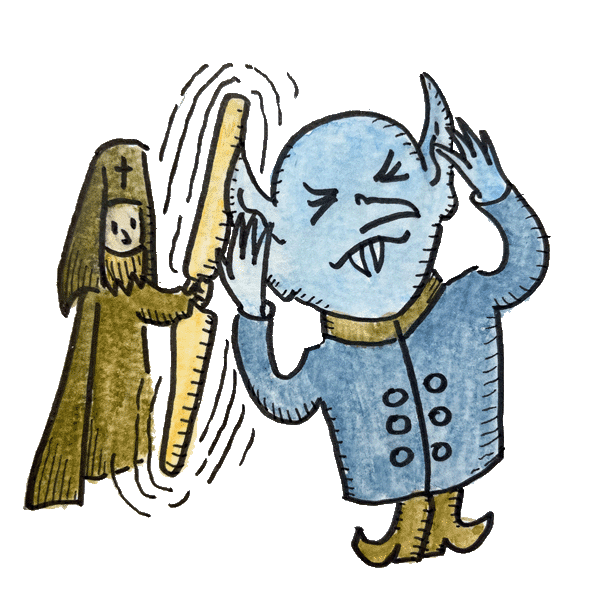
This documentary showed an Orthodox priest walking through town carrying a large piece of wood, called a toaca. This is a type of portable sematron used to create sound. He would bang on the toaca with a hammer as a way to keep vampires away. Despite scouring the Internet, I can’t find an exact reason for this. My best guess is that it annoyed the vampire. 

Make Your Vampire Do Math

I’ve posted about this before, but the toaca reminded me of another way to annoy vampires. I’d first learned about this in an X-Files episode (Bad Blood). Here we see the quintessential way to piss off a vampire. 

Many Slavic people believe that vampires were forced to count the holes in fishing nets or the number of scattered seeds. It was common for townsfolk to hang a net over their door or spill seeds on the stoop as a way to deter would be blood-drinkers. The most common seed used was mustard seed, also known as eye of newt.

So folks, want to annoy the bejeezus out of your local vampire? Start banging on some wood. And be sure to scatter seeds all over the place. You’ll be safe… at least until the vampire gets done counting.

Tim Kane

[mailerlite_form form_id=2]

Egyptian Afterlife: Weighing of the Soul

Arkane Curiosities

The ancient Egyptians believed that all deeds resided in a person’s heart — the bad and the good. When you died, your heart was weighed against the feather of Maat (goddess of truth and justice). This process was called the weighing of the soul and it determined what sort of afterlife you could expect.

Ma’at – A Universe in Perfect Order

The goddess Ma’at was the daughter of Ra and married to Thoth, god of wisdom. But she was so much more than a simple goddess in the mythological hierarchy of Egypt. Ma’at was a primordial force that keep the world working. With Ma’at, the world had order because she kept everything in balance.

The ancient Egyptians believed the universe had an order to it, and it was Ma’at who kept everything in balance. Her name referred to the overarching concept of truth, order, and justice that she represented. The ancient Egyptians believed that the world was maintained through the principles of Ma’at, which included notions of truthfulness, moral integrity, and social harmony.

A Single Feather

The Feather of Ma’at, also known as the Feather of Truth, was a symbolic element in ancient Egyptian mythology and religious beliefs. After death, a person’s soul would enter the Hall of Ma’at in the underworld, where their heart would be weighed against the Feather of Ma’at on a set of scales. 

If the heart was found to be lighter than the Feather of Ma’at, it symbolized that the person had led a virtuous and just life, adhering to the principles of truth and social harmony. The person was deemed worthy to proceed to the eternal paradise known as the “Field of Reeds.”

Should the scales tip unfavorably, signifying a heart burdened with the weight of wrongdoing, a dire fate awaited the soul. Ammit, a fearsome deity with the head of a crocodile, body of a lion, and hindquarters of a hippopotamus, stood ready to devour the heart. The soul of the deceased would then face eternal punishment or be denied access to the afterlife.

The emphasis on the balance between one’s actions and truth echoes the universal human pursuit of leading a morally upright life. The choices we make in life reverberate beyond our existence.

Tim Kane

[mailerlite_form form_id=2]
Unraveling the Veil: The Origins of SCP Entities

Arkane Curiosities

In the darkest recesses of our world, where reality intertwines with the unfathomable, lies a secret organization tasked with containing and studying the most extraordinary and perilous entities known to mankind. Welcome to the realm of the SCP Foundation. Step into a world where the laws of nature unravel, and the impossible becomes tangible. But what exactly are these creatures and what are the origins of SCP entities?

The Birth of the SCP Foundation

The SCP Foundation (which stands for Secure, Contain, Protect) emerged in 2007 in the “paranormal” /x/ forum of 4chan. An anonymous user posted the original thread introducing the concept of the SCP Foundation, a secret organization dedicated to securing, containing, and protecting anomalous entities and phenomena. This user was later identified as Moto42. People expanded on the post and soon a wiki was set up to explore the concept of the SCP Foundation. 

To understand the origins of SCP entities, we simply look back to  legends and myths from all over the world. Supernatural beings and unexplained events have always been with us. These stories serve as precursors to the modern SCP entities, hinting at a long history of the abnormal intertwined with human existence.

The First Entity

The annals of the SCP Foundation record the inaugural SCP entity: SCP-001. Often referred to as the “Broken God” or “Gate Guardian,” this entity holds a unique position within the SCP Foundation. It is the subject of intense debate and speculation, with multiple conflicting theories surrounding its true nature.

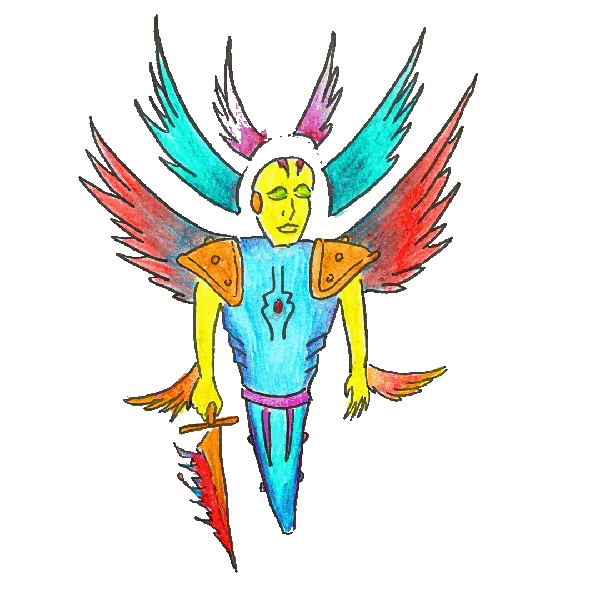
SCP-001 is a Keter class entity (we’ll explore Keter anomalies in the next post). The Gate Guardian is humanoid in shape and about 700 cubits high (1033 feet). It possessed luminous wings sprouting from its shoulders, back, temples, angles and wrists. 

Where Do SCP Entities Come From?

At the core of the SCP Foundation’s universe are the SCP entities themselves. These entities can take the form of objects, creatures, locations, or even abstract concepts. Each SCP entity is assigned a unique identification number and accompanied by a detailed document known as an SCP entry. These entries serve as containment protocols, scientific analysis, and records of incidents related to the respective SCPs.

There is no single source for the development and discover of SCP Entities. Their origins are a who’s who of supernatural and strange.

Natural phenomena: Some SCP entities arise from natural occurrences or anomalies that exist within the fabric of the world. These could be inherent abnormalities in nature or manifestations of unknown forces.

Human-created anomalies: Certain SCP entities are the result of human experimentation, scientific accidents, or the misuse of advanced technologies. These anomalies can possess dangerous and unpredictable characteristics.

Extra-dimensional or inter-dimensional entities: SCP entities may come from alternate dimensions, parallel universes, or realms beyond conventional human perception. These entities often possess abilities or properties that defy the laws of our reality.

Supernatural or mythological origins: SCP entities can be rooted in ancient legends, myths, and folklore. They may be ancient beings, deities, or spirits with immense power and influence.

Extraterrestrial sources: Some SCP entities have extraterrestrial origins, originating from other planets, distant galaxies, or encounters with unidentified flying objects (UFOs). These entities may have arrived on Earth through various means, bringing with them their unique traits and abilities.

Anomalous artifacts or objects: SCP entities can also be tied to anomalous artifacts or objects with mysterious origins. These items may possess inherent properties that give rise to or house the entity within them.

Collaborative Creation

One of the defining aspects of the SCP Foundation project is its collaborative nature. A community of writers and fans passionately contributes to the ongoing development and expansion of the SCP universe. Individuals can create new SCP entities, provide feedback, and engage in discussions. This collaborative approach has led to a diverse and ever-growing collection of SCP entities, each with its own intriguing narrative and characteristics. As of now, there are over 6000 documented entities.

Tim Kane

[mailerlite_form form_id=2]

The Dancing Hut of Baba Yaga

Arkane Curiosities

Picture a small thatched hut of warped boards, old rusty nails, and decaying thatch. Bizarre symbols and human skulls adorn the walls. You step too close and the hut rises up, perched atop gigantic chicken legs growing out of the foundation. This is the dancing hut of Baba Yaga, one of the most bizarre and bewildering sights in all of Slavic folklore.

The Dancing Hut

The Dancing Hut was originally a simple wooden cabin, built by Baba Yaga as a place to retreat and conduct her sorcery in solitude. Over time, however, the Hut began to take on a life of its own, growing in size and becoming increasingly twisted and malevolent. Perhaps, Baba Yaga cast a powerful enchantment on the Hut, imbuing it with a sinister sentience that allowed it to move and dance of its own accord.

Why chicken legs? Does Baba Yaga have a fondness for poultry? It might be a nod to the ancient Slavic tradition of using chicken feet in various magical rituals. Baba Yaga simply incorporated this imagery into the Hut as a symbol of her power.

One site mentions that Baba Yaga’s hut might not have always resided atop chicken legs (or курьи ножки meaning chicken bones). Instead it might have sat on smoked legs (курные). This is the practice of setting a house up on wooden struts saturated with smoke to avoid rot. This was common in the houses of the dead where Slavic people stored the ashes of their ancestors. 

Ditching the Broomstick

Baba Yaga didn’t use the conventional methods of flying like a broomstick or flying carpet. Picture, if you will, a gigantic wooden mortar, with a pestle as long as a tree trunk jutting out from one end. Baba Yaga sat in the hollowed-out bowl of the mortar, gripping the pestle like a joystick, cackling maniacally as she hurtled through the skies. Yes, you read that right. A mortar and pestle, the kind used for grinding herbs and spices in the kitchen.

She did incorporate a broom in flying. Not for the flying part, but to keep her peregrinations secret. The witch gripped a broom constructed of silver birch and swept away any traces of her passage. 

Be Warned

For those brave enough to seek out Baba Yaga and her dancing hut, the rewards can be great. The witch is known to possess great knowledge and power, and those who approach her with respect and humility may find themselves blessed with her gifts. 

But be warned: Baba Yaga is a creature of chaos and contradiction, and her dancing hut is but one facet of her strange and otherworldly existence. To encounter Baba Yaga is to embark on a journey that is both perilous and profound, a dance with the unknown that may lead to either enlightenment or destruction.

Tim Kane

[mailerlite_form form_id=2]