The Age of Miracles Has Put This Reader on Edge

This is the strangest book I’ve read so far. It has me on the verge of a panic attack. Why? Because it details an end of the world scenario so plausibly, I can imagine it happening. The premise of the book is that the world is slowing. The spin of the Earth is slowing down. Each day adds minutes, and soon that trickle becomes a flood. As I read, I found myself thinking what I would do in this situation. The prospects became grimmer as the story unfolded: birds fell out of the sky, slowing sickness afflicted the population, tens of thousands of whales were beached, and gradually—as the days lengthened to 72 hours—all the world’s vegetation died out.

I admired how the author, Karen Thompson Walker, weaved the scientific effects into dramatic plot points. For example, instead of simply having someone suffer from the slowing sickness (a sort of dizziness and weakness), she had the mother of the main character faint while driving and run down a man in the street. Likewise, as trees began to die, she could simply have stated that thy fell over. Instead, she used to underscore the political division between the clock timers (those who stick to the 24 clock) and the real timers (those who try to sleep longer to match the growing days). A tree falls through the only real timer left on the block. People suspect it might have been cut.

One interesting aspect of the book is that the Earth is one of the central characters in the story. It is obviously sick. We all know, as we read, what will happen to this sick patient in the end, yet we can’t leave her bedside. Even I, as I read, was fascinated with the next disaster. How could things get worse.

Some things that bothered were were how the main character, 11-year-old Julia, was handled. Walker attempted to give her a poignant coming of age story in a dying world. Somehow she felt hollow. Walker clearly details what happens to her. How her loneliness spins out from her. Her thoughts seem clinical in a way. I wanted a visceral reaction. I think some of the problem stemmed from the narrator, Julia, telling the story from the future (when she’s in her twenties).

A few other inconsistencies bugged me. The first was the random insertion of profanity. It’s almost as if Walker felt she needed to add a few cuss words to qualify it for young adult status. Mostly, these got in the way. Also, she made a point of stating that the price of grapes had risen to $100 per pound. Yet after that, there were several instances of characters macking out on ice cream. Surely the price for that would have shot through the roof.

Overall, I recommend this book. The central concept of the Earth slowing are worth the read alone.

Tim Kane
There Are No Original Ideas (And That’s A Good Thing)

Everyone goes on and on about original ideas, yet the the notion of an original idea in art has only been with us for about one-hundred years. This concept was propagated by the Modernists who sought to abandon the superstitions and folklore of the past. These Modernists valued the strange and surreal over traditional storytelling. Novelists like James Joyce and William Faulkner wanted their stories to be difficult and complex. They thought that if the story were intricate, then it would supersede oral tradition. (Ironically, Joyce’s seminal work, Ulysses, modeled itself off of the Odysseus myth.) Even today, we look for originality as a sign that something is “good”.

Skipping to before the twentieth century, we see that folklore and tradition reign. People retold stories over and over again, in a game of telephone that lasted centuries. The myth of Odysseus wasn’t even written down for ages. People simply memorized the story.

There’s also something to be said for a good story. Myth and folklore have plenty of great ideas. So use them. Why struggle to come up with something brand new, when the old tales work. They have to work. They survived. It’s evolution for writing. Even the US Government acknowledges this. You can copyright an execution (how you write something) but not an idea. That’s why you typically see two or even three movies about the same subject from Hollywood: Dante’s Peak and Volcano; Armageddon and Deep Impact.

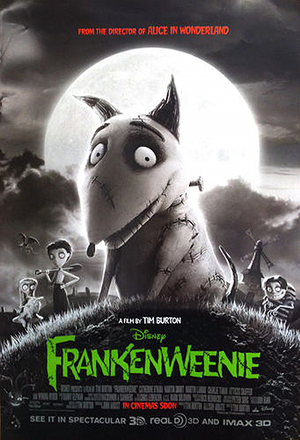
Take Frankenweenie. It’s a rehash of the Frankenstein story. But who cares. I plan to see it. The concept was reinvented by Tim Burton to become a macabre comedy. The original short film was hilarious. Now that’s it’s expanded into a full film, it should be hilarious. Do I constantly think back to how Burton pirated from Mary Shelly? No. I think of how inventive he was in his adaptation.

If you feel hemmed in as an artists because you simply can’t think of an idea, reverse your strategy. Look for good stories and then write your own take on it. Reimagine and reinvent. Put your own spin on it.

Tim Kane

A Love Hate Relationship with Feedback

Whenever people comment on my work (be it writing or the occasional artistic creation), I subconsciously want them to love it. I think we all do. And should said critic offer some helpful feedback, I instantly have the same knee-jerk reaction. “I put so much time into this. Why don’t you love it?”

As an artist, I know that change is good. I makes the art better. But it hurts. I’ve learned that the more it hurts, the better the ultimate project. Doesn’t mean it makes abiding by the criticism is any easier. It’s damn hard. I find that time helps me accept it better. If I try to take on the comments straight away, I get defensive and the work suffers. Yet if I give it a few days or a week, then I struggle through it.

That being said, some comments you need to ignore. Just because one person didn’t like something, doesn’t mean you have toss the bathwater (baby and all) out the window. I usually gauge my revisions as to how many people responded to it (another reason to have a good critique group). The more that thought something was off, then it’s probably off and should change. Only one person. Then keep it.

A great example of reaction to feedback is from the great sculptor Rodin. He had just finished the statue of Honore de Balzac. The figure had long robes with the hands poking out in front. It was four in the morning when he finished and he roused his students in order for them to appreciate his masterpiece. (Honestly, what sort of criticism could you expect from sleepy pupils?)

Each and every student loved the work. They went on and on about the hands. “What hands…Master. Only God could have created such hands. They are alive!”

Something snapped in Rodin (he was an artist, you know). He grabbed an axe. Horror stricken, the students threw themselves on him, trying to protect the statue. Rodin overpowered them and with one swing, he chopped off the magnificent hands.

He turned to his bewildered students and called them fools. “I was forced to destroy these hands because they had a life of their own. They didn’t belong to the rest of the composition. Remember this, and remember it well: no part is more important than the whole!”

Monument to Honoré de Balzac, first modeled 1897 by Rodin

I guess that’s one way to deal with criticism. I know one writing group that has a shredder in the room. Just in case. I’m not saying hack your work apart. Take some time. Otherwise your work will end up like Rodin’s statue. To this day, the statue of Honore de Balzac has no hands. The long sleeves appear to cover the hands, but we know what really happened.

Tim Kane

Foot in Mouth Syndrome

Charisma’s Cordelia Chase in ‘Buffy the Vampire Slayer never had much tact.

Some folks are born with a silver spoon in their mouth. Me, I had a foot stuck up in there. It seems I have no inner filter. If something pops into my brain, it shoots out my mouth. If I were enlisted, my lips would sink a whole lotta ships.

My most infamous slip involved meeting a friend. Before I was introduced, this friend was described as “big” and “large”. She was my senior, agewise on par with my parents. So when I met her, yes she was a tall woman. But of course, that’s not what popped through my brain. Instead I thought, and said, “I’ve seen bigger woman.”

Let me give you all a secret: women don’t like to hear such things. Even if is truthful.

Somehow, despite my lack for tact, I have developed a sort of filter when I teach sixth grade. Before becoming a teacher I cussed up a storm. Yet, beyond all expectations, I don’t let loose a stream of profanities in class. Even when certain students deserve it (yes, I’m looking at you).

Often these days, I spout out strange nuggets of geeky knowledge, like you can’t send bones through the US mail. Most of my coworkers are used to such strange outbursts. They even have an expression for me. It’s the line. I need to know where it is and not cross it.

Maybe someday there’s be an outbreak of foot in mouth and then we can all be brutally honest. Until then, tact lives on.
Tim Kane

What to Read: Three Different Categories of Fiction

You have to know yourself as a reader. Which type of fiction do you lean toward? Knowing the different kinds of fiction can certainly help. I get totally into this—my Master’s thesis being on genre studies. But I’ll save wordy for a doctoral thesis and give you the reader’s perspective.

Realistic or Literary Fiction
These are the books that deal with real life. They’re usually called literary fiction in bookstores, but I also lump in realistic fiction, because that applies better to young adult books. Basically these books focus more on characters and their personal problems over plot. There is a line that divides literary form realistic. Literary can often be very self-absorbed and even be devoid of plot. Realistic fiction typically has some semblance of a problem and resolution.

Some good examples (pulled from my favs) are:

Genre
These books are defined by their plot structures. Characters can be secondary and will sometimes follow stereotypes. Readers return to these books because we know what to expect. Certain situations and settings reoccur over and over. There are many different types of genres, such as: Science Fiction, Fantasy, Horror, Thriller, Romance, and Mystery.

Some more favs:

Genre Pastiche
This is where things get interesting. Since the 1980s, films had run the gamut of genre and began mashing them up. Books are doing the same. One of the most popular pastiches is paranormal romance (horror and romance). This allows readers who love genre, to mix things up.

Final set of favs:

  • Horror + Realistic Fiction: A Monster Calls by Patrick Ness
  • Science Fiction + Fantasy: Leviathan by Scott Westerfeld
  • Fantasy + Realistic Fiction: Life of Pi by Yann Martel

Next time you look for a good read, think about the type of read you are. Choose your book based on your tastes. If you have a writing bent, then check out how to write for each genre.

Tim Kane