Wordle Transforms Stories into Art

A colleague of mine introduced me to a website called Wordle. This site allows you to paste text (any text) and it will create a word cloud. The size of the word reflects how often its used in the text. For my experiments, I used a few short stories I’d written and posted on this blog.

This is from a blog post called “Do-It-Yourself Zombie Kit.” No surprise that zombie would get center stage. The story is tongue in cheek about what you’d really need to do to create your own zombie (voodoo style).

This is a piece of flash fiction titled “Selling Your Sister to the Goblins.” I like that Wordle put “teeth” next to “goblin.”

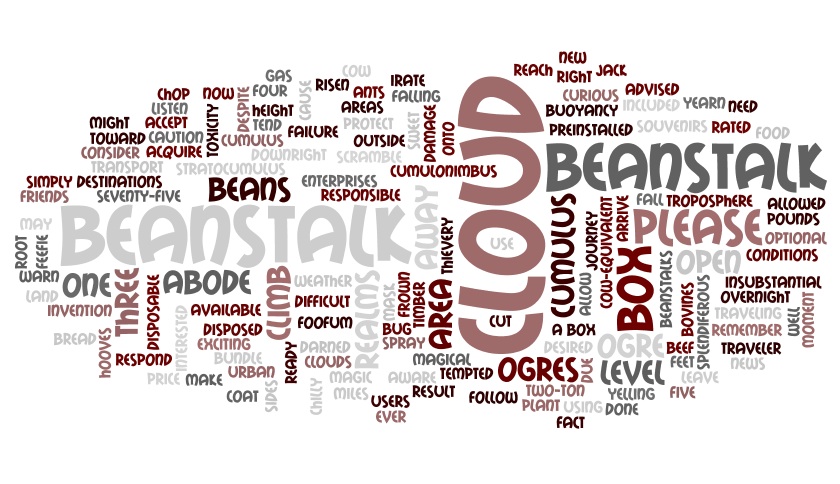
This is a flash fiction called “Beanstalk in a Box” which is a take on a reinvented fairy tale. Here beanstalks and Jack become a nineteenth century advertisement. I love that Wordle made cloud so big in a word cloud.

This is another flash fiction called “C: Terrible Consonant.” This is a surreal story about how the letter C is trying to kill me. I love how the word “ccccccCCCCCCcCCcCCCC” gets tossed at the bottom with a jaunty angle.

Give Wordle a try. So fun.

Tim Kane

There Are No Original Ideas (And That’s A Good Thing)

Everyone goes on and on about original ideas, yet the the notion of an original idea in art has only been with us for about one-hundred years. This concept was propagated by the Modernists who sought to abandon the superstitions and folklore of the past. These Modernists valued the strange and surreal over traditional storytelling. Novelists like James Joyce and William Faulkner wanted their stories to be difficult and complex. They thought that if the story were intricate, then it would supersede oral tradition. (Ironically, Joyce’s seminal work, Ulysses, modeled itself off of the Odysseus myth.) Even today, we look for originality as a sign that something is “good”.

Skipping to before the twentieth century, we see that folklore and tradition reign. People retold stories over and over again, in a game of telephone that lasted centuries. The myth of Odysseus wasn’t even written down for ages. People simply memorized the story.

There’s also something to be said for a good story. Myth and folklore have plenty of great ideas. So use them. Why struggle to come up with something brand new, when the old tales work. They have to work. They survived. It’s evolution for writing. Even the US Government acknowledges this. You can copyright an execution (how you write something) but not an idea. That’s why you typically see two or even three movies about the same subject from Hollywood: Dante’s Peak and Volcano; Armageddon and Deep Impact.

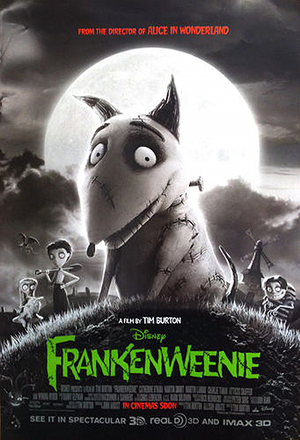
Take Frankenweenie. It’s a rehash of the Frankenstein story. But who cares. I plan to see it. The concept was reinvented by Tim Burton to become a macabre comedy. The original short film was hilarious. Now that’s it’s expanded into a full film, it should be hilarious. Do I constantly think back to how Burton pirated from Mary Shelly? No. I think of how inventive he was in his adaptation.

If you feel hemmed in as an artists because you simply can’t think of an idea, reverse your strategy. Look for good stories and then write your own take on it. Reimagine and reinvent. Put your own spin on it.

Tim Kane

A Love Hate Relationship with Feedback

Whenever people comment on my work (be it writing or the occasional artistic creation), I subconsciously want them to love it. I think we all do. And should said critic offer some helpful feedback, I instantly have the same knee-jerk reaction. “I put so much time into this. Why don’t you love it?”

As an artist, I know that change is good. I makes the art better. But it hurts. I’ve learned that the more it hurts, the better the ultimate project. Doesn’t mean it makes abiding by the criticism is any easier. It’s damn hard. I find that time helps me accept it better. If I try to take on the comments straight away, I get defensive and the work suffers. Yet if I give it a few days or a week, then I struggle through it.

That being said, some comments you need to ignore. Just because one person didn’t like something, doesn’t mean you have toss the bathwater (baby and all) out the window. I usually gauge my revisions as to how many people responded to it (another reason to have a good critique group). The more that thought something was off, then it’s probably off and should change. Only one person. Then keep it.

A great example of reaction to feedback is from the great sculptor Rodin. He had just finished the statue of Honore de Balzac. The figure had long robes with the hands poking out in front. It was four in the morning when he finished and he roused his students in order for them to appreciate his masterpiece. (Honestly, what sort of criticism could you expect from sleepy pupils?)

Each and every student loved the work. They went on and on about the hands. “What hands…Master. Only God could have created such hands. They are alive!”

Something snapped in Rodin (he was an artist, you know). He grabbed an axe. Horror stricken, the students threw themselves on him, trying to protect the statue. Rodin overpowered them and with one swing, he chopped off the magnificent hands.

He turned to his bewildered students and called them fools. “I was forced to destroy these hands because they had a life of their own. They didn’t belong to the rest of the composition. Remember this, and remember it well: no part is more important than the whole!”

Monument to Honoré de Balzac, first modeled 1897 by Rodin

I guess that’s one way to deal with criticism. I know one writing group that has a shredder in the room. Just in case. I’m not saying hack your work apart. Take some time. Otherwise your work will end up like Rodin’s statue. To this day, the statue of Honore de Balzac has no hands. The long sleeves appear to cover the hands, but we know what really happened.

Tim Kane

Mine Your Inner Hurt

It doesn’t matter what sort of art you take up—writing, painting, music, cooking—you need to dig deep into whatever hurt you have. If not, then the art will be false and flimsy.

Salvador Dali pondering how to make himself insane in the office of Dr. Sigmund Freud from the film “The Death of Salvador Dali.”

I was watching the Next Food Network Star. On one episode, a contestant opened up about how he lived his childhood scavenging from garbage cans. This not only moved me, it showed how authentic he was. Another contestant would not open up. She obviously had some sort of hurt in the past. One that had shaped her way of thinking, yet she was afraid of going to that dark place. On that episode she was eliminated. Why? Because she didn’t connect with the viewers.

Be authentic with your art. If it doesn’t hurt, then you’re not doing it right. When you dig into your inner self, it’s like therapy. Only art comes out the other end. If you’re not willing to be brutally honest with yourself, then your work will feel false. It’s like the difference between a museum painting and a hotel painting. They both contain skill, but only one has passion.

Salvador Dali once toured a museum of paintings. After viewing them all, a reporter asked him which one he liked the most. Dali pointed at a door, freshly painted and still wet. He said there was more skill and passion in that door than any of the other paintings.

Tim Kane

Staring at the Progress Bar

I used to make my living as a computer graphic designer. I was pretty good at it. I designed ads for Winston Tires (not around anymore) and designed the box for TurboTax (that’s still with us). What I hated about the process was the computer. Being totally reliant on technology to get the work done is frustrating. Mostly, it was the progress bar.

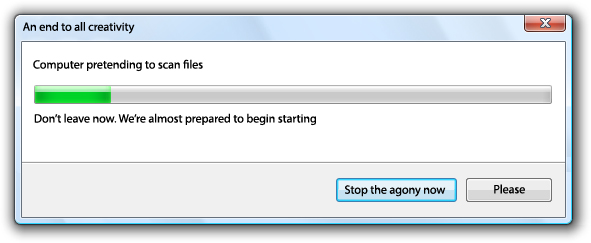
You know how it goes. Here’s the situation right now. I’ve decided to update and add a few videos to my iPad. So I hook everything up through iTunes and then the bane of my existence appears. The progress bar. It inches forward, sucking the life from me.

I should walk away, but I can’t. It’s hypnotic. I stare at it, watching the percentage creep forward. I can literally stand there for hours. It’s so pointless. Finally, head upstairs and take a shower because I needed to go out soon. That broke the trance. Once I was away from the progress bar, I could actually progress with my life.

Writing doesn’t have quite as much of that. First off, the file sizes are so small, there’s only a glimpse of a progress bar. Also, I can print out pages or switch to long hand and still be productive. Take that technology.

If you’re stuck with something that is technology dependent, I feel for you. No one likes the progress bar. The best advice I can give you is make sure your other outlets (creative or otherwise) don’t rely on batteries, updates, or Internet.

Tim Kane