Let Me Download Your Book for Free (It’s My Religion)

What some people won’t do to get around supporting artists. I’m not one to prop up big corporations and their tireless lawsuits against  kids copying music. Heck, I made my share of mix tapes and gave them away. But as a writer, I understand that if you give everything away, you can’t support yourself. Novels, songs, movies—these all take months and years to create. We all love the idea of the starving artist, but I also like to pay my rent.

Kopimizm.svg

Now there’s a movement in Sweden where copying and disseminating information is protected under the umbrella of religion. Yes, it’s true. The Swedish government has recognized Kopimism as an official religion. What are the doctrines? Glad you asked:

* All knowledge to all
* The search for knowledge is sacred
* The circulation of knowledge is sacred
* The act of copying is sacred

Sounds a bit scary doesn’t it. This is movement born from the hacker culture. By hooking onto a religion, the Kopimists can also gain political leverage. Does this mean that US hackers can claim amnesty for religious reasons? Probably not yet.

Looking through the official Kopimism site reveals some puzzling contradictions. On one hand, they state: “All people should have access to all information produced. A gigantic Boosting Knowledge for humanity.” This makes sense. Why hide valuable information? My first thought goes to helpful drugs that can benefit everyone.But then I spot this a few lines down: “The absolute secrecy is holy in the church of kopimism.” Doesn’t this contradict what they just said about shareing?
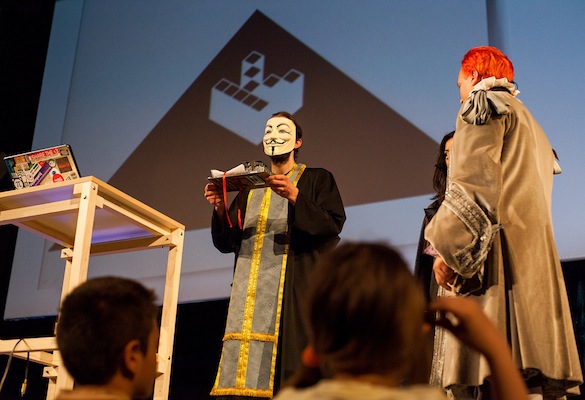
A Kopimist marriage. Not sure why the priest is dressed like V for Vendetta.

A Kopimist marriage. Not sure why the priest is dressed like V for Vendetta.

The Kopimist Church of Idaho (Yes, our Idaho) has a more straightforward approach. They want to send books to people in South America or Africa. Not bibles, but books. Any books. Pure information. This form of information sharing I can get behind. It’s like humanitarian aid for the mind.

pirate-bay-drones

Interestingly, this religion is officially tied to The Pirate Bay, a BitTorrent site that allows people access to movies, and music. In order to keep their servers away from copyright enforcers, The Pirate Bay has purchased remote drones to carry the servers 8,000-9,000 feet above Greek airspace. If the Greek government agrees, this could tie the Greeks into breaking copyright laws.

This photo comes from a Merseyside Police demonstrate their new aerial surveillance drone in Liverpool. Don't expect The Pirate Bay to work like this any time soon, though

This photo comes from a Merseyside Police drone in Liverpool.

What’s the future for the Kopimist movement? Will governments grant them the ability to bypass copyright law? If so, I think you’d see a lot of cheap people flocking to this religion. It’s like the Napster of intellectual property.

Tim Kane

Authors Are Software Developers

I was installing the latest version of Microsoft Office when it struck me: authors are software developers. Or they should be. Think about. Now that books are digital, authors create the product that Kindles, Nooks, iPads consume. What if authors embraced this rather than fled from it?

Think I’m crazy? School districts are already learning about the tricky situation of purchasing ebooks. A textbook is a thing that can get old, ripped, or wear out. Once a school district buys it, it can milk that book for many years (often way past when it needs to be updated). For an interesting aside on this matter, read how companies are dealing with ebooks and libraries. But buying a set of ebooks for a school is more like purchasing a software subscription (or at least is should be). Read more at digital book world.

Take your favorite author. One of mine (that’s still publishing) is Stephen King. Say, instead of me buying (or not buying) each book he puts out, what if I could subscribe to the author. Then I would have his new releases delivered to me. Maybe for authors not so first tier, companies could offer genre book subscriptions, with authors packaged together. This would be most beneficial to authors because they might appear in multiple packages and earn money from each one.

The services wouldn’t be much different from Satellite radio stations of when you choose your viewing packages for satellite or cable. The reader would get instant access to both existing books, but more to come. Maybe even some exclusive material (like those bonus tracks on iTunes) that would warrant the subscription service.

Authors would get a steady flow of income because subscriptions are a pay per month service. The author simply has to keep producing stories (or software) to fill the reading void.

That said, I wonder which authors would be the next Microsoft (the company that build software we all can’t live without).

Tim Kane

Easter Bunny Myth (Or How a Raunchy Rabbit Got His Own Constellation)

I’ve always wondered about the origins of the Easter Bunny. I knew a little, like that Easter comes from the Anglo Saxon goddess of Spring called Eostre or Ostara. The more I dug, the more interesting things I uncovered.  Eostre was concerned with waking up the countryside after winter (a bit like the Persphone myth).

3131cbd5c5f1fb0836df0a5ca82456ac

Legend has it that Eostre was feeling guilty that spring was arriving so late (The original celebration took place on the first full moon after the spring equinox). When she arrived on the scene to warm things up for Spring, she saw a bird frozen in the snow, dying. She cradled the shivering creature, nourishing it with life.

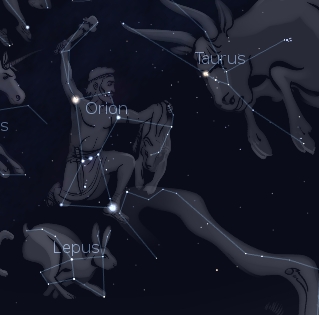
The bird became her pet (also lover). He could no longer fly (as his wings were icicles), so the goddess transformed him into a snow hare with the name of Lepus. (There’s a whole other story about Lepus from the Greeks involving Orion.)

She gave Lepus the power of swift speed so he could evade hunters (presumably Orion). However, to honor his former stature as an avian, Lepus was able to lay eggs. This is where it goes a bit raunchy. Lepus, being a quick one, starting hanging out with some other girls. Eostre, jealous, threw the hare up into the stars where he remains to this day as a constellation.

lepus2

Later, Eostre took pity on her former lover, allowing him to return to Earth once a year for (you guessed it) some egg laying. The catch was, the eggs only went to kids participating in the Eostre festivals held each spring.

Tim Kane

Happiness is a Disease

Love doesn’t make you happy. Neither does money. It turns out that happiness makes you happy. Sounds redundant, doesn’t it. But it turns out that happiness is a sort of social disease. Check out this study done by the Framingham Heart guys. They studied 4739 people for twenty years. The conclusion was that being around happy people makes you happy. It even works on two degrees of separation (a friend of a friend). But not with happy coworkers (who probably just annoy you).

plato1

This brings up all sorts of crazy ideas. Like, could you inoculate yourself against happiness? Could there be a happiness cult? As always, my mind turns to film in these instances. The first to pop to mind was actually TV. In the episode Plato’s Stepchildren of Star Trek (1968), the crew is captured by the Platonians. These beings can control the crew, making them act in all sorts of ridiculous ways. The best is watching Spock laugh. You have to zoom ahead to the two-minute mark to see Spock emotionally freak out.

This is just crazy laughter. To see real, infectious laughter, we need to turn to Austin Powers. Here, Dr. Evil has just revealed his plan, and then his laughter spreads to everyone in the scene.

Then, there’s laughter that disturbs you. Ash, from Evil Dead II is deranged. It’s the sort of happiness you never want, but that sometimes happens in the wee hours. This too is mighty infectious.

So I guess the counterpoint to this theory is: If you want to be happy, ditch the slugs and nay-sayers and hang out with some happy folk.

Tim Kane

Self-Destructing Ideas (To Sit or Not to Sit)

Imagine if you had an idea. A great one. Something that might amaze people. Only to have that idea explode into nothingness after a few people hear about it. This is not fiction. It’s a reality.

Book and music companies use digital rights management (DRM) to control how their products are used. Harper Collins only allows library users to check out a book so many times before the book “self-destructs”. They say that this mimics the wear and tear on a real book. But the digital copy doesn’t have wear and tear. It’s just an idea.

To make this point even more absurd, take a look at the Self Destruct Chair by graphic designer Thibault Brevet. This seat is designed to allow eight people the pleasure of sitting on it. After that, it falls apart and you need to buy a new one.

DRM CHAIR from Thibault Brevet on Vimeo.

We’re all used to products built as cheaply as possible so that it easily breaks. Then you really do nee to buy a new one. But ideas don’t break. That’s what a digital book is. An idea. Yes, companies need to make money, but limiting library access is ridiculous.

Another example of seats that attack back comes from China. It seems there are too few benches in parts to accommodate all the butts that want a seat. Most people would assume you’d simply build more parks. Nope, the folks of the Yantai Park in Shangdong province, eastern China, have other ideas. The benches are coin operated. Yes. They have spikes that stick up to keep you from sitting. Slip in a coin and get a few precious minutes of ass time before the iron maiden spikes skewer your nether regions.

park-bench-spikes_1697959i

Oh, for safety reasons, the benches emit a piercing bleep just before the spikes pop up. So now we’ve destroyed two ideas: The idea of sitting on a bench, and the idea of a quiet park (imagine the chorus of beeping, coupled with the occasional yelp from a slow park-goer).

Incidentally, the Chinese were not responsible for this brilliant idea. The bench above is built by Fabian Brunsing and is called the Pay & Sit bench. Apparently, this has been torturing Europeans for a few years now. Check out this video (meant as an actual advertisement to get you to purchase one).

PAY & SIT: the private bench (HD) from Fabian Brunsing on Vimeo.

I think the next logical step is this:

art_conceptuel_small

This is a conceptual art piece titled “Office Terror” designed by Johan Schulé. I think this artist nailed it (so to speak) that sitting is a pleasure and should not be overlooked. Just like any idea. You can’t tax or make money off of it.

Tim Kane