El Coco and the Legend of the Evil Coconut

The legend of El Coco has its roots in numerous Spanish-speaking countries. Millions of children across the globe encounter the tale of El Coco in their bedtime stories. What are the mysteries surrounding the El Coco legend? And what exactly do they have to do with an evil coconut?

An Evil Coconut

El Coco derives its name from the Spanish word for coconut El Coco is described as having a brown, hairy face that evokes the eerie image of a frightening coconut. This mythical bogeyman enters children’s bedrooms if they fail to sleep soundly or behave properly.

A Cautionary Tale for Kids

Spanish-speaking parents caution their children that El Coco lurks on neighborhood rooftops, searching for those who refuse to go to bed on time or exhibit disobedient behavior. Should a child become a target of El Coco, the creature may emerge from under the bed or inside a cupboard to whisk them away.

While this tale may sound unsettling, it instills good behavior, obedience to parents, and caution around strangers. These essential teachings are vital for children as they grow, shaping them into responsible and capable adults.

A Haunting Rhyme

As children lay in their beds, a parent will recite the El Coco rhyme to send them off to sleep. 

Duérmete niño
Duérmete ya
Que viene el coco
Y te llevará.
Duérmete niño
Duérmete ya
Que viene el coco
Y te comerá.

Go to sleep child
Sleep now
The coco is coming
And it will take you.
Go to sleep child
Sleep now
The coco is coming
And it will eat you.

Quite the pleasant tale to tell your kids. This song reinforces the message by warning the child that failing to go to sleep will summon El Coco, who will make them disappear.

The Legend Works

Picture yourself in a dimly lit home, shrouded in darkness with no street lights outside. The family gathers around the fire, sharing tales of a mysterious bogeyman. Whether you are a child or an adult, listening to the legend of El Coco, and then hearing the wind whistle through the trees or an animal screech, would undoubtedly be sufficient to instill a sense of caution and encourage well-behaved behavior, steering clear of any potential encounter with the monster!

Tim Kane
Asema – The Corpse Light Vampire

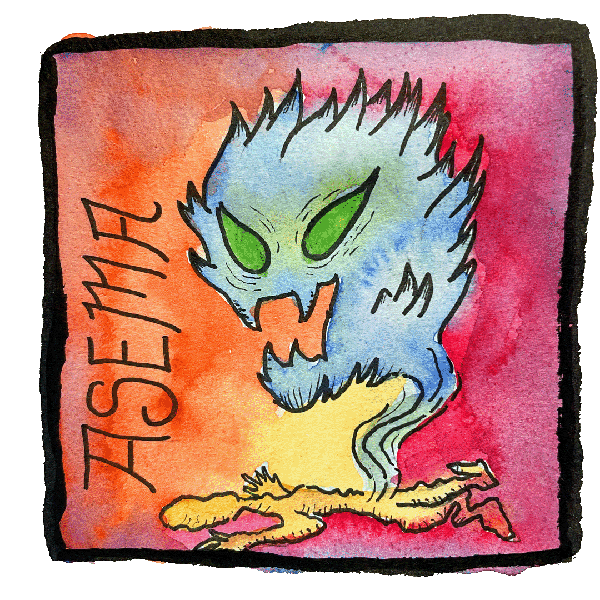
The cloak of night descends and the human skin slips away, falling into a heap on the floor. What remains is a radiant orb of blue light. This is the Asema, a vampire native to the northern stretches of South America. The corpse light vampire, also known as a ball vampire, invades homes, driving by its insatiable thirst for blood.

Bloody Habit

The Asema loves the taste of human blood. It often would not drain a victim dry, choosing to return night after night. But if your blood was particularly tasty, you might be emptied that very night. With the break of dawn, it resumed their human guise, repeating this haunting cycle day after day.

Defensive Measures

Placing garlic around your bedside will deter the Asema. Some people consume herbal concoctions to render their blood unappealing to these supernatural beings. 

Many vampires can be waylaid with scattered seeds. The Asema takes this OCD behavior to the next level. You can mix in the trimmed claws of an owl with the seeds. The Asema must pick up and count the seeds, yet if it grabs a single owl claw, it must drop them all and start over. 

Shriveled Skin

The best way to stop an Asema permanently involves its discarded skin. You give the skin a heavy dose of salt, but not as the usual seasoning. In this case, you want to shrink the skin so that it will not longer fit the Asema when it returns in the morning and the day’s light will destroy it.

In this fashion, the Asema bears a similarity to the Malaysian Penanggalan. In that case, you fill the discarded skin with shards of glass. On wonders if these two vampires are related or have a common ancestor?

Tim Kane

[mailerlite_form form_id=2]

La Siguanaba: The Horse Faced Woman

The myth of La Siguanaba is closely linked withMayan heritage — a haunting portrait of a beautiful woman in a white dress who emerges at night, beckoning to unsuspecting travelers or those who have transgressed societal norms. Passed down through generations, this legend bears the unique imprints of various cultures that have woven their distinct elements into its narrative. But who is La Siguanaba?

Modern Folklore

Picture the moonless nights in the Salvadoran countryside, where La Siguanaba prowls, captivating unwary travelers—often unfaithful men—near bodies of water. She appears as a near-nude figure, radiating an irresistible charm. She entices men with the promise of intimacy.

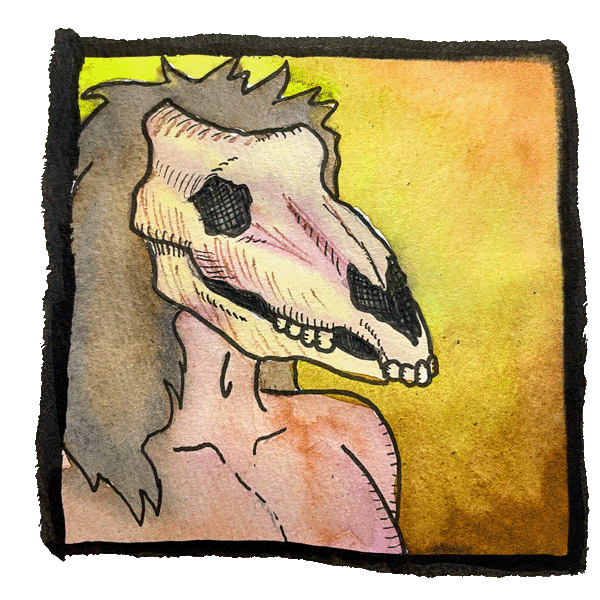
When she gets her victim along, her facade dissipates, revealing her true visage—a horse’s face. Some legends show her with huge deformed breasts that she beats on rocks to terrify her victims. Some succumb to sheer fright, while others are driven to madness. Those unfortunate enough to survive find themselves abandoned in the wilderness, condemned to wander until their inevitable demise.

Aztec Influence

In Central America, the tale of La Siguanaba maintains close ties to the ancient Aztec religion. La Siguanaba was originally known as Sihuehuet, translating to “beautiful woman.” Sihuehuet, a peasant woman, possessed an unparalleled beauty that could captivate even the gods themselves, including Tlaloc, the lord of the storm.

Sihuehuet ensnared Tlaloc, and bore him a child. But she apparently didn’t have any maternal inclinations. She neglected the child and cheated on Tlaloc when he went to war. 

Driven by an insatiable hunger for power, Sihuehuet plotted to eliminate Tlaloc and usurp his divine throne. Crafting a poisonous plan, she intended to assassinate him. Yet, the scheme backfired when it transformed Tlaloc into a monstrous entity that wreaked havoc upon the community.

Upon learning of La Siguanaba’s malevolent actions, Tlaloc sought aid from the mighty god Teotl. Teotl then cursed her with the epithet “Siguanaba,” meaning “hideous woman.” This curse warped her into the nightmarish figure with a horse-faced appearance. Her days are now spent laundering clothes by a river’s edge while endlessly searching for her lost son, trapped in her grotesque form as punishment for her past misdeeds.

Warding Off La Siguanaba

The best advice is to simply not be lured with the prospect of sex with a strange woman. But should you fall victim, here are some ways to protect yourself: 

  • Pull your hair
  • Bite into a machete, a metal coin, or a cross necklace

You can also scare her away by yelling three times: “no te vas a ir Maria, pata de gallina,” which means “you are not leaving, crabgrass Maria”.

Tim Kane

[mailerlite_form form_id=2]

Mètminwi: The Haitian Boogeyman

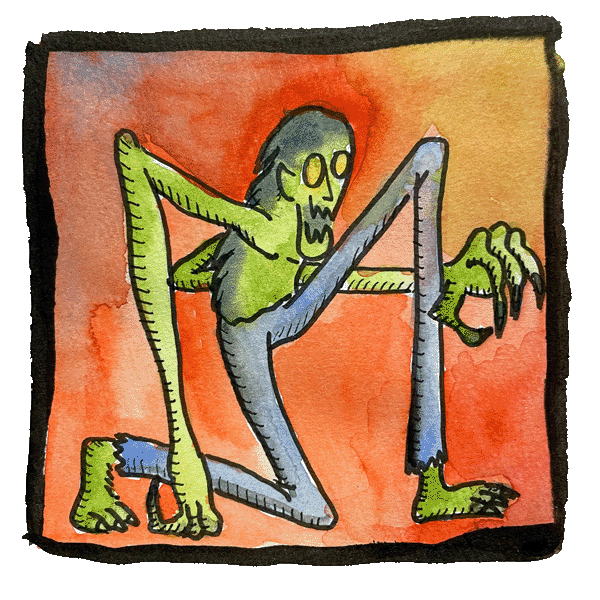
One boogeyman stands taller than all the rest—the towering Mètminwi. This mysterious Haitian boogeyman, rumored to be a colossal two stories in height, haunts the nocturnal streets, where tales of his appearance vary from incredibly long-legged to a giant with stilt-like limbs and arms.

Tales of the Twilight Terror

Throughout Haitian folklore, various renditions describe Mètminwi as a seclusive giant with haunting red eyes and a pale, frowning countenance. His haunting presence emerges precisely at midnight, and he is said to prowl the streets, indiscriminately catching and consuming any unfortunate soul still lingering outside, regardless of their behavior.

The Mètminwi’s story serves as a cautionary tale, instilling lessons about obedience, respect, and the consequences of defying the night’s rules. The legend is a tool to dissuade mischief and wandering after the witching hour, guiding the young to heed the warnings of their elders.

Understanding the Legend

While the descriptions of Mètminwi might vary, the central message remains consistent: he stands as a looming figure in the night, a warning against venturing out after midnight. Mètminwi name is a clever play on words, translated as “midnight master.” It’s a reminder that a midnight snack at home might be a safer choice than a moonlit stroll on the streets of Haiti.

Mètminwi, in essence, remains a steadfast reminder to all: the night belongs to the daring, but it also holds its own share of mysterious and cautionary tales.

Tim Kane

[mailerlite_form form_id=2]

History of the Ouija board — From Witchboards to Ouija

The Ouija board’s origins are deeply rooted in the Spiritualism movement of the 19th century, a period of intense spiritual exploration. To understand the history of the Ouija board, we must first travel back to the heart of the 19th century, when the Spiritualism movement was sweeping across America. Delve into the captivating history of the enigmatic Ouija board, a tool that has fascinated, terrified, and intrigued people for generations.

Seances and Talking Boards

In the wake of the American Civil War, the country was gripped by an overwhelming sense of loss and grief. Families were torn apart, and many were desperate for a means to reconnect with their departed loved ones. This despair led to the emergence of Spiritualism, a movement that claimed to bridge the gap between the living and the dead.

As part of the Spiritualism movement, seances gained immense popularity. Mediums would gather with those seeking contact with the deceased, holding sessions in dimly lit rooms filled with incense and mysticism. The movement was greatly influenced by the Fox sisters, who claimed to communicate with the spirit world through mysterious “knocks.”

The Talking Boards, also known as Witch Boards, made their debut during this period. These boards featured the alphabet, numbers, and simple “yes” and “no” responses. Participants would place their hands on a planchette—a heart-shaped or teardrop-shaped device with a window—allowing spirits to guide their movements to spell out messages.

The Birth of the Ouija Board

In the 1880s, E.C. Reiche, a Prussian immigrant and undertaker, began creating prototypes of these talking boards on the side. It was these prototypes that would eventually evolve into the Ouija board. 

Charles Kennard, an entrepreneur with a keen eye for opportunities, actively promoted what he claimed to be his invention of the talking board to potential investors. His persistence paid off when local attorney Elijah Bond took an interest. Bond, who had a sister-in-law with strong mediumistic abilities, saw the potential in the talking board. The Kennard Novelty Company was incorporated on Halloween, 125 years ago, marking the start of mass manufacturing of Ouija boards as we know them today.

Helen Peters and the Ouija Name

According to legend, Helen Peters, the sister-in-law of Elijah Bond, was using the Ouija board when she asked the board what it wanted to be called. The board, under the influence of unknown forces, spelled out “O-U-I-J-A.” Intrigued and curious, Helen inquired about the meaning behind this peculiar name. The board replied, “Good luck.” Though, in reality, the name was written on her necklace locket at the time

With a desire to protect their invention, Charles Kennard, Elijah Bond, and Helen Peters sought to patent the Ouija board. However, their journey faced a roadblock in the form of the patent chief, who was skeptical of their claims. He agreed to grant them the patent under one condition: they must use the Ouija board to reveal his name.

Helen Peters took up the challenge, and with the Ouija board’s guidance, she successfully spelled out the patent chief’s name, securing the patent for the Ouija board. This peculiar incident cemented the board’s mystique and added an extra layer of intrigue to its history.

Tim Kane

[mailerlite_form form_id=2]