The Bloody Eye of Horus

Ever read a newspaper story about someone mutilated in an accident? We can’t look away from these things. As human beings, we’re drawn to the macabre. It seems the Ancient Egyptians were no different. The myth surrounding the eyes of Horus (god of kingship, victory, and the sky) is a bizarre tale.
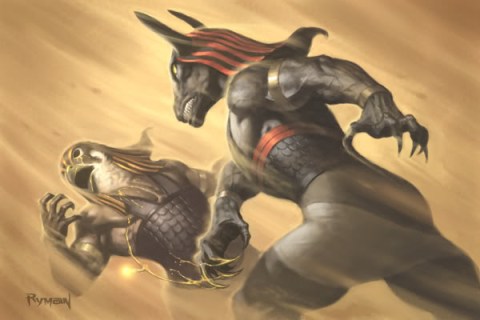
horus vs. set

Illustration by James Ryman. Click to go to his website.

Every year I help put on an Egypt Day at my school for the sixth graders. This year, I wanted to give them a taste for the myths of the Egyptians. After digging around through my books, I discovered some really bizarre things about Horus.

First off, there are so many legends and myths in Egypt that contradict each other. For example, the god Seth is sometimes Horus’s brother and other times his uncle.I settled for one that I could string together in one sitting.

The Left Eye of Horus (The Wadjet Eye)

The Egyptians had two different types of desert: The red desert and the black desert. As Westerners, we’re trained to think of black as evil, but the opposite was true in Egypt. If you travel down to Home Depot or Lowes and buy some potting soil, chances are it will be black. That’s because black soil meant life. Red soil, at least to the Egyptians, represented the dry harsh desert.

Horus was the god of the black desert, which meant he represented life. His brother, Seth, stood for the red desert. So obviously these guys weren’t going to get along. As I researched this, their dynamic seemed similar to Thor and Loki.

Seth was jealous of Osiris, their third and eldest brother (a whole lot of other mythology surrounds the resurrection of Osiris and is better left to those with more authority). Let’s just say that Seth wanted what Osiris had and was willing to fight to get it.

Seth transformed himself into a bull (lots of animal transformations with these older gods) and trampled Osiris to death. Horus sough Seth out for revenge. Seth dealt the first blow, ripping out Horus’s left eye. Seth then cut the eye into six pieces.

Each piece became magical and stood for one of the basic senses: sight, hearing, smell, taste, touch, and thought.

But still, Horus wanted his eye back. He turned to Thoth (god of Wisdom and the guy who always seems to get Egyptian gods out of a jam). Thoth glued the pieces back together using spit. Yes, spit.

EyeofHorusFractions

Here’s the geeky math part in me. Each part of Horus’s eye stood for a fraction. ( The part was also the hieroglyphic symbol for that fraction). When you add all the parts together, something interesting happens.

math

When you create common denominators (I also teach math in my myths) you find that there’s a piece missing. In other words, when you add all the pieces of Horus’s eye back together, one tiny part is missing. The Egyptians believed that that this missing part was filled in by Thoth’s spit.

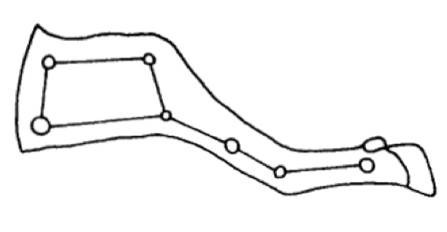
So there you have it, Horus has a brand new eye. Now he’s ready to give Seth a beat down. He catches up with his brother and promptly slices off his leg. (Remember, Seth is still in bull form). Horus wants to make sure that the hoof that killed Osiris never harms anyone ever again.

You can still see this severed leg anytime you look into the night sky. Instead of seeing a big dipper, the Egyptians saw this constellation as Seth’s severed leg.
leg

In the next post, I’ll talk about Horus’s right eye (the Eye of Ra) and Sekhmet (the goddess you don’t want to invite to dinner, unless you have plenty of beer).

Tim Kane

I Abandoned My Baby to Die

Okay, so I’m not really taking about a flesh and blood baby here. But if you’re a writer, you will understand. I had to abandon a novel I was working on for nearly three years. I dropped it cold. One day, revising a chapter. The next. Gone.

sisyphus

I felt strange. A piece of writing, especially something of novel length, does feel like a child. You give birth to it, and watch it grow. In the case of this novel, I’d started it time and time again over the course of two years. Then, using the NaNoWriMo month of November, I plowed through and completed a whole draft.

It was awful.

That wasn’t the way I was used to writing. I like chapters to come off polished and clean, not all ragged and error filled. Yes, I did have 50,000 words. But that was not a story.

That was one year ago. I took up the job of revising it and found that I was starting from scratch again. A few of the plot ideas from the writing marathon remained, but mostly, I had to trash it all and start over, yet again.

Dragging my butt over to the keyboard became harder and harder. I found plenty of excuses. Yet I still wrote. I’m not a quitter. It just felt like rolling a rock uphill. Every time I sat down, I’d only made inches of progress. (Just call me Sisyphus).

Then I had an opportunity to revise a former novel. My agent wanted to know if there were any changed before going for a second round with publishers. The difference in my writing was ridiculous. I yearned to write. I pushed myself to crazy limits to totally revamp and revise that writing.

That’s when I realized that the unfinished novel had to go. The passion wasn’t there anymore.

And so I left it, like the Spartans do with their babies, to fend for itself. Parts of the old writing will live on in my imagination. I know I’ll cannibalize scenes and ideas. That’s what writers do. But I will never take up that novel again.

I think I was too in love with the idea and the world of that novel and not in love with the characters. That’s a danger for me. Characters and story need to come first.

The current novel, started the same day the old one was abandoned, and it is going swimmingly.

Tim Kane

How Does Your Body Move After Death?

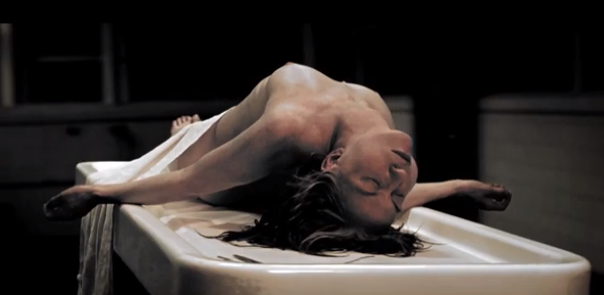
There are actions on your body long after death. Many I wasn’t even aware of until after seeing “Danse Macabre”. When this first started, I thought… Uh Oh. This is going to be some artsy piece where someone “interprets” the movements of a corpse. No way. Nearly all the movements the actor/dancer portrays seem genuine and believable. I say nearly, because the rigor on the table leading to the fall is staged, but for a good reason. It leads to an incredible image of the person falling down the drain with her blood.

Here are some stills from the film.

photo 4

I had never considered how a person’s feet would slide after being hanged. This is a  detail that is typically lost when we think of a hanged person. Many of the movements in this piece walk the line of morbid and beautiful.

Screen Shot 2013-11-04 at 5.17.31 AM

This, as I said, was the most staged position. The rigor led to the body falling off the table. Yet the scene that followed was astounding.

Screen Shot 2013-11-04 at 5.21.29 AM

Screen Shot 2013-11-04 at 5.21.19 AM

We go from a view of the drain to a shot of the body, curled up, falling away. Stunning.

photo 2

I had never considered this rather pedestrian movement of the body. Quite literally, it is lowered into a casket. I’d never thought about how the body was placed in there.

photo 3

The most beautiful, and surprising movement, came from an interior shot of the casket. As it is being moved around, the body slides. I’d never even contemplated that.

Here is the full video. It’s about 9 minutes.

Tim Kane

The Monsters that Lurk in Illuminated Texts

Imagine spending all day, every day, writing. That was the lot for many Medieval monks. It was grueling work, so we can’t begrudge them a little levity in the margins. The illustrations that adorn illuminated texts go from the silly to the downright bizarre. Here are some of my favorites.

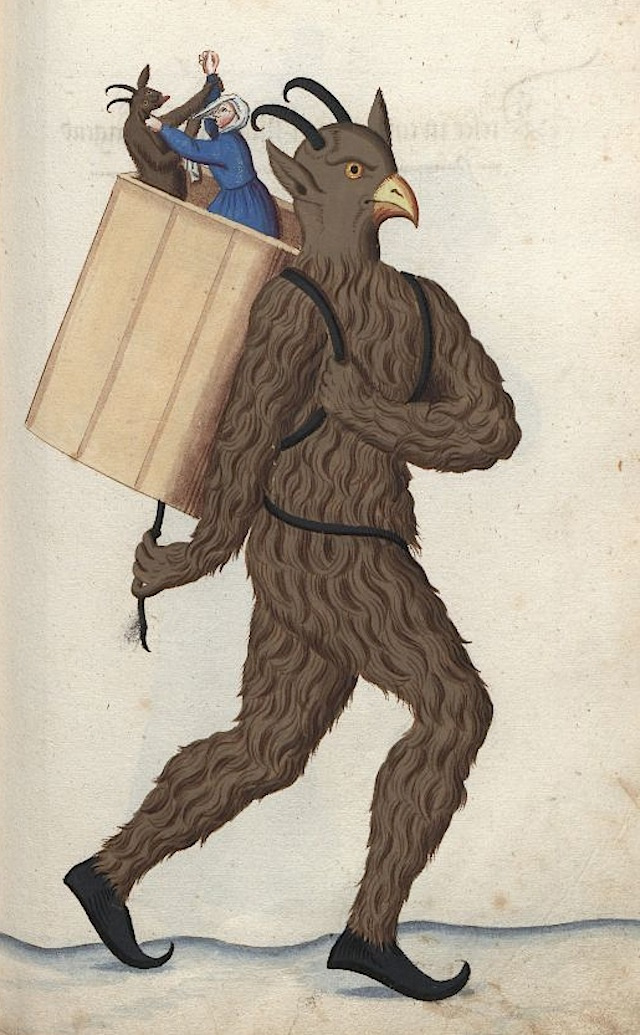
A bird-like demon with a smaller fighting demon and a woman in his basket, from Nürnberger Schembart-Buch, 17th century

A bird-like demon with a two figures fighting in his basket, from Nürnberger Schembart-Buch, 17th century

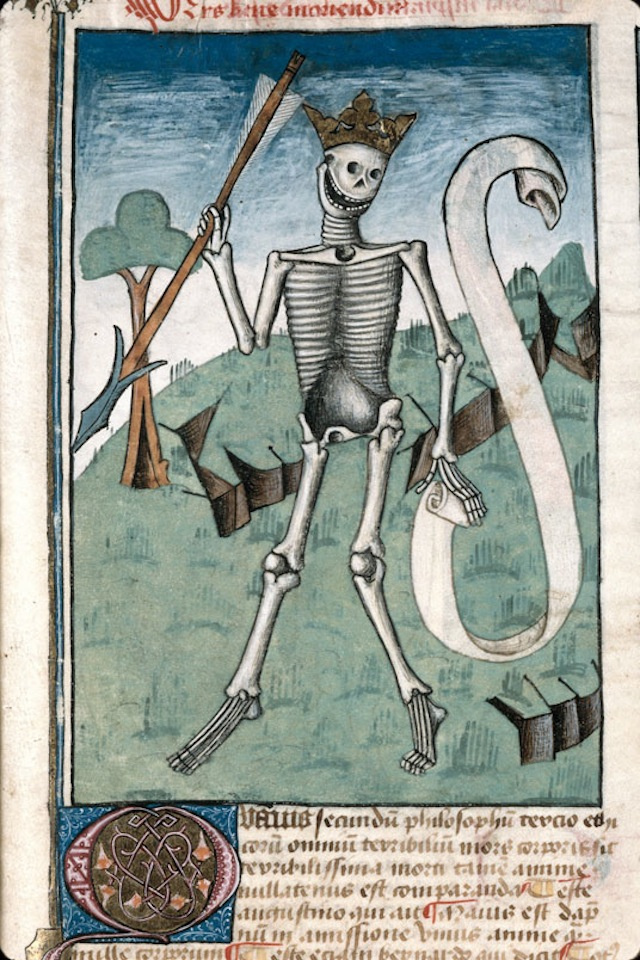
I included this skeleton from Ars bene moriendi (France, 1470-1480) mostly because I love skeletons.

I included this skeleton from Ars bene moriendi (France, 1470-1480) mostly because I love skeletons.

Bizarre bird-cat from the Luttrell Psalter, Add 42130 f.197r, c.1325-1335

Bizarre bird-dog-tiger from the Luttrell Psalter, Add 42130 f.197r, c.1325-1335


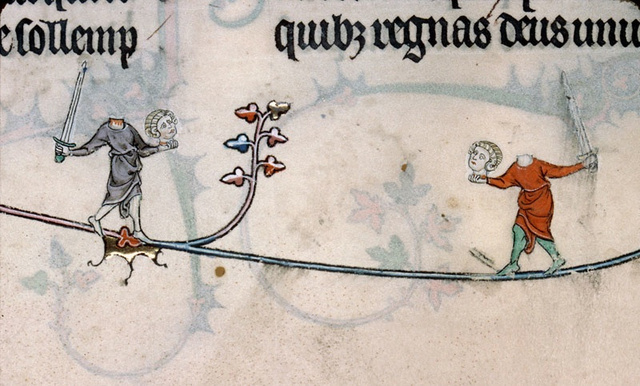
A battle between headless combatants from the Breviary of Renaud de Bar, France, 1302-1303

A battle between headless combatants from the Breviary of Renaud de Bar, France, 1302-1303

Here we have what appears to be a demon (or monster) eating a doughnut. This is from Les Grandes Heures du duc de Berry, Paris, 1409.

Here we have what appears to be a demon (or monster) eating a doughnut. This is from Les Grandes Heures du duc de Berry, Paris, 1409.

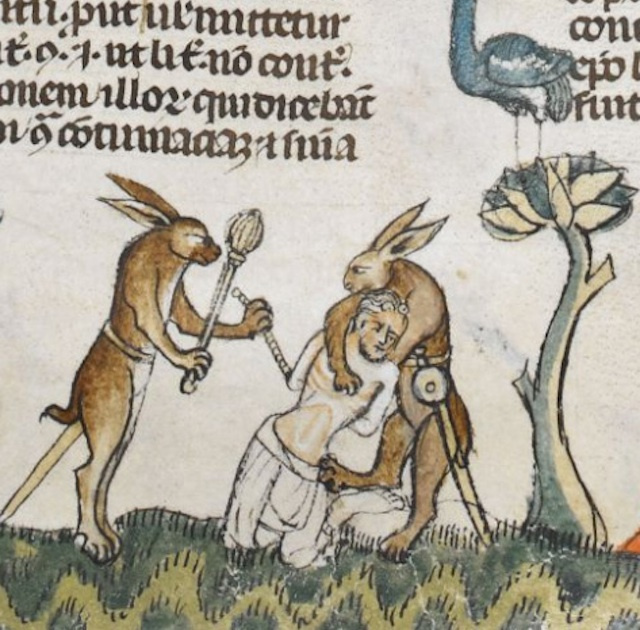
There seems to be a trend in Medieval illuminations of animals attacking people.

Homicidal rabbit from Gorleston Psalter, England, 14th century

Homicidal rabbit from Gorleston Psalter, England, 14th century

A very angry, axe-weilding, ape. (Source unknown)

A very angry, axe-weilding, ape. (Source unknown)

Rabbits about to kill a man from The Smithfield Decretals, c. 1300

Rabbits about to kill a man from The Smithfield Decretals, c. 1300

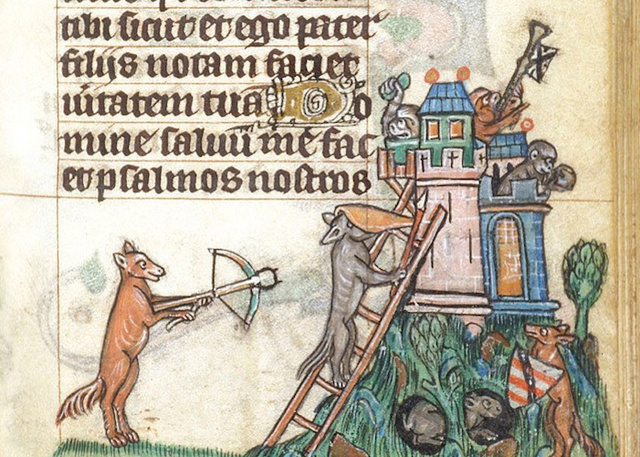
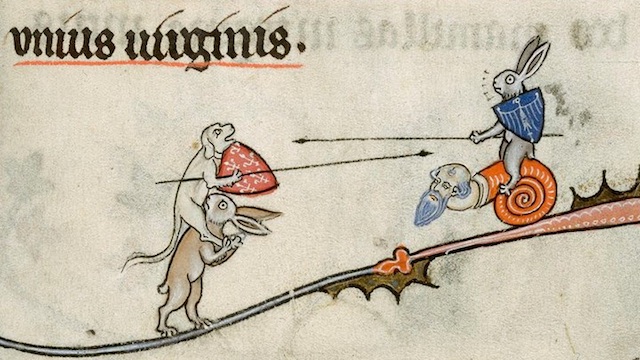
We also see many examples of animal warfare.

Dogs battle rabbits from the Breviary of Renaud de Bar, France, 1302-1303

Dogs battle rabbits from the Breviary of Renaud de Bar, France, 1302-1303

Here, foxes siege a castle of monkeys from a 13th-century Bible.

Here, foxes siege a castle of monkeys from a 13th-century Bible.

A dog and a rabbit joust. Source unknown.

A dog and a rabbit joust. Source unknown.

And then there are the snails. Seriously. Many many illustrations show knights battling snails. Scholars are baffled as to the significance.

A knight about to slay an monstrous snail from The Smithsfield Decretals, decretals of Gregory IX, Tolouse, c. 1300. Illuminations were added about forty years later in London.

A knight about to slay an monstrous snail from The Smithsfield Decretals, decretals of Gregory IX, Tolouse, c. 1300. Illuminations were added about forty years later in London.

Another knight (this one riding a dragon) is about to spear two snails from The Queen Mary Psalter, c 1310-1320 via British Library

Another knight (this one riding a dragon) is about to spear two snails from The Queen Mary Psalter, c 1310-1320 via British Library

So the next time you see a snail, pull your sword.

Tim Kane

Monsters and Aliens, Oh My

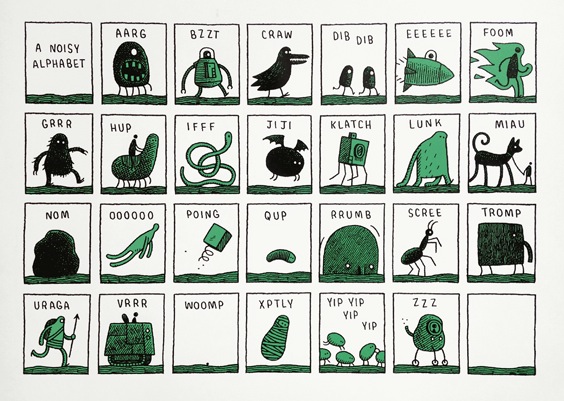
Tom Gauld creates stunning prints of monsters and aliens. Check out his hairy monster below. I took the liberty of animating it so you could see all 3 prints.

rGF6Vp

Animated gif of a monster’s internal organs. Click to see him animate.

He also has a “Noisy Alphabet” where aliens create all the sounds.

52_nastrip6002

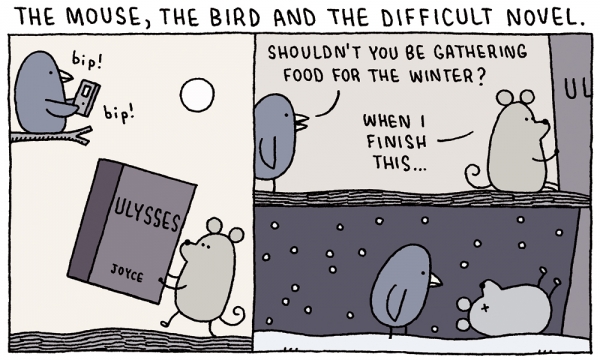
He also has multiple comic strips. Here’s my fav, having read Ulysses myself.

11_letters179

Check this artist out. You won’t be disappointed.

Tim Kane