Protagonists-R-Us

We’re having a sale. Today only. Buy one protagonist, and get the antagonist at a fifty-percent discount. Such a deal. You can’t have one without the other.

I teach writing to sixth grade students. Here’s a typical plot line: Character meets another character and they talk. Then they meet a third character. They talk some more. Finally they all rush back to a) home, b) school, c) a castle. Yes, I know it matches up with a few of the Twilight books (don’t be a hater, I actually like Stephanie Meyers), but what most of my tween writers lack is an antagonist.

Or to be more specific, conflict generated by an antagonist. The two are inseparable. Yes I know that the protagonist herself can have doubts, thus generating conflict. Likewise, nature can also be an obstacle. But let’s face it, nothing beats a good ole white hat versus black hat. (If you wanted to go the Twilight route, Meyers handled that quite well.)

The antagonist defines the protagonist. He often strives for the exact same goal as the protagonist. Since only one can achieve that goal, it creates tension. I love antagonists that mirror the protagonist. For example, if I have a protagonist who hates monsters and the grotesque, I might pair him with a an antagonist who is a monster herself, yet despises it. Perhaps they’re both seeking the goal of destroying the evil beasts. Yet our hero does this out of fear and ignorance, while the villain strives for this goal from self loathing.

However you achieve it, make your antagonist linked to your protagonist. It creates a deeper bond and makes the final mano-a-mano showdown that much more interesting.

Tim Kane
Why Authors Still Need Agents

Recently, I was lucky enough to witness a keynote speech by Mark Coker, the founder of Smashwords. He talked about a day when writers supersede agents and publishers. He even made a joke of it:

One day, an author will tell some friends, “I just got a book deal.”
And they reply, “I’m sorry.”

This elicited groans from the audience (mostly writers with a handful of agents and editors). I agree in principle with Mr. Coker. Publishers have dropped the ball. They need to cut their own costs to become competitive and offer authors a greater piece of the revenue stream. Amazon’s 70% is far better than the 12% you get from publishers.

I still see a place for agents. Next time you’re on Amazon, or Barnes and Noble, troll through the lists of available ebooks. You’ll see plenty of indie authors. That’s a good thing. The ebook has become the great equalizer. Yet, try purchasing one of these indie books.

I did.

I tried quite a few. None were worth the $0.99. Typos were rife. Even when they weren’t the story sagged or had horrific info dumps, or just bad writing. What all these books had in common was a lack of agents and proper editing.

Agents serve as gatekeepers. They champion good books and turn the rest to the door. It’s true, that agents take less and less clients these days, but this is an issue based on the poor state of the publishers. If those corporate guys can get things turned around, I think you’d see many more author’s picked up.

The truth is, as a reader, I want someone to vouch my books. I don’t have a lot of time to read, and wasting it on poor prose is infuriating. That’s not to say that lousy books can’t make it through the agent and publisher system. They can and do. But usually I sour on these as a matter of style. Agents, at the very least, make sure the writing is free of errors and has a decent story.

Tim Kane

When Do You Let Your Creative Pooch Off the Leash?

Animal strokes ... Leonardo da Vinci's Studies of a dog's paw, about 1485. Photograph: The National Gallery of Scotland, Edinburgh

Where do you go to dream up that killer plot twist? I own a restless mind, and like a puppy scrounging for a toy, it’s always off on an adventure somewhere. During my working hours I reign it in, focusing on the task at hand. Oddly, I have a structured and logical side, and I think this takes control in my school situations. Yet when I take off the dog chain and let it loose, my inner puppy romps all over creation.

Over the years, I’ve learned to channel this rampaging creative force. Direct it toward solving difficult writing problems that stymie my logical side. Usually, what I do is mull over a problem, maybe read a few pages of my manuscript in progress and then give my brain time to work.

What works best is showers. I’m stuck there for fifteen minutes. I can’t write, so my left-brain can’t ruin things by trying to put it all into words. Usually when I emerge, a soppy mess, I rush to a pad of paper and jot the whole thing down in one mind dump. So far this technique has never failed me.

I also find that driving produces the same results for the same reason. I can’t write. This leaves my mind free to explore the permieter of the yard inside my head, sniffing and digging the dirt. I often mind myself stopping in a parking lot and unloading on whatever scrap of paper I have. If you ever see me parked and writing, don’t come near. I’m working.

One time, on a drive to Disneyland, there was nowhere to pull over. Thank goodness my phone has a record feature. I must have put down a dozen tiny recordings. Some no more than a few words. My wife must have thought me insane. At least I kept my eyes on the road.

I used to settle in coffee houses for the same effect. Though with the rise of Starbucks, most independent java joints have vanished. Plus I brew my own killer cups at home these days.

So what about you? Where do you let your creative pooch off the leash? Does the dog deliver the goods, fetching back trinkets of character or plot for you to use?

Tim Kane

Google+ What’s the Big Deal?

We writers like to stay up on the whole social media thing. I tweet and blog. Inevitably, I knew I’d have to check out Google+, the newest shiny network on the block. I can’t say I was bowled over.

The interface looks like a milquetoast version of Facebook. Yet it doesn’t seem to have the social factor boiled in the way Facebook does. Ultimately I could see Google+ killing Facebook. After all, Facebook seems to mess with their privacy settings on a monthly basis.

On the surface, the circles function of Google+ seems like a superior solution. Yet there’s something to be said for Facebook’s simplicity. On Google+, I needed to move all my friends to circles. I’m not sure what would happen if I had more than would fit in that little circle. Now on Facebook, I have close to 100 friends. If I could port these over to Facebook, I’d have to manually move them into circles. What a pain.

One strange limitation about Google+ is that you can’t direct message someone or write on their wall. When I wanted to send a message to just one friend, I had to remember their exact name and then add that to my post. Plus, my message would simply appear in their stream. It could get lost.

Folks say Google+ will take down Twitter. Frankly, I don’t see it. Google+ feels too cold and logical. Everything is thought out. Twitter is funky. It has this bizarre system of hashtags that doesn’t follow any rules. Just like the English language, it evolves. I couldn’t imagine Google+ used as a revolutionary tool in countries around the world.

My final complaint with Google+ is the lack of a good iPad app. Without it, I can only access the mobile site. Have you ever seen the mobile site? It feels like I’m working on a computer terminal circa 1985. Almost DOS like. It’s horrific. And this is the best Google can do? I know that Apple is their competition, but if they want to woo users over, they have to jazz up the joint.

Tim Kane

The Nook Makes Me A Better Reader

While attending a young adult workshop at the SDSU Writer’s Conference, I gleaned an interesting tidbit. Someone in the audience brought up the idea of a protagonist in his early twenties at college. Our presenter nixed it. College bound folk are inundated with textbooks and studies. Often, they don’t have time to read.

That was the case for me. College killed my reading instincts. Before that, I read like a fiend. Afterward, I hardly picked up a book. Magazines drew me in, mostly because of the brevity of the articles. I remember distinctly my first serious novel that I read form cover to cover: The Alientist.

I continued to write, yet my reading suffered. Finally audiobooks came to my rescue. I read, or listened, while commuting. This worked well, but I yearned for that actual visual experience. (Try writing down a clever quote from a spoken text. Not as easy as it seems.)

Then my wife purchased an iPad for my last birthday. I checked out the ebook options. There were limitless. Trouble was, the iPad as so heavy. (I have and iPad 1, but even the iPad 2 is weighty.) Meanwhile, my reading had picked up. I am addicted to several young adult series. My latest favorite is Leviathan by Scott Westerfeld.

Much like other YA books, this one is a tome. Reading it makes my arms hurt. I tend to read in bed with the book held above me. So my mind drifted back to ereaders. I checked the whole spectrum. I didn’t need all the fancy web-browsing and apps. (I have an iPad, after all). What I wanted was a basic ereader that was very light. Enter the Nook.

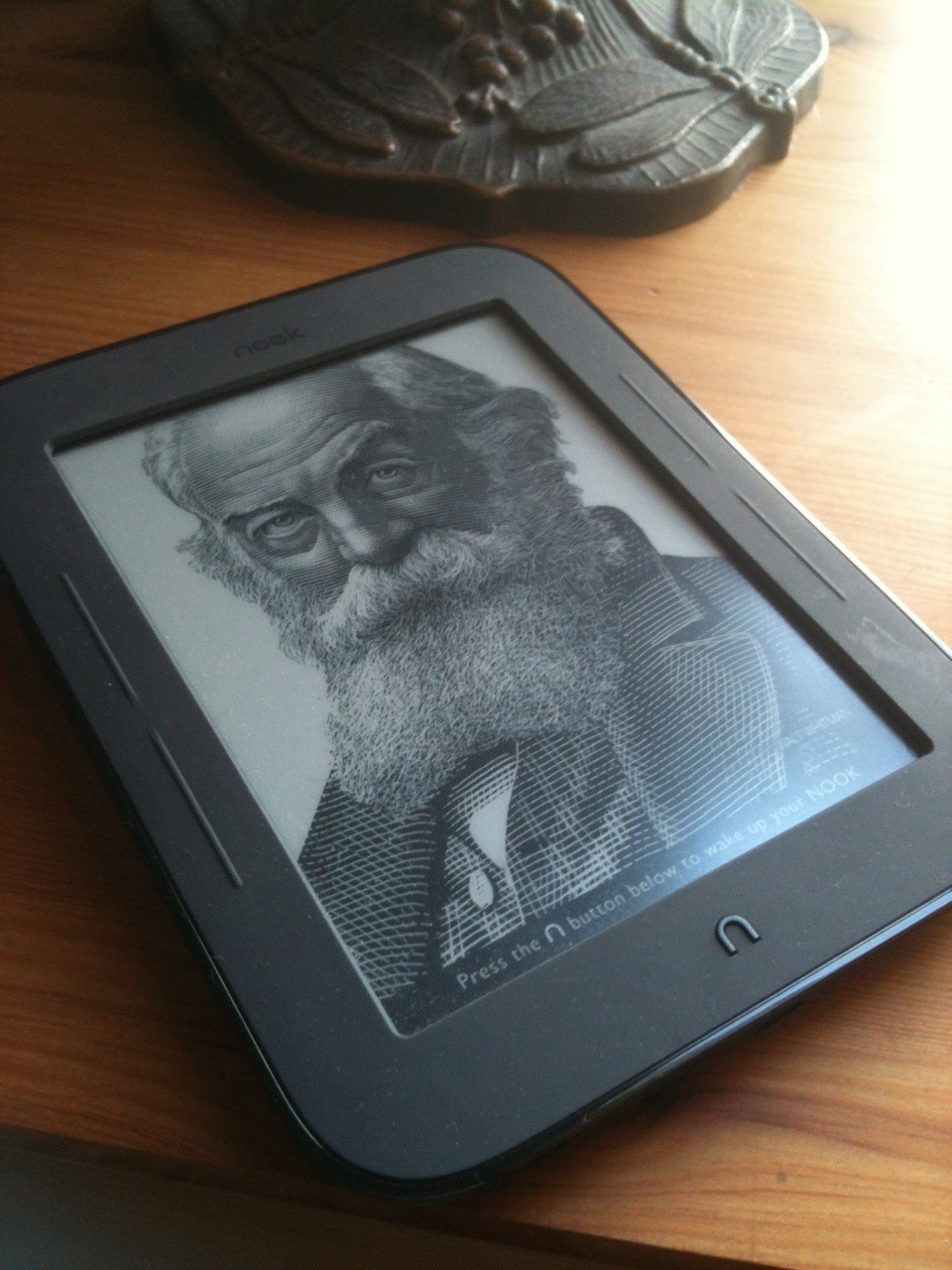
I adore this product. The eink is amazing. It reads just like my paper book. The buttons make page turning easy and my arms never grow tired. Finally, it’s created a renaissance in reading for me. Just as the iPod revitalized my love of music, so has the Nook spurned me to be a more voracious reader.

Long live the ereader.

Tim Kane