The Seven and a Half Rules Writer’s Shouldn’t Need

Writing is a confusingly simple process of transcribing motives and plot points into physical form. Here are some tips.

Rule 1
You’ll need a pencil or a pen. Perhaps charcoal or crayons are your flair. Something to make the interior screams of your brain visible to the masses.

Rule 2
Paper is the choice of four out of five writers. However, don’t turn a cold shoulder to bark, bedsheets or cave walls. All excellent media.

Rule 3
Fortify yourself with stimulants. All that creativity can drain on your soul. I recommend chocolate and coffee. But that’s just me.

Rule 4
Sometimes you don’t feel like writing. You stare at the paper (or computer screen if you’re the techno-type) and nothing comes. Just pure white. Minutes slip by and your mind reels. Congratulations, you’re meditating. Some people pay big money for that kind of thing.

Rule 5
A diary or a journal can be a tremendous place to let your innermost turmoil spill on to the page. Just be sure to lock that book up. Wouldn’t want any of those secrets leaking into your writerly work.

Rule 6
Don’t forget to add characters. I hear those are important to your writing. Unless you’re genre, then ignore them and plot, plot, plot.

Rule 7
Set your story someplace interesting. Not a bathroom or a school. Maybe a jungle or the DMV waiting line. Those places are always chock full of suspense.

Rule 7 and a half
Be sure to have a compelling ending.

Write on fellow wordsmiths.

Tim Kane
Hate Club: Why I Despise Most Published Writers

I hate other writers. But let me be specific. I hate published writers. I don’t think I’m alone in this. It’s a jealousy thing. We all want that recognition. Not just ebook indie-publishing, but in the book store, everyone reading-your-book fame.

Realistically, this doesn’t happen very often. So the hate club builds members. We all channel our collective frustration at those published folks. We say, “I could do that,” or “That book isn’t so good.” When deep down, we yearn to be them.

Today I took a step closer to joining the other side. I’ve found an accomplice in the form of a literary agent. No guarantee of being published (or even selling well) but it’s invigorating to know that someone is basing their income and livelihood on your creative chops.

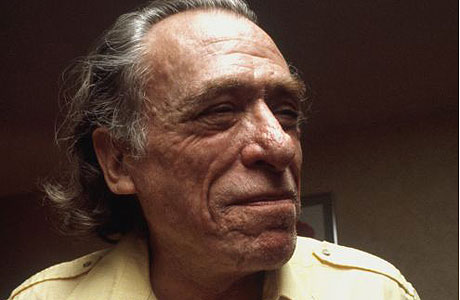
It reminds me of a Charles Bukowski poem I read once. I’ve scoured my poetry books, but can’t locate it again. It basically had Bukowski commenting on all the haters he had. Those that felt they could write a better poem.

In my search, I did run across this poem about writing. A good one for the Hate Club.

some suggestions

in addition to the envy and the rancor of some of
my peers
there is the other thing, it comes by telephone and
letter: “you are the world’s greatest living
writer.”

this doesn’t please me either because somehow
I believe that to be the world’s greatest living
writer
there must be something
terribly wrong with you.

I don’t even want to be the world’s greatest
dead writer.

just being dead would be fair
enough.

So what have we learned? Even success has it’s downsides.

Feel free to hate.

Tim Kane

Typewriter Love

Every time I pick up a book from the earlier part of the twentieth century (heck all the way up to the 80s, really), I think: Damn, this whole thing was written on a typewriter. That’s takes patience. And plenty of carbons.

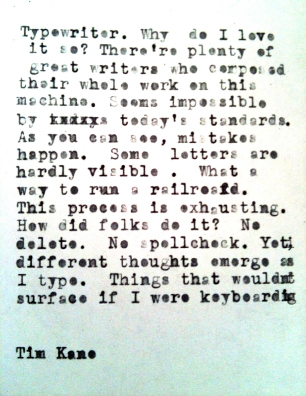
I thought I’d give it a go, on a small scale, mind you. Here’s the results.

If you have as much trouble as I do reading this, here’s what it says:

Typewriter. Why do I love it so? There’s plenty of great writers who composed their whole work on this machine. Seems impossible by today’s standards. As you can see, mistakes happen. Some letters are hardly visible. What a way to run a railroad. This process is exhausting. How did folks do it? No delete. No spellcheck. Yet different thoughts emerge as I type. Things that wouldn’t surface if I were keyboarding.

It took me a few drafts to realize where the apostrophe was. Also, as you notice, I realized I needed to switch to double spacing after periods (rather than the now accepted single space).

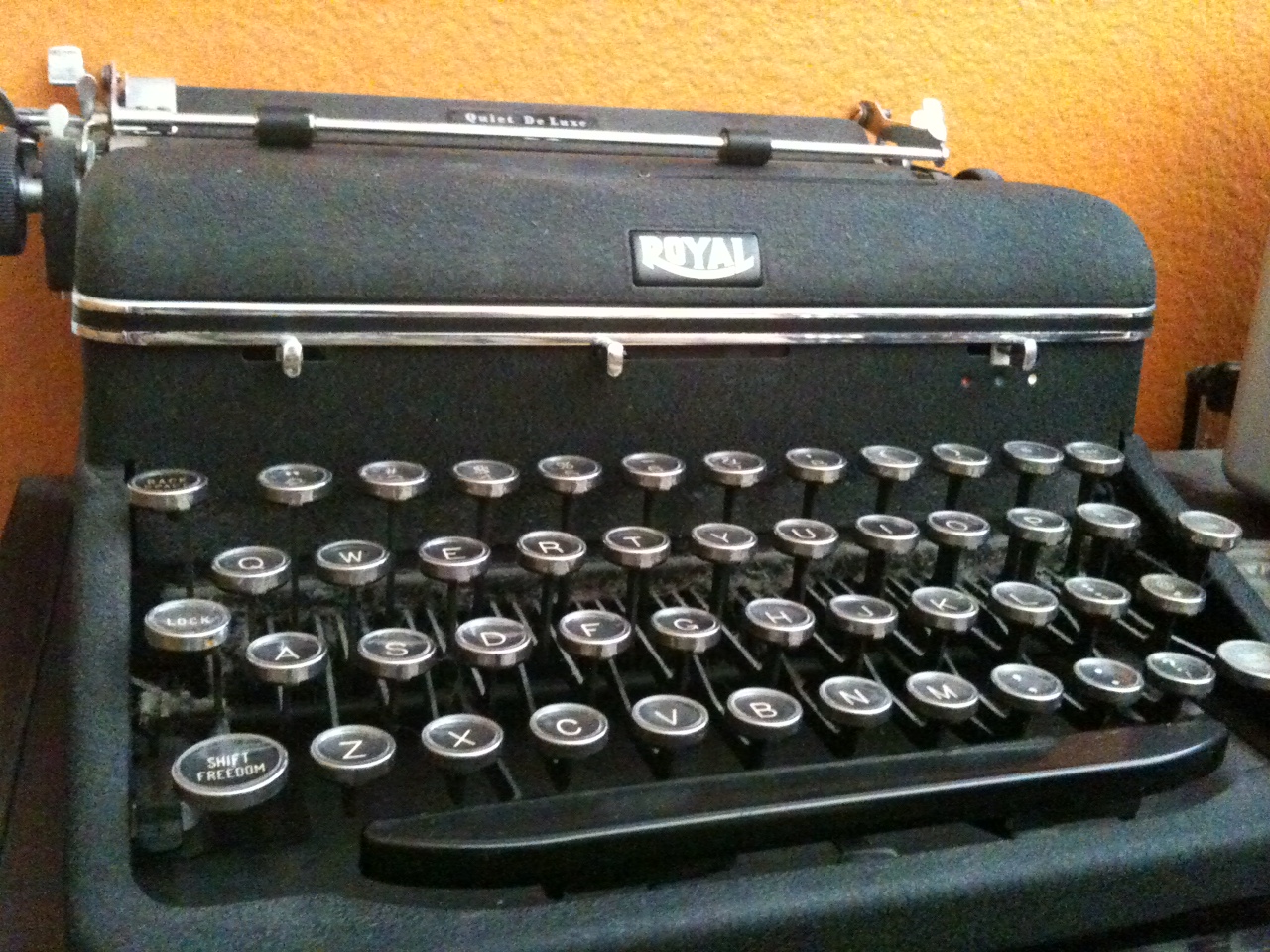
Here’s the machine I worked on: The Royal Quiet De Luxe.

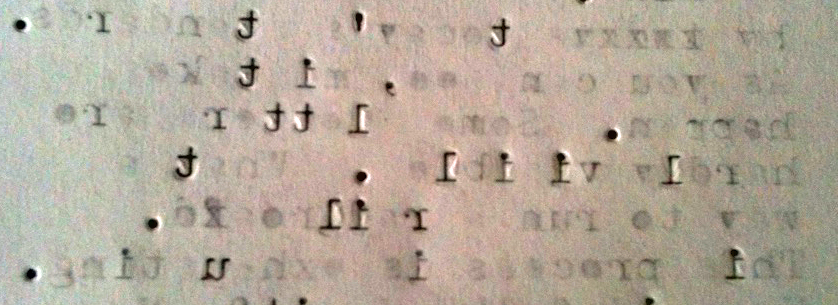
One interesting outcome that you’d never see with modern printers were the dents. I had to strike the keys so hard, they dented the paper. In a few spots they even created holes. Here’s a picture of the backside of the paper.

Trippy, isn’t it?

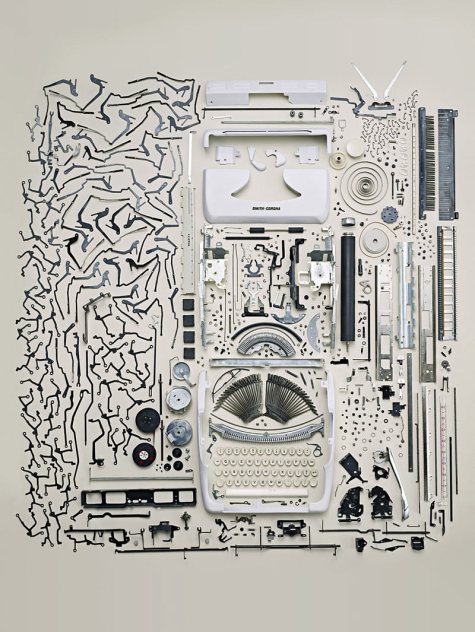
One last picture to round out my typewriter love. This isn’t mine. Rather it’s from photographer Todd McLellan. This is from a series called “The Way Things Work.”

The Way Things Work by Todd McLellan

Type on.

Tim Kane

Scheduled Stress

I am a very organized person. I thrive on efficiency. In fact, this sometimes leads to inefficient behavior. When I’m doing some activity (say washing dishes) and think of a better (more efficient) way to do the task, I’ll backtrack and start over. That’s just the way I roll.

My subconscious seems to work in a similar, highly organized way. The past two weeks have been a blur of activities. As a school teacher, I have final report cards and a sixth-grade promotion to plan and execute. The day after promotion (literally), I drove three hours up to Los Angeles for a conference on the new common core teaching standards. Then back at home, I picked up my new car from the dealer. Finally I shopped and decorated for my daughter’s fifth birthday party. All fun exciting activities, but quite draining.

The stress takes a toll on my body, yet it won’t show until the deadlines are completed. It’s as if my mind has a mental checklist. Until everything is ticked off, it will allow no sickness. Now that all my tasks are done and I’m officially on vacation, I get sick. My body collapses under the strain of so much to do in such a short time.

I don’t know if anyone else has this sort of condition. It might just be be. At least I can let my body relax. More deadlines are coming. Writerly ones. The kind I like.

Tim Kane

Should Young Adult Books Be Rated for Content?

I can see the issue of rating books from two angles. As a teacher, I have to be damn careful what YA books I bring into my sixth grade classroom. Life would be a whole lot easier if I could glance at the rating and determine if it’s even worth adding. Currently, I only add books I’ve personally read and can vouch for. This takes a bit of time. I read slower than ketchup dribbles from a bottle.

Then there’s the writer in me. Would slapping labels on books act as a deterrent to some books with higher ratings (or an attractant, depending on the kid). Is this a form a censorship, as some have said? I disagree with the last point. Just labeling the product doesn’t censor it. Mostly, it limits access.

I certainly don’t think that books need to fall into the categories of movies, where readers will have to pull out an ID to purchase the novel. I would see the system more like what exists now for comic books, video games, and television. An advisory label. That doesn’t bother me too much.

One thorny issue to consider, should this new rating system come to pass, is this: what about indie writers? Would they self rate? Would some rating board come into play? Unlikely on the second count. Who would fund such a board and how could anyone rate the thousands of books that come out daily? That leaves self rating which also means that the authors could play with the rating, raising or lowering, to suit their tastes. Hey, what’s to stop an author from republishing the book with a lower rating if the sales didn’t click the first time? Nothing, really.

This, in itself, points out the ridiculousness of any rating system. In this world of instant publishing, people could circumvent it and manipulate any rating system easily. Even webpages that are supposed to have adult content only ask the user to click OK if they’re old enough. Like that stopped anybody.

What got the ball rolling on this recent round of “rate these books” is the novel Fifty Shades of Grey by E. L. James. Although this is an adult novel, it started as a fanfiction for Twilight, having Edward and Bela take up a quite different relationship than Stephanie Meyers had intended. When asked to remove the fanfiction from the fan site, James simply posted it onto her site. After reworking the book and changing the characters, she published it (to remarkable success).

The trouble is, it’s still linked to Twilight (no officially, mind you) and the novel attracts droves of young adult readers. In fact the movie will most likely garner an R rating, thus preventing many fans from seeing it. So should these fans even be reading it? Maybe not. But would a rating system really stop them?

Tim Kane