The Dark Whispers of the Elder Futhark

I don’t buy into most divination practices. Many don’t make sense (like the I Ching) or some are too darned complicated (Tarot), but I do have a yen for runes. Maybe it’s the German heritage, but these symbols speak to me.
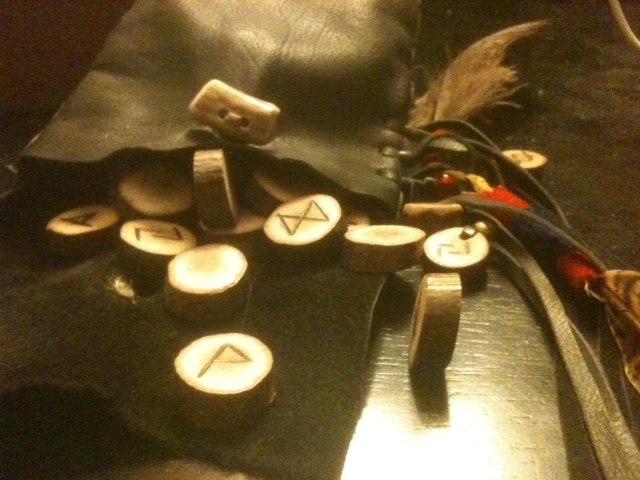
runebag

The word rune has a long and clandestine history. The Old Norse called it runir meaning secret or hidden lore. In Old English it became rün, a secret consultation. Finally the Gothic language titled it as runa, dark sayings, or whispers. These dark whispers are not malicious by any stretch of the imagination. Rather, the runes are like a friend, confiding secrets to you, and rune casting is the best way to get your new friend talking.

Each rune symbol represents both a letter of the alphabet and an idea (see the letters here), but these are a far cry from their true meaning. This only comes from using the runes, over and over and over again. I don’t mean be a fanatic about it. For goodness sake have a life, but allow these messages and the stories they represent to enter into your life.

I don’t put in for the various meditations and soul searchings that many of the books I’ve read suggest when working with runes. I’m a pragmatist. How can I get these things to work for me? What I’ve found is that the runes, as a divination source, are far more practical and straightforward than say the Tarot. I tried various divinatory techniques with the runes, kept what I liked, threw away the rest.

One that I use most often and with tremendous success is rune casting. What’s best about this method is that I don’t even need to have any runes on me to practice it. Once I threw a casting in the parking lot of McDonalds with a bundle of coffee stirrers. I’ve found that there is a bond that develops between you, the caster, and the runes themselves. Often you must read into the casting to find its true meaning, sometimes going by gut reaction.

The manner for casting is pretty simple. If you’ve purchased or made a set of runes, make sure they’re all inside a pouch. Reach inside with the question posed clearly in mind. It helps to be brutally specific here. The more loopholes you allow the runes, the more they’ll take. This method works best with questions that can be answered with a qualified yes or no. Don’t ask how or why because the runes won’t tell you. As in everything in life, you’ll have to figure those out for yourself. Reach inside, grasp a handful of runes, and toss them onto the ground or table. Now a word of caution here, toss does not mean hurl with the force of a two-year-old with his ball. You don’t want to loose any of the runes, just scatter them randomly. Let them decide how to land. The basic interpretation is simple, if more runes are turned face up, the answer is positive (yes), if more are turned down, negative (no). The trick comes in qualifying the answer. What’s the ratio of upright to overturned runes? If you have, say four to one or five to two, the answer is a very sure yes. If they’re all turned face up, then you have little doubt in the matter. The same goes for face down. When the ratio is close or dead even, then you’re stuck with a qualified maybe. Don’t be disappointed. This only means that your fate isn’t decided yet.

EhwazFinally you can interpret the meanings of the upright runes themselves. The most important rune to see is Ehwaz, because it confirms without a doubt those runes around it. It can push a maybe over to yes or confirm a negative result for sure.

If you don’t have runes to cast, you can also use a set of nine sticks, or coffee stirrers or straws, anything about the same size. This method is little more unpredictable and sometimes yields nothing more than a vague notion. I’ve used it for a quick spot check when away from home. Cast the sticks out just like the runes and then examine them. Because the rune signs are all made up of straight lines, sometimes the sticks will form the shapes of a rune. Be careful though, not every crossed stick is Gebo or Naudhiz. When a rune is created, it’ll be rather obvious. If you get nothing, then you’re left with another maybe. In this method you typically see only a single rune, and must interpret the answer from that rune’s meaning. Usually this will not give you a yes or no answer, rather a quality regarding your question. Like I said, it’s not rocket science, but it can help guide you in a clutch.

Rune casting is like inviting a new person over for diner. The first time you meet will be awkward. You may struggle for things to say. But the more often you two meet, the closer you’ll become, until soon you’ll find yourself rather comfortable with those crazy looking symbols. Then you might feel a gentle rush of air by your ear as you catch just a snippet of those dark whispers. The secrets of the runes.

Tim Kane

Zombie Walk

How times have changed. I recall playing tag in the schoolyard pretty much the way it’s always been  played. One person is “it”. He tries to tag everyone else. No goal save running around like crazy.

Now, my daughter introduced me to the twenty-first century version: Zombie Walk. One person is it (called a witch). Everyone else  gets to be humans. The zombie/witch shambles along, trying to catch the humans, who shriek in mock terror. The zombie must touch a human and count up to the age of the human (an easy feat for a kindergartener). Then the human becomes a zombie and the game continues.

Imagine how shocked our parents would have been if we were busting out this zombie tag in the 70s and 80s? Back then, zombies were pure horror. Remember Night of the Living Dead? That was the staple back then. Now, we have a film with a zombie romance: Warm Bodies.

Additionally, there are even zombie picture books, like Zombie in Love (see my review of it here).

Social Hiatus

The time between Christmas and New Years I totally unplugged. Not to say I didn’t get on the internet. Shopped plenty. Watched some YouTube. But nothing social. No Twitter. No Facebook. No blogging. Just hanging with my family. The experience was great. Plenty of doing nothing. (Which is something my mind is not at all used to.) Now, at the other end of this hiatus, I find myself resisting getting back into the groove of blogging and writing. I keep on wanting to push it off to another day. A lovely thought except for the fact that I know nothing will ever get done if I don’t place ass to chair now.

This is the first step.

Blog on. Write on. Here comes 2013.

Tim Kane

The Joy and Sorrow of Mistletoe

I’m a huge fan of folklore and the history behind traditions. Here’s what I dug up on Mistletoe, everyone’s favorite kissing plant.

It turns out that Avengers fans will recognize their favorite villain in the mistletoe story. Yes, Loki is responsible for more mischief. But, we’re ahead of ourselves. First let’s go the the number two power in the Norse universe (and one that seems to be absent in the Marvel films): Frigga. Like Odin, she could also see the future, but was less doom and gloom about it.

800px-FriggSpinning

“Frigga Spinning the Clouds” by John Charles Dollman

She gave birth to her son, Balder, on the winter solstice. He, being the god of light and truth, fits the season well as the days slowly grow longer leading up to the summer solstice. However, she also received a dream that her son would die. She asked all manner of things in the world to swear an oath to never hurt Balder. This was easy because he was the popular type, with a sunny disposition. (Yes I know, you can hate me now.)

balder

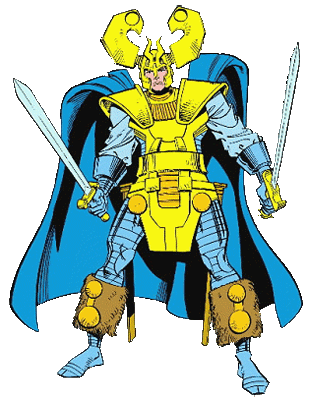
The Marvel version of Balder

The one she passed up was mistletoe. Accounts vary. Some say that mistletoe was too young and immature. Another version says that is was too small and inconsequential. Needless to say, this turned into Balder’s Achilles Heel.

The gods, being the ones to push things to the limit, decided to test Balder’s invulnerability. They hurled all sorts of weapons at him, including Thor’s axes. None harmed him. Loki sidled up to Hod, the blind god of darkness. Loki had fashioned a dart (some versions say an arrow, but mistletoe is tiny, so I buy the dart version). He helped Hod aim and shot it toward Balder, striking the god right in heart.

balder_died

Balder being Killed by Hod and Loki

At this point the story splits into a happy ending and a sad one. Let’s do the sad one first.

Balder died and went to Niflheim. The goddess Hel promised to return Balder to life if every living thing shed a tear for him. Loki again twisted the knife by assuming the form of the giantess Thok. In this form, he refused to cry, dooming Balder to remain in Niflheim forever.

The gods saw through Loki’s deception. The trickster transformed to a salmon to escape. And he almost slipped away. Except his brother, Thor, nabbed him. Loki was then bound in a cave with venom dripping on his chest until Ragnarok.

Now the happy ending.

After being struck by the mistletoe dart, Frigga cried over her fallen son. She cried so much, that mistletoe took pity and formed milky white berries to represent her tears. Her crying also restored Balder to life. Frigga made the plant a symbol for love and she promised to bestow a kiss on any who passed under it.

You pick the ending. Either way, there’s a lot more to this tiny plant than a seasonal amusement.

Tim Kane

Change or Perish

I recently watched the flick Bad Teacher which included a short rant by one character about how opera is dying. And he was right. This art from will die out, but not because people aren’t learning to love it. It’s because it refuses to adapt.

Let me step back and explain my own experiences with this art form. My dad, bless his soul, loved opera. And he loved it loud. Every Sunday morning on speakers almost as tall as me. I guess most kids had their parents blast Rolling Stones or AC DC. Me? I got Mozart and Beethoven.

That’s not to say I hated it outright. I did play a supernumerary (think “extra”) in a production of Tosca. There’s this one aria that still haunts me this day. I loved being under the stage and hearing it each night. Yet this opera was written over a hundred years ago. And those by Mozart and Beethoven are even older. My point, maybe opera needs some significant new blood to revitalize it.

Think about it. How many operas can you name? The only ones that come to mind are Barber of Seville and the Ring series by Wagner. It probably doesn’t help that both of these were performed by Bugs Bunny and Elmer Fudd.

rabbitofseville

I think the main problem is that opera is seen as pure and elite. I know that’s how my dad viewed it. Those who love it see the art form as superior to others. With that attitude, how are you ever going to adapt? With fewer young folk into it, opera will die out. Plain and simple.

But that’s a good thing.

Once it’s dead, it’s free. People can dive back and lift those wonderful melodies up again. What would opera sound like if mixed with hip hop or electronica, or even good old rock. I know this is sacrilege, but this might be what it takes to bring it back to life. What does it say when the most interesting opera performance I’ve seen in a while came from Fifth Element?

Taking this idea to heart, don’t hold any of your own art forms as sacred. Have a key idea or character in a story? One that seems so vital the writing couldn’t survive with out. Kill the character or idea. Then see what happens. Maybe you’ll bring it back in a new and exciting form.

Tim Kane