Nosferatu: The Film Resurrected (Part 2)

Florence Stoker, widow to Bram Stoker, did all she could to stamp out any imitators to the vampire in Dracula. She had all copies of Freidrich Willhelm Murnau’s Nosferatu, Eine Symphonie des Grauens burned. Yet Nosferatu did not stay dead. Like any good horror movie, the villain revived himself and carried on the fight. A print of the film resurfaced in 1929, playing to audiences in New York and Detroit. However preeminent Dracula scholar, David J. Skal, writes that the film “was not taken seriously” and that most audiences considered it “a boring picture”. The print was then purchased by Universal to see what had already been done in terms of a vampire movie. The film was studied by all the key creative personnel leading to the Universal production of Dracula in 1931.
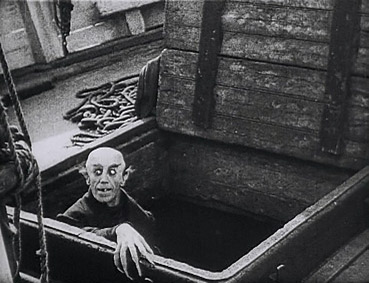
nosferatu5b

The undead film continued to rise from the grave throughout the years. An abridged version was aired on television in the 1960s as part of Silents Please, and subsequently released by Entertainment films under the title Terror of Dracula, and then again by Blackhawk Films under the name Dracula. Blackhawk also released the original version to the collector’s market under the title Nosferatu the Vampire. An unabridged copy of the movie survived Florence Stoker’s death warrant and was restored and screened at Berlin’s Film Festival in 1984.

Despite its influence on the making of the 1931 Dracula, Nosferatu has few film decedents. It’s theme of vampire as a scourging plague has only been seriously taken up by two films: the 1979 remake by Werner Herzog, Nosferatu: The Vampyre.

Another film (same year) was the television miniseries of Salem’s Lot, directed by Tobe Hooper.

Perhaps if the original Nosferatu, Eine Symphonie des Grauens had been allowed regular release, this would not be the case. It remains to be seen if Nosferatu will vanish again with the daylight or if this rare film will rise again in a new form.

For more information on the making of the original Dracula, check out David Skal’s book Hollywood Gothic: The Tangled Web of Dracula from Novel to Stage to Screen.

Tim Kane

Nosferatu: The Film That Died (Part 1)

There is no doubt that Freidrich Willhelm Murnau’s Nosferatu, Eine Symphonie des Grauens (Symphony of Horror) is a piece of landmark cinema, both for its Expressionist filmmaking and its unique treatment of the vampire as plague. Yet few people saw this monumental film prior to 1960. Though slated for destruction by Bram Stoker’s widow, the film managed to survive, popping up in the most peculiar places.

NosferatuShadow

Here is a trailer for Nosferatu (colorized, but it’s the best of the batch) that shows just how ominous Max Schrek was in this part.

Nosferatu debuted at the Marble Hall of the Berlin Zoological Gardens in 1922. The movie was the first and last product of a small art collective called Prana Films — the brainchild of artist Albin Grau (later Nosferatu’s production designer). A month later, Florence Stoker caught wind, and she started the legal machines rolling. Her only income at this point was her deceased husband’s book Dracula, and she would not let some German production company steal her meal ticket. During the 1920s, intellectual rights were a bit dodgy, so Florence paid one British pound to join the British Incorporated Society of Authors to help defend her property. Never mind that the society would also pick up the tab for the potentially huge legal bills.

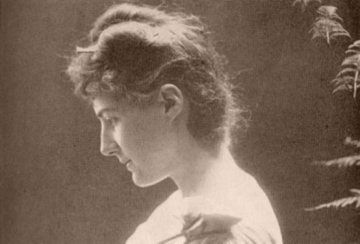
Florence_StokerFlorence seemed unaware that a second vampire film, this one called Drakula, was produced by a Hungarian company in 1921. Although the title harkens back to Bram Stoker’s novel, the resemblance ends there. This film, now lost save for some stills, was more concerned with eye gouging than straight out vampirism. Nosferatu on the other hand took much of its plot from Stoker’s Dracula, changing only the names.

The film continued to be exhibited in Germany and Budapest up through 1925, though Prana was beleaguered by creditors and harassed by Florence Stoker. They tried to settle with the society, offering a cut of the film’s take in order for them to use the Dracula title in England and America. Florence would not relent.

She not only wanted Prana to halt exhibition of the film, she wanted it torched — all prints and negatives of the film destroyed. And she got her way. In 1925 Florence won her case and the destruction order went through. Nosferatu, Eine Symphonie des Grauens vanished into thin air just as Count Orlock, the vampire in the film, did when exposed to the rays of the morning sun.

For more information on the making of the original Dracula, check out David Skal’s book Hollywood Gothic: The Tangled Web of Dracula from Novel to Stage to Screen.

Tim Kane
Werewolf Ointment and Child Horderves

Most folk think they know the werewolf legend. You get bit by a werewolf and then become one. Yet how did the first werewolves begin? Its like the chicken and the egg dilemma. The best place to look is sixteenth century France. Between 1520 and 1630 there were 30,000 cases of lycanthropy. That’s a whole lot of baying at the moon. Reading through the various cases, I noticed some trends emerge.

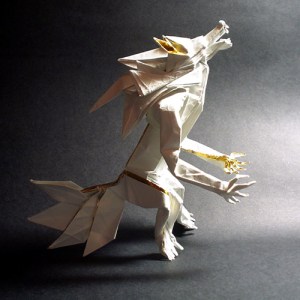
Origami Werewolf

Origami Werewolf

The Dark Lord

It’s no surprise in a devout Christian country that the devil would be blamed for any wrongdoing. In two legends, a figure dressed all in black approaches the victims and tempts them. In 1502, Pierre Burgot was trying to gather up his sheep when he ran across an ominous horseman all in black. The stranger called himself “The Lord” and asked Burgot to obey him. In a second meeting, The Lord commanded that Burgot denounce God.

Another case involved a boy called Jean Grenier. He ran away from an abusive father, finally meeting the Lord of the Jungle in the woods. The man was tall, dressed in black, and sat upon a horse. (Puts a whole new meaning to tall, dark and handsome.) This Lord kissed Grenier with icy lips. On their second meeting (and it seems the nasty part of the deal happens at the second meeting) the Lord scratched a tattoo onto the boy’s thigh, marking him.

Curse of the Werewolf 1961

Curse of the Werewolf 1961

Werewolf Ointment

Apparently the Dark Lord carries around vials of werewolf ointment. In both the above cases, this is what caused the transformation. In the case of Burgot, he met a man called Michel Verdum (possibly a friend of the Lord). He commanded Burgot to strip naked and rub magic ointment on his body. During the process, Burgot saw his arms and legs transform, becoming hairy and lupine. Verdum also became a werewolf and together they ravaged the countryside.

The boy lycanthrope, Grenier, had a similar experience. The Jungle Lord gave the boy ointment and a wolf skin. After anointing himself, the wolfskin transformed Grenier into a werewolf. One view of the lycanthrope is as a skin walker.

The Beast of Gevaudan, published by Basset, 1764 (color engraving). Musee Nat. des Arts et Traditions Populaires, Paris, France­

The Beast of Gevaudan, published by Basset, 1764 (color engraving). Musee Nat. des Arts et Traditions Populaires, Paris, France­

Eating Children

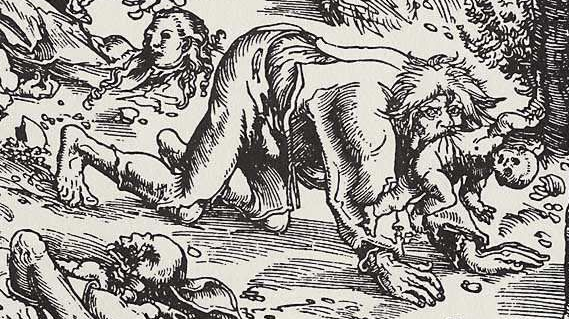
Apparently, the favorite food of werewolves is children, raw and crunchy. Burgot tore apart a seven-year-old boy and abducted a four-year-old girl. He and Verdum ate up every last bit. Grenier attacked and ate fifteen children, including one from a cradle.

The werewolf of Caude (1598) was tried for killing and eating a boy of fifteen. There was also a werewolf who used a tailor shop to lure children (because so many kids desperately yearn to hem and stitch).

Finally, the Hermit of Dole (Gilles Garnier) munched down on several children in 1573. Another werewolf, Gilas Garner, attacked children with paws and teeth, eating flesh from their legs and belly. Bottom line, it did not pay to be a teen in medieval France.

Werwolf2

Werewolf by Lucas Cranach

In none of these cases do further werewolves multiply by excessive bites. The legends seem clear that some mingling with the dark forces causes lycanthropy, not some disease.

Tim Kane

Bizarre Ways to Become a Vampire

When you step outside the films and popular fiction, vampirism gets a little wonky. In Eastern Europe you don’t get bit to become a vampire. Often, you’re born a vampire. Say what? True, many people equate vampirism to a curse. And there are plenty of ways to get cursed.

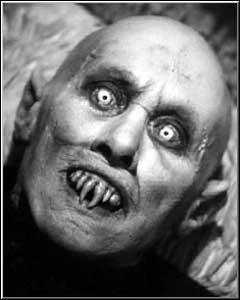
the-master

A child born with a caul (a piece of membrane that covers a newborn’s face) would become a vampire after dying. To prevent this, the caul needed to be removed, dried, and ground up. Then the child would eat the powdered caul on his or her seventh birthday.

tumblr_l9zjjdhVgw1qcai1d

A very common cause of vampirism is to die without ever being baptized. This leaves the person vulnerable to malicious spirits.

Suicide is the number one cause of vampirism nearly everywhere (Europe, Africa, China). Similar to being unbaptized, suicide was considered a sin against God. The person was buried away from the village, not on hallowed ground. The English had an interesting tradition of interning the corpse at a crossroads with a steak through the heart. The stake prevented the body form being animated by evil spirits.

In Germany, people who died from an accident risked becoming a vampire. Just a little to the south, in Bavaria, simply leading an immoral life could turn you into a vampire after death. Werewolves were closely related to vampires. Therefore, anyone who ate meat from an animal killed by a wolf would become a vampire.

Finally, is anything disturbs your grave, you will rise as a vampire. If an animal runs across your grave, you’re a vampire. Strangely, if a nun crosses your grave, forget about it. Vampire. This begs the question, how many nuns are traipsing through the cemetery?

Be careful folks. Multiple mistakes with your life (or death) can transform you in to the living dead.

Tim Kane

Zombie Walk

How times have changed. I recall playing tag in the schoolyard pretty much the way it’s always been  played. One person is “it”. He tries to tag everyone else. No goal save running around like crazy.

Now, my daughter introduced me to the twenty-first century version: Zombie Walk. One person is it (called a witch). Everyone else  gets to be humans. The zombie/witch shambles along, trying to catch the humans, who shriek in mock terror. The zombie must touch a human and count up to the age of the human (an easy feat for a kindergartener). Then the human becomes a zombie and the game continues.

Imagine how shocked our parents would have been if we were busting out this zombie tag in the 70s and 80s? Back then, zombies were pure horror. Remember Night of the Living Dead? That was the staple back then. Now, we have a film with a zombie romance: Warm Bodies.

Additionally, there are even zombie picture books, like Zombie in Love (see my review of it here).