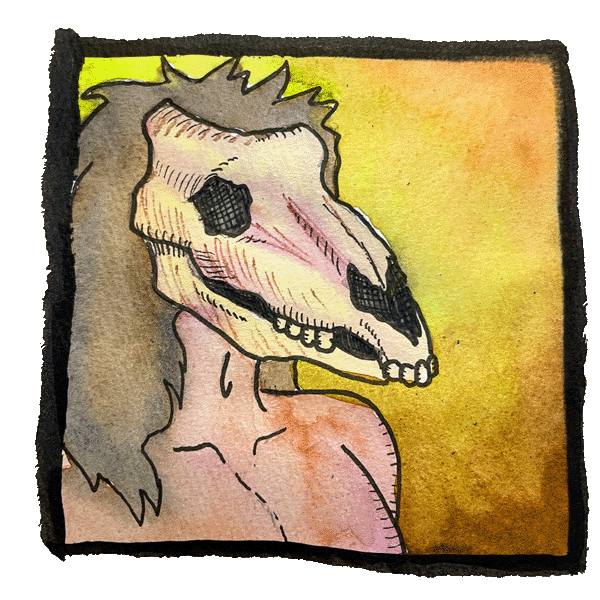
La Siguanaba: The Horse Faced Woman

The myth of La Siguanaba is closely linked withMayan heritage — a haunting portrait of a beautiful woman in a white dress who emerges at night, beckoning to unsuspecting travelers or those who have transgressed societal norms. Passed down through generations, this legend bears the unique imprints of various cultures that have woven their distinct elements into its narrative. But who is La Siguanaba?

Modern Folklore

Picture the moonless nights in the Salvadoran countryside, where La Siguanaba prowls, captivating unwary travelers—often unfaithful men—near bodies of water. She appears as a near-nude figure, radiating an irresistible charm. She entices men with the promise of intimacy.

When she gets her victim along, her facade dissipates, revealing her true visage—a horse’s face. Some legends show her with huge deformed breasts that she beats on rocks to terrify her victims. Some succumb to sheer fright, while others are driven to madness. Those unfortunate enough to survive find themselves abandoned in the wilderness, condemned to wander until their inevitable demise.

Aztec Influence

In Central America, the tale of La Siguanaba maintains close ties to the ancient Aztec religion. La Siguanaba was originally known as Sihuehuet, translating to “beautiful woman.” Sihuehuet, a peasant woman, possessed an unparalleled beauty that could captivate even the gods themselves, including Tlaloc, the lord of the storm.

Sihuehuet ensnared Tlaloc, and bore him a child. But she apparently didn’t have any maternal inclinations. She neglected the child and cheated on Tlaloc when he went to war. 

Driven by an insatiable hunger for power, Sihuehuet plotted to eliminate Tlaloc and usurp his divine throne. Crafting a poisonous plan, she intended to assassinate him. Yet, the scheme backfired when it transformed Tlaloc into a monstrous entity that wreaked havoc upon the community.

Upon learning of La Siguanaba’s malevolent actions, Tlaloc sought aid from the mighty god Teotl. Teotl then cursed her with the epithet “Siguanaba,” meaning “hideous woman.” This curse warped her into the nightmarish figure with a horse-faced appearance. Her days are now spent laundering clothes by a river’s edge while endlessly searching for her lost son, trapped in her grotesque form as punishment for her past misdeeds.

Warding Off La Siguanaba

The best advice is to simply not be lured with the prospect of sex with a strange woman. But should you fall victim, here are some ways to protect yourself: 

  • Pull your hair
  • Bite into a machete, a metal coin, or a cross necklace

You can also scare her away by yelling three times: “no te vas a ir Maria, pata de gallina,” which means “you are not leaving, crabgrass Maria”.

Tim Kane

[mailerlite_form form_id=2]
Mètminwi: The Haitian Boogeyman

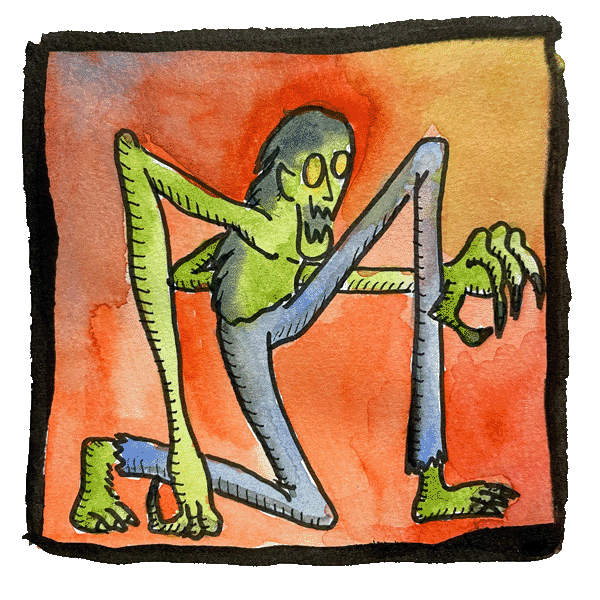
One boogeyman stands taller than all the rest—the towering Mètminwi. This mysterious Haitian boogeyman, rumored to be a colossal two stories in height, haunts the nocturnal streets, where tales of his appearance vary from incredibly long-legged to a giant with stilt-like limbs and arms.

Tales of the Twilight Terror

Throughout Haitian folklore, various renditions describe Mètminwi as a seclusive giant with haunting red eyes and a pale, frowning countenance. His haunting presence emerges precisely at midnight, and he is said to prowl the streets, indiscriminately catching and consuming any unfortunate soul still lingering outside, regardless of their behavior.

The Mètminwi’s story serves as a cautionary tale, instilling lessons about obedience, respect, and the consequences of defying the night’s rules. The legend is a tool to dissuade mischief and wandering after the witching hour, guiding the young to heed the warnings of their elders.

Understanding the Legend

While the descriptions of Mètminwi might vary, the central message remains consistent: he stands as a looming figure in the night, a warning against venturing out after midnight. Mètminwi name is a clever play on words, translated as “midnight master.” It’s a reminder that a midnight snack at home might be a safer choice than a moonlit stroll on the streets of Haiti.

Mètminwi, in essence, remains a steadfast reminder to all: the night belongs to the daring, but it also holds its own share of mysterious and cautionary tales.

Tim Kane

[mailerlite_form form_id=2]

History of the Ouija board — From Witchboards to Ouija

The Ouija board’s origins are deeply rooted in the Spiritualism movement of the 19th century, a period of intense spiritual exploration. To understand the history of the Ouija board, we must first travel back to the heart of the 19th century, when the Spiritualism movement was sweeping across America. Delve into the captivating history of the enigmatic Ouija board, a tool that has fascinated, terrified, and intrigued people for generations.

Seances and Talking Boards

In the wake of the American Civil War, the country was gripped by an overwhelming sense of loss and grief. Families were torn apart, and many were desperate for a means to reconnect with their departed loved ones. This despair led to the emergence of Spiritualism, a movement that claimed to bridge the gap between the living and the dead.

As part of the Spiritualism movement, seances gained immense popularity. Mediums would gather with those seeking contact with the deceased, holding sessions in dimly lit rooms filled with incense and mysticism. The movement was greatly influenced by the Fox sisters, who claimed to communicate with the spirit world through mysterious “knocks.”

The Talking Boards, also known as Witch Boards, made their debut during this period. These boards featured the alphabet, numbers, and simple “yes” and “no” responses. Participants would place their hands on a planchette—a heart-shaped or teardrop-shaped device with a window—allowing spirits to guide their movements to spell out messages.

The Birth of the Ouija Board

In the 1880s, E.C. Reiche, a Prussian immigrant and undertaker, began creating prototypes of these talking boards on the side. It was these prototypes that would eventually evolve into the Ouija board. 

Charles Kennard, an entrepreneur with a keen eye for opportunities, actively promoted what he claimed to be his invention of the talking board to potential investors. His persistence paid off when local attorney Elijah Bond took an interest. Bond, who had a sister-in-law with strong mediumistic abilities, saw the potential in the talking board. The Kennard Novelty Company was incorporated on Halloween, 125 years ago, marking the start of mass manufacturing of Ouija boards as we know them today.

Helen Peters and the Ouija Name

According to legend, Helen Peters, the sister-in-law of Elijah Bond, was using the Ouija board when she asked the board what it wanted to be called. The board, under the influence of unknown forces, spelled out “O-U-I-J-A.” Intrigued and curious, Helen inquired about the meaning behind this peculiar name. The board replied, “Good luck.” Though, in reality, the name was written on her necklace locket at the time

With a desire to protect their invention, Charles Kennard, Elijah Bond, and Helen Peters sought to patent the Ouija board. However, their journey faced a roadblock in the form of the patent chief, who was skeptical of their claims. He agreed to grant them the patent under one condition: they must use the Ouija board to reveal his name.

Helen Peters took up the challenge, and with the Ouija board’s guidance, she successfully spelled out the patent chief’s name, securing the patent for the Ouija board. This peculiar incident cemented the board’s mystique and added an extra layer of intrigue to its history.

Tim Kane

[mailerlite_form form_id=2]
Unearthing the Macabre Tale of Abhartach, the Irish Vampire

Arkane Curiosities

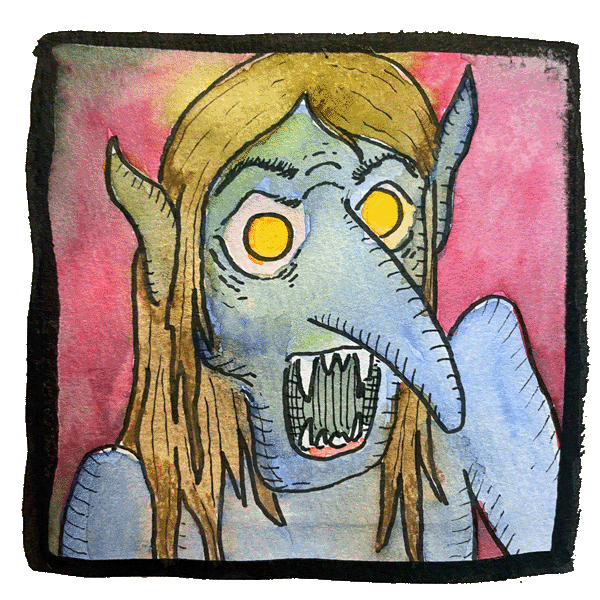
We all know about the legend of Dracula, But have you ever heard of Abhartach, the Irish vampire? This lesser-known figure from Irish folklore hails from the hauntingly beautiful County Derry in Northern Ireland. Unlike your typical vampire, the story of the Irish Vampire is rooted in ancient legends with a unique twist.

The First Death

Long ago, in the 5th or 6th century, there lived an evil chieftain named Abhartach. Described as a goblin-like figure with a grotesque appearance, he was a possessive and jealous husband and he harbored suspicions of his wife’s infidelity. 

One fateful night, he attempted to climb outside his wife’s bedroom window to catch her in the act. But in a twist of fate, he slipped and plummeted to his death, his life extinguished in an instant. His subjects, recognizing the need to accord him the honors befitting a chieftain, laid him to rest in a most peculiar manner—standing upright.

Yet, as the sun dipped below the horizon on the following day, Abhartach defied the laws of life and death. He returned, a nightmarish revenant, demanding a gruesome tribute from his terrified subjects. With a sinister thirst for their blood, he ordered them to bleed in order to create a bowl of blood for his consumption.

The Second and Third Deaths

As time wore on, the people grew weary of living in perpetual fear. They turned to a local chieftain, Cathán, to rid them of the curse once and for all. Twice, Cathán dispatched the Abhartach and each time the creature returned, demanding more blood from the terrified populace.

Cathán turned to the local druid, seeking guidance from the wise sage. The druid revealed the key to defeating the undead chieftain. Abhartach could only be vanquished by a sword forged from yew wood, buried upside down with his feet reaching skyward. A massive stone placed upon the grave would act as a barrier against his resurrection. Surrounding the stone, the branches of sacred Irish trees, such as hawthorn and rowan, were to be intertwined to further hinder his return.

The druid’s warning was grave and ominous. Should the stone ever be removed, Abhartach would be unleashed once more upon the world. With unwavering determination, Cathán followed the druid’s counsel, executing the sacred ritual to the letter.

The Abhartach Defeated

Finally, the curse was broken. Abhartach was silenced, and the people could breathe a sigh of relief, freed from the clutches of their undead ruler. To ensure the memory of their harrowing ordeal lived on, the twigs surrounding Abhartach’s resting place grew into a formidable thorn tree, and a colossal stone tomb (a dolmen) was erected to seal the memory of their struggle.

Today, only a solitary stone and the ancient tree remain, standing as silent sentinels to the legend of Cathán, Abhartach, and the extraordinary ritual that safeguarded a world from an evil that should never walk among us again.

Over two decades ago, a bold attempt to clear the sinister thorn tree and massive stone marking Abhartach’s resting place was foiled by inexplicable occurrences. Chainsaws broke down three times while trying to cut down the tree, and the chainsaw chain wrapped around the stone intended for removal, snapping and cutting a worker’s hand. The worker’s blood seeped into the ground, leaving the cursed site untouched since, as if Abhartach’s malevolence still guards his unholy resting place.

Inspiration for Dracula

Collected during the late 1800s by renowned folklorist and historian Patrick Weston Joyce, this chilling folktale would have undoubtedly circulated in Dublin, where Bram Stoker served as a civil servant. The eerie connection between the Irish term “droch fhola,” signifying “bad blood,” and the name “Dracula” is an intriguing linguistic parallel that adds another layer of intrigue to the lore surrounding Stoker’s legendary vampire character.

Tim Kane

[mailerlite_form form_id=2]
How to Annoy a Vampire

Arkane Curiosities

I watched an old documentary on Vlad Dracula hosted by none other than Vincent Price. Most of the information I was already aware of, but one bit jumped out at me. A unique way to annoy a vampire involving sound.

The Resonant Toaca

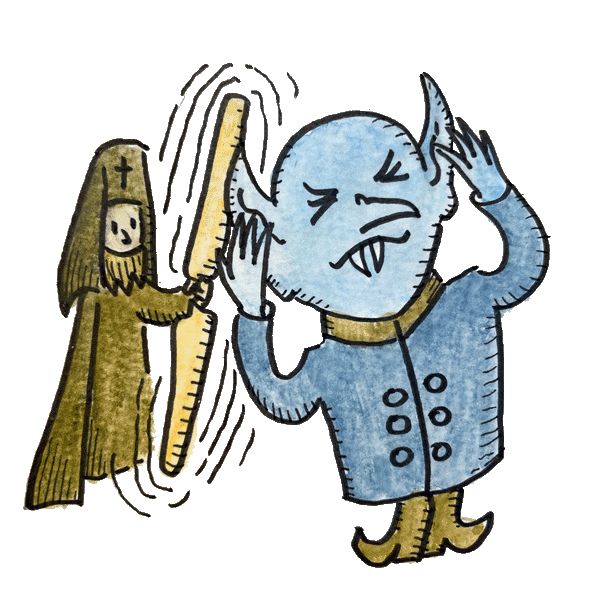
This documentary showed an Orthodox priest walking through town carrying a large piece of wood, called a toaca. This is a type of portable sematron used to create sound. He would bang on the toaca with a hammer as a way to keep vampires away. Despite scouring the Internet, I can’t find an exact reason for this. My best guess is that it annoyed the vampire. 

Make Your Vampire Do Math

I’ve posted about this before, but the toaca reminded me of another way to annoy vampires. I’d first learned about this in an X-Files episode (Bad Blood). Here we see the quintessential way to piss off a vampire. 

Many Slavic people believe that vampires were forced to count the holes in fishing nets or the number of scattered seeds. It was common for townsfolk to hang a net over their door or spill seeds on the stoop as a way to deter would be blood-drinkers. The most common seed used was mustard seed, also known as eye of newt.

So folks, want to annoy the bejeezus out of your local vampire? Start banging on some wood. And be sure to scatter seeds all over the place. You’ll be safe… at least until the vampire gets done counting.

Tim Kane

[mailerlite_form form_id=2]