Protagonists-R-Us

We’re having a sale. Today only. Buy one protagonist, and get the antagonist at a fifty-percent discount. Such a deal. You can’t have one without the other.

I teach writing to sixth grade students. Here’s a typical plot line: Character meets another character and they talk. Then they meet a third character. They talk some more. Finally they all rush back to a) home, b) school, c) a castle. Yes, I know it matches up with a few of the Twilight books (don’t be a hater, I actually like Stephanie Meyers), but what most of my tween writers lack is an antagonist.

Or to be more specific, conflict generated by an antagonist. The two are inseparable. Yes I know that the protagonist herself can have doubts, thus generating conflict. Likewise, nature can also be an obstacle. But let’s face it, nothing beats a good ole white hat versus black hat. (If you wanted to go the Twilight route, Meyers handled that quite well.)

The antagonist defines the protagonist. He often strives for the exact same goal as the protagonist. Since only one can achieve that goal, it creates tension. I love antagonists that mirror the protagonist. For example, if I have a protagonist who hates monsters and the grotesque, I might pair him with a an antagonist who is a monster herself, yet despises it. Perhaps they’re both seeking the goal of destroying the evil beasts. Yet our hero does this out of fear and ignorance, while the villain strives for this goal from self loathing.

However you achieve it, make your antagonist linked to your protagonist. It creates a deeper bond and makes the final mano-a-mano showdown that much more interesting.

Tim Kane
Why Authors Still Need Agents

Recently, I was lucky enough to witness a keynote speech by Mark Coker, the founder of Smashwords. He talked about a day when writers supersede agents and publishers. He even made a joke of it:

One day, an author will tell some friends, “I just got a book deal.”
And they reply, “I’m sorry.”

This elicited groans from the audience (mostly writers with a handful of agents and editors). I agree in principle with Mr. Coker. Publishers have dropped the ball. They need to cut their own costs to become competitive and offer authors a greater piece of the revenue stream. Amazon’s 70% is far better than the 12% you get from publishers.

I still see a place for agents. Next time you’re on Amazon, or Barnes and Noble, troll through the lists of available ebooks. You’ll see plenty of indie authors. That’s a good thing. The ebook has become the great equalizer. Yet, try purchasing one of these indie books.

I did.

I tried quite a few. None were worth the $0.99. Typos were rife. Even when they weren’t the story sagged or had horrific info dumps, or just bad writing. What all these books had in common was a lack of agents and proper editing.

Agents serve as gatekeepers. They champion good books and turn the rest to the door. It’s true, that agents take less and less clients these days, but this is an issue based on the poor state of the publishers. If those corporate guys can get things turned around, I think you’d see many more author’s picked up.

The truth is, as a reader, I want someone to vouch my books. I don’t have a lot of time to read, and wasting it on poor prose is infuriating. That’s not to say that lousy books can’t make it through the agent and publisher system. They can and do. But usually I sour on these as a matter of style. Agents, at the very least, make sure the writing is free of errors and has a decent story.

Tim Kane

Geek Speak: A Twenty-First Century Disease?

Often my mind works in quotes. “My friends, you bow for no one.” or “How about a magic trick?” These sorts of things bounce through my brain like pin balls. Sometimes I tilt, and get sucked into pop-culture mayhem. I don’t know if this is a twenty-first century disease, but I do know that it plagues me.

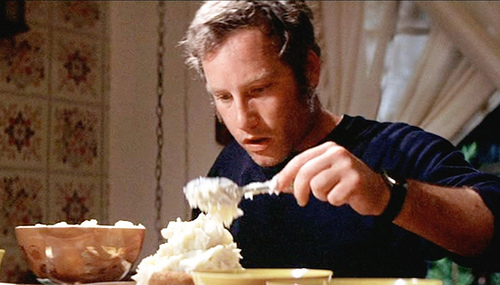
I sat down at the table with a plate of mash potatoes. My very first thought, even before butter or salt or silverware was: “This means something.” Then I formed the potatoes into a replica of the Devil’s Tower. My colleague sitting next to me had no idea what I was going on about.

Then, when I heard a friend of mine issue a tiny little squeak of a cough, I instantly thought: “I think I have the black lung.” He got it, and a series of Zoolander quotes ensued.

I’m lucky in that my wife gets most of these. We have the same humor level and watch mostly the same films. Likewise, my fellow teachers at school are geek inclined. Yet when did conversation turn into requotes from movies or television? It’s almost like my mind has become a twitter stream and I’m in constant retweet mode.

I find this frustrating as a writer because I dare not let this stuff slip into my pages. First, this stuff is so dated that it becomes obsolete within a few years. Second, this type of trivia is specialized. Only a few close friends will get all the references. Not an idea situation for young readers who don’t understand how cameras can work with film.

Tim Kane

Addicted to Pinterest

Gah, yet another social media site to drag me away from writing. If you’ve haven’t visited this site, you might be frustrated when you do. It’s by invitation only. Granted, you simply apply and a few days later get the invite in the mail. The site will give you a sample, but, the waiting is hard to deal with.

Once you’re in, kiss at least three or four hours of life goodbye. (I was fortunate enough to have this happen while holed up in a cabin in the woods, so the time drain wasn’t nearly as detrimental.) The idea is this: remember all those amazing pictures you download from the internet and then stick in a file and forget? Pinterest lets you post and share them. You can comment and repin pics you see from friends. The topics are endless.

Most of the pinners seemed to concentrate on products and people. I guess folks find that time worthy. Me, I went to all the amazing art I’ve always loved, yet could never find a way to catalog. Illustrators, steampunk artists, comic book art, you name it. I also plan to add all those spelling and grammar goofs I constantly see, yet seems wasted when seen individually.

I suggest you check this site out, but be warned, you may never return the same.

Tim Kane

The Myth of Writing in a Cabin in the Woods

Jonny Depp from Secret Window

It’s not all it’s cracked up to be. Granted, my cabin was also full of other teachers and the whole place is surrounded by sixth graders. However, I do have certain conveniences you wouldn’t associate with cabin life: a constant stream of hot coffee, blistering hot showers, and wifi. So writing up a whole new novel should be a snap, right? Not so much.

I find that I’m a solitary person. I like to write alone. Blog posts and the like, sure, I can do that anywhere. Writing on a fiction manuscript, for that I need total concentration. It’s true, there were bits and times where I was completely alone in the cabin, and I could have worked it in. Yet those times were never reliable. What I mean is, you never know when a colleague will wander in and want to talk.

Add to this the lack of any kind of desk or table. Not too bad if you’re typing out a 250 word blog post. But if you intend on crunching 1000 or 2000 words, you’ll find that neck cramps ensue. Trust me, I know. I got them midweek just working on curriculum.

Finally, there’s the lack of structure. Sure I need to show up at meals and there’s a recess block to oversee, but between those my time is mine. Yay, more time equals more writing. Try it sometime. I think you’ll find it’s the opposite. At home, I can carve out one or maybe two hours a day. Always at the same time. Reliable. Both before and after are filled with things to do. It makes my writing charged because I know if I don’t get it done, then I’ll have to wait another day.

This is not to say I got nothing done. Since I could tell that formal words-on-page style writing was going to be a challenge, I tackled things that I typically have a hard time doing at home. Plotting. I plotted out the whole dang novel. Start to finish. Not every scene, but the milestones. Seeing it as a whole allowed me to fix some plot problems. One particularly pesky one dogged me for a while. I stepped into the cabin shower for forty minutes and worked out the solution in my head (without having to pay for the water bill).

So the next time you dream of being alone in a cabin in the woods, think again. It’s not the best environment for writing. Try writing every day. Repeat until the novel is complete.

Tim Kane