Readophile

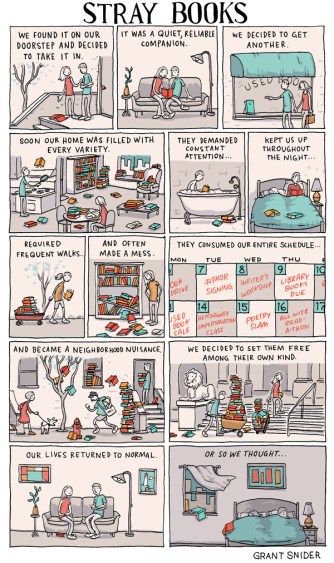
I love everything that has to do with books. Most of my love exhibits itself in clever sayings or aphorisms about reading and books. At incidental comics, I stumbled upon an amazing comic about adopting books. Check out Stray Books:

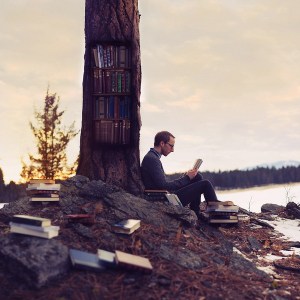
I makes me want to adopt books. Now, how about books as a wall. In 2005, Swiss artist Jan Reymond began constructing elaborate installations each year, made of the old, unsold books as a last hurrah for the soon-to-be discarded objects. He also made a tree out of books. That’s dedication.

Then I found a photographer Kirsty Mitchell. Following her mother’s death from a brain tumour in 2008, Kirsty channelled her grief into her passion for photography. She retreated behind the lens of her camera and created Wonderland, an ethereal fantasy world.

Below is The Storyteller: A reference to Kirsten’s English teacher mother, a model sits elegantly on a carpet of bluebells enveloped by books.

Finally, we have artist Robert The (yes, that’s his name). He takes books and then cuts them up to create new symbols. A lobster. A broom. A cake. And yes, a gun.

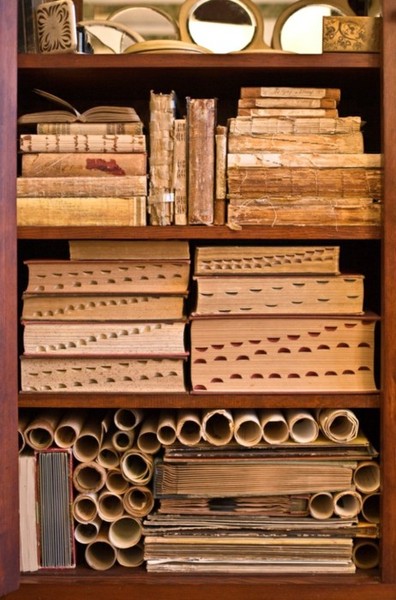
I still love to read books too. Now, mostly ebooks. But sometimes there’s something special about glue and paper. If the picture below doesn’t make you shiver with excitement, then real, physical books, aren’t for you.

Tim Kane

The Age of Miracles Has Put This Reader on Edge

This is the strangest book I’ve read so far. It has me on the verge of a panic attack. Why? Because it details an end of the world scenario so plausibly, I can imagine it happening. The premise of the book is that the world is slowing. The spin of the Earth is slowing down. Each day adds minutes, and soon that trickle becomes a flood. As I read, I found myself thinking what I would do in this situation. The prospects became grimmer as the story unfolded: birds fell out of the sky, slowing sickness afflicted the population, tens of thousands of whales were beached, and gradually—as the days lengthened to 72 hours—all the world’s vegetation died out.

I admired how the author, Karen Thompson Walker, weaved the scientific effects into dramatic plot points. For example, instead of simply having someone suffer from the slowing sickness (a sort of dizziness and weakness), she had the mother of the main character faint while driving and run down a man in the street. Likewise, as trees began to die, she could simply have stated that thy fell over. Instead, she used to underscore the political division between the clock timers (those who stick to the 24 clock) and the real timers (those who try to sleep longer to match the growing days). A tree falls through the only real timer left on the block. People suspect it might have been cut.

One interesting aspect of the book is that the Earth is one of the central characters in the story. It is obviously sick. We all know, as we read, what will happen to this sick patient in the end, yet we can’t leave her bedside. Even I, as I read, was fascinated with the next disaster. How could things get worse.

Some things that bothered were were how the main character, 11-year-old Julia, was handled. Walker attempted to give her a poignant coming of age story in a dying world. Somehow she felt hollow. Walker clearly details what happens to her. How her loneliness spins out from her. Her thoughts seem clinical in a way. I wanted a visceral reaction. I think some of the problem stemmed from the narrator, Julia, telling the story from the future (when she’s in her twenties).

A few other inconsistencies bugged me. The first was the random insertion of profanity. It’s almost as if Walker felt she needed to add a few cuss words to qualify it for young adult status. Mostly, these got in the way. Also, she made a point of stating that the price of grapes had risen to $100 per pound. Yet after that, there were several instances of characters macking out on ice cream. Surely the price for that would have shot through the roof.

Overall, I recommend this book. The central concept of the Earth slowing are worth the read alone.

Tim Kane
What to Read: Three Different Categories of Fiction

You have to know yourself as a reader. Which type of fiction do you lean toward? Knowing the different kinds of fiction can certainly help. I get totally into this—my Master’s thesis being on genre studies. But I’ll save wordy for a doctoral thesis and give you the reader’s perspective.

Realistic or Literary Fiction
These are the books that deal with real life. They’re usually called literary fiction in bookstores, but I also lump in realistic fiction, because that applies better to young adult books. Basically these books focus more on characters and their personal problems over plot. There is a line that divides literary form realistic. Literary can often be very self-absorbed and even be devoid of plot. Realistic fiction typically has some semblance of a problem and resolution.

Some good examples (pulled from my favs) are:

Genre
These books are defined by their plot structures. Characters can be secondary and will sometimes follow stereotypes. Readers return to these books because we know what to expect. Certain situations and settings reoccur over and over. There are many different types of genres, such as: Science Fiction, Fantasy, Horror, Thriller, Romance, and Mystery.

Some more favs:

Genre Pastiche
This is where things get interesting. Since the 1980s, films had run the gamut of genre and began mashing them up. Books are doing the same. One of the most popular pastiches is paranormal romance (horror and romance). This allows readers who love genre, to mix things up.

Final set of favs:

  • Horror + Realistic Fiction: A Monster Calls by Patrick Ness
  • Science Fiction + Fantasy: Leviathan by Scott Westerfeld
  • Fantasy + Realistic Fiction: Life of Pi by Yann Martel

Next time you look for a good read, think about the type of read you are. Choose your book based on your tastes. If you have a writing bent, then check out how to write for each genre.

Tim Kane

Reading is a Visceral Experience

Memories constantly hijack my brain. It’s great except the timing. Like cooking, or driving, or even teaching. What’s interesting is that the memories that reappear are almost always from exciting times in my life (like vacation or pretty much all my teen years). The only other “memories” that make an appearance are those I get from reading.

Joel Robinson’s whimsical visual abstractions of the reading experience

Often, months or years later, I can recall the exact experience of reading a particular book. I know exactly where I was sitting (the bathroom floor) as I zoomed through the final pages of Miss Peregrine’s School for Peculiar Children. It’s visceral. I recall how my arm and shoulder ached from reading so long.

Is it that reading affects my imagination? Is that why? I know that the other memories (those from my real life) I recall so strongly because of the intense emotions involved. But reading? Are those same intense emotions triggered?

How about you? How many of you have had flashbacks to reading books? I just had another now. Reading the final Harry Potter book in the hallway outside my daughter’s room (this being when she was only an infant). I couldn’t turn the pages fast enough.

I wonder if this is a personal insanity or one that’s shared.

Tim Kane

How Do You Find a Good Book to Read in the eBook Age?

Some folk lament the fact that physical bookstores, with their collections of paper and glue, are vanishing. Heck, my city has only one bookstore. I relate. I love wandering the aisles of the bookstores, just picking something up and giving it a page through. But I’ll tell you a secret. Often, the books I pick up and then buy from a bookstore are not the ones I really love. I’ve been disappointed more than once.

What I do relish in bookstores are the recommendations by the employees. These people have read and loved these books and want you to read them too. Ignore the tables with the covers all facing up. The book placement there is often paid for by the publisher.

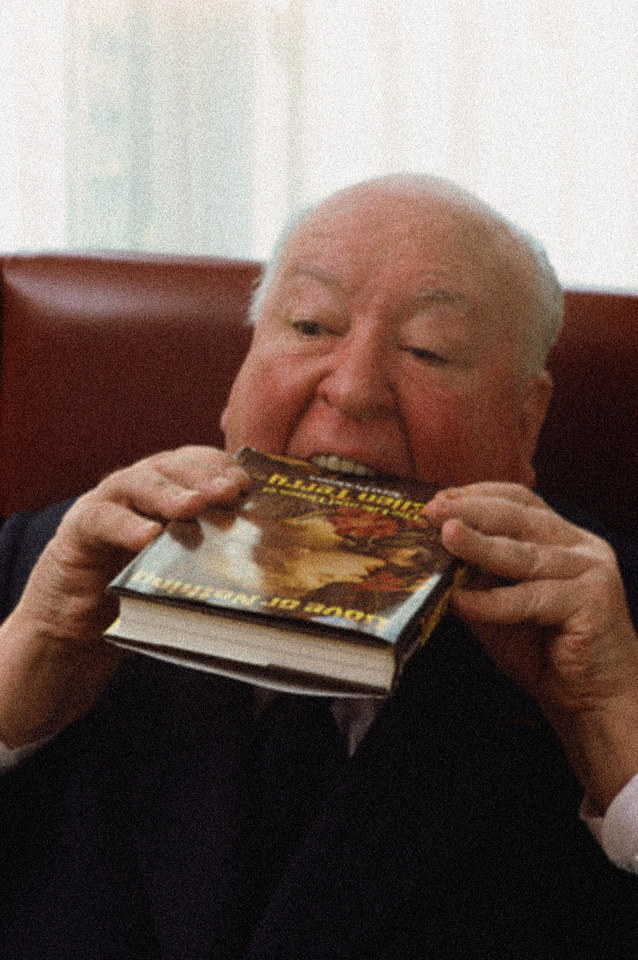
Alfred Hitchcock enjoying Tom Prideaux’s Love or Nothing: The Life and Times of Ellen Terry.

You can get that same sort of recommendation in the digital age. Often, I look up a book I’ve already read and loved on Amazon. Then I see what else the site recommends. Or I ask my reading friends (on Facebook or Twitter). The best part, I can download a sample of the ebook and read enough to get hooked (or bored).

The final resource for book hunters is book blogs. Check out these three blogs to help find your next read.

SPA Middle School Blog: This site shows recommendations from actual seventh and eight graders. Awesome to know I have similar tastes.

Young Adult Books Central Blog: This place is massive. It reviews books as well as tracks reader reviews. You can sort books in many ways with plenty to choose from.

We Need Reads Blog: A great review blog by a pair of avid readers. Their review of Speak says it all.

Tim Kane