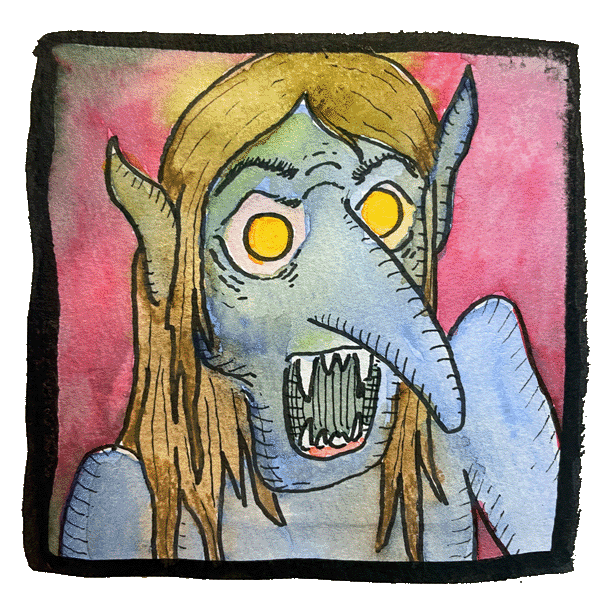
Unearthing the Macabre Tale of Abhartach, the Irish Vampire

Arkane Curiosities

We all know about the legend of Dracula, But have you ever heard of Abhartach, the Irish vampire? This lesser-known figure from Irish folklore hails from the hauntingly beautiful County Derry in Northern Ireland. Unlike your typical vampire, the story of the Irish Vampire is rooted in ancient legends with a unique twist.

The First Death

Long ago, in the 5th or 6th century, there lived an evil chieftain named Abhartach. Described as a goblin-like figure with a grotesque appearance, he was a possessive and jealous husband and he harbored suspicions of his wife’s infidelity. 

One fateful night, he attempted to climb outside his wife’s bedroom window to catch her in the act. But in a twist of fate, he slipped and plummeted to his death, his life extinguished in an instant. His subjects, recognizing the need to accord him the honors befitting a chieftain, laid him to rest in a most peculiar manner—standing upright.

Yet, as the sun dipped below the horizon on the following day, Abhartach defied the laws of life and death. He returned, a nightmarish revenant, demanding a gruesome tribute from his terrified subjects. With a sinister thirst for their blood, he ordered them to bleed in order to create a bowl of blood for his consumption.

The Second and Third Deaths

As time wore on, the people grew weary of living in perpetual fear. They turned to a local chieftain, Cathán, to rid them of the curse once and for all. Twice, Cathán dispatched the Abhartach and each time the creature returned, demanding more blood from the terrified populace.

Cathán turned to the local druid, seeking guidance from the wise sage. The druid revealed the key to defeating the undead chieftain. Abhartach could only be vanquished by a sword forged from yew wood, buried upside down with his feet reaching skyward. A massive stone placed upon the grave would act as a barrier against his resurrection. Surrounding the stone, the branches of sacred Irish trees, such as hawthorn and rowan, were to be intertwined to further hinder his return.

The druid’s warning was grave and ominous. Should the stone ever be removed, Abhartach would be unleashed once more upon the world. With unwavering determination, Cathán followed the druid’s counsel, executing the sacred ritual to the letter.

The Abhartach Defeated

Finally, the curse was broken. Abhartach was silenced, and the people could breathe a sigh of relief, freed from the clutches of their undead ruler. To ensure the memory of their harrowing ordeal lived on, the twigs surrounding Abhartach’s resting place grew into a formidable thorn tree, and a colossal stone tomb (a dolmen) was erected to seal the memory of their struggle.

Today, only a solitary stone and the ancient tree remain, standing as silent sentinels to the legend of Cathán, Abhartach, and the extraordinary ritual that safeguarded a world from an evil that should never walk among us again.

Over two decades ago, a bold attempt to clear the sinister thorn tree and massive stone marking Abhartach’s resting place was foiled by inexplicable occurrences. Chainsaws broke down three times while trying to cut down the tree, and the chainsaw chain wrapped around the stone intended for removal, snapping and cutting a worker’s hand. The worker’s blood seeped into the ground, leaving the cursed site untouched since, as if Abhartach’s malevolence still guards his unholy resting place.

Inspiration for Dracula

Collected during the late 1800s by renowned folklorist and historian Patrick Weston Joyce, this chilling folktale would have undoubtedly circulated in Dublin, where Bram Stoker served as a civil servant. The eerie connection between the Irish term “droch fhola,” signifying “bad blood,” and the name “Dracula” is an intriguing linguistic parallel that adds another layer of intrigue to the lore surrounding Stoker’s legendary vampire character.

Tim Kane

[mailerlite_form form_id=2]
How to Annoy a Vampire

Arkane Curiosities

I watched an old documentary on Vlad Dracula hosted by none other than Vincent Price. Most of the information I was already aware of, but one bit jumped out at me. A unique way to annoy a vampire involving sound.

The Resonant Toaca

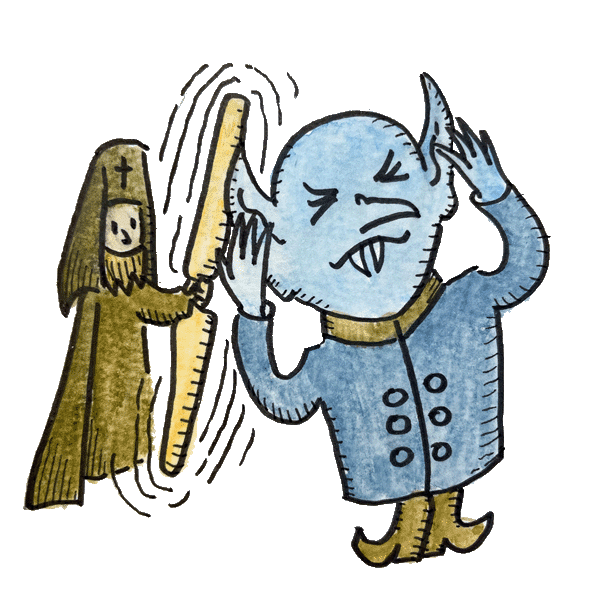
This documentary showed an Orthodox priest walking through town carrying a large piece of wood, called a toaca. This is a type of portable sematron used to create sound. He would bang on the toaca with a hammer as a way to keep vampires away. Despite scouring the Internet, I can’t find an exact reason for this. My best guess is that it annoyed the vampire. 

Make Your Vampire Do Math

I’ve posted about this before, but the toaca reminded me of another way to annoy vampires. I’d first learned about this in an X-Files episode (Bad Blood). Here we see the quintessential way to piss off a vampire. 

Many Slavic people believe that vampires were forced to count the holes in fishing nets or the number of scattered seeds. It was common for townsfolk to hang a net over their door or spill seeds on the stoop as a way to deter would be blood-drinkers. The most common seed used was mustard seed, also known as eye of newt.

So folks, want to annoy the bejeezus out of your local vampire? Start banging on some wood. And be sure to scatter seeds all over the place. You’ll be safe… at least until the vampire gets done counting.

Tim Kane

[mailerlite_form form_id=2]
Stairs in the Woods

Arkane Curiosities

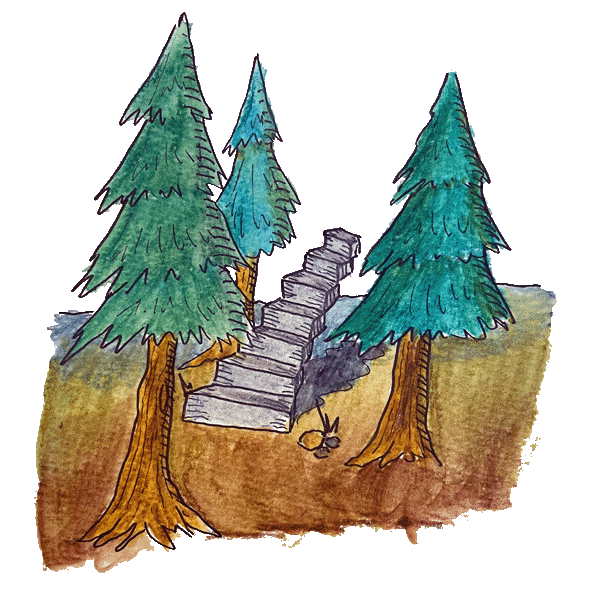
Stairs have to lead somewhere, right? But with the urban legend, “Stairs in the Woods”, these enigmatic stairs lead nowhere. A popular urban legend and creepypasta, the legend typically involves hikers, campers, or explorers stumbling upon a staircase in the middle of the woods, seemingly out of place and disconnected from any structure or building.

Staircases Out of Place

Picture this: a remote, isolated location within the woods, devoid of any man-made structure. Yet, right in the midst of this natural beauty, a staircase emerges—completely out of context and utterly surreal. These staircases, often made of wood or stone, stand mysteriously isolated, beckoning those who come across them to unravel their enigma.

Key elements of the legend include:

Isolation and Unusual Placement: The stairs are often described as being in a remote or isolated location within a forest or wilderness area, far away from any recognizable structures.

Appearance and Design: The stairs are usually made of stone and often appear pristine or well-maintained, despite their strange location and lack of any nearby structure. They may look brand new or very old, with varying designs.

Unexplained Mystery

The origin and purpose of the stairs are never clear. No one knows how or why they were placed there. Some think they are the remains of structures that have rotted away, leaving the stone stairs behind. Others wonder if these stairs lead to another world or even hell. 

Tim Kane

[mailerlite_form form_id=2]

Grúacach: Wild Goblins of Ireland and Scotland

Arkane Curiosities

In the folklore of Ireland and Scotland, amidst the emerald landscapes and misty hills, resides wild goblins called Grúacach (also Gruagachs or even Brownies). These spirits are often associated with the land and are believed to inhabit certain natural features or landmarks, rather than constructed houses.

Helpful Spirits

The Grúacach is described as a small, hairy, humanoid figure, often depicted as having wild, untamed hair and a disheveled appearance. It dresses in animal hides or simple clothing, and possessing a playful or helpful disposition.

Grúacachs reside in and around homes, especially in remote or rural areas, where they form a close bond with the family or individuals — assisting with household chores, farming tasks, and general maintenance of the home. 

Given the ability to become invisible, they prefer to operate in secret, shying away from direct acknowledgment. But you can reward the Grúacach with a jug of cream. 

Though generally gentle and helpful, Grúacachs will often scuttle about and get under your feet. Also, if they feel unappreciated, neglected, or slighted in any way, they might play tricks or pranks on the occupants of the home.

If your Grúacach becomes a nuisance, simply invite over a member of the clergy. These spirits have a great fear of priests and will there presence will drive the Grúacach away. 

Nature Guardian

The Grúacach is believed to have a strong connection to nature, particularly the forests and streams. It is said to be protective of the natural world and the creatures inhabiting it. They are often associated with specific ancient sites, sacred groves, or notable landmarks. It’s believed that they dwell within or near these areas, watching over them. 

Since the Grúacach is impervious to extreme temperatures, they can live in any cave, hollow or cleft in the landscape. All around Ireland and Scotland, you’ll find large stones leaned together called Grúacach houses. 

While these spirits are generally helpful, they can display mischievous behavior if angered or mistreated. A Grúacach may engage in pranks or mischief to teach a lesson to those who disrespect nature or its dwelling. It’s customary in Irish and Scottish folklore to treat these beings with caution and respect. People would avoid disturbing their dwellings or disrespecting the natural sites associated with them.

Rooted in Celtic Lands

The legend of the Grúacach is deeply rooted in Irish and Scottish culture, and it embodies respect and reverence for nature and the environment. It also serves as a cautionary tale to treat the natural world and its creatures with care and appreciation.

Tim Kane

[mailerlite_form form_id=2]

Twirl Till You Puke – the Art of Gyromancy

Arkane Curiosities

Imagine spinning around rapidly until you’re dizzy enough to take a tumble. That’s the essence of gyromancy. This age-old art has twirled its way through history, captivating curious minds and spinning seekers into new realms of insight. Take a spin down the memory lane of gyromancy’s history, followed by a twirl into the peculiar world of falling gyromancy. And remember, it’s not the future until you twirl till you puke.

Gyromancy Through the Ages

To truly appreciate the peculiar charm of falling gyromancy, we must first explore the roots of gyromancy itself. This ancient practice has been a part of human fascination for centuries.

Gyromancy derived from the Greek words “gyros” (meaning “circle” or “turn”) and “manteia” (meaning “divination”). The Greeks believed that spinning could unlock mystical insights into the future, making gyromancy one of their cherished divination methods.

Getting Dizzy for Divination

Before you start, draw a circle of letters on the ground or floor, preferable when the moon was in an appropriate astrological position. Then start spinning. You walk in circles or even stumble around. When you eventually fall, and you will fall, the letter you land on is indicated. These seemingly random characters are then pieced together to form words, phrases, or sentences, serving as the divination message.

Interpreting the results of falling gyromancy is where the true magic lies. With no standardized rules to abide by, interpretations are as diverse as the seekers themselves. It’s a mix of intuition, context, and symbolism, making each reading unique and personal.

Spinning Coins

Another method saves the puking and lets a coin do all the spinning. The set up is the same as before, only you need a much smaller circle of letters, something that could fit on a table or possibly even a ouija board. 

Make a nick on one edge of the coin. This will serve as a pointer. Then spin the coin as you concentrate on your query. Words are eventually spelled out by using the letters the coin “points” to.

The Final Spin

So, the next time you find yourself twirling in thought, perhaps consider giving gyromancy a spin – who knows what whimsical messages may await when you take a tumble in pursuit of ancient wisdom!

Tim Kane

[mailerlite_form form_id=2]