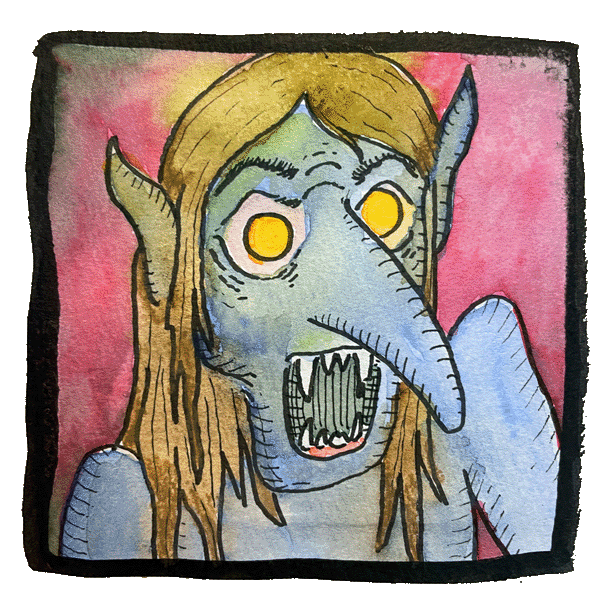
Unearthing the Macabre Tale of Abhartach, the Irish Vampire

Arkane Curiosities

We all know about the legend of Dracula, But have you ever heard of Abhartach, the Irish vampire? This lesser-known figure from Irish folklore hails from the hauntingly beautiful County Derry in Northern Ireland. Unlike your typical vampire, the story of the Irish Vampire is rooted in ancient legends with a unique twist.

The First Death

Long ago, in the 5th or 6th century, there lived an evil chieftain named Abhartach. Described as a goblin-like figure with a grotesque appearance, he was a possessive and jealous husband and he harbored suspicions of his wife’s infidelity. 

One fateful night, he attempted to climb outside his wife’s bedroom window to catch her in the act. But in a twist of fate, he slipped and plummeted to his death, his life extinguished in an instant. His subjects, recognizing the need to accord him the honors befitting a chieftain, laid him to rest in a most peculiar manner—standing upright.

Yet, as the sun dipped below the horizon on the following day, Abhartach defied the laws of life and death. He returned, a nightmarish revenant, demanding a gruesome tribute from his terrified subjects. With a sinister thirst for their blood, he ordered them to bleed in order to create a bowl of blood for his consumption.

The Second and Third Deaths

As time wore on, the people grew weary of living in perpetual fear. They turned to a local chieftain, Cathán, to rid them of the curse once and for all. Twice, Cathán dispatched the Abhartach and each time the creature returned, demanding more blood from the terrified populace.

Cathán turned to the local druid, seeking guidance from the wise sage. The druid revealed the key to defeating the undead chieftain. Abhartach could only be vanquished by a sword forged from yew wood, buried upside down with his feet reaching skyward. A massive stone placed upon the grave would act as a barrier against his resurrection. Surrounding the stone, the branches of sacred Irish trees, such as hawthorn and rowan, were to be intertwined to further hinder his return.

The druid’s warning was grave and ominous. Should the stone ever be removed, Abhartach would be unleashed once more upon the world. With unwavering determination, Cathán followed the druid’s counsel, executing the sacred ritual to the letter.

The Abhartach Defeated

Finally, the curse was broken. Abhartach was silenced, and the people could breathe a sigh of relief, freed from the clutches of their undead ruler. To ensure the memory of their harrowing ordeal lived on, the twigs surrounding Abhartach’s resting place grew into a formidable thorn tree, and a colossal stone tomb (a dolmen) was erected to seal the memory of their struggle.

Today, only a solitary stone and the ancient tree remain, standing as silent sentinels to the legend of Cathán, Abhartach, and the extraordinary ritual that safeguarded a world from an evil that should never walk among us again.

Over two decades ago, a bold attempt to clear the sinister thorn tree and massive stone marking Abhartach’s resting place was foiled by inexplicable occurrences. Chainsaws broke down three times while trying to cut down the tree, and the chainsaw chain wrapped around the stone intended for removal, snapping and cutting a worker’s hand. The worker’s blood seeped into the ground, leaving the cursed site untouched since, as if Abhartach’s malevolence still guards his unholy resting place.

Inspiration for Dracula

Collected during the late 1800s by renowned folklorist and historian Patrick Weston Joyce, this chilling folktale would have undoubtedly circulated in Dublin, where Bram Stoker served as a civil servant. The eerie connection between the Irish term “droch fhola,” signifying “bad blood,” and the name “Dracula” is an intriguing linguistic parallel that adds another layer of intrigue to the lore surrounding Stoker’s legendary vampire character.

Tim Kane

[mailerlite_form form_id=2]
How to Annoy a Vampire

Arkane Curiosities

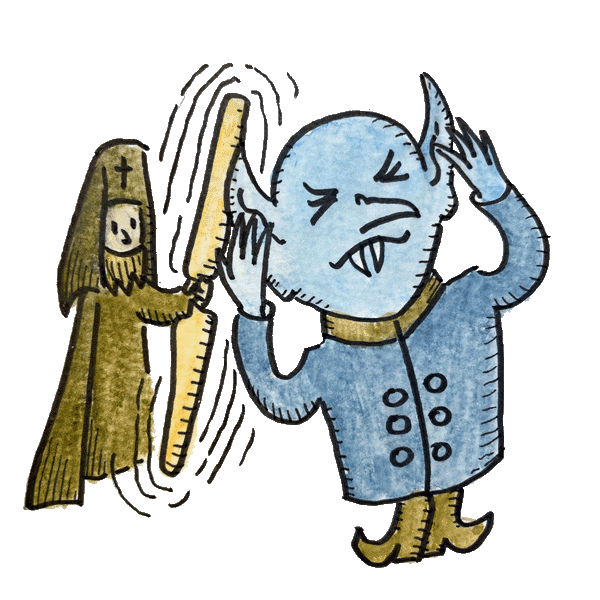
I watched an old documentary on Vlad Dracula hosted by none other than Vincent Price. Most of the information I was already aware of, but one bit jumped out at me. A unique way to annoy a vampire involving sound.

The Resonant Toaca

This documentary showed an Orthodox priest walking through town carrying a large piece of wood, called a toaca. This is a type of portable sematron used to create sound. He would bang on the toaca with a hammer as a way to keep vampires away. Despite scouring the Internet, I can’t find an exact reason for this. My best guess is that it annoyed the vampire. 

Make Your Vampire Do Math

I’ve posted about this before, but the toaca reminded me of another way to annoy vampires. I’d first learned about this in an X-Files episode (Bad Blood). Here we see the quintessential way to piss off a vampire. 

Many Slavic people believe that vampires were forced to count the holes in fishing nets or the number of scattered seeds. It was common for townsfolk to hang a net over their door or spill seeds on the stoop as a way to deter would be blood-drinkers. The most common seed used was mustard seed, also known as eye of newt.

So folks, want to annoy the bejeezus out of your local vampire? Start banging on some wood. And be sure to scatter seeds all over the place. You’ll be safe… at least until the vampire gets done counting.

Tim Kane

[mailerlite_form form_id=2]
Predicting the Future Using Cats

Arkane Curiosities

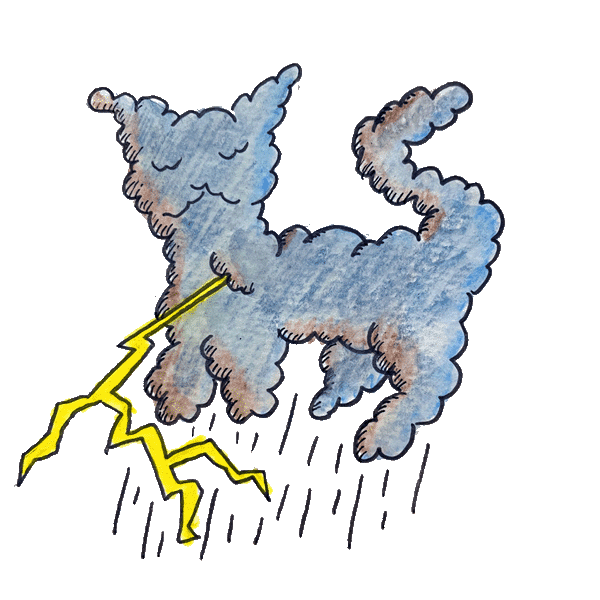
If you own a cat, then you possess the ability to divine the future. Throughout history, people have developed various unusual and often superstitious methods of divining the future, yet none is stranger than Ailuromancy, or predicting the future using cats. It works pretty much how it sounds. You watch the movements of said cat, and their actions reveal future outcomes, if it’s in the mood that day.

Egyptian Dreams

Since Egyptians had a thing for cats, it’s no wonder they developed this in the art of ailuromancy. One type of divination involved writing a question on a small tablet along with the name of a deity. The tablet was washed and placed inside a dead cat’s mouth (probably because a live cat wouldn’t tolerate such foolishness). Then the diviner would gain the answer the question in a prophetic dream. 

Weather Alerts

A sneezing cat could mean rain in the coming days. Even washing their faces vigorously can mean rain. If the cat turns its tail to a fire or any substituting heat source, it foretells possible heavy rain or hard frost. Curling up with forehead touching the ground foretells a storm coming your way. 

Visitor Predictor

Apparently cats can foresee visitors. If a famine licks its ears three times, check which direction it’s looking. This is where you can expect a visitor to come from. What’s more, you can divine the gender, too. If it puts its paw around the right ear, expect a male visitor. Left ear, a lady. No indication for other fluid genders. 

Fickle Luck

A cat following you is a sign of money coming your way. Yet if a black cat crosses your path, you’re sure to have bad luck. Except, should you find one white hair on a black cat, this means the cat is good luck. If you look into a cat’s eyes too long, it will bring you only bad luck.

A Warning of Sickness

Should you have sickness in your house, make sure you keep the cat close by. If it leaves and won’t be coaxed back inside, then the ill person may die. Likewise, if a cat sneezes three times in a row, the whole family will come down with a cold.

The Devil’s Creature

The worst act of ailuromancy dates back to 16th century Scotland. A person would roast a cat alive on a spit in a ritual called taghairm. Supposedly, this would summon the devil to protect the cat, who by now was screaming in agony. The devil would beg the person to relent and end the cat’s suffering. Yet the cruel SOB who started this torment would hold out until the devil had promised to fulfill a certain future request. Only then, could the cat’s misery come to an end. So who is the evil one in this scenario?

Thankfully, this sort of practice doesn’t happen anymore. Instead, we can settle for interpreting the whimsical doings of cat as it predicts future rain or perhaps a visitor. 

Tim Kane

[mailerlite_form form_id=2]

Egyptian Afterlife: Weighing of the Soul

Arkane Curiosities

The ancient Egyptians believed that all deeds resided in a person’s heart — the bad and the good. When you died, your heart was weighed against the feather of Maat (goddess of truth and justice). This process was called the weighing of the soul and it determined what sort of afterlife you could expect.

Ma’at – A Universe in Perfect Order

The goddess Ma’at was the daughter of Ra and married to Thoth, god of wisdom. But she was so much more than a simple goddess in the mythological hierarchy of Egypt. Ma’at was a primordial force that keep the world working. With Ma’at, the world had order because she kept everything in balance.

The ancient Egyptians believed the universe had an order to it, and it was Ma’at who kept everything in balance. Her name referred to the overarching concept of truth, order, and justice that she represented. The ancient Egyptians believed that the world was maintained through the principles of Ma’at, which included notions of truthfulness, moral integrity, and social harmony.

A Single Feather

The Feather of Ma’at, also known as the Feather of Truth, was a symbolic element in ancient Egyptian mythology and religious beliefs. After death, a person’s soul would enter the Hall of Ma’at in the underworld, where their heart would be weighed against the Feather of Ma’at on a set of scales. 

If the heart was found to be lighter than the Feather of Ma’at, it symbolized that the person had led a virtuous and just life, adhering to the principles of truth and social harmony. The person was deemed worthy to proceed to the eternal paradise known as the “Field of Reeds.”

Should the scales tip unfavorably, signifying a heart burdened with the weight of wrongdoing, a dire fate awaited the soul. Ammit, a fearsome deity with the head of a crocodile, body of a lion, and hindquarters of a hippopotamus, stood ready to devour the heart. The soul of the deceased would then face eternal punishment or be denied access to the afterlife.

The emphasis on the balance between one’s actions and truth echoes the universal human pursuit of leading a morally upright life. The choices we make in life reverberate beyond our existence.

Tim Kane

[mailerlite_form form_id=2]

The Curious Case of Keter SCP Entities: Where Chaos Meets Containment

Arkane Curiosities

Keter symbolizes the pinnacle of difficulty when it comes to containment. Keter SCP entities are among the most unpredictable and potentially catastrophic anomalies lurking within the SCP Foundation’s vaults.

Origins of the Keter Classification

Derived from the Hebrew word for “crown” and comes from the topmost part of the Tree of Life in the Jewish Kabbalah. Just like a crown sits atop a regal head, these Keter entities hold a position of authority and demand the utmost attention and care.

Now, let’s shed some light on a few examples of famous Keter SCP entities that have left researchers scratching their heads and clutching their containment manuals for dear life.

SCP-106 – The Old Man

Also known as Corporal Lawrence, this enigmatic and elusive creature appears as an elderly man who seems to be rotting. It will remain motionless for days at a time to wait for its prey. It will “corrode” any object it comes in contact with, generating rust, rock or cracks in the material. 

It can also phase through solid matter, leaving behind a patch of corrosive mucus. In actuality, it slips into a pocket dimension and then is able to exit from any point connected to the initial entry point. Thus, it is contained within 40 layers of lead-lined steel to slow and detect its movement. 

SCP-610 – The Flesh That Hates

This entity is a pervasive and rapidly spreading biological infection that affects both organic and inorganic matter.

SCP-610 primarily manifests as a skin condition, initially appearing as a series of red rashes and blotches on the infected individual’s skin. Within five hours , the infection progresses, causing the skin to decay and erode. The affected tissue is gradually replaced by a highly resilient and flexible organic substance similar to muscle and cartilage, often referred to as “flesh.”

Infected individuals may develop multiple appendages resembling arms or legs. In addition, their head might elongate or distort. Finally, the skin May split open revealing additional fleshy appendages.  

The infection is highly contagious and can spread through direct contact with infected individuals or exposure to infected biological matter, including blood, tissue samples, or airborne spores.

SCP-2317 – The Devourer of Worlds

The containment area for this cosmic horror is seemingly benign: a wooden door leading to the basement of a Massachusetts brownstone. However, passage through the door leads you to an pocket-dimension where the Devourer of Worlds is chained. 

SCP-2317 is humanoid in appearance but colossal in size, standing over 200 kilometers tall. It has horns like tree branches and overlapping scales. 

The entity is supposed to be chained to seven pillars, but six of these chains have already broken. As the name implies, should SCP-2317 ever fully break free, it is capable of devouring entire universes. Let’s hope that the final chain holds. 

Containing the Horrors

In the face of such formidable anomalies, the dedicated researchers and agents of the SCP Foundation persist in their ceaseless efforts to maintain a semblance of order. They tirelessly toil, concocting elaborate containment procedures and protocols, hoping to contain these unruly forces.

Tim Kane

[mailerlite_form form_id=2]