Have a Blue Fish Day (Using Surrealism in Your Writing)

When I was younger, sometimes I would declare that such and such a day was a blue fish day, meaning it had that ethereal quality as if waking from a dream.

What I later learned, was that I was utilizing the the paranoiac-critical method to unlock my unconscious mind. It might just sound like I made those words up. I didn’t. Salvador Dalí did. He was fascinated by the unconscious mind and dreams. (He plagued Freud with letters begging for an audience).

Paranoiac-Critical Method
Typically we’re taught to associate rational cause and effect explanations to events in our lives. Dalí wanted the reverse. A sort of stream of consciousness where irrational thoughts could be attached to events. He described the paranoiac-critical method as a “spontaneous method of irrational knowledge based on the critical and systematic objectivity of the associations and interpretations of delirious phenomena.”

Ballerina in a Death's Head is an example of the paranoiac-critical method. Do you see a skull or a ballerina?

In short, this is the ability of the viewer to perceive multiple images within the same configuration. All of us practice the paranoiac-critical method each time we gaze up at clouds in the sky and imagine different shapes. In fact all those sighting of Jesus on a slice of toast or a stucco wall are simply the Paranoid Critical Method in action.

A great introduction to Dalí and the whole surrealist world comes in the short film “The Death of Salvador Dalí.”

But you don’t have to sit idly by to create these associations. There are certain games you can play to help activate this irrational side of your brain.

Exquisite Corpse
This is a game played often by the Surrealists. In this, each person writes part of a sentence, and then folds the paper over so that the next person has no idea what was written. In this fashion, a collage of words creates a bizarre sentence. The name derives from the first playing of the game: “Le cadavre exquis boira le vin nouveau.” (“The exquisite corpse will drink the new wine.”)

The game was also played with pictures. One person might draw the head and then fold the paper over so that only a few connecting lines could be seen. This would continue until a total figure had been created.

4-part Corpse drawing; Man Ray, Yves Tanguy, Joan Miro, Max Morise

Cut Ups
It seems the surrealists did have their limit as to what they’d accept. At a surrealist rally in the 1920s Tristan Tzara built a poem from scratch by pulling words out of a hat. A riot broke out and wrecked the theater. Andrè Breton expelled Tristan Tzara from the movement.

Not until forty years later did this technique reemerge. Brion Gysin, a painter and writer, noticed that he’d sliced though the New York Herald Tribune on his cutting board. The cut sections lined up and could be read across. He loved the idea so much that he fashioned and essay called, Minutes to Go. Here’s an excerpt.

“Sickle moon terror nails replica in tin ginsberg. Replicas of Squareville — grey piebald pigeons — pointedly questioned, mimic each other.”

I used this technique to write the opening line to my first published short story. I was stuck and wanted a jarring image to pull the reader in. Sitting in a coffee shop, I picked up the newspaper and started tearing (I didn’t have scissors). I had to do two or three tries until something decent came up, but I think you’ll agree, the technique works.

Unfamiliar puddles of light lurked in the crevices like cancer.

So the next time you’re stuck with a scene or a character or even an idea, turn to the Surrealists for help. As your rational brain gets stuck in rut, unwilling to deliver words on the page, kick it in the but by unlocking your irrational side. Make your day a blue fish day and see what happens.

Tim Kane
Is the Steampunk Mechanical Hand a Reality?

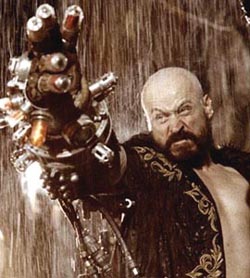
Rasputin's Steampunk Hand

Okay, so the mechanical construct Rasputin wore in the first Hellboy movie was actually a glove, but it illustrates the dream of steampunk aficionados everywhere: The Mechanical Hand. With today’s robotic technology, we should have Luke Skywalker hands. Right? But what about the heyday of the Victoria? Could gears make the cut?

Victorian Prosthesis

It turns out there was a macabre looking Victorian prosthesis on display in the London Science Museum. This construct of steel and brass articulates at the elbow via a spring, and the wrist joint rotates and moves up and down just like the real McCoy. The fingers curl up to grip items. This was the actual appearance, so the arm was most likely concealed with a glove.

This doesn’t offer much support for the mechanical arm. Yet, if you travel back another 400 years, you’ll find the legendary Gottfried von Berlichingen (aka Götz of the Iron Hand).

The German "Iron Hand" Mercenary

This German mercenary lost his right hand from a cannonball in 1504. He commissioned a custom mechanical hand that connected to his elbow. This remarkable feat of engineering contained spring mechanisms, buttons, and levers that allowed the fingers to operate with amazing dexterity. It earned him is nickname: “that one of the iron hand” (mit to der eisernen Hand).

Strap on super gauntlet

Gottfried’s iron fingers were controlled with ten mechanical wheels. These were sensitive enough to grip a sword (for terrorizing wealthy nobles), or clutch a quill (to write those ransom notes).

Medieval Skywalker hand

So there you have it. Looking back at Army of Darkness, the machination banged out for Ash looks pretty plausible now.

Give me some sugar baby

My question, why don’t we have more cool mechanical prostheses? If a German noble could bang it out 500 years ago, why can’t we? This historical precedent bodes well for all those steampunk constructs.

Tim Kane

Did the Greek Gods Eat Mini Marshmallows?

Ambrosia. The word either inspires dread or joy from the coconut and marshmallow concoction. But the origin of this word leads to a recipe for immortality.

Now, why the interest in the snack food of a defunct pantheon? Besides the fact that mythology is plain cool, I’m doing research for a new novel. What better way than to blog about it. Now, I’ve really dug how Rick Riordan handled the Greek gods in Lightning Thief. But I feel he could have done more with ambrosia and nectar. (Maybe he has in subsequent books). So, I’m here to explore these mythical foods, as well as what makes a god immortal.

It seems that the Greeks interchanged ambrosia and nectar. Ambrosia could be eaten or drunk. Nectar was mostly drunk, but sometimes eaten. Me, I always thought of ambrosia as the food (maybe because of the fruit salad) and nectar as the drink.

There’s little information on how ambrosia and nectar are made. Apparently doves carried the food to the gods on Olympus. Ambrosia is described as being nine times sweeter than honey and its fragrance guards against disagreeable speech. I take this last part to mean that arguments won’t break out over the dinner table—good idea when you’re dealing with the Olympian family dynamic. (My guess, they weren’t serving Ambrosia when Eris plunked her golden apple on the table.)

What is clear is that eating the stuff makes you a god. Right after Apollo had been born, he climbed up to mount Olympus (a stunning feat for a newborn) where he received ambrosia and nectar to make him immortal.

A version of the Tantalus myth has the fellow dining at the table of the gods. Tantalus slips some nectar and ambrosia in his toga, and then shares the stuff with his friends on Earth. Not a cool move. Sure you get immortality, but is that really going to help you when Zeus hurls a thunderbolt at your butt?

My first exposure to the stuff (not literally, but in literature) was with the 1904 novel The Food of the Gods and How it Came to Earth by H. G. Wells. In this story these scientists, Bensington and Redwood, create a new chemical food called Herakleophorbia IV, which makes things grow to ginormous size. Being responsible nineteenth century scientists, they feed this stuff to their kids and the result is 40 foot babies. Kind of a weird story, but it falls in line with the Greek myths. The gods and titans were supposed to be gigantic.

The interesting thing I stumbled on was the gods’ blood, or lack thereof. It seems that the Greek gods bleed ichor. I only knew this stuff from Dungeons and Dragons and H. P. Lovecraft, so in my mind, I saw this black oily liquid. However, the ichor of the gods is a golden and resplendent. The theory goes that since the gods do not eat mortal food (food that rots and dies) neither do they. After all, the word ambrosia derives from the root of mbrotos, meaning mortal. Add the prefix “a” prefix to get “not mortal”. The food won’t rot, so neither will the consumer.

So what happens when these immortal gods don’t get their food fix? Well, they can’t die. Instead, the godly ones lie down, breathless, and sleep. They loose all power until they get more ambrosia and nectar.

Now eating (or drinking) ambrosia changes mortals. I’m assuming a human’s blood would transmute to ichor. I don’t know how much you need to ingest. Did Tantalus eat enough? Who’s to say.  After Achilles died, Thetis anointed him with ambrosia to destroy the human side he inherited from his mortal father, Peleus. This implies that simply rubbing the stuff on your skin transforms you, killing your mortality.

Bottom line, you start sipping from the nectar cup, there might be no turning back. It’s like the forbidden apple. One taste is too much. No wonder the gods were irked when someone stole the stuff. There were too many bickering brothers and sisters in Olympus already. Why add a few interlopers?

Ambrosia serves as the ultimate class division between mortals and immortals. Gods have it. Men yearn for it. And no, the recipe for immortality does not include marshmallows.

Tim Kane

An Ode to Drinking Coffee in the Shower

Chocolate colored, steaming, so hot it burns your lips. Yup, I’m talking java. The liquid accelerant that slaps your mind every morning. Just the scent will get me out of bed.

Here’s the problem. Time. I like to indulge my coffee goodness. Gulping wastes the tawny-colored libation. Plus it’s liable to scorch the tongue. I typically brew up a liter to slurp in the am hours. So how do you have your proverbial cake and drink it too? The answer is combining tasks.

My second love is the shower. My wife says is swim in there. Truthfully I do my best problem solving under a piping-hot drenching. I’ve considered buying waterproof paper and pen, but that’d probably ruin the experience. It’s the fact that this is the one place I can’t write anything down which makes it the very reason so many ideas germinate there. So yeah, I take my time, swimming through my thoughts.

I used to slurp some coffee just before heading into the shower, only to return to a cooled cup. (Microwaves are none too kind to the brew.) One morning, I just took the mug o’joe in with me.

Now I’ve had plenty of people interrogate me on the logistics of this feat. Frankly, I hardly gave it much thought. My shower has sliding doors, so I simply set the cup on top, hooking the mug when I need a java boost. The whole experience reminds me of that episode where George Costanza eats his pastrami sandwich, watches TV, all while in bed (the perfect combination of three worlds). As to the logistics, it’s not like I face the water stream while I drink. That would dilute the coffee with water. I just sip now and then, enjoying the shower.

For all of you wanting a little slice of heaven, join us coffee shower drinkers (though at this point I might be the only one).

Tim Kane

Top Ten Directors

Okay, so I was talking to one of my students about our favorite directors. By the way, you’ll need to watch out for this kid. I’d say in 10 years, he’ll be well on his way to being on this list. Look for the name Jonny Santana in about 2020.

Anyway, we have a dinky media program at our school run by the eminent Lee Sison. I say dinky because it’s never been much until Jonny came along. He James Cameron’ed it by pushing the boundaries to the point that our computer can’t cope (we’re upgrading). His effects are up to Robot Chicken level.

So I got to thinking who would make my list of best directors. They have to be based on the directorial style, not just the actors and the screenplay. I noticed I hewed close to those directors that also write. I also noticed that my list includes mostly creepy directors (not personally, but in the subject matter they film). Nearly all have done at least one horror movie.

Criteria:

1. Casting (how well does this director choose and use talent?)
2. Pacing (do the shots flow well from once scene to another, and does it have a brisk pace?)
3. Vision (Do I remember a film a few days or years after seeing it? Does it linger? Also, how creative is this director? Are the films good because of his choices or just because of a good script and actors?)

I list my favorite movies from most favorite to least.

10. Quentin Tarantino
Favorite Films: Kill Bill 1 and 2, Inglorious Basterds, Reservoir Dogs, Pulp Fiction, Death Proof/Grindhouse
Extra: Also writes his own screenplays. The only reason he’s not higher is that he’s better at writing than shooting. He’s only recently learning to use the camera effectively.

9. Alfred Hitchcock
Favorite Films: The Birds, Psycho, Vertigo, Rear Window, Rebecca
Extra: Never looked through a camera lens. Always trusted his cinematographer

8. Peter Jackson
Favorite Films: The Lord of the Rings Trilogy, Frighteners, Heavenly Creatures, King Kong, Dead Alive, Bad Taste (a horrible bad movie that’s fun to watch).
Extra: Writes or Co-writes nearly all his screenplays. Looks like a Hobbit.

7. Guillermo Del Toro
Favorite Films: Cronos, Devil’s Backbone, Hellboy 1 and 2, , Blade II, Pan’s Labyrinth, Mimic
Extra: Writes or Co-writes nearly all his screenplays. Really twisted and weird guy.

6. Robert Rodriguez
Favorite Films: Sin City, El Mariachi/Desperado, From Dusk Till Dawn, The Faculty, Planet Terror
Extra: Scores most of his films. Defied the Hollywood union system by filming in Mexico. Writes or Co-writes nearly all his screenplays

5. Tim Burton
Favorite Films: Beetlejuice, Mars Attacks, A Nightmare Before Christmas, Sleepy Hallow, Edward Scissorhands, Batman and Batman Returns, Pee-wee’s Big Adventure, Ed Wood, Sweeny Todd, Corpse Bride, Alice in Wonderland (I feel his worst films are the remake of Planet of the Apes, and Big Fish)
Extra: Has crazy ideas that actually work on screen. You always know you’re watching a Burton film.

4. Terry Gilliam
Favorite Films: Time Bandits, Twelve Monkeys, Brazil, The Crimson Permanent Assurance (Part of Monty Python’s The Meaning of Life), The Fisher King, The Adventures of Baron Munchausen
Extra: Also has super crazy ideas. Was the animator for Monty Python. Often writes his own screenplays.

3. Timur Bekmambetov
Favorite Films: Wanted, Day Watch, Night Watch
Extra: Super crazy visual effects. Makes Matrix look amateurish. Hasn’t directed a lot in the U.S. yet, but look for him. His Moby Dick will rival Snyder’s 300. Also the subtitles for Day Watch are wicked (the best ever).

2. Stanley Kubrick
Favorite Films: The Shining (Best Stephen King Adaptation ever), 2001, A Clockwork Orange, Dr. Strangelove, Full Metal Jacket, Spartacus (Okay, so this was really Kirk Douglas’s film, but it’s still an awesome flick).
Extra: So Eyes Wide Shut sucked, and Kubrick’s a real jerk to work for. But hey, his films are iconic and they stick with you. I can still picture some of the shots in my head. He also writes the screenplay for all his movies.

1. James Cameron
Favorite Films: Aliens, Terminator 1 and 2, True Lies, Titanic, Avatar, The Abyss
Extras: I’ve never seen a film by Cameron that I didn’t like. He’s never really had a flop (The Abyss didn’t do as well as expected, but still pulled in the dough). There’s not another director out there that can say that.

Honorable Mentions:

· Sam Rami (almost made the top 10 because Spiderman 1 and 2 are the best films ever—seriously—but Spiderman 3 was terrible and Darkman is hard to watch).
· Christopher Nolan (also almost made the top 10, but he needs a larger body of work. Still Memento and Insomnia are pure genius. Also, there’s the Batman thing.)
· Edgar Wright (I want him on my top 10, but 2 good films does not a career make. But Shaun of the Dead and Hot Fuzz are fantastic. Two of my top films.)
· Kenneth Branagh (a great director, but sometimes I don’t feel like Shakespeare. Let’s see how Thor turns out).
· Ridley Scott (in the same league as Kubrick, read hard to work with, but his films are amazing. Particularly Bladerunner).
· Zack Snyder (So Dawn of the Dead and 300 were unbelievably good. But Watchman wasn’t. Not by far. Let’s wait and see).
· Danny Boyle (Two of my most favorite flicks are Shallow Grave and 28 Days. But I’m just not crazy to see Slumdog Millionaire).
· Michael Bay (Hollywood hates him, but he sure can put together an action flick. You can always trust that his movies will deliver. But I feel he lacks in the vision department.)
· Gore Verbinski (Pirates of the Caribbean rocks. So does The Ring. Let’s see where he goes.)