History of the Ouija board — From Witchboards to Ouija

The Ouija board’s origins are deeply rooted in the Spiritualism movement of the 19th century, a period of intense spiritual exploration. To understand the history of the Ouija board, we must first travel back to the heart of the 19th century, when the Spiritualism movement was sweeping across America. Delve into the captivating history of the enigmatic Ouija board, a tool that has fascinated, terrified, and intrigued people for generations.

Seances and Talking Boards

In the wake of the American Civil War, the country was gripped by an overwhelming sense of loss and grief. Families were torn apart, and many were desperate for a means to reconnect with their departed loved ones. This despair led to the emergence of Spiritualism, a movement that claimed to bridge the gap between the living and the dead.

As part of the Spiritualism movement, seances gained immense popularity. Mediums would gather with those seeking contact with the deceased, holding sessions in dimly lit rooms filled with incense and mysticism. The movement was greatly influenced by the Fox sisters, who claimed to communicate with the spirit world through mysterious “knocks.”

The Talking Boards, also known as Witch Boards, made their debut during this period. These boards featured the alphabet, numbers, and simple “yes” and “no” responses. Participants would place their hands on a planchette—a heart-shaped or teardrop-shaped device with a window—allowing spirits to guide their movements to spell out messages.

The Birth of the Ouija Board

In the 1880s, E.C. Reiche, a Prussian immigrant and undertaker, began creating prototypes of these talking boards on the side. It was these prototypes that would eventually evolve into the Ouija board. 

Charles Kennard, an entrepreneur with a keen eye for opportunities, actively promoted what he claimed to be his invention of the talking board to potential investors. His persistence paid off when local attorney Elijah Bond took an interest. Bond, who had a sister-in-law with strong mediumistic abilities, saw the potential in the talking board. The Kennard Novelty Company was incorporated on Halloween, 125 years ago, marking the start of mass manufacturing of Ouija boards as we know them today.

Helen Peters and the Ouija Name

According to legend, Helen Peters, the sister-in-law of Elijah Bond, was using the Ouija board when she asked the board what it wanted to be called. The board, under the influence of unknown forces, spelled out “O-U-I-J-A.” Intrigued and curious, Helen inquired about the meaning behind this peculiar name. The board replied, “Good luck.” Though, in reality, the name was written on her necklace locket at the time

With a desire to protect their invention, Charles Kennard, Elijah Bond, and Helen Peters sought to patent the Ouija board. However, their journey faced a roadblock in the form of the patent chief, who was skeptical of their claims. He agreed to grant them the patent under one condition: they must use the Ouija board to reveal his name.

Helen Peters took up the challenge, and with the Ouija board’s guidance, she successfully spelled out the patent chief’s name, securing the patent for the Ouija board. This peculiar incident cemented the board’s mystique and added an extra layer of intrigue to its history.

Tim Kane

[mailerlite_form form_id=2]
How to Annoy a Vampire

Arkane Curiosities

I watched an old documentary on Vlad Dracula hosted by none other than Vincent Price. Most of the information I was already aware of, but one bit jumped out at me. A unique way to annoy a vampire involving sound.

The Resonant Toaca

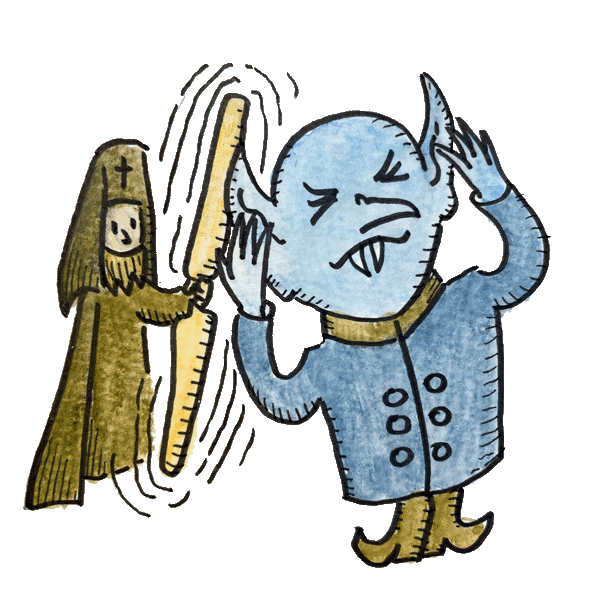
This documentary showed an Orthodox priest walking through town carrying a large piece of wood, called a toaca. This is a type of portable sematron used to create sound. He would bang on the toaca with a hammer as a way to keep vampires away. Despite scouring the Internet, I can’t find an exact reason for this. My best guess is that it annoyed the vampire. 

Make Your Vampire Do Math

I’ve posted about this before, but the toaca reminded me of another way to annoy vampires. I’d first learned about this in an X-Files episode (Bad Blood). Here we see the quintessential way to piss off a vampire. 

Many Slavic people believe that vampires were forced to count the holes in fishing nets or the number of scattered seeds. It was common for townsfolk to hang a net over their door or spill seeds on the stoop as a way to deter would be blood-drinkers. The most common seed used was mustard seed, also known as eye of newt.

So folks, want to annoy the bejeezus out of your local vampire? Start banging on some wood. And be sure to scatter seeds all over the place. You’ll be safe… at least until the vampire gets done counting.

Tim Kane

[mailerlite_form form_id=2]
Stairs in the Woods

Arkane Curiosities

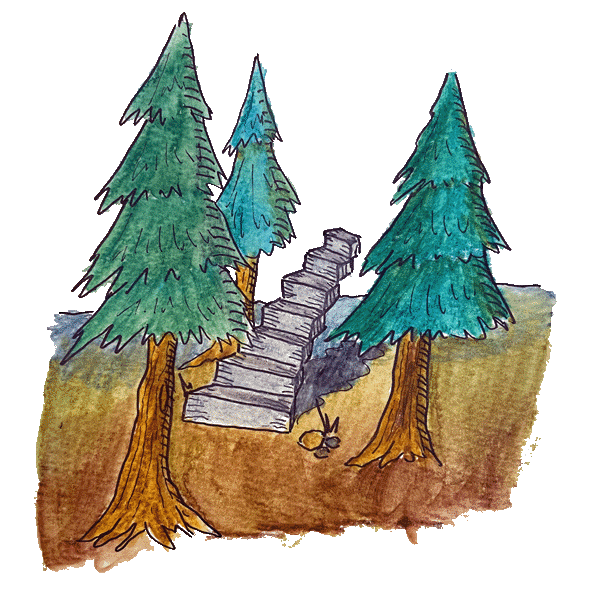
Stairs have to lead somewhere, right? But with the urban legend, “Stairs in the Woods”, these enigmatic stairs lead nowhere. A popular urban legend and creepypasta, the legend typically involves hikers, campers, or explorers stumbling upon a staircase in the middle of the woods, seemingly out of place and disconnected from any structure or building.

Staircases Out of Place

Picture this: a remote, isolated location within the woods, devoid of any man-made structure. Yet, right in the midst of this natural beauty, a staircase emerges—completely out of context and utterly surreal. These staircases, often made of wood or stone, stand mysteriously isolated, beckoning those who come across them to unravel their enigma.

Key elements of the legend include:

Isolation and Unusual Placement: The stairs are often described as being in a remote or isolated location within a forest or wilderness area, far away from any recognizable structures.

Appearance and Design: The stairs are usually made of stone and often appear pristine or well-maintained, despite their strange location and lack of any nearby structure. They may look brand new or very old, with varying designs.

Unexplained Mystery

The origin and purpose of the stairs are never clear. No one knows how or why they were placed there. Some think they are the remains of structures that have rotted away, leaving the stone stairs behind. Others wonder if these stairs lead to another world or even hell. 

Tim Kane

[mailerlite_form form_id=2]
Divine the Future With Eggs — Oomancy

Arkane Curiosities

Throughout history, we have sought to unravel the mysteries of the future through various forms of divination. One of the lesser-known methods is oomancy, the art of predicting the future by interpreting the patterns formed when an egg is cracked open. While it may sound bizarre, oomancy has deep roots in different cultures and continues to be practiced by some today. Learn how to divine the future with eggs.

The Origins of Oomancy

Oomancy, also known as ovomancy, derives from the Greek word “oion,” meaning egg, and “manteia,” meaning divination. Gaius Suetonius Tranquillus, a Roman historian, described how the Empress Livia Drusilla stowed a chicken egg in her cleavage, thinking it would determine the sex of her unborn child. 

The Process of Oomancy

Oomancy typically involves a specific ritual that begins with the selection of an egg. In some traditions, the color, size, or even the source of the egg may hold significance. Once the egg is chosen, the diviner focuses on their question or intention, concentrating their energy on the egg.

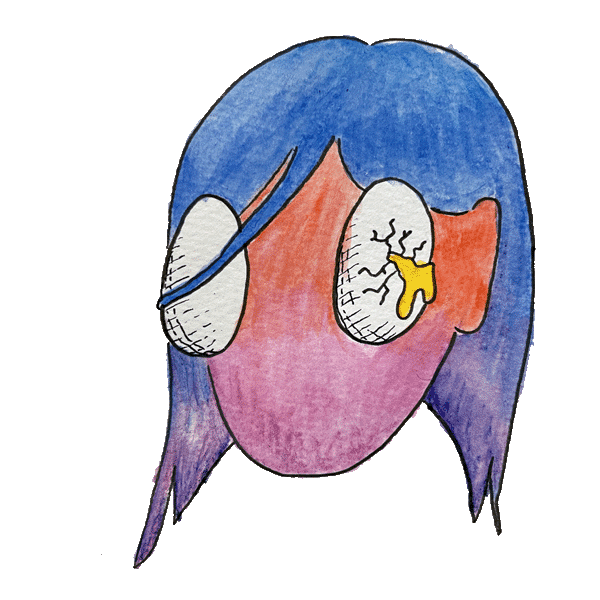
The next step is to crack the egg open and slowly pour into a glass of warm water. The warmth will allow the white to firm up a little.  The patterns formed by the raw egg white can reveal answers and insights related to the question or situation at hand.

Interpreting Oomancy Patterns

Various aspects of the egg, such as the shapes, lines, and colors in the egg white and yolk, are analyzed for their significance. Here are some common interpretations:

  1. Lines and Shapes: Cracks, lines, and shapes in the egg white or yolk may be seen as symbols. For example, a heart shape might represent love and happiness, while a snake-like pattern could symbolize deceit or danger.
  2. Consistency: The texture and consistency of the egg’s contents can provide additional clues. A runny egg might indicate fluidity and change, while a firm egg could suggest stability and security. Additionally, a clear white is thought to be positive, while a cloudy eggs signifies obstacles and uncertainty. 
  3. Symbolism: As you examine the egg white from all angles, you might discover some symbols. A clover indicated happiness and prosperity. A horseshoe denotes good financial luck. Seeing an arch foretells problems with coworkers and family. 

Believer or skeptic, oomancy might tap into the primal ability to divine the future. Even though you might see it trending on social networks, know that this divination form has been cracking open the future for centuries. 

Tim Kane

[mailerlite_form form_id=2]
Predicting the Future Using Cats

Arkane Curiosities

If you own a cat, then you possess the ability to divine the future. Throughout history, people have developed various unusual and often superstitious methods of divining the future, yet none is stranger than Ailuromancy, or predicting the future using cats. It works pretty much how it sounds. You watch the movements of said cat, and their actions reveal future outcomes, if it’s in the mood that day.

Egyptian Dreams

Since Egyptians had a thing for cats, it’s no wonder they developed this in the art of ailuromancy. One type of divination involved writing a question on a small tablet along with the name of a deity. The tablet was washed and placed inside a dead cat’s mouth (probably because a live cat wouldn’t tolerate such foolishness). Then the diviner would gain the answer the question in a prophetic dream. 

Weather Alerts

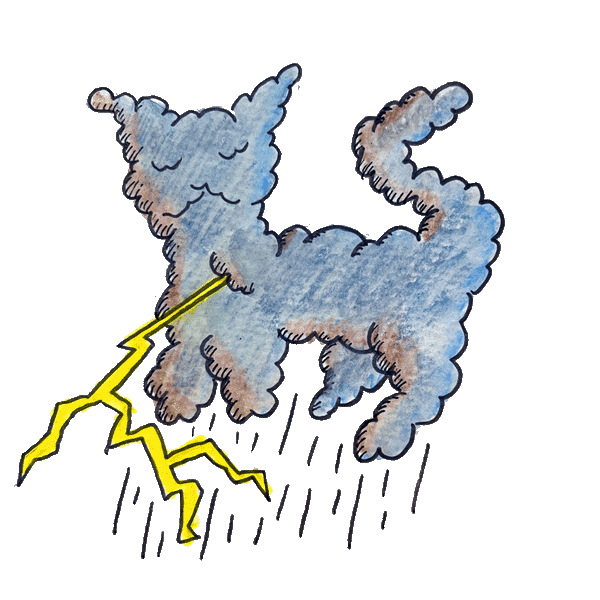
A sneezing cat could mean rain in the coming days. Even washing their faces vigorously can mean rain. If the cat turns its tail to a fire or any substituting heat source, it foretells possible heavy rain or hard frost. Curling up with forehead touching the ground foretells a storm coming your way. 

Visitor Predictor

Apparently cats can foresee visitors. If a famine licks its ears three times, check which direction it’s looking. This is where you can expect a visitor to come from. What’s more, you can divine the gender, too. If it puts its paw around the right ear, expect a male visitor. Left ear, a lady. No indication for other fluid genders. 

Fickle Luck

A cat following you is a sign of money coming your way. Yet if a black cat crosses your path, you’re sure to have bad luck. Except, should you find one white hair on a black cat, this means the cat is good luck. If you look into a cat’s eyes too long, it will bring you only bad luck.

A Warning of Sickness

Should you have sickness in your house, make sure you keep the cat close by. If it leaves and won’t be coaxed back inside, then the ill person may die. Likewise, if a cat sneezes three times in a row, the whole family will come down with a cold.

The Devil’s Creature

The worst act of ailuromancy dates back to 16th century Scotland. A person would roast a cat alive on a spit in a ritual called taghairm. Supposedly, this would summon the devil to protect the cat, who by now was screaming in agony. The devil would beg the person to relent and end the cat’s suffering. Yet the cruel SOB who started this torment would hold out until the devil had promised to fulfill a certain future request. Only then, could the cat’s misery come to an end. So who is the evil one in this scenario?

Thankfully, this sort of practice doesn’t happen anymore. Instead, we can settle for interpreting the whimsical doings of cat as it predicts future rain or perhaps a visitor. 

Tim Kane

[mailerlite_form form_id=2]