Readophile

I love everything that has to do with books. Most of my love exhibits itself in clever sayings or aphorisms about reading and books. At incidental comics, I stumbled upon an amazing comic about adopting books. Check out Stray Books:
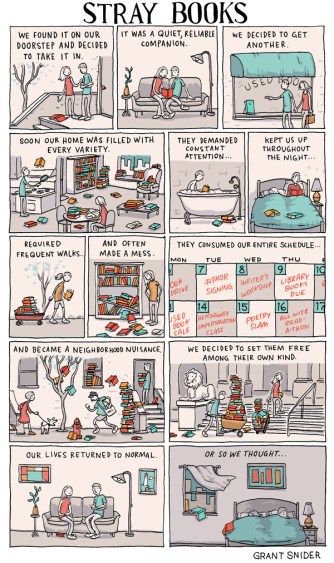
I makes me want to adopt books. Now, how about books as a wall. In 2005, Swiss artist Jan Reymond began constructing elaborate installations each year, made of the old, unsold books as a last hurrah for the soon-to-be discarded objects. He also made a tree out of books. That’s dedication.

Then I found a photographer Kirsty Mitchell. Following her mother’s death from a brain tumour in 2008, Kirsty channelled her grief into her passion for photography. She retreated behind the lens of her camera and created Wonderland, an ethereal fantasy world.

Below is The Storyteller: A reference to Kirsten’s English teacher mother, a model sits elegantly on a carpet of bluebells enveloped by books.

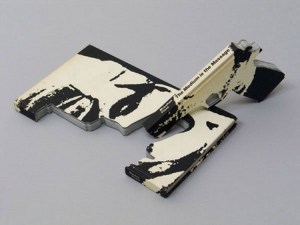
Finally, we have artist Robert The (yes, that’s his name). He takes books and then cuts them up to create new symbols. A lobster. A broom. A cake. And yes, a gun.
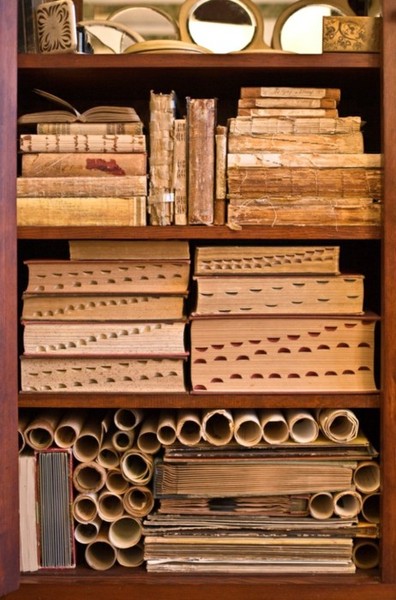
I still love to read books too. Now, mostly ebooks. But sometimes there’s something special about glue and paper. If the picture below doesn’t make you shiver with excitement, then real, physical books, aren’t for you.
Tim Kane

How to Burn Books in the Digital Age

I have to be honest with you. I have burned a book. It’s something I can never live down and it haunts me.

I was somewhere in my early teens. Either middle school or high school. I was a big D&D nut and loved watching The Evil Dead series. I purchased a copy of the Necronomicon. Now I realize how harmless this book is, but at the time, it seemed stunning and real to me. As well as to my dad.

He freaked. He’d had a bad experience with a Tarot deck years ago. For him, it was round two. He couldn’t take the book being in my house. He convinced me to dispose of it. I wish I had said no. I should have. No book deserves this. It’s what people with small minds do to ideas.

I was young. I capitulated.

The barbecue fired up. The book thrown on. I couldn’t watch the whole process. I left.

It seems like people will be burning books forever. Or will they? Recently, there have been a rash of book burnings for Fifty Shades of Grey. Do I think this book is worthy of great literary merit? Hardly. Yet it certainly doesn’t deserve burning. These people bought the book. Thus more money flows to EL James.

It got me thinking. Would we still have these burnings in a decade or so? With the advent of ebooks, we might face a time when there are no print versions of a book to burn. What then? Will people burn their Kindles and Nooks? How silly would that be?

Perhaps they would all press the delete button at the same time. Yeah, cause that would send a message. How anti-climactic.

Maybe future book Nazis will create viruses to attack and delete books. A clever concept, though it might be beyond the scope of their intelligence. Also, deleting other people’s books is tantamount to setting arson to a bookstore.

We all know that there will still be print books in some form in the future. After all, people still print out photos despite the plethora of ways to use the digital pictures. It brings up the idea that a clever author might be able to circumvent the mad book burners if he or she knows the book will be controversial. Future authors could simply print their book only as an ebook.

Although a truly brilliant author would want the book to be burned. There’s no better publicity than setting a book aflame. If it weren’t for the repulsiveness of the act, it’s be a great publicity stunt.

This writer is curious as to how people will take out their wrath on future books. I’m certain they will find a way. Hate always does.

Tim Kane

Absolutely True Story of a Part Time Reluctant Reader

I’ll be honest. I really didn’t want to read The Absolutely True Diary of a Part Time Indian. Reluctantly, when there was nothing else on my reading list, I picked it up. Then I couldn’t put it down. The narrator, Arnold Spirit, says it like he means it. Being poor sucks. Listen to his voice:

Poverty doesn’t give you strength or teach you lessons about perseverance. No, poverty only teaches you how to be poor.

He goes on to say how fried chicken is almost equal to Jesus in his house for the joy it brings. The thrust of the story is a boy trying to find himself and escape the poverty of living on the Indian reservation. When he goes to the white school, he has to pretend he’s rich. Mostly out of embarrassment for how he has to walk to school each and every day.

Yeah, so I pretended to have a little money. I pretended to be middle class. I pretended I belonged.

Nobody knew the truth.

Of course, you can’t lie forever. Lies have short shelf lives. Lies go bad. Lies rot and stink up the joint.

Add to this compelling narrative the awesome illustrations by Ellen Forney and you have a book that’s addicting. Arnold deals with his anger and fears through illustrating. And the pictures are hilarious. Check out these.

Arnold also has to cope with leaving his best friend Rowdy, who’s always there for him.

I was so depressed that I thought about crawling into a hole and disappearing forever.

By Rowdy talked me out of it.

“It’s not like anybody’s going to notice if you go away,” he said. “So you might as well gut it out.”

When Arnold leaves the rez for the white school, Rowdy sees this as a betrayal.

The book deals with Arnold finding his way with his new life and his old friendships. I highly recommend this to any teen or adult reader.

Tim Kane

Why I Need Two Copies of Certain Books

Sometimes I need more than one copy of a book. Usually fiction. Almost always when it’s an amazing read.

AN E-READER ANNOTATION MINI-MANIFESTO

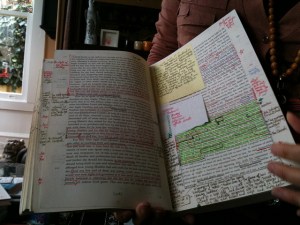
I start everything now as an ebook, though back in the days of long commutes, the audiobook ruled. When the narrative is crisp and alluring, I need to mark it up. Dissect it and see how it ticks. It’s the analytical mind in me. Sure, my Nook lets me highlight words and phrases, but it’s not the same. I need to dog ear pages. Scribble in the margins. Basically mess with it.

That’s when I purchase a second copy. I’ll zip around to spots I remember. My goal is almost always: “How did this writer pull this off?” Was it a subtle nuance of the narrator’s voice? Verb choice? Sentence length? I need to know. I circle and scribble all over the thing.

I recall once (and this will date me) when I had the notion to write a screenplay for The Island of Dr. Moreau by H. G. Wells. This was about a year before the Val Kilmer and Marlon Brando version hit theaters (they beat me to the punch). I had taken a pencil (because this was a treasured version of the story) and went to work blocking scenes. Now I wish I hadn’t because I have plenty of erasing to do.

The one book I have in nearly every form is The Girl Who Loved Tom Gordon by Stephen King. I started with an audiobook. Then bought the paperback (to mark up for a college paper). Finally, I chanced upon a hard bound copy heavily discounted. All I need now is an ebook and my collection is complete.

Am I alone in this? Does anyone else out there snap up multiple copies of books?

Tim Kane

The Age of Miracles Has Put This Reader on Edge

This is the strangest book I’ve read so far. It has me on the verge of a panic attack. Why? Because it details an end of the world scenario so plausibly, I can imagine it happening. The premise of the book is that the world is slowing. The spin of the Earth is slowing down. Each day adds minutes, and soon that trickle becomes a flood. As I read, I found myself thinking what I would do in this situation. The prospects became grimmer as the story unfolded: birds fell out of the sky, slowing sickness afflicted the population, tens of thousands of whales were beached, and gradually—as the days lengthened to 72 hours—all the world’s vegetation died out.

I admired how the author, Karen Thompson Walker, weaved the scientific effects into dramatic plot points. For example, instead of simply having someone suffer from the slowing sickness (a sort of dizziness and weakness), she had the mother of the main character faint while driving and run down a man in the street. Likewise, as trees began to die, she could simply have stated that thy fell over. Instead, she used to underscore the political division between the clock timers (those who stick to the 24 clock) and the real timers (those who try to sleep longer to match the growing days). A tree falls through the only real timer left on the block. People suspect it might have been cut.

One interesting aspect of the book is that the Earth is one of the central characters in the story. It is obviously sick. We all know, as we read, what will happen to this sick patient in the end, yet we can’t leave her bedside. Even I, as I read, was fascinated with the next disaster. How could things get worse.

Some things that bothered were were how the main character, 11-year-old Julia, was handled. Walker attempted to give her a poignant coming of age story in a dying world. Somehow she felt hollow. Walker clearly details what happens to her. How her loneliness spins out from her. Her thoughts seem clinical in a way. I wanted a visceral reaction. I think some of the problem stemmed from the narrator, Julia, telling the story from the future (when she’s in her twenties).

A few other inconsistencies bugged me. The first was the random insertion of profanity. It’s almost as if Walker felt she needed to add a few cuss words to qualify it for young adult status. Mostly, these got in the way. Also, she made a point of stating that the price of grapes had risen to $100 per pound. Yet after that, there were several instances of characters macking out on ice cream. Surely the price for that would have shot through the roof.

Overall, I recommend this book. The central concept of the Earth slowing are worth the read alone.

Tim Kane