How Does Your Body Move After Death?

There are actions on your body long after death. Many I wasn’t even aware of until after seeing “Danse Macabre”. When this first started, I thought… Uh Oh. This is going to be some artsy piece where someone “interprets” the movements of a corpse. No way. Nearly all the movements the actor/dancer portrays seem genuine and believable. I say nearly, because the rigor on the table leading to the fall is staged, but for a good reason. It leads to an incredible image of the person falling down the drain with her blood.

Here are some stills from the film.

photo 4

I had never considered how a person’s feet would slide after being hanged. This is a  detail that is typically lost when we think of a hanged person. Many of the movements in this piece walk the line of morbid and beautiful.
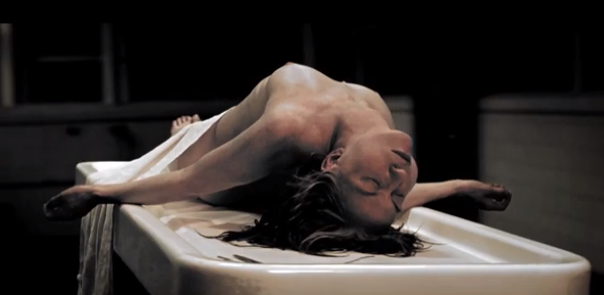
Screen Shot 2013-11-04 at 5.17.31 AM

This, as I said, was the most staged position. The rigor led to the body falling off the table. Yet the scene that followed was astounding.

Screen Shot 2013-11-04 at 5.21.29 AM

Screen Shot 2013-11-04 at 5.21.19 AM

We go from a view of the drain to a shot of the body, curled up, falling away. Stunning.

photo 2

I had never considered this rather pedestrian movement of the body. Quite literally, it is lowered into a casket. I’d never thought about how the body was placed in there.

photo 3

The most beautiful, and surprising movement, came from an interior shot of the casket. As it is being moved around, the body slides. I’d never even contemplated that.

Here is the full video. It’s about 9 minutes.

Tim Kane
Do You Die A Little Bit Every Day?

How risky is risky? When you have a brush with death, when does that brush turn into a downright shove? That’s the question that Ronald A. Howard attempted to answer with the “micromort” or tiny death.

Skull-1

The micro-mort is a unit of death. Add enough micro-morts and, you guessed it, you’re dead.

When Ronald A. Howard started as a professor at Stanford, he concentrated on breaking a fatal risk into small units. A micromort is a one-millionth chance of death. Different risk activities would have different levels of death, a higher or lower micromort total.

This guy isn’t going midichlorian on us. He simply wants to guague the risk of death.

Here are some examples:

  • Drinking water in Miami for a year increases your likelihood of dying by one micromort
  • General anaesthetic in an emergency operation garners a micromort of 10
  • Driving 250 miles in a car increases your death chances  by one micromort (I’m not sure if this is continuous driving or over a period of days).

Things fall into perspective when you find out that you can only travel 6 miles via motorcylce to get that one micromort increase. This makes it a much more dangerous trip.

The micromort can be viewed as the average “ration” of lethal risk that people are exposed to daily. So don’t get all hung up on it. The life expectancy for an average human is one million half hours (source here). That means that micromorts turnout to me a measure of your life (because you will eventually die). That would mean you spend 1 micromort per half hour. Any activity that raises that (like general anaesthetic) creates more risk.

Tim Kane

Bizarre Ways to Become a Vampire

When you step outside the films and popular fiction, vampirism gets a little wonky. In Eastern Europe you don’t get bit to become a vampire. Often, you’re born a vampire. Say what? True, many people equate vampirism to a curse. And there are plenty of ways to get cursed.

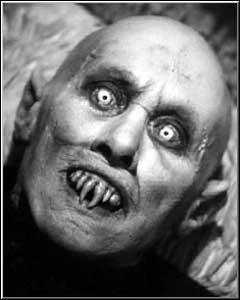
the-master

A child born with a caul (a piece of membrane that covers a newborn’s face) would become a vampire after dying. To prevent this, the caul needed to be removed, dried, and ground up. Then the child would eat the powdered caul on his or her seventh birthday.

tumblr_l9zjjdhVgw1qcai1d

A very common cause of vampirism is to die without ever being baptized. This leaves the person vulnerable to malicious spirits.

Suicide is the number one cause of vampirism nearly everywhere (Europe, Africa, China). Similar to being unbaptized, suicide was considered a sin against God. The person was buried away from the village, not on hallowed ground. The English had an interesting tradition of interning the corpse at a crossroads with a steak through the heart. The stake prevented the body form being animated by evil spirits.

In Germany, people who died from an accident risked becoming a vampire. Just a little to the south, in Bavaria, simply leading an immoral life could turn you into a vampire after death. Werewolves were closely related to vampires. Therefore, anyone who ate meat from an animal killed by a wolf would become a vampire.

Finally, is anything disturbs your grave, you will rise as a vampire. If an animal runs across your grave, you’re a vampire. Strangely, if a nun crosses your grave, forget about it. Vampire. This begs the question, how many nuns are traipsing through the cemetery?

Be careful folks. Multiple mistakes with your life (or death) can transform you in to the living dead.

Tim Kane

Vampire Apotropaics Part 4: Die Vampire Die

We all want vampires dead, but what to do when it’s the middle of night and there are no stakes nearby? Why, reach for a sock, of course.

By far the most common method to off a vampire is with a stake. Van Helsing uses it, why shouldn’t you? However, you don’t always have to chop up grandma’s antique chair. A needle also works. Romanians believe (present tense, mind you) that a needle inserted into the navel will kill a vampire. Why the navel? That’s where the second heart lies. It has to have a second one, because the first one went kaput when the person died. The second heart is what keeps the vampire alive after death.

Vampire blood was so evil that any person who came in contact with it would become insane. Therefore during staking, an animal hide was placed over the body. Vampires were seen as squishy blood balloons, so this form of protection helped minimize splatter.

Click on the picture to bring up the YouTube clip.

Steven Weber (playing Jonathan Harker) could have used a bib in Mel Brooks’s “Dracula Dead and Loving It.” Click on the picture to bring up the YouTube clip.

A consecrated bullet would kill a vampire, but not in the way you think. Shoot it through the coffin. One reason for this might be that it spoiled the coffin and gave the vampire no place to rest. A version of this can be seen in Coppola’s Bram Stoker’s Dracula where they ruin the vampire’s coffin but placing holy wafers in the dirt. The idea that sunlight can kill vampires is an invention of film. In Poland and Prussia, the creatures can hunt the living from noon till midnight. Even Bram Stoker’s Dracula could function in daylight.

1943 Son of Dracula played by Lon Chaney Jr. just before sunlight strikes him.

1943 Son of Dracula played by Lon Chaney Jr. just before sunlight strikes him.

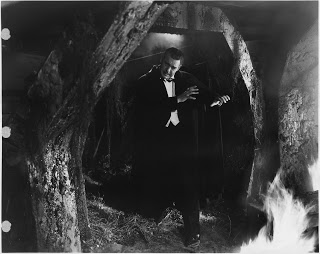
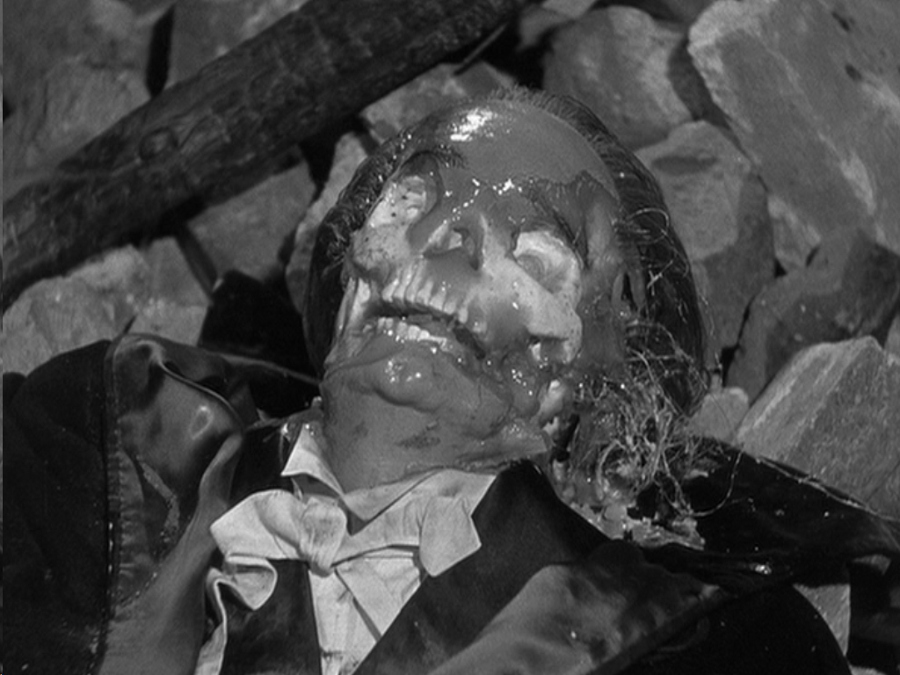
The first film to have a vampire to die by sunlight is Son of Dracula with Lon Chaney Jr. as the vampire. The rays of dawn strike his body and he fades from sight. A few months later, Return of the Vampire showed Bela Lugosi (playing a vampire called Armand Tesla) succumb to sunlight. Though this isn’t really fair, as he was simultaneously being staked by his werewolf servant. The film did depict the first image of a vampire melting in the sun.

The first face melting of a vampire in sunlight (or from staking, who's to say).

The first face melting of a vampire in sunlight (or from staking, who’s to say).

If you suspected that your kin were a vampire the solution was simple. Dig up the body, dismember, burn to a crisp and drink the ashes. A pretty hefty cure if you ask me. Boiling oil was another method to destroy the undead.

Vampires were considered terribly OCD (counting knots or grains of rice). The final method of demise plays off this weakness. Steal the vampire’s left sock (I’m assuming this is the evil one with the Latin name for left being sinister). Then fill it with rocks and toss it into a river or other running water. The creature will go after it (possibly crying, “Who took my sock.”) and the moving water will be its downfall. Moving water was long believe to destroy vampires.

That’s it. Now you know all there is about how keep vampires out. If, however you’re yearning for a midnight nibbling, you know not to take the guy’s sock. He needs that.

Tim Kane

Vampire Apotropaics Part 3: Undead Bondage

In this segment learn how carpets, oil or a bowl of cold water can keep a vampire in his place.

This segment of vampire aprotopaics deals with constraint or restrictive measures. The goal is to make sure the undead cannot move or leave its grave. The most obvious implement were ropes. In some areas of Eastern Europe the knees were bound or the whole body tightly tied with rope. Finally, binding the corpse in a carpet completely immobilized it, thus preventing the vampire from rising from the dead.

Sharp items, meant to injure or weaken the vampire were also common. Many corpses were buried with knives or the more infamous sickle (possible the reason we associate death with a sickle). Usually the sharp item was positioned to cause damage to the undead. With the sickle, it was placed over the neck so that if the vampire should rise, he would slice off his head.

A 19th century image of the reaper

A 19th century image of the reaper

In Morocco steel, iron, or silver daggers were left in the grave while the Slavs used hairpins. Thorns also did the job, though being much smaller, these were inserted in key points: under the tongue or in the navel. Some corpses were bound with thorny briars. On possible reason for this was to keep the body from swelling (a key sign of vampirism). In Eastern Prussia, a bowl of cold water was placed under the boards were the corpse lay in rest. Additionally, tin spoon were laid on top to weigh the body down.

Explorer VI:Vampire ForensicsNGC US- Ep Code: 4816

In 2006, a team excavated a mass grave from the 16th century in Venice. They discovered a skeleton with a brick jammed between it’s teeth. Possibly another restraint to keep the vampire from attacking.

Iron has always been though to repel evil. In Romania, iron forks were sometimes stabbed into the heart, eyes, and breast of the deceased while the Bulgarians drove a red-hot poker through the heart. Boiling oil, poured around the grave, was believed to prevent the vampire form leaving. So too, bowls of of excrement and poison.

Sometimes just ignoring a vampire was enough to protect yourself. In Romanian lore, it was believed that vampires could only ask a question one time. The superstition arose that you should only answer someone if they call upon you three times. If you answer a vampire’s request, then he will have power over you.

In Austin Powers The Spy Who Shagged Me Mustafa (played by Will Ferrel) must be asked a question three time for him to answer it. Not really a vampire, but it sprang to mind. Click the picture for a link to the scene on YouTube.

In “Austin Powers The Spy Who Shagged Me” Mustafa (played by Will Ferrel) must be asked a question three time for him to answer it. Not really a vampire, but it sprang to mind. Click the picture for a link to the scene on YouTube.

In the final segment, we explore ways to destroy the vampire, including but not limited to drinking ashes, a needle, and a sock (yes, a sock).

Tim Kane