Absolutely True Story of a Part Time Reluctant Reader

I’ll be honest. I really didn’t want to read The Absolutely True Diary of a Part Time Indian. Reluctantly, when there was nothing else on my reading list, I picked it up. Then I couldn’t put it down. The narrator, Arnold Spirit, says it like he means it. Being poor sucks. Listen to his voice:

Poverty doesn’t give you strength or teach you lessons about perseverance. No, poverty only teaches you how to be poor.

He goes on to say how fried chicken is almost equal to Jesus in his house for the joy it brings. The thrust of the story is a boy trying to find himself and escape the poverty of living on the Indian reservation. When he goes to the white school, he has to pretend he’s rich. Mostly out of embarrassment for how he has to walk to school each and every day.

Yeah, so I pretended to have a little money. I pretended to be middle class. I pretended I belonged.

Nobody knew the truth.

Of course, you can’t lie forever. Lies have short shelf lives. Lies go bad. Lies rot and stink up the joint.

Add to this compelling narrative the awesome illustrations by Ellen Forney and you have a book that’s addicting. Arnold deals with his anger and fears through illustrating. And the pictures are hilarious. Check out these.

Arnold also has to cope with leaving his best friend Rowdy, who’s always there for him.

I was so depressed that I thought about crawling into a hole and disappearing forever.

By Rowdy talked me out of it.

“It’s not like anybody’s going to notice if you go away,” he said. “So you might as well gut it out.”

When Arnold leaves the rez for the white school, Rowdy sees this as a betrayal.

The book deals with Arnold finding his way with his new life and his old friendships. I highly recommend this to any teen or adult reader.

Tim Kane
Writer or Hoarder?

My latest literary venture involves a character who’s a hoarder and I’ve had the most difficult time getting information about this person together. My usual style of banging it out on the computer will not cut it. It seems I have to live a little of the hoarding to get the character right. (Hey, I’m Daniel Day Lewis.)

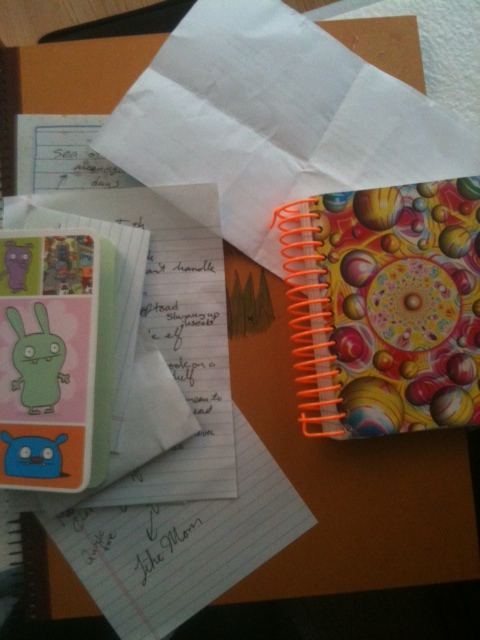
I’ve found that jotting notes down on scraps of paper work best. And these are any scraps at any time. Receipts, PTA flyers, envelopes. I managed to snatch a mini spiral just so I could keep most of the notes in one spot. Now I’m frantic that I’ll…

A) Lose them

B) Not be able to make any sense of them

So in true loner-living-in-a-cabin style, I grabbed a big notebook and began transcribing. It’s taking forever because at this point I have pages of notes scattered across a few different notebooks. What keeps circling back in my brain is whether I should write it down at all.

I’m a lister. That’s what I do. I like to make lists and notes. However, I often don’t check them. I find just making the list is enough. Same with writing. I often jot down all these details and then hardly look at them. Though I usually need them to get names and dates straight in the manuscript.

Stephen King once said that any idea you need to write down, can’t be a good idea. His thoughts are: If it’s truly captivating, you’ll recall most of it when the time comes.

I’m sorry, Mr. King, but I love to write it down. Mostly because I have snippets of conversation or thoughts that I want to preserve.

The only other interesting thing about my transcription process is the number of delays that have arisen. It seems that almost every time I sit down to work on the notes, something distracts me. A friend’s apartment flood and she needs my help (legit). It’s back to school night at my daughter’s school. I’m dead tired and pass out as I open the book. Or are these simply the hoarders way to put off the inevitable?

Still, I persevere. I yearn to organize these notes the way my character (the hoarder) can’t.

Tim Kane

Why I Need Two Copies of Certain Books

Sometimes I need more than one copy of a book. Usually fiction. Almost always when it’s an amazing read.

AN E-READER ANNOTATION MINI-MANIFESTO

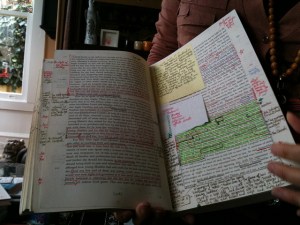
I start everything now as an ebook, though back in the days of long commutes, the audiobook ruled. When the narrative is crisp and alluring, I need to mark it up. Dissect it and see how it ticks. It’s the analytical mind in me. Sure, my Nook lets me highlight words and phrases, but it’s not the same. I need to dog ear pages. Scribble in the margins. Basically mess with it.

That’s when I purchase a second copy. I’ll zip around to spots I remember. My goal is almost always: “How did this writer pull this off?” Was it a subtle nuance of the narrator’s voice? Verb choice? Sentence length? I need to know. I circle and scribble all over the thing.

I recall once (and this will date me) when I had the notion to write a screenplay for The Island of Dr. Moreau by H. G. Wells. This was about a year before the Val Kilmer and Marlon Brando version hit theaters (they beat me to the punch). I had taken a pencil (because this was a treasured version of the story) and went to work blocking scenes. Now I wish I hadn’t because I have plenty of erasing to do.

The one book I have in nearly every form is The Girl Who Loved Tom Gordon by Stephen King. I started with an audiobook. Then bought the paperback (to mark up for a college paper). Finally, I chanced upon a hard bound copy heavily discounted. All I need now is an ebook and my collection is complete.

Am I alone in this? Does anyone else out there snap up multiple copies of books?

Tim Kane

PostIt Notes Have Defeated My iPhone

I love my iPhone. It is the one piece of technology that never leaves my side. Ever. It’s always there to wiki up the meaning of “Second Word Country”, to see how high the heat index will be today, or to snap a picture of a book I want to buy. It’s my second brain.

Yet it doesn’t work for tasks.

Sure, iPhone and all those other smart phones have app after app to help manage tasks and calendar events. Yet none work for me. Mostly it’s because its too much of a hassle to enter the task or date. Now I don’t have Siri, so maybe that would solve the problem, but I doubt it. There’s a fundamental issue of tactility and visibility that’s at work here.

I need to get the note written fast, be able to see it, and sometimes feel it. Otherwise I will forget. My go to tool are PostIt notes (the copyright is intended here as other stickie notes don’t cut it).

I stick PostIts everywhere. My favorite is to write one, fold back the sticky portion, and slip it into my pocket. Then, when I empty my pockets at home, bingo, there it is. Then I’m apt to stick it to a door or a wall. Someplace I can’t help but see it.

Some of the strangest places I’ve attached notes are to the dash of my car (usually reading, “Gas” or “Grocery”). Recently I stuck one to the seat of my chair so that every time I went to sit, I saw it. It’s the nagging that works for me. I won’t remove the note until I accomplish the task. And the notes can be damn annoying at times. Like a grandma that keeps harping over and over.

The notes are also location specific. The one on my chair had to do with something on my home computer. The car dash went along with driving. I also have notes stuck at various places on my classroom desk to remind me of all sorts of activities. I know there are apps out there that are triggered by location. I’ve tried them. They don’t work as well, either failing to go off or not being precise enough. Plus they drain the battery. So PostIt notes it is.

The ultimate event came a week ago. I’d had this note at home that was destined for work, but I kept forgetting to take it. I then decided to stick it the one place I knew I would look at and still have in my classroom: my iPhone. Yup, I had a yellow PostIt note attached to the screen of my iPhone. One of the kids giggled when she saw me pull out the phone. But it worked. The note took up residence in my classroom and the task was accomplished.

Long live the PostIt.

Tim Kane

Wordle Transforms Stories into Art

A colleague of mine introduced me to a website called Wordle. This site allows you to paste text (any text) and it will create a word cloud. The size of the word reflects how often its used in the text. For my experiments, I used a few short stories I’d written and posted on this blog.

This is from a blog post called “Do-It-Yourself Zombie Kit.” No surprise that zombie would get center stage. The story is tongue in cheek about what you’d really need to do to create your own zombie (voodoo style).

This is a piece of flash fiction titled “Selling Your Sister to the Goblins.” I like that Wordle put “teeth” next to “goblin.”

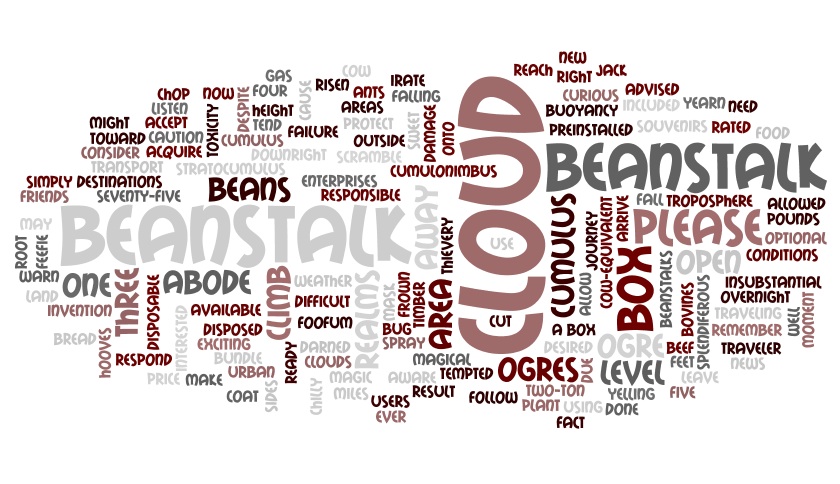
This is a flash fiction called “Beanstalk in a Box” which is a take on a reinvented fairy tale. Here beanstalks and Jack become a nineteenth century advertisement. I love that Wordle made cloud so big in a word cloud.

This is another flash fiction called “C: Terrible Consonant.” This is a surreal story about how the letter C is trying to kill me. I love how the word “ccccccCCCCCCcCCcCCCC” gets tossed at the bottom with a jaunty angle.

Give Wordle a try. So fun.

Tim Kane