Masters Class on Voice

Every start reading a book and find that you simply cannot put it down? You’re hooked. Snagged. Hopelessly snared by the character unspooling the story. That, my friends, is voice. Some authors have it in spades. It’s a very tricky subject to nail down. Rather than pontificate, let’s show two amazing examples.
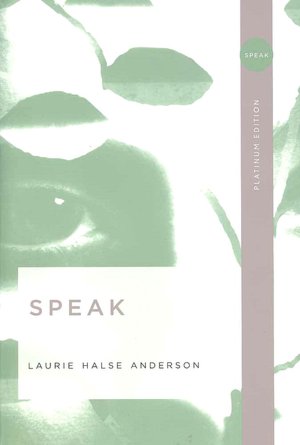
Speak, by Laurie Halse Anderson

“The musical would be easy for me. I am a good actor. I have a whole range of smiles. I use the shy, look-up-through-the-bangs smile for staff members, and the crinkly-eye smile with a quick shake of my head if a teacher asks me for an answer. If my parents want to know how school went, I flash my eyebrows upward and shrug my shoulders. When people point at me or whisper as I walk past, I wave to imaginary friends down the hall and hurry to meet them. If I drop out of high school, I could be a mime.”

You can smell the desperation on the narrator in Speak. How does Anderson make it happen? Look closely, she has the narrator’s thoughts fire away like dialogue. It helps that she uses a first-person narrator in present tense. It creates an immediacy that resonates with the reader. She also utilizes made up words and phrases to convey this girl’s distinct point of view. Check out: “look-up-through-the-bangs smile.” Everyone can picture this. It so completely describes the action, yet it also demonstrates the girl’s viewpoint. Strong verbs like “flash my eyebrows” or descriptions like “crinkly-eye smile” also paint a picture of this narrator.

How Lamar’s Bad Prank Won a Bubba-Sized Trophy, by Crystal Allen

“Since Saturday, I’ve fried Sergio like catfish, mashed him like potatoes, and creamed his corn in ten straight games of bowling. And it’s just the middle of the week. People call Wednesday “hump day,” but for Sergio, it’s “kicked-in-the-rump day.” I’m his daddy now. The maddest, baddest, most spectacular bowler ever.”

Allen uses many of the same techniques as Anderson. She works with a first-person narrator in present tense. She makes up phrases like “kicked-in-the-rump day” and “creamed his corn.” She also employs fragments to better create the feel of clipped speaking. Notice she started the second sentence with “and.” Not grammatically correct, but if she’d fixed it, the narration would have lost it’s punch.

So when scanning for a book to read, look for a narrator who lets it all hang out. Or, if you’re a writer, use these techniques to add captivating voice to your writing.

Tim Kane

Literary Easter Eggs

I love to give gifts for Easter, so in that spirit, I have several writerly nuggets of advice gleaned from Ray Bradbury. They come mostly from an interview he did back in 2001. Here are my favorites, passed along to you via a frisky Sylvilagus audubonii (Desert Cottontail).

Get Rid of Unbelievers

Are there people in your life who won’t support your writing? I don’t mean support as in pay for your lazy butt, but people who frown on your endeavors. Fire them. Unfriend them. Unlike them. Unfollow them. They will drag your dream down.

Write with Joy

Why did you get into writing in the first place? There had to be a spark of joy there. Right? Fan that spark until it’s a flame. Make your work your love. After all, for most of us, no one’s paying for it. So if a story feels like drudgery, scrap it. Start a new one that you love.

List Ten Things you Love

Then write about them. Create stories about them. Combine your passions. I love to write and cook. No, that doesn’t mean I’ll write a cookbook. But I do have some ideas in the works for stories that involve cooking.

List Ten Things You Hate.

Kill these things but putting them on the page. It’s great therapy. I once had a difficult time with a few friends of mine, so I bashed out a screenplay. A serial killer screenplay. Then I promptly offed all the offending friends. I felt awesome afterward. Thought I’m not sure what this says about my psyche.

Type Anything, So Long as It’s English 

The first thing that pops into your head. Put it down. Use word associations to break through that dreaded writer’s block. Hey, words on the page beats a blank page. Even if they don’t make a lot of sense. You might even try the Write of Die website. The screen turns red if you stop typing for too long.

Don’t Write for Everyone

It just takes one person. Someone to notice and appreciate your writing. Maybe it’s the fella who will tell you that you’re not totally nuts.

Be a Cheerleader

Writing is a lonely awful business full of neck aches, bleary eyes, and rejection letters. Sometimes people need a little encouragement. Writers need to support other writers. It’s the only way we’ll all get through this.

Tim Kane

Steampunk Shakespeare

What if William Shakespeare had lived in Victorian times? What would he make of mechanical engines and steam-power? That’s the premise behind The Omnibus of Doctor Bill Shakes and the Magnificent Ionic Pentatetrameter.

I discovered this contest by happenstance, trolling through the Twitterverse. The concept so intrigued me, I had to give it a go. Truth be told, this was the hardest story I’ve ever written. I had to balance good storytelling with accuracy to the Bard’s intent (and sometimes actual lines) while incorporating stempunk elements. It’s also the work I’m most proud of to date.

My contribution to the Omnibus was The Malefaction of Tybalt’s Mechanical Armature. I set a scene of Romeo and Juliet in post Civil War America. Why hadn’t anyone else ever thought to do that? Civil War is tailor made to the sort of family rivalry integral to the Shakespeare story. There were many possibilities, yet I opted to center my tale on Tybalt. He was an escaped slave whose sister was Juliet (still on the plantation). Romeo and the Montegues were the plantation owners.

Rather than take on the whole war, I set the story in Kansas (as state with leanings toward both side in the conflict). The town is run by the Capulets, who own a mining company. He’s also adept with mechanics and has built Tybalt a mechanical arm to replace the one that was sheared off in a cotton gin accident. (Romeo was running the gin, thus fueling Tybalt’s hatred).

I was incredibly nervous when submitting this story. What if the folks a Doctor Fantastique’s Show of Wonders didn’t pick it up? Where else was I going to sell a story about a steampunk Tybalt? I couldn’t really even reslant it. It was them or nothing. Luckily, it sold and many revisions later, the tale will appear in the omnibus May 11th.

Writing this tale also helped me reimagine a manuscript I’d written (and rewritten) over five years. One agent read though it and finally passed. It had potential, yet I couldn’t stomach rewriting it another time. It was going to go into the drawer forever. That is, until I realized I could tweak the tale and set it as a steampunk tale. This not only worked, but revitalized my interest in the manuscript.

The power of the Bard shines through, even when he’s dealing with cogs and top hats. Be sure to check out The Omnibus of Doctor Bill Shakes and the Magnificent Ionic Pentatetrameter, for sale May 11th.

Tim Kane


Spelling Shortfalls (Personal Word Demons)

I am not the world’s best speller. Yet I teach English as one of my core subjects in sixth grade. I’m a big believer in having a building error-checker. You should be able to sense when a word is wrong, even if you can’t figure out how to spell it correctly.

Ironically I was a finalist for a spelling bee in first grade. My stage fright was so great, that I pleaded with the teacher not to let me go. She obliged and I was spared the task of standing on stage and mangling words (though I must have been pretty good at that stage).

My error detector is fairly well tuned. I can sniff out some weird words even on printed paper (no squiggly red lines needed). Yet I do have my blind spots that, for whatever reason, baffle me.

Success: I am determined to spell this word as “sucess”. I think because the second C makes and S sound, my mind tunes it out.

Traveling: I desperately want to add another L to this, making it “travelling”.

Meet and Met: Whenever I type either of these words, I pause and sound it out to make sure I’m using the correct on. A year teaching Kindergarten helped with this.

Lose: This is my all time Achilles heel. I know it and still I type it wrong. I want to spell it as “loose”. In my defense, there is no logical phonetic reason for the spellings. Lose has that weird Z sound it it, like “looz”. Am I crazy here, or does it not sound like it should have a pair of Os in it? I mean, you try spelling it phonetically. It wouldn’t be such a big deal if “loose” weren’t around.

So next time you see a tweet or a blog post from me were I am “loosing my mind”, send me a quick message and tell me that my demon word has struck again.

Tim Kane

How Do You Define Yourself As A Writer?

Hi, I’m a creative and imaginative dreamer? Really? Sounds like you’re a bum to me.

Why can’t we get away with introducing ourselves via our talents? So often we define ourselves with jobs (teacher) and relationships (father of a wonderful daughter). Think about it, we even describe kids by their age or station. My daughter is 4 and a half, about to enter Kindergarten. Not a word about her personality at all.

As writers, we particularly suffer from this. I know that I do. I’ve published a non-fiction book and multiple short stories, yet why do I often feel like I’m not a “real” writer yet. Why? Because I don’t have that elusive “novel” published. It’s frustrating because I know I am a writer. I write. Every day. But it’s those accolades that we yearn for.

Perhaps we should all loosen up a bit. Let’s be what what we do. I write. Ergo, I’m a writer.

Nuff said.

Tim Kane