The Un-History of the Undead Part 2: Romero Zombies

"They're coming to get you Barbara."

October brings the ghoul out of me every year. My mind delves in the macabre (as usual), but during this month nobody stares. Flesh eaters and the living dead hardly warrant a second look.

In part 1 of this series, I examined the folklore behind the Voodoo zombie. Movies through the sixties all featured shambling, glassy eyed figures who were as menacing as a line at the DMV. Then, on on October 2, 1968, one movie changed everything.

Night of the Living Dead so shocked America, that Variety’s review included this scathing critique: “On no level is the unrelieved grossness of ‘Night of the Living Dead’ disguised by a feeble attempt at art of significance.” Ironically, George Romero had originally wanted to make an art-house movie, but quickly realized that an exploitation movie would be the best chance of making a profit.

What was it that had audiences of the late 60s so terrified? Up until then, monsters were typically people in rubber suits, and zombies had been relegated to strangling or bludgeoning their victims. Romero made his zombies crave human flesh. Critic Robert Ebert commented on the horror in the pages of Reader’s Digest: “This was ghouls eating people.” (The idea of consuming human flesh was borrowed from the mythology of the ghoul, who rips its victims apart and devours them whole.)

Romero’s zombies were completely divorced from the corps cadavers of the Caribbean. His creatures rose from the dead through a pseudo-scientific agent— A Venus probe that returns to Earth is hinted as the cause for the living dead. Rather than appearing docile and compliant, they were wildly aggressive, doing everything possible to tear people apart and eat their flesh. Finally, the zombie’s fate in Romero’s film was permanent. There was no zombie master to kill, and salt would not wake these creatures from their trance. These were truly the living dead. The additions Romero made to the zombie mythology have so dominated the genre that few movies made afterward strayed from his formula. (One notable exception is Wes Craven’s The Serpent and the Rainbow, made in 1987 from the book by Wade Davis.)

Romero never refers to his walking dead by the word zombie. Instead each of his films calls them the living dead. Despite this technicality, modern moviegoers made the connection. When Romero’s second film, Dawn of the Dead, was released in 1978, it was distributed internationally as Zombie (or Zombi).

An intriguing fact presents itself when titles of zombie films are viewed as a whole. Nearly every film title translated into English will use the word zombie, even if this was not in the original title. Take for example the 1980 Spanish and French production El lago de los muertos vivientes (literally, The Lake of the Living Dead). When this film was released in the United States, it took the title Zombie Lake. Interestingly, the word zombie hardly ever appears in titles for French, Spanish, or Italian films. (The notable exception to this is Lucio Fulci’s series of films titled Zombi 2, 3, 4 and 5. This may be due to Fulci releasing Zombi 2 as an unofficial sequel to Dawn of the Dead, which was titled Zombi.) These languages prefer to call the walking dead les morts vivants (French for the living dead) or simply los muertos (Spanish for the dead). Perhaps these counties were influenced by the George Romero films, or even that the word zombie has a stronger connection with the Americas, having its origin in the Caribbean.

So once again, let’s revisit that lowly creature on our front stoop. We expect our zombies to be rotten and hungry for flesh, not blank-faced and obedient. When the mythology leapt from one medium to another, folklore to film, it transformed. Certain elements were lost. Others were reinvented. Perhaps we’re not finished yet. As zombies enter new realms, the meanings of this word may further mutate to a point where we might not even recognize it.

By Tim Kane

I brought this article back from the dead in recognition of the digital release of Stories in the Ether. This has my story, Moth and Rust, which is my take on the zombie story that involves a weary husband who does his wife’s chores for years, only to drop dead. Yet, she still insists he work his butt off. No rest for the dead. Don’t worry, the young nephew has some ideas how to solve this undead problem.


Check out Stories in the Ether in Kindle or Lulu.

The Un-History of the Undead Part 1: Zombie Folklore

Don't bury me. I'm not dead!

Imagine that a zombie knocked on your door—a real, true to life (or death) zombie. You open the door and find a black man, looking every bit normal and alive, except for the listless expression and glazed eyes. No shambling carcass of rotting flesh and bones. It does not salivate for your intestines or brains.

The word zombie signifies a member of the undead—those creatures that come back to haunt the living. However, the image that comes to mind for this creature has been greatly shaped by popular media, such as literature and film. In the example above, the first description comes from folklore, while the second is influenced by fiction. How did our perception of these creatures change over the years?

Lafcadio Hearn introduced English speakers to the word zombie through his brief article, “The Country of the Comers-Back”, which appeared in Harper’s Magazine in 1889. (Although the OED dates zombie back to 1819, it was Hearn’s article that circulated widely enough to catch the public’s attention.) Hearn had traveled to Martinique in 1887 to study local customs and folklore for a series of articles on the Caribbean. It was there that he heard talk of zombies.

While it’s true that Hearn discovered the zombie, it was left to American adventurer William Seabrook to capitalize on it. Arriving in Haiti in 1928, he left no stone unturned in his quest for the corps cadavers (walking dead). This led to his autobiographical travelogue The Magic Island, which became an immediate bestseller.

A Haitian farmer by the name of Polynice introduced Seabrook to some real live zombies. The farmer brought the adventurer to the middle of a plantation and pointed out three zombies and the man controlling them. Seabrook went up to each of the zombies in turn, and found them to be little more than dumb brutes, working mindlessly. The eyes were dead, unfocused and vacant.

A central precept of Voodoo, a hybrid of African animism and Catholicism, is the possession of a body by the loa. The loa is usually translated as god or divinity, but it is closer to a genie, demon, or spirit. A person was believed to have two souls, the gros-bon-age (the big good angel), and the ti-bon-age (the little good angel). Each soul served a purpose. The gros-bon-age served to give the body life, while the ti-bon-age gave the person their personality. During a Voodoo ceremony, the loa would displace the ti-bon-age, and thus control the person’s body.

A Voodoo sorcerer, called a bòkò, had the ability to transform any person into a zombie. The bòkò would sprinkle a powder on the doorstep, and when the intended victim stepped on it, the magic entered through the soles of the feet. The person died soon after. Within three days the bòkò snuck into the graveyard, recited a magical chant, and called the victim’s name several times. The zombie had no choice but to answer and come out of the ground. The bòkò then beat the body with a whip to keep the ti-bon-age from returning. Often the bòkò kept the ti-bon-age in a jar. This was called a zombie astral, while the body that walked around, soulless, was called a zombie cadavre.

Every member of society shunned the zombie. This fear did not center on what the creature might do physically. Zombies were entirely docile. It was becoming a zombie that so horrified the islanders. This represented a return to slavery, as the creature must literally do whatever its master bids. Even after death, you might return to work in servitude. Canadian ethnobiologist Wade Davis spent several years researching the zombie powder. He commented, “Given the availability of cheap labor and the physical condition of the zombie, there is no economic incentive to create a force of indentured labor” (American Scientist, 1987).

In order to prevent loved ones from becoming zombies, Haitians took precautions similar to what the Serbians did for vampires. The body was often killed again, either by poison, strangulation, stabbing, a shot to the head or decapitation. Measures were also taken to prevent the zombie from rising. A wealthy family would bury their loved one in a solid tomb, while the less off would inter the body under a piece of heavy masonry. In order to prevent the zombie from answering this call, precautions were made. The mouth might be sewn up or tied shut using a strip of cloth fastened over the head and under the chin. Finally, a zombie might be distracted so that he might not hear the bòkò calling his name. There were two types of distractions. First the body would be buried with an eyeless needle so the corpse would spend eternity trying to thread it. The other method involved scattering seeds in the coffin, and the zombie was forced to count them all, one by one.

Becoming a zombie was not necessarily a permanent condition. There were several cases of people who died, only to be discovered many years later seemingly normal. One Clairvius Narcisse died in 1962 after complaining of sickness and coughing up blood. Eighteen years later his sister, Angelina, discovered him in the l’Estere marketplace. His speech was slurred and his muscles were weak, but he knew that he was no longer a zombie. Apparently, after being dug up and beaten by the bòkò, he had worked on a farm with other zombies. Only when one of the zombies killed the zombie master did they all become free.
Another way to cure an individual of the zombie curse was with salt. If a zombie consumed even a grain of salt, the fog that swirled around his brain would lift, and he would become filled with an unspeakable rage. He would first turn on the one who controlled him, killing the zombie master and destroying his property. The released zombie would then go in search of his tomb, claw at the dirt, and collapse onto his empty grave.

Seabrook’s 1929 publication of Magic Island touched off interest in the zombie and the Caribbean. Unlike Dracula or Frankenstein, the zombie wasn’t under copyright, since Seabrook was essentially reporting on fact. This led to the production of Universal’s 1932 White Zombie, with Bela Lugosi as the zombie master. (The film was preceded by a dreary play, Zombie, penned by Kenneth Webb. The production opened and closed in 1932 after only twenty performances.) The film cemented the Haitian myth of the zombie as a soulless body accepting any order. However the Voodoo version of the zombie would quickly be forgotten in the 60s when an independent filmmaker from Pittsburg got a hold of the concept.
Part 2 will examine what Romero has done to the zombie mythology.

By Tim Kane

I brought this article back from the dead in recognition of the digital release of Stories in the Ether. This has my story, Moth and Rust, which is my take on the zombie story that involves a weary husband who does his wife’s chores for years, only to drop dead. Yet, she still insists he work his butt off. No rest for the dead. Don’t worry, the young nephew has some ideas how to solve this undead problem.

Check out Stories in the Ether in Kindle or Lulu.

A Clean and Darkened Place—When to Drink Whisky

Current Whisky Collection

I was watching James May Drinks Britain, the episode where he tries some ridiculously strong Scotch whisky that should make him blind. James made a comment about how drinking whisky took him to a dark place.

Now if you’re like me, you might be confused about how to spell this drink. I know that it’s sometimes whiskey and other times whisky. Apparently, this is an issue of great debate. The Scottish take the spelling of their honored drink pretty seriously. They omit the e, making it just whisky. American bourbon, and other like spirits, are whiskey.

I believe whisky to be a noble drink, right up there with the finest of wines. Apparently fresh distilled whisky is clear and very similar to vodka. It’s the aging in wood casks that gives the drink the amber color and distinct flavor.

That got me thinking. When would you really drink whisky?

If it really were just an aged vodka, you could toss it into any old concoction and have yourself a fine cocktail. But it’s not that easy. If you frequent pubs, I imagine whisky might be one of the many drinks in your arsenal, along with the various beers and liquors. Yet if you live in Southern California, and in my case, southern Southern California, then you really have few pub options. I think there are only three or four real pubs, and they’re about 30 miles north. Typically, Corona and Budweiser engage in a never ending war for converts.

I don’t imagine you’d order a glass of whisky with your average meal. It’s not that kind of drink. It requires commitment and a degree of reflection. I think this is what James May was after when he spoke of dark places. A good whisky will close in around you like a warm blanket, leaving you only with your thoughts. You wouldn’t interrupt this with a side of fries and a burger, would you?

But what about the Manhattan, you say? That has whiskey in it (notice the spelling). Yes. And also bitters and vermouth. It’s a standard cocktail. I really don’t think you’ve be mixing single malt with anything but water.

Okay, a quick aside. If you’re confused by single malt, this means that the whisky comes from only one distillery and is not mixed with any other whiskies (called a blended whisky). Single malts come in fancy corked bottles with those Scottish or Irish names that just roll off the tongue, like Caol Ila and Te Bheag (Kool Eela and Chay Vek respectively). The prices start at about fifty a bottle and easily shoot up to the two-hundred range.

So back to the Manhattan. Yes, you mix whiskey into the drink, but it’s a blended whiskey at best. Single malts are for solo drinking. And that leaves late at night, in the dark, where your thoughts can unravel into lumps of yarn and lose fabric.

My current list of single malts include the following:

Dalwhinnie 15 years
This is the first bottle I ever bought. I still have it.

Macallan 10 years
I haven’t had a Macallan I didn’t love. So sweet. Devoured almost all of this bottle.

Balvenie 21 years (Portwood)
Bought this after finishing my first middle grade novel. Great mix of peat and sweetness. Nearly drained after two years.

Ardbeg 10 years from Islay
From one of the islands off the coast of Scottland. Islay produces a very peaty bunch of whiskies. First I didn’t think I’d like the peat. But I’ve warmed to it. Bought this after finishing Tarot novel.

Caol Ila 18 years also from Islay
Bought this on my last trip through London, about six years ago. Most is still in the bottle. Super peaty.

As you can see, I tend to purchase bottles to commemorate finishing first drafts of novels. I admit that I rarely imbibe. That’s how some bottles stay around for so long. The reason is as I detailed above. Add to that the fact that I can fall asleep anywhere, anytime. I’ve even fallen asleep while reading. Out loud. So I typically drink caffeinated coffee right before I go to sleep. (No trouble going out. Head hits pillow and I’m gone.)

Only the occasional late nights, when I’m wide awake enough to last the drink, do I partake of whisky. When I do take the opportunity, the lights are dimmed and I sit in the dark with a small glass of amber liquid. Then the thoughts simply flow, clean and pure.

Tim Kane

Must See Booths at the San Diego Comic Con

Every year the Comic Con hits town, I head down to the Exhibition floor to check out the vendors. Yes there are the mega-sized corporate booths like Lucasfilm and Marvel, but unless you sprint to them directly after the doors open, they’re mobbed. (In fact, I’m often amazed at how there are already lengthy lines when I arrive directly after opening hour.) I prefer to frequent some lesser known vendors.

Urban Vinyl
My first stop is the Urban Vinyl Toys area. This is always located in the upper left corner of the massive floor (find the map PDF here). If you’re not familiar with Urban Vinyl, it means toys that you’re not meant to play with. I know what you’re thinking. Huh? Why shouldn’t I play with them. This is an offshoot of the action-figure-in-original-package set. Only here, these toys are designed to be looked at, not played with.

Take Funko (booth 4829). Last year I bought a Thing bobble head. Sure I wiggle it once in a while, but most of the time it sits on my desk looking nifty and admired by my students. Yes I disagree that all Urban Vinyl toys need to be no touch items.

My absolute favorite is Conduct Happiness (booth 4832), creator of such slogans as “The Pea Pea Dance,” and “Pea in the Pool.” My daughter loves their Go Pea Go book. If I could, I’d buy everything at their booth. One of their neighbors is also a fav or mine: Mr. Toast (booth 4831). They make plush toys of unusual items, like toast and bacon. Basically, you can have your own plushy breakfast. (A bit like those ads at drive ins with the dancing hamburger and soda cup).

Cthulhu
Ok, I’m a sucker for anything old gods. Mostly I like the aesthetic, the tentacles and creepy vibe. For a general smorgasbord of items look no further than Adventure Retail (booth 4423, catty-corner to Urban Vinyl). They have plenty of stuffed old gods (we have a Nyarlathotep) and they even carry Cthulhu slippers (have these too). I’ve also picked up some Lovecraft audio books produced by Audio Realms.

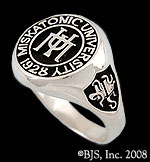
All the way on the other side of the exhibition hall (quite a trek), you’ll find Badali Jewelry (booth 530 right next to the ZDN Zombie Defense Network). They have the most amazing Cthulhu jewelry. I own the Miskatonic class ring. This year they will reveal a new Necronomicon necklace.

Steampunk
Okay, last year I found an aisle that had three or four great steampunk vendors (I want to say there were on the fringes—far right or left of the floor), but seeing as the Comic Con hasn’t designated any stempunk section, I’ll have to hunt for it again. One vendor that is easy to find is Weta’s Dr. Grordbort (Booth 2615 sharing with Dark Horse). If you’ve never experienced Dr. Grordbort’s awesome ray guns, then you are not a true steampunker. These guns make you want to shed the internet for some steam and brass. So far I’ve picked up the tiny models of each gun (I still can’t afford the full sized ones).

That’s pretty much it. I wander around, looking for eye catchers. If I can afford it, I’ll try to extend my Fantastic Four collection. But seeing as one issue in this range starts at a Ben Franklin, I often can’t afford these pleasures.

Enjoy the Comic Con and remember, pace yourself. That’s a big convention center.

Tim Kane

What Can Tarot Cards Teach You About Morality?

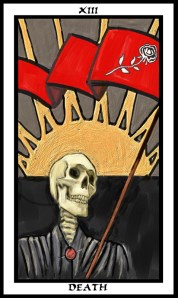
Death card designed by *ligoscheffer

I sat down to do research on the Tarot for a young adult novel, yet found that the majority of the books dealt only with the meanings of each card. There was precious little on their actual history. Most of the books simple threw out a vague paragraph or two about playing cards, Egyptian gods, and mystical forces. Yeah, that’s going to help.

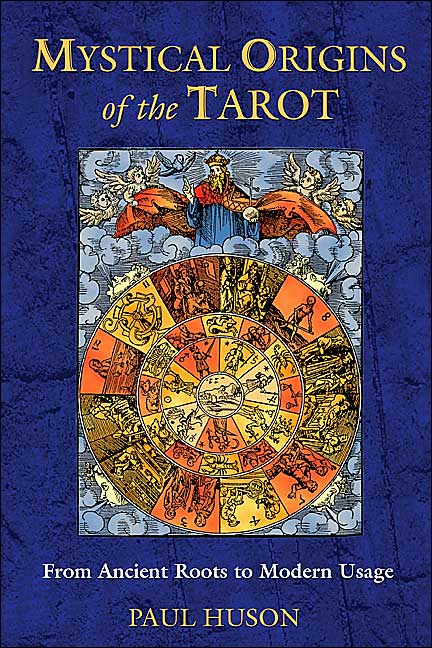
Then I stumbled on Paul Huson’s book Mystical Origins of the Tarot. He linked the Tarot to the Turkish Mamlük cards and all the way back to Chinese “money-suited” Dongguan Pai cards. All this explained the origin of the four suits. Huson’s best argument links the major arcana (which he calls trumps) to Christian morality plays like the Dance of Death.

Okay, strap on your time traveling belts, it’s history time.

The Catholic Church had long banned any sort of pagan drama (read Greek theatre). But, once they had successfully eradicated all hints of pagan storytelling, the Church allowed certain dramatic events (relating to the bible) to be depicted at Easter or Christmas. What started as a pure recitation of Gospel, gradually blossomed into lines of verse performed on a stage.

The French drama, “Adam”, appeared by the twelfth century, which was performed before the gates of the church. By the thirteenth century, plays not based wholly on scripture appeared. The “Miracle of Theophilus”, by Rutebeuf, depicts the popular legend of Theophilus, who lost his holy office and bartered his soul to the devil to regain it. (A precursor to Faust.)

Typical Medieval Morality Play

Morality plays were an offshoot of the Miracle plays, which encouraged proper Christian behavior rather than simply quoting gospel. The most famous morality was “Everyman” (originally called “The Summoning of Everyman”). In this drama, Everyman, who dresses in fine clothes and seems to lead a wild and sinful life, has a visit from Death. Everyman must undergo a pilgrimage to absolve himself from sin before meeting his end. He asks if he’ll have any company on this journey. Death replies that only those who are brave enough will come.

The various characters represent virtues personified. One by one, all the characters desert Everyman, unwilling to face Death with him. Everyman’s friends and family (Fellows, Kindred, Cousin) refuse to go along. Finally Goods (representing worldly belongings), also backs away.

Good Deeds would accompany Everyman, but she is too weak to walk. Her sister, Knowledge, leads Everyman to Confession, who instructs him how to show penance. This allows Good Deeds to travel with Everyman.

Discretion, Strength, Beauty, and Five Wits promise never to leave Everyman’s side. Yet, when they arrive at his grave, and Everyman begins to die, they each leave. In the end, only Good Deeds will follow him into the grave. The play makes its grim point that we can only take with us the things we’ve given.

Paul Huson's Mystical Origins of the Tarot

The Black Death ravaged Europe throughout the fourteenth century. The epidemics were so frequent and merciless, that everyone had to face the prospect of death. This led to the Dance Macabre (Dance of Death), as an offshoot of the English morality play.

This is another play where Death is viewed not as a destroyer, but a messenger from God. The drama consisted of a monk reading Scriptures while actors representing death (dressed in yellow linen painted with bones) escorted other actors to the grave. Every position in society was represented (the King, a Bishop, a beggar, a soldier, a farmer, etc.)  The purpose of the play was to illustrate that regardless of your position or wealth, you were going to die and must Repent now. This idea was summed up in the phrase: “Memento Mori” which translates to “Remember you shall die.”

This procession of figures mimics the trumps of the Tarot. We start with the lowly Fool, and travel up through the Emperor (representing the king) and finally the Pope. At least that’s the theory laid down by Paul Huson. He goes on to state that the various middle trump cards mimic the personified virtues (Justice, Fortitude, Temperance, and the Hermit for Prudence). Dame Fortunate routinely appeared in morality plays, and she’s represented in the Tarot as the Wheel of Fortune.

The four most important events in a Roman Catholic’s life, known as the Four Last Things, are represented by the four trump cards:  Death, the Devil, Judgement, and the World (if we agree with Huson that the world could mean heaven).

I found the connection of morality plays (like the Dance of Death) with the Tarot a compelling argument. There are plenty of books that border on pseudoscience, linking the Tarot to UFOs and Egyptian gods, but Huson lays out a reasonable argument based on historical traditions.

Next time you pick up a Tarot deck, think back to these Medieval dramas. And remember, you too shall die, so start wracking up those good deeds.

Tim Kane