How Far Would You Go to Write?

I had a dream the other day that I was stuck in LA traffic, late for a meeting with a film producer. And when I say traffic, I mean that the cars had virtually stopped. I drove in the shoulder and veered through off ramps just to make some time.

The trouble was, this wasn’t a dream. It was a memory.

As I began my writing career, I had aspirations of becoming a screenwriter. I dashed off three or four of my own scripts. Read Variety. Even started filming a Dracula script with my friends. It was through Variety that I found a producer/director that needed his script punched up. I won’t mention the name. The script is still active and I could get paid upon production. I’ll also develop the mutant power of telepathy and go to Vegas and make millions at poker. The chances are about the same.

This script was along the lines of the Syfy network movies. You know the ones I’m talking about. They have a colon in the title—Magma: Volcanic Disaster, Kraken: Tentacles of the Deep. Only this script wasn’t fantasy or scifi. It was a heist flick where girls took off their clothes every five pages or so for no important reason. Yet, and I have to emphasize this point, the producer wanted this to be a serious action film.

I took on the job and worked many late nights grasping for reasons to justify the main female characters disrobing. I managed to get the producer to cancel all but two of the scenes. (Maybe if I hadn’t, the film would have gotten made. Who knows.) Anywho, I live in San Diego and the producer was, well, in Hollywood. A few times a week, I’d drive up there to meet him and go over the script. It was hell. I never got paid. Not even for gas.

What can I say? I was young and hungry. The opportunity looked good. I learned plenty from the experience. I could finish a whole script under deadline. I could convince someone to ditch unwanted scenes. I could dodge cars while driving fifty in the shoulder.

How far are you willing to go for your writing?

Tim Kane
Hunger Games as a Force for Good

I earn my benjamins as a teacher. This week kicks off the massive load of state and district testing. It’s our Super Bowl. Our World Series. And, I think, possibly our Hunger Games.

The kids always stress during this time. I work with eleven and twelve-year-olds. Some still bring stuffed animals to school this week to lower their anxiety. I typically purchase candy and little goodies to pass out during testing. Tiny ways to boost their moral. Yet this year, I stumbled onto what I think is a brilliant idea.

The idea sprouted last week when the students were completing our end of unit exams. One boy was terribly sick and miserable the whole morning. I busied myself putting up a hand drawn Finn and Jake picture from Adventure Time, and (because so many kids have read the books) a giant mockingjay. Underneath I penned: “May the odd be ever in your favor.” By recess, the boy had a smile on his face. I asked him about it and he said that Katniss had struggled and not given up. He knew that he could do the same.

That did it. I decided to go whole hog on the Hunger Games theme. Cause that’s essentially what we do to the kids. The Capital (State of California) requires tributes (students) to battle for their entertainment (bubble in multiple choice questions). The same pressure the tributes in the books feel, my students get in spades. There are even careers. You know the kids. The ones that adore testing and always seem to come out on top.

This year, instead of just walking around to give kids treats, I purchased some silver tissue paper. I’m wrapping the treats in aluminum foil. Then their sponsor (me) will drop the silver parachutes on their desks when they need it the most. I’m hoping to put in little notes (like the ones Haymitch delivered) to help inspire the kids.

I certainly hope the testing doesn’t end with most of the kids deceased and two holding poisoned berries.

Tim Kane

Four High Production Book Trailers

In the last post, I explored four low budget book trailers. Well here are the big boys. Not always better, as you’ll see. Most of these have a hefty budget and were most likely produced by the publishers.

A Monster Calls by Patrick Ness

This trailer certainly has that Hollywood feel. It clearly delivers the premise of this books. I’ve actually read the sample chapter and it dovetails with this trailer almost scene for scene. It shows the reader exactly what he or she would expect.

Going West by Maurice Gee

Are you amazed? You should be. The cut paper art is breathtaking. I couldn’t take my eyes away. Now, can you tell me what the book is about? Yeah, there was the voice over reading snippets from the book, but I didn’t listen. The visuals overpowered the text. This is an example of the production team going too far.

I can’t say for certain, but I believe the art may be by Peter Callesen.

The Return Man by V. M. Zito

The trailer, put together by Swank Banana Productions, sucks you in with very simple visuals and text that interacts with the smoke. I have to say, I was drawn to this trailer. I can see the same techniques working on a smaller budget (perhaps without the fancy text).

Leviathan by Scott Westerfeld

The illustrations by Keith Thompson drive this book trailer. It shows that if you know someone who can draw, the trailer can center around this artwork. Again, this does a superb job of hitting it’s target audience of steampunk readers.

Tim Kane

Four Intriguing Low-Budget Book Trailers

I am creating a book trailer for a friend of mine, so of course I perused the YouTube offerings to see what’s what. Book trailers seem to fall into two categories: the low-budget and the “hey did a Hollywood filmmaker direct that?”. In a subsequent post, I’ll tackle some of the high end book trailers. The ones below are anywhere from a near zero budget to knowing some film students to help you. Let’s check them out…

Souless by Gail Carriger

This trailer appears to use found footage, or perhaps recreated footage, in a grainy black and white. Instead of a voice-over, black screens with text outline the premise of the book. Like it or not, this trailer gives you want you need, a reason to buy (or not buy) the book. It clearly explains the genre and premise as well as giving the mood of the writing. Compare the Souless trailer to the one below.

A Common Pornography by Kevin Sampsell

This trailer is quite clever and low budget (simply a camera filming the author). It engaged the viewer, but perhaps not enough to click over and check out the book. Despite the shocking title, I get no sense of what the book is about. I did click over to Amazon, but only so that I could be sure it wasn’t really about pornography (you never can tell these days).

Nocturnal by Scott Sigler

This is the man that gave away so much of his writing that gathered tens of thousands of followers. The publishers came begging to sign him. Although this trailer has a heightened budget, it is still essentially drawings animated to outline the plot. It’s the pacing and style that capture you. I was instantly enthralled. It also serves its purpose: you know what the book is about.

i am in the air right now by Kathryn Regina

I am addicted to this trailer. It not only captivates me, but makes me want to read Regina’s poetry. Partly this is due to her reading some of poetry for the trailer. She “animates” her poems, matching the images to the words. While the we see images of a bird crying for help and wasting away, we hear this:

“I was thinking of the bird that flew into a man’s head, hard, so that it actually flew inside the head and it got trapped there and confused.”

Addicting. This is clearly a brilliant book trailer, though not easily emulated unless you’re writing poetry.

The next post will explore some of the higher budget book trailers.

Tim Kane

Hunger Games: Movie vs. Novel

Often people complain that a movie is nothing like the book. Well of course. A movie unspools images whereas a book delivers content through some 70-100 words. It takes me the better part of a week to finish a book, but only two hours to see the average movie. Given the condensed medium of film, there’s no way to include everything that appears in a book. And no need to really.

There are advantages to each media. A smart filmmaker will realize this and utilize the unique qualities of film to not only condense sections of the book, but also highlight others. If you haven’t read or seen the Hunger Games book or film, you may find sections spoiled.

The movie zoomed through the opening chapters of Hunger Games at light speed. I think they did this to allow them to spend more time on the actual arena combat. Many of the thoughts that Catniss used to express backstory or her attitudes could not transfer to film. For example, her whole story about saving the cat and Prim’s love for it was condensed to a single line: “I’ll still cook you.”

One element I felt they didn’t communicate well was the matter of names and the reaping. The film established that Galen had his name in 42 times, but didn’t go into putting your name in extra times to get food. My guess is that the filmmakers felt this wasn’t as crucial and viewers would get the concept as the film went on. It certainly didn’t bother me.

Rather than put the entire backstory of Peta and the bread and Mom’s zoning out at the start, the film smartly incorporated these into tiny flashbacks. The best was during the tracker jacker delirium scene where Catniss remembered how her dad died and Mom tuned out.

The film also solved a few problems I had with the book. I noticed that Suzanne Collins was one of the screenwriters, so perhaps she took a second look at her material. First, the fact that she never mentioned the position of cameras at any time in the novel really bugged me. It go so that I couldn’t focus on the story. The film handled this with one scene. Catniss climbs a tree and a knot twists to look at her. That one moment alone told us that everything could be a camera.

Also, the novel had a conspiracy plot at the end that felt tacked on. The film provided cut-away scenes with the gamemaker and President Snow that expertly delivered this same feeling without distracting from the plot. The best part of this was the final scene with the gamemaker. The key to films is what they can deliver with a single image. The gamemaker is led to a room and locked in. A bowl with berries (the same that Catniss nearly swallowed to poison herself) were presented on a table. The message was clear. He screwed up and was expected to pay the price. This also underscored the tyranny of the Capitol’s regime.

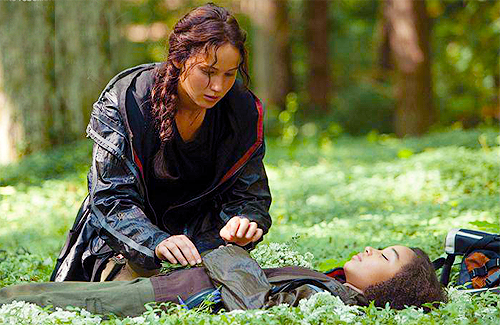
The film added many scenes showing the gamemaker designing and running the game. This really helped me understand how the arena functioned. I liked seeing them comment on the tracker jackers as well as seeing the dogs being designed. (I didn’t miss that the dogs were former contestants as this bothered me in the book.) One of the best added scenes was the riot in District 11. I know the book was explicit about cutting the scene where Catniss added flowers to Rue’s body so that viewers wouldn’t see it. However, I liked seeing the riots in District 11 and the subsequent put down.

The last element that the film added is a technique I saw before in Green Mile: The Song. Catniss sings a song to Prim at the beginning. I knew right away this would be the same song she’d sing to Rue. It served to create an emotional connection between Catniss’s little sister, and her adopted ward, Rue, in the game.

The next time someone whines about how badly films adapt books, explain to them that a film is not a book. Stories you read and the action unfolds in your mind. The film shows you the action, so it will never match the images in you head.

Tim Kane