I don’t buy into most divination practices. Many don’t make sense (like the I Ching) or some are too darned complicated (Tarot), but I do have a yen for runes. Maybe it’s the German heritage, but these symbols speak to me.

The word rune has a long and clandestine history. The Old Norse called it runir meaning secret or hidden lore. In Old English it became rün, a secret consultation. Finally the Gothic language titled it as runa, dark sayings, or whispers. These dark whispers are not malicious by any stretch of the imagination. Rather, the runes are like a friend, confiding secrets to you, and rune casting is the best way to get your new friend talking.
Each rune symbol represents both a letter of the alphabet and an idea (see the letters here), but these are a far cry from their true meaning. This only comes from using the runes, over and over and over again. I don’t mean be a fanatic about it. For goodness sake have a life, but allow these messages and the stories they represent to enter into your life.
I don’t put in for the various meditations and soul searchings that many of the books I’ve read suggest when working with runes. I’m a pragmatist. How can I get these things to work for me? What I’ve found is that the runes, as a divination source, are far more practical and straightforward than say the Tarot. I tried various divinatory techniques with the runes, kept what I liked, threw away the rest.
One that I use most often and with tremendous success is rune casting. What’s best about this method is that I don’t even need to have any runes on me to practice it. Once I threw a casting in the parking lot of McDonalds with a bundle of coffee stirrers. I’ve found that there is a bond that develops between you, the caster, and the runes themselves. Often you must read into the casting to find its true meaning, sometimes going by gut reaction.
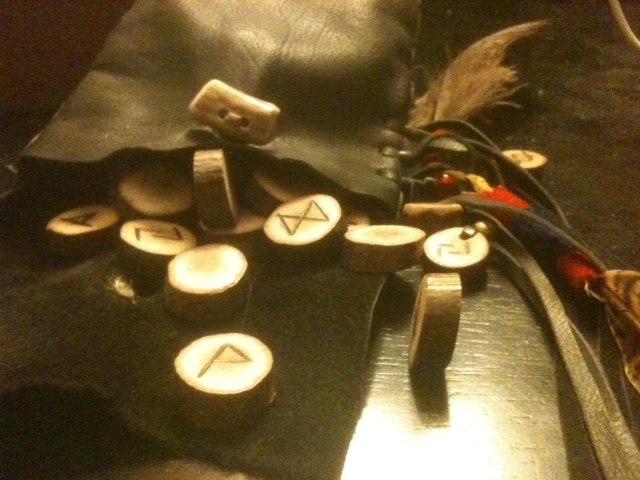
The manner for casting is pretty simple. If you’ve purchased or made a set of runes, make sure they’re all inside a pouch. Reach inside with the question posed clearly in mind. It helps to be brutally specific here. The more loopholes you allow the runes, the more they’ll take. This method works best with questions that can be answered with a qualified yes or no. Don’t ask how or why because the runes won’t tell you. As in everything in life, you’ll have to figure those out for yourself. Reach inside, grasp a handful of runes, and toss them onto the ground or table. Now a word of caution here, toss does not mean hurl with the force of a two-year-old with his ball. You don’t want to loose any of the runes, just scatter them randomly. Let them decide how to land. The basic interpretation is simple, if more runes are turned face up, the answer is positive (yes), if more are turned down, negative (no). The trick comes in qualifying the answer. What’s the ratio of upright to overturned runes? If you have, say four to one or five to two, the answer is a very sure yes. If they’re all turned face up, then you have little doubt in the matter. The same goes for face down. When the ratio is close or dead even, then you’re stuck with a qualified maybe. Don’t be disappointed. This only means that your fate isn’t decided yet.
 Finally you can interpret the meanings of the upright runes themselves. The most important rune to see is Ehwaz, because it confirms without a doubt those runes around it. It can push a maybe over to yes or confirm a negative result for sure.
If you don’t have runes to cast, you can also use a set of nine sticks, or coffee stirrers or straws, anything about the same size. This method is little more unpredictable and sometimes yields nothing more than a vague notion. I’ve used it for a quick spot check when away from home. Cast the sticks out just like the runes and then examine them. Because the rune signs are all made up of straight lines, sometimes the sticks will form the shapes of a rune. Be careful though, not every crossed stick is Gebo or Naudhiz. When a rune is created, it’ll be rather obvious. If you get nothing, then you’re left with another maybe. In this method you typically see only a single rune, and must interpret the answer from that rune’s meaning. Usually this will not give you a yes or no answer, rather a quality regarding your question. Like I said, it’s not rocket science, but it can help guide you in a clutch.
Rune casting is like inviting a new person over for diner. The first time you meet will be awkward. You may struggle for things to say. But the more often you two meet, the closer you’ll become, until soon you’ll find yourself rather comfortable with those crazy looking symbols. Then you might feel a gentle rush of air by your ear as you catch just a snippet of those dark whispers. The secrets of the runes.
Tim Kane


 Tim Kane Books